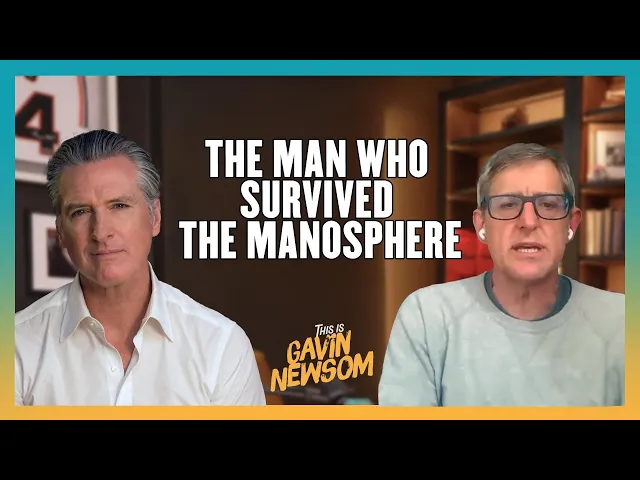
Louis Theroux on the Manosphere (Inside Toxic Masculinity)
This is Gavin Newsom
0:00 You've got to the heart of the matter, and I sometimes say the weirdest thing
0:03 about weird people is how normal they are.
0:05 This isn't the manosphere, this is the boyosphere.
0:07 It's more of a grift than an ideology.
0:09 These [music] guys are selling,
0:10 selling, selling, selling, selling, selling, selling.
0:13 So, those of you who have tuned in to the podcast know we've
0:16 dove [music] deep into the issue of the crisis of men and boys.
0:18 Richard Reeves and the Institute of Men and Boys, talked to Scott Galloway,
0:22 a number of other guests also talked about the manosphere,
0:26 but we've never gone quote-unquote inside [music] the manosphere,
0:29 and that's why I'm so excited to have my next guest, Louis Theroux, who's done
0:35 [music] dozens and dozens of documentaries on the porn industry,
0:38 neo-Nazis, did documentary on Scientology, Westboro Baptist Church,
0:44 and just completed this really insightful documentary about the manosphere.
0:49 This is a wide-ranging conversation you don't want to miss.
0:54 This is Gavin Newsom.
0:57 And this is Louis Theroux.
1:02 [music] Where are you?
1:02 In In London proper?
1:03 Where are you specifically?
1:05 I'm in London, England.
1:07 In northwest London in an area called Kilburn.
1:09 Uh northwest, I don't know.
1:11 If If you really have to know London to know where exactly,
1:14 but I just cycled back from Trafalgar Square, and it took me about 25 minutes.
1:19 I love it.
1:19 What's What How much What's Where do you spend most of your time?
1:23 Are you out there just on the plane around the globe?
1:26 I have I have three boys, three sons.
1:30 And as they've got older, I've traveled less.
1:32 Like, before I came on this call, I was thinking about my life and times,
1:36 as I want to do as an older man, 55 years old.
1:38 Huh.
1:39 I was traveling a lot, you know,
1:41 when I was trying to win my spurs as a documentary maker.
1:45 So, a lot of back and forth.
1:46 I I I have I'm half American, half Um I've just started.
1:51 Is that all right?
1:52 Yeah.
1:52 But, I've just kind of gone into my origin story.
1:55 [laughter] It's all good.
1:57 uh I uh So, my dad's American.
1:59 He's a travel writer and novelist from Medford, Massachusetts.
2:02 I grew up with a US passport, but I grew up in South London.
2:06 And I've always been slightly split, you know,
2:09 identity-wise between the UK and the US.
2:12 And then when I graduated and was trying to figure
2:15 out what to do with my life in '91, uh I went to the US and thought,
2:20 "Well, I'll put that passport to some use and get
2:23 some legal work with in Boston." Then I thought,
2:26 "Well, I should really, you know, work with words.
2:28 That's what my dad does.
2:29 That's what my mom does.
2:30 She works for the BBC, or used to." And I got a job in San Jose,
2:34 California on a free weekly called the Metro.
2:38 And really, I credit my experience in San
2:40 Jose as being the formative experience professionally,
2:45 or certainly one of them of my life.
2:46 Like, you know, some people say that, "I went to Africa." My dad's thing was he
2:49 went he went he was in the Peace Corps and he went and taught in Malawi.
2:53 My thing was I worked for a free weekly in San Jose.
2:57 But there was something about being decontextualized and being
2:59 exposed to a culture that was very different.
3:02 Um And and and also working with words, writing articles, you know,
3:08 from the bottom up was I worked for the Willow Glen
3:11 Resident and the Metro and then the San Jose City Times,
3:14 all under the same umbrella, writing about city council meetings,
3:17 but also character-driven stories about uh past life
3:22 regression counseling and people who who were into guns.
3:28 So, the whole kind of buffet of the Western American experience.
3:32 And that was the jumping-off point for so many things that followed.
3:36 And I was thinking, as I say, before I came on this call,
3:38 I've made over the years 14 different
3:41 documentaries in the great state of California.
3:45 So much of the last 25 years for you
3:48 obviously been defined by Uh, of these I mean,
3:51 what you could describe or has been described
3:53 by people that watch you these sort of fringe subcultures,
3:56 your willingness to enter into that, you know,
3:59 into worlds that that people are curious about but don't know much about.
4:03 What What was What was the first
4:05 What was the inspiration for the first documentary?
4:07 I mean, you're You're there writing,
4:09 chronicling, culture but politics and, you know,
4:12 you're you know, finding your way 14 just in California alone documentaries.
4:17 Just in California.
4:18 Yeah, so I I There's a psychological dimension
4:22 to that and then a kind of professional.
4:24 I I was someone who grew up in, as I said, South London.
4:28 I was always anxious.
4:29 I was always worried prone.
4:31 I always saw other people and thought,
4:32 "They've got the They've got They've figured something out that I haven't." Uh,
4:36 but there's also a quality to feeling like an outsider that it gives you uh,
4:41 observational skills.
4:43 It makes It makes you attentive.
4:44 Uh, it makes you a good listener because you suspect that um,
4:50 you suspect that other people are clued
4:52 up about something or you just feel comforted
4:54 by the idea that you're enveloped in in the strangeness
4:57 of how other people lead their lives.
4:58 So, I I was always a fringe dweller in that sense and I can you know,
5:03 I I moved to America Yeah,
5:05 I was always attracted to whether it was reading about
5:08 or or or finding out about whether practices that struck me as odd,
5:12 whether it was weird religious practices or or bizarre pathologies.
5:17 Then fast forward, I was in America figuring out
5:20 how I I thought I should be a writer.
5:21 My dad's a writer.
5:22 I worked for Spy magazine and then some friends after Spy magazine,
5:27 that was a magazine, you know, based in New York in the '90s,
5:29 it folded and then some friends went
5:31 to work with the documentary maker Michael Moore who
5:34 at that time had made Roger& Me and was
5:37 working on a new TV series called TV Nation.
5:40 And they my friend said like you should come and talk to Michael.
5:44 He's looking for some He needs to have a British
5:46 correspondent because some of his money is coming from the BBC.
5:50 So, uh I went along, under-qualified, nervous,
5:54 uh no wardrobe to speak of, with no reasonable
5:58 right to expect anything uh to come of the meeting,
6:02 not realizing that all those things, lack of wardrobe,
6:04 under-qualified, nervous, in Michael's eyes were kind of positives, right?
6:09 Yep.
6:10 He didn't want uh he didn't want uh a wind-swept well,
6:16 a bit like yourself, Kevin, cuz you're you've been [laughter]
6:19 accredited with having good looks and sort of be TV being TV ready.
6:24 Like, I wasn't that TV ready guy.
6:26 And and he I think he thought, well, his awkwardness is is a is an asset.
6:30 Like, his awkwardness and he sort of um I mean,
6:33 he I think he might have assumed that it was
6:36 a it was a kind of a party trick almost.
6:39 Like, oh, he's intelligent, but he pretends to be bumbling.
6:41 In fact, I was just bumbling, but I was also very keen.
6:45 So, he hired me to make my first segment,
6:48 which was about groups that think the world is about to end.
6:52 Mhm.
6:52 And it was called Millennium.
6:54 Took me to Oakland, California, funnily enough, among other places.
6:58 There were four or five different uh cults or sects featured,
7:02 but the first one was led by Harold Camping,
7:05 and he was predicting the end of the world the later that year, 1994.
7:10 Wow.
7:11 it didn't end.
7:12 It was spoiler spoiler alert, the world didn't end.
7:16 Uh then I went down to El Cajon, outside of uh San Diego.
7:20 It was a it was a UFO group called What were they called?
7:24 Uh I can't even remember what they were called.
7:26 They thought that they thought that UFOs were going to land in 2001.
7:30 Mhm.
7:30 And uh spoiler alert, that that didn't happen, either.
7:33 But that that kind of experience of uh you know,
7:38 notwithstanding I had no TV skills,
7:40 what I did have was curiosity and and a sense of uh fascination.
7:45 Like I I If I had My problem was I
7:47 would I was overinterested and I tended not to interrupt.
7:49 Like I was really like, "So,
7:51 when's the world actually going to end?" And they're like,
7:53 "Well, it's on the Thursday,
7:54 but it's too late for salvation because that happens on the Tuesday." You know,
7:58 and all the details.
8:00 But, I basically loved the experience of uh
8:04 immersing myself in the in in these other mindsets.
8:07 Like I sometimes pretentiously what Friedrich Nietzsche, the philosopher,
8:11 would say like, "Insanity is madness in individuals is rare,
8:14 but in epochs, groups of people, and religions,
8:19 it is the norm." Something like that.
8:21 In other words, like we're all swimming in the waters of irrationality.
8:25 We just don't see it, you know?
8:28 And if we just recognize So,
8:30 that kind of i- that kind of uh organized irrationality, Mhm.
8:35 you know, which isn't It's not psychosis, right?
8:37 It's not that kind of madness.
8:39 It's the madness of, "Oh, yeah,
8:41 I'm going to sell my house because the UFOs are going to land
8:44 or because Harold Camping has told me that Jesus is coming later
8:48 in the year." That's that's actually a sane person who's been so
8:53 conditioned by a belief system that he's acting in ways that are irrational.
8:57 So, in a weird way, that first one,
8:59 I went on to do a second one about the Ku Klux Klan uh
9:03 as they were rebranding themselves a civil
9:05 rights group civil rights group for white people.
9:07 That was in Texas and Arkansas.
9:10 And on and on, but that those that first story about cults and and and you know,
9:15 it was a template, set me off on a trajectory that I haven't deviated from.
9:21 You know, I do programs in the longer length now.
9:24 Uh that was a sort of 10-minute segment.
9:25 Now, I do 60-minute documentaries.
9:28 Uh it's very much been a furrow that I've plowed uh you know,
9:33 with a great deal of pleasure and some success ever since.
9:37 And we and we'll get to the Inside the Manosphere,
9:39 which love to talk about your latest documentary in a moment,
9:42 but what is there been a thread that connects?
9:45 I mean, it's it's interesting.
9:46 One of the I mean, you've consistent watching
9:49 some of these documentaries and Inside the Manosphere,
9:52 you come across not as condescending, but truly interested, curious, open.
9:58 You create a safe space where, you know,
10:00 people start to express themselves and then their contradictions
10:04 are exposed and and but it at the same time,
10:08 you know, the way you just described a rational irrational mindset.
10:13 Um is there been a thread that connects all
10:16 of these documentaries beyond just the curiosity and the fringe,
10:18 but is it is there an empathy
10:21 that you've developed for many of these subjects, Matt?
10:24 this is this this is you've got to the heart of the matter and um the short
10:30 version is I sometimes say uh the weirdest
10:33 thing about weird people is how normal they are.
10:35 Yeah.
10:36 By which I mean that you you find out
10:38 that people arrive at irrationality what I would consider irrationality.
10:44 And by the way, I don't necessarily exclude myself from that, but and and they
10:48 they they it's kind of it's fee
10:50 it's satisfying [snorts] very relatable human needs.
10:54 And I and I do try and disrupt that binary of us and them.
10:58 Like I do try and see them as people who are available.
11:01 They're up for grabs.
11:03 They're they're they're persuadable.
11:05 Or if they're not persuadable,
11:06 cuz most of the time they're actually not persuadable,
11:09 but they are they're promotionally present.
11:11 Like they want to relate.
11:13 They want to be friendly or that they they want to persuade you
11:17 of why what they're doing is the right way and you've you've made a mistake.
11:21 Like a very the first episode I made of this my first
11:24 TV series of my own was called Weird Weekends.
11:27 It was about militia men.
11:29 It was very Trumpy in its way, although it was 1996,
11:33 uh so it was a long time before, but people who believe in conspiracy theories,
11:37 they think that um the UN is taking over the world and uh
11:43 that their only safety is by hiding
11:45 in redoubts up in northern Idaho and Montana,
11:47 stockpiling guns, and sort of sitting out the end times in one way or another.
11:54 Quite a paranoid mindset,
11:55 but but the the shock was going up there and sort of finding out, wow,
11:59 there's something about these guys this kind
12:01 of a little bit romantic and almost cool, like they were like cowboys.
12:04 Like the seduction of it was palpable.
12:07 Like it wasn't like, how could you possibly believe this?
12:10 It was like, oh, I kind of get the mystery and romance.
12:13 Like everyone wants to be the hero of their own life,
12:16 and this is a way of leading out an epic destiny.
12:20 Then I met part of the same journey,
12:21 I went to a the headquarters of a group called Aryan Nations.
12:24 They were the most extreme of that world.
12:27 Like they they sort of unapologetic were neo-Nazis.
12:32 Uh they lived in a compound up in Coeur d'Alene in northern Idaho.
12:36 And at that time their pastor was a guy
12:38 called the head they they start themselves a church.
12:40 I don't know if that was a tax dodge or PR thing,
12:43 or maybe they sincerely believed that they were the true Israelites,
12:47 like these white guys.
12:49 But they they they lived in a compound that was straight out of central casting
12:53 with a fence around it and a guard
12:54 tower and two German shepherds called Hans and Fritz.
12:58 Wow.
12:58 I mean, I was scared going there.
13:00 The biggest uh the but I was so relieved when I met Pastor Richard Butler and he
13:06 was like 85 years old and his his second
13:08 in command or his aide-de-camp was called Jerry Grudl,
13:10 who was about 70 years old.
13:13 And I thought, if it comes to it, I think I can take them, right?
13:16 Like if physical if it gets physical.
13:17 [laughter] Um but they they took me around and I remember Jerry Grudl uh took
13:23 me to the top of the guard tower and he He talking about how much he
13:26 likes England and he the town of Cheltenham and he's a big fan of Benny Hill
13:29 and then he starts talking about a sitcom
13:31 from the 70s called Are You Being Served?
13:34 Which will mean nothing to your audience, but what it meant to me was well,
13:38 this is a guy who's a deep Anglophile, number one, but number two,
13:42 like this is a guy who really wants to kind of be my friend.
13:46 Now, uh that's an awkward thing for a journalist
13:51 when he's dealing with a neo-Nazi, right?
13:53 I mean, in one sense it's it's awkward,
13:55 but it's kind of it was it's awkward a lot.
13:58 I mean, it was kind of funny, but it's also a little embarrassing.
14:00 It was complicated and I but the surprise was wow,
14:04 these are people who really are in some respects lonely, right?
14:09 In some respects looking for connection.
14:11 And I'm not in any way trying to minimize the hatefulness of it.
14:14 There's no excuse for it, you know, I deplore it, obviously,
14:17 but but you can't blind yourself to the the polyvalent quality of extremism.
14:23 You know, and I've seen it across the board,
14:24 whether it's in Coalinga, the you know,
14:27 the maximum security mental hospital for sexually violent predators and you go
14:32 among them and they are they are there presenting as regular people.
14:38 And uh and you're like, wow, they they don't you know,
14:42 I mean, I don't mean to be glib,
14:43 but like you you you sort of have to check yourself
14:47 and and remind yourself of the things
14:49 they've done so because you're being filmed,
14:52 you make a documentary and actually there's an expectation
14:56 to bring an appropriate level of objectivity and and forbearance,
14:59 but at the same time you're thinking at times
15:02 like he's he's he's if I didn't know better,
15:04 I'd think he's kind of a nice guy, you know, he's an okay guy.
15:09 Which is the paradox.
15:10 That the paradox this is the cross I'm burdened with.
15:13 Um you mentioned one other thing which was manosphere,
15:16 which I know we're coming on to, but the other thing that's happened in the 25
15:21 of of working is that a lot of this so-called fringe stuff went mainstream.
15:28 Yeah.
15:29 You know, and going back to the Silicon Valley and the changes in culture,
15:34 I think the big thing we've seen the biggest
15:36 change I've seen is uh how the internet, but social media specifically,
15:43 has has allowed um people to aggregate people who
15:48 in the in the past might have not felt in community with people.
15:51 Like before they might have shortwave radio, magazines,
15:55 or they a few of them might be on BBSs on the internet like bulletin boards,
16:00 but they they weren't um pinging each other on Snapchat, you know,
16:04 or WhatsApp, or God forbid streaming live on their own platforms.
16:09 And uh so in good ways we've seen the internet,
16:12 if you've got a a disease and it's rare, you can now crowdsource solutions.
16:16 That's That's wonderful.
16:18 But if you are planning a race war to initiate the end times,
16:23 uh you can also find your community.
16:25 And it's not such a good thing.
16:27 And or if you uh want to proselytize
16:30 on behalf of being a flat-earther or an anti-vaxxer,
16:33 you can find a ready audience.
16:35 And not just that, you can catalyze
16:36 an even bigger audience by spreading that information.
16:39 So those programs that in the past seemed not exactly harmless,
16:43 but I had the luxury of being able to see them as uh part of something lonely.
16:49 Like you The The empathy that you built with them felt relatively safe.
16:53 Even the skinheads, when I was with you doing Louis and the Nazis,
16:57 they were damaged men from difficult backgrounds who'd come out of prison.
17:02 Some of them had developed a a kind of white
17:04 racial identity as a safety mechanism having been in prison.
17:09 Like or I've seen that in San Quentin.
17:12 Yeah.
17:12 It's very hard to go against the flow.
17:14 You gang up, and that that's that's I don't know if it's still the case but when
17:18 I was there in 2012 in 2008-9 that's how it was but so you could sort
17:26 of extend a bit of understanding and you
17:29 I guess you can still but it's now closer
17:31 to the the power is less obviously hierarchical now
17:37 it's not so now they are in some respects
17:40 equally powerful you know in some respects when
17:43 I go and document whether it's white nationalism
17:45 or extremism or toxic content I'm just one more
17:49 content maker turning up to document another content maker
17:54 and I no longer go or or my BBC
17:57 paymasters or whoever's financing the project no longer
18:00 owns the conversation and the and monopolizes
18:04 the the platforms in the way that they used to.
18:07 Meaning they're streaming at the same time that that like tiki-taki was.
18:11 Well in a small way they have they have
18:13 they have their own outlet like So going back
18:16 five years I made a documentary called Extreme
18:18 and Online that was about Nick Fuentes and the Groypers.
18:23 And I spent a couple of days with Nick Fuentes who
18:28 has since gone on to some notoriety based on his affiliation
18:32 with Kanye West or Ye as he's now called and also
18:36 his sort of taking up the mantle post Charlie Kirk.
18:40 But he's he so irrespective of me them streaming me when
18:43 I arrived they're just people who got platforms of their own.
18:47 I mean midway through making that program Extreme and Online it's
18:51 on I'm not not trying to do a big plug but I think
18:53 it's on BBC Select in the US which no one has so
18:58 you can forget about that but I I remember arriving and I was
19:02 filming with him and and then I took a break we went back
19:05 to London to kind of figure out next steps and in the meanwhile
19:07 he was streaming about me saying I met a guy I Louis
19:11 Louis Theroux and people saying "What's he like?" He's kind of pretentious.
19:14 He's kind of pretentious.
19:16 So, he's got his I mean, he's got his platform,
19:20 and he's broadcasting his version of our encounter,
19:23 and then I've got mine, and hopefully I'm reaching more people.
19:27 Then fast-forward a few years,
19:29 uh but that was the first exposure to make your program,
19:33 and in a weird way, I found it chastening,
19:36 but also uh enjoyably enjoyably challenging, right?
19:43 You know, I like [clears throat] I I sometimes I
19:45 sometimes joke I specialize in getting out of my depth,
19:47 and I I enjoyed the sense of I don't want my job to be too easy,
19:53 and I and I think it kind of keeps you honest, you know what I mean?
19:57 And if I'm if I'm there,
19:59 and and he's doing his version, and he and he's releasing,
20:02 you know, there was a guy called Baked
20:04 Alaska who was part of the same documentary,
20:06 and he filmed me while I was there, and I filmed him, and he streamed me,
20:10 and it creates an interesting dynamic,
20:13 but it also allows for a an enjoyable piquancy to the encounters.
20:18 And then later on, I went deeper
20:20 into that with this more recent documentary for Netflix,
20:23 which is called Louis Theroux Inside the Manosphere,
20:25 where I was either being live-streamed or appearing
20:29 on podcasts in there in their world throughout,
20:33 and then being made to be uncomfortable, and having to deal with their gatchas,
20:39 or their attempts to discomfort and discombobulate me.
20:44 Uh it's it's fascinating.
20:46 I this notion I mean,
20:47 you're this iterative conversation where you're making the movie,
20:51 it's making you I mean, it's searching you,
20:53 you're searching it, you're back I mean,
20:55 it's almost it's like a ping-pong match almost,
20:57 and obviously it's promoting itself even before it's complete.
21:01 And so, it obviously has
21:02 Well, that would be I know, that's a good I know.
21:04 It's It's isn't it?
21:05 Like, we cuz a part of me is like, "Oh, this is kind of a nightmare." I mean,
21:08 truthfully, I knew going into it it would happen and I hoped it would happen,
21:12 but it's also uncomfortable.
21:13 And then I did realize, well, it is chumming the water,
21:16 like, gets everyone uh it gets everyone.
21:19 But, you know, you raise a serious question,
21:21 which is um if they are feeding off my content or feeding
21:29 off my presence for their content um I'm going to preempt your question.
21:34 Am I am I in some way amplifying them?
21:39 Am I a pawn in their game?
21:40 How do you deal with Yeah.
21:43 um How do you deal with it?
21:45 Like, me platforming them or just it actually
21:48 bringing them attention or it As I say,
21:50 it's sort of being a character it These live streamers they stream
21:56 their lives uh more or less 24 Not 24/7 because they're not asleep,
22:01 but it might be 8 hours a day or 10 hours a day.
22:03 Mhm.
22:04 Uh the most recent example uh you'll know is Clavicula who
22:11 I think you must be aware he's he shouted you out.
22:14 He said I I don't know if he's a fan,
22:16 but he he he thought you were better looking than J.D.
22:18 Vance, which in their world is um Yeah.
22:22 meaningful.
22:23 Currency.
22:23 It's kind of a mix It's a mixed
22:25 blessing receiving that kind of compliment, right?
22:27 Yeah.
22:28 Uh from the looks maxers and on the internet.
22:33 [laughter]
22:33 By the way, my son was very proud cuz he he was very familiar with uh Clavicula.
22:38 That's a another conversation.
22:41 which I know is like is actually the sweet spot.
22:43 One of the reveal The reveals of making the documentary was,
22:46 "This isn't the manosphere, this is the boyosphere." Boyosphere.
22:49 Right?
22:49 Mhm.
22:50 It's kids uh age between 12 and maybe 17.
22:55 That's the sweet spot.
22:56 And they they And in my day, we're not far apart in age,
23:00 but we probably grew up watching Dukes of Hazzard, the A-Team.
23:04 Of course.
23:04 Um So, it was B.A.
23:06 Baracus, uh Peter the Fool.
23:08 Like it was that and you thought those are all maybe the Six Million Dollar Man,
23:12 but but there was a or Starsky and Hutch.
23:14 There was a feeling like these are these are badass.
23:17 Yeah.
23:17 You know, they break a few rules to get things done.
23:20 You know, they're not going to listen to the chief.
23:23 They're going to go out and kick ass and take names
23:25 and and do what they have to to catch the bad guy.
23:28 Like there was a sort of a an outlaw an outlaw
23:31 kind of maverick code and in in in in this day
23:34 and age like our kids are getting our boys
23:36 are getting content in the same way we did, but from the internet.
23:39 And in our time as well, there were I don't know if it was rockers or punk
23:43 or heavy metal or Guns N' Roses or whatever it was,
23:47 but we sort of believed that these were
23:49 our guys cuz we were kids and we we wanted
23:52 people who felt out outlaw and and naughty and disruptive
23:55 and who our parents probably didn't approve of, right?
23:58 So, nowadays that that's YouTubers.
24:00 Like YouTubers are filling that space for good or ill.
24:03 And the complicated part is they're obviously real as much as they
24:09 are also performing themselves and they are going out and you know,
24:15 there's no gatekeeper there's no one at CBS
24:17 ABC or BBC like saying, "You know what?
24:21 This is before the watershed, so let's tone it down.
24:24 You know, it's a little bit the language is a little bit blue.
24:28 Like like you know, these there's not there's nothing
24:30 there's no there's no influence that's going to stop them.
24:33 They stream on a platform called Kick many of them
24:36 where the the content moderation is extremely uh loose.
24:41 Yeah.
24:42 It's owned by gambling company,
24:43 so a lot of it's tied in with gambling promotion.
24:46 And basically anything goes.
24:49 And part part of the filming, you know,
24:52 one of my insights such as it is was that this is
24:55 less about or it's it much as it's about ideology, it's also about sales.
25:01 And these are guys who found a a business model that involves putting out spicy
25:07 or divisive or explicitly bigoted and misogynistic,
25:11 homophobic, racist content that gets eyeballs because
25:14 the algorithms just like things that are divisive.
25:18 And then the upsell is some crappy FX trading app or finance trading
25:24 app or a workout some workout regimen that'll give you muscles or supplements.
25:31 Uh one of the paradoxes is that you know people say like oh it's a rabbit hole,
25:35 but truthfully with a rabbit hole it gets weirder the deeper you go,
25:38 but actually it's really weird.
25:41 The shop front is weird like cuz that's how they get your attention.
25:44 Andrew Tate saying I don't think women should drive and women shouldn't vote,
25:48 but then behind the facade is something quite banal.
25:51 And that's what you know and that's why you should sign up to the real world.
25:55 And it's a not terribly insightful or interesting so-called online university.
26:01 So it's all incentivized uh by business and by an attempt to monetize outrage.
26:08 So take away.
26:09 And and so just interesting to me.
26:12 I mean back to this documentary that was
26:15 just released as you suggested on Netflix
26:16 last month and has gotten a lot of attention with the premiere number one
26:21 on Netflix and and you know it it continues to this day cuz these guys
26:26 are continuing to talk about you
26:28 and this this whole subject matter of of the manosphere,
26:31 but but the point you just made is the point
26:33 that you emphasize or at least comes across even if it's
26:36 not expressed um intentionally or at least edited in that context
26:42 is that it's more of a grift than an ideology.
26:44 That these guys are selling selling selling selling selling selling selling.
26:47 It's not necessarily right-wing conservatism, but it is misogyny.
26:52 Um that there's just it's it's it's an interesting take
26:57 on this whole frame because so much of the manosphere from our perspective,
27:00 sort of the lazy perspective,
27:02 is framed in contemporary terms to Trump's success,
27:06 big podcasters like Joe Rogan or Theo Von,
27:10 folks that I know you've you've uh that are
27:12 that are adjacent to this, that are not necessarily part
27:15 of this, but Andrew Tate seems so much of the origin
27:18 story of what is contemporarily expressed as the manosphere.
27:25 You didn't get him necessarily to be on the documentary,
27:30 but he's part of your documentary.
27:32 But tell me a little bit about Andrew Tate.
27:35 Tell me a little bit about your kids, your three sons.
27:38 Tell me about the why this subject matter
27:42 uh was the subject uh for this latest documentary.
27:46 So I I I went through lockdown with uh three sons, which uh you know,
27:52 any father or mother who went through lockdown with kids,
27:56 I think we're still recovering from that.
27:58 Um Louis, how how old are the How old are the boys?
28:00 How They're now 20, 18, and 11.
28:04 So at the beginning of COVID,
28:06 they would have been what like 15, 13, and six or seven.
28:11 It was it was a lot.
28:12 Uh and like like everyone else,
28:16 we all defaulted to phones and screens a great deal.
28:20 Um just for that, you know,
28:22 that's how they kept in touch with their friends, and as as did we.
28:26 But I remember 2022, slight like slightly started to come out the other side,
28:32 I began hearing um about Andrew Tate from my my boys,
28:36 the older boys saying like Andrew Tate said this funny thing.
28:39 And I like it was a name.
28:41 You know where like that's where Andrew Tate is like, "Well,
28:42 why are you you keep talking about this guy
28:44 Andrew Tate?" Like I'm supposed to have heard of him.
28:46 They're like, "Oh, he's really funny." So,
28:48 it was uh it was spicy content to the effect of "Women
28:52 are all like this." And and then also his flex his flexes.
28:56 Like he's like, "Oh,
28:57 people say uh they don't like the color of my Bugatti." And I say,
29:01 "What color's your Bugatti?" That was you know,
29:03 kind of funny, kind of a funny flex, right?
29:06 I mean, one thing that you always have to give take credit
29:09 for is he's extremely articulate and he's a kind of brilliant broadcaster,
29:14 you know, irrespective of the message.
29:15 He has a fluency for language and phrasing and messaging.
29:20 And in addition, he figured out something about the internet.
29:23 So, he would be doing you know, his background was American dad, British mom,
29:27 separated parents, grew up mixed race Lu uh in uh Luton in very well,
29:34 I'd say very it's a rough area of a satellite
29:36 of London that's got its own social challenges and got into kickboxing,
29:41 then got into reality TV, but always had a sense of his own mission.
29:45 Good-looking guy, muscular, 6'3",
29:49 and with a evidently some natural gift for charming women.
29:55 Uh and so, he had uh taken to the podcast
29:59 circuit and was doing interviews and then he was talking
30:03 a lot about various online uh online sales techniques or what
30:08 a part of it was something he called the um PHD.
30:13 And it was the Pimping Ho's Degree.
30:15 And you could subscribe to his course,
30:17 and he would teach you how to be a player for one of the better term.
30:20 It was basically a repackaged version of something I'd
30:24 also made a program about called Pick Up Artistry,
30:27 uh which was this uh subculture of using uh body language
30:34 and messaging in order to having
30:36 almost mysterious and magical attraction over women.
30:39 Um there was a book about it called The Game by Neil Strauss.
30:43 So, I and it's quasi hypnotic techniques.
30:46 Like, you use these words and women will fall into your lap.
30:49 So, that was the precursor culture to Tate, plus a little bit of Ice Cube Slim,
30:53 like a kind of pimp speak based on the writings of the kind
30:57 of pimp subculture of the of the sort of '50s and '60s.
31:01 Um, all packaged together uh,
31:04 in this kind of the form of this muscular, good-looking kickboxer,
31:07 and then doing his podcast, uh, he realized that the the more outrageous he was,
31:14 the more it was getting traction.
31:16 And then he would get clippers, uh, guys sort of piece work or gig work,
31:21 part-timers around wherever, like working from their homes,
31:25 who would take little bits and and put them
31:27 on the internet where they put them on, uh, Tik Tok.
31:30 Most of it was Tik Tok.
31:32 I sometimes joke joke It's not really joke I sometimes say like,
31:34 "Andrew Tate's actually a side effect of the Tik
31:36 Tok algorithm." Or he was at the time.
31:39 Um, and then that would get viral, and then suddenly his name was everywhere.
31:43 And more and more people were clipping him and getting more viral.
31:46 So, that led to this moment of emergence
31:48 of him as the most Googled man on the planet.
31:51 But, the techniques he used were picked up on by other influencers looking to be
31:56 the next Andrew Tate in slightly different
31:58 forms or with similar messaging or slightly different.
32:01 And so, for our documentary, originally uh,
32:04 the hope was we might get Andrew Tate or his brother Tristan Tate.
32:07 I continued to kind of a kind of back and forth with them,
32:11 DMing them as we were filming.
32:13 It never It never resulted in a one-on-one encounter.
32:17 But, we have other contributors who sort of speak to the culture.
32:20 Um, uh, we have four main ones.
32:22 Justin Waller, who's a friend of Tate's.
32:24 A guy called Myron Gaines, who's sort of an associate of Nick Fuentes.
32:28 He's a He's probably the most extreme one we follow.
32:30 He's a podcaster based in Miami.
32:33 Yep.
32:33 Uh, we have Sneak, Fresh and Fit part of Fresh and Fit, Sneako,
32:38 his real name is Nick Nicholas De Belletize,
32:40 he's a streamer now based in New York.
32:43 And a UK based streamer who goes by HS Tiki Toki, real name Harrison Sullivan.
32:50 All of them in different ways illustrating
32:53 the sales grift or the the ways in which
32:58 this new media influence the culture is going
33:01 viral and being streamed by by our kids.
33:04 I should say my kids are somewhat out the other side.
33:08 And and and and they would say like we never believed Andrew Tate.
33:12 Like we just enjoyed it as we thought it was funny.
33:16 Yeah.
33:16 Right?
33:16 We like and he's like yeah dad you it is funny you got to admit it's funny.
33:20 This is me being my kids now.
33:22 But it is funny like and actually no one really why are you getting triggered?
33:25 Like no one really thinks that.
33:27 But truthfully while a lot of kids don't think
33:30 that like enough of them do for it to be concerning.
33:34 Like I think we we should give our children the credit
33:36 of knowing most of the time how to read irony
33:40 and and and understand that this is you know much
33:42 as a comedian on stage might say things they don't mean.
33:46 You know there's an element of that but that doesn't
33:49 get you all the way off the hook.
33:52 And and I think the most extreme thing you know
33:56 that I saw probably while filming wasn't even explicitly ideological.
34:01 Like it was a what they call a pred sting.
34:04 Which is a moment when they set up a an encounter
34:07 with someone they accuse or believe to be a sexual
34:11 predator on flimsy evidence I would argue and then as we
34:15 as we observed from a distance they basically beat him up.
34:21 And that that for me even as a documentary maker, you know,
34:24 it's one thing to sort of talk to someone about their beliefs
34:28 or historic practices or you know criminals in a prison or whatever.
34:32 but when you're there and seeing a a planned
34:35 what appears to be a planned attack and physical violence,
34:38 basically as you know,
34:40 because they're doing it in order to engage people at home on you know,
34:44 on on the platform Kick and they're watching their viewer count go up.
34:47 You're seeing in real time a criminal act or what appears to be
34:51 a criminal act being incentivized by the algorithms of the tech platform.
34:56 And that was one of the most compelling parts
34:57 of the documentary was it what Ed Matthews or some
35:00 of these predator stings that they're doing and as he's justifying
35:03 it and you're visibly shaken up a little bit by it,
35:06 but they're making the point how the numbers algorithms everything's dialed up,
35:10 the rage is is dialed up and and then he claims that he deleted
35:13 it only to find out that they clipped the heck out of it and monetized
35:17 They've already clipped it.
35:18 It's already gone viral.
35:19 It's too late.
35:19 You know, it's much as the same with you know, when I talked to Sneako,
35:23 who's also like these are guys who would
35:25 say our women shouldn't be able to vote.
35:27 Yeah.
35:27 Women are in various respects not the equals of men.
35:34 There's this sort of attempt to roll back
35:37 It's almost generous to call it a 19th century,
35:39 but some sort of earlier sense of you know, masculinity in a time when you know,
35:46 you women should be absolutely either discouraged
35:48 from or maybe forbidden from leaving the workplace.
35:51 Mhm.
35:52 And these are guys who say like well, I'm banned from most of the platforms.
35:57 A lot of them are back now.
35:59 Sneako's back on YouTube, I think and he's certainly on X.
36:02 And I by the way, I'm not necessarily even arguing that that's
36:05 I I I think that's a whole other question about you know,
36:07 how whether banning works or not,
36:09 but either way even the banned ones their clips will go viral and you know,
36:14 we mentioned Nicholas Fuentes like he's been banned from all platforms.
36:17 He's back on X.
36:19 But um everyone sees his content because it gets clipped up and circulated.
36:26 So it's not a straightforward question of oh,
36:29 we've got to deplatform these people.
36:32 And truthfully, you know, it isn't really a free speech issue because
36:36 it's not so much that everyone you know,
36:40 this idea well, you want to ban and censor.
36:44 Truthfully, what's happening isn't isn't uh a free speech a kind
36:48 of a level playing field for um for people's views.
36:52 It's an it's an amplification and an incentivization of extremism.
36:58 Right?
36:59 Uh we are being more or less cajoled, coerced, finagled,
37:05 hornswoggled into watching things that we might not even want to watch
37:11 that much by appealing to our kind of lowest common denominator.
37:15 Like, you look at your feed and it's like here's something else,
37:18 here's something else.
37:19 And without being lewd,
37:20 like I sometimes having made a few films about adult film or the adult world,
37:24 I sometimes use the metaphor of pornography.
37:26 Like, everything's become kind of version of pornography.
37:30 Like, it's the it's it's either emotional pornography,
37:33 it's uh political pornography,
37:35 which extremist content is it's looking for a quick a sort of a quick hit.
37:40 What's going to grab you?
37:41 What are you going to see the thumbnail or the What
37:43 are you going to see that will be like,
37:45 oh, I I've got to see that because it's it's so glaringly strange and appealing.
37:51 It's firing deepest basis parts of my brain
37:55 and my amygdala and I'm I'm I'm helpless.
37:58 You know, they've kind of hacked our brains.
38:00 They've connected the most up-to-date and sophisticated kinds of media
38:05 dissemination with the most primitive parts of our brains.
38:10 Yeah.
38:10 And um and that's that's a dangerous that's a dangerous
38:14 cocktail like that doom scrolling I don't feel good about myself,
38:18 but I can't quite switch off sort of mindset.
38:23 When you were interviewing these folks, I mean, you know,
38:26 I think the Myron Gaines uh clips were
38:29 interesting in the documentary because he was visibly uncomfortable.
38:32 You're talking to his girlfriend at the time and you know,
38:36 you're getting two different stories.
38:37 You know, the folks in front of the screen and then the folks behind the screen.
38:42 You know, to the extent that they ever go offline.
38:45 But I you almost I mean, the way it least appeared to me
38:48 in the documentary is there's there's kind of split personalities.
38:51 These guys are performing.
38:54 Yes.
38:54 More than anything else.
38:55 It's complicated.
38:56 Yeah, I think it's I think it's a mistake to take it all at face value.
39:00 Uh one of the things I said to the team early on was,
39:03 you know, there was this conversation about it's about the manosphere,
39:06 but what about, you know,
39:08 how do we reflect the kind of the female experience in the film?
39:11 You know, and there are female manosphere influencers um who promote,
39:15 you know, bizarrely the same sort of content saying uh you know,
39:20 because the view that uh the manosphere view
39:22 is like women are basically pardon the expression hoes.
39:26 Like, you know, that that women are just attracted to men of high
39:29 value and a man is only as good as his metric like his income,
39:34 his height, maybe the size of his sexual organ.
39:37 Like, you are literally numbers and that's how women see you.
39:42 Like, women are that their view is that women are shallow.
39:44 And so, it's a it's kind of strange and you know,
39:47 demeaning to to to both the men and the women.
39:51 Um but at the same time you sort of want to see well,
39:54 what how do we sort of see the the way women kind of exist alongside these guys?
39:59 And my feeling was like we don't really,
40:01 you know, most of the manosphere influence actually are men.
40:04 And like all men, um they exist alongside women and what we'll find is
40:11 like it's it's actually a little bit of a hack of of my own,
40:14 a professional hack is like if you try
40:15 if you're struggling with figuring out who someone is,
40:18 you see them with their significant other.
40:21 You know, I've I've done programs about
40:22 celebrities and I can't get through this guy.
40:24 I often joke like if I went to do a program about Trump,
40:29 who knows, maybe it'll happen.
40:30 I would um probably spend more time with Melania,
40:34 you know, or I'd want to see them side by side.
40:37 How do they negotiate each other?
40:39 You know, they say no man is a hero to his valet.
40:41 That's an old cliche,
40:42 but in the same contest like no man or woman is a hero to their significant
40:48 other and and so I I just had an instinct that when we met these guys,
40:52 they're going to be performing masculinity saying like,
40:54 "I I can have any woman I want." And you know,
40:57 and and then the girlfriend's going to be there and and and they'll be like,
41:01 "Anyway, never mind nothing." You know,
41:03 like they'll just they'll they'll just they'll
41:05 kind of have to moderate it or something.
41:08 And um or it will be you'll get a sense that the woman
41:13 is not on board with it or Cuz I've done programs about pimps,
41:16 too, and you know, pimps are real.
41:18 Like it's strange to see, but the women are very often uh you know,
41:23 deprived of other choices in different respects, grappling with low self-esteem.
41:28 They're damaged.
41:29 They're in a bad spot.
41:30 So, there is a there is a kind of emotional and social algebra
41:34 in which it it takes place that kind of makes it make sense,
41:38 you know, albeit in a toxic way.
41:40 Anyway, when sure enough when we turn up with Myron Gaines and he's
41:43 saying like a lot of these guys I believe in one-way monogamy.
41:47 I'm not doing the accent right.
41:48 I'm all over the map.
41:49 And he goes um I go,
41:50 "What's that?" And they say um He says that I think I should
41:55 be uh allowed to basically have pursue as many romantic adventures as I like,
42:00 but my wife, my girlfriend is is completely loyal to me,
42:04 and that's the way it should be.
42:05 And she And then it's just as we're talking about it,
42:09 his girlfriend Angie arrives and then then I kind of calculatedly,
42:14 cynically you might say, dob him in.
42:16 I'm like, "Hey, um Angie, Myron is just saying that, you know,
42:20 he wants to have multiple wives and and and and you are you signed up
42:24 to that?" And you can see like she's like she makes this face and like,
42:28 "I don't know, you know,
42:29 we've talked about that and I'm not sure." And then which is which is
42:34 not surprising What's a little bit surprising
42:36 is that he starts backpedaling and saying like,
42:40 "Well, you know, that's a long way off." And and and I go,
42:44 "Well, it sounds like you're avoiding." He goes, "And who knows?
42:46 Maybe I'll decide I don't want multiple wives."
42:50 Which in his world is a huge misstep cuz what you don't want to be doing is
42:56 uh pandering to the perception of female expectation, right?
43:00 It's called losing frame.
43:04 [laughter] You're supposed to stick by with, you know, it's non-negotiable.
43:06 You got to be it is what it is.
43:08 Like that's considered alpha behavior.
43:10 Yep.
43:10 So, he was kind of unmasked or at least found guilty of non-alpha behavior.
43:17 [laughter] Something I participate in quite freely, by the way,
43:19 but um uh as in the non-alphaness.
43:22 But but in his world that was a misstep
43:24 and so you see uh you see him feeling Mhm.
43:29 uh discombobulated, unmasked, humiliated, maybe.
43:33 So, it was one of those moments you feel like, "Okay,
43:35 I think I did my job today." Do you are these folks enduring?
43:40 Meaning are they I mean, 10 years from now,
43:42 do you see the boy sphere turning into the manosphere?
43:45 Do you see a or is it just just this is a continuation as you,
43:49 you know, you reflect back?
43:50 I mean, you've you know, past is prologue in terms of just this has existed,
43:54 it will continue to exist, but now it's being amplified,
43:57 weaponized, the grievance that is our algorithm.
43:59 It's just it's finding us.
44:01 I mean, is
44:02 Yeah, that's a that's a it's a big one and uh that's a very opposite question.
44:08 I mean, I I purposefully framed the film around the extreme of the manosphere.
44:11 There's a really good article in The New York Times
44:14 which you can find on the website or on the app,
44:16 which is something along the lines of like, we're all in the manosphere,
44:19 which kind of makes the case that we we we
44:22 we shouldn't make the mistake of making all masculine behavior,
44:25 quote unquote, toxic.
44:27 Like, I think it's okay to say a lot of the time,
44:29 not all the time, but a lot of the time,
44:31 a lot of guys like things that a lot of the time a lot of women
44:34 might not like or that they're they're there
44:36 are interesting divergences that don't hold true universally,
44:40 but which is nevertheless helpful.
44:42 You know, it shouldn't be necessarily toxic to say like,
44:45 most men might prefer this and most women might not prefer.
44:49 You know, and for some reason that's become in some circles,
44:54 I don't even know like, there's a perception that maybe that's controversial.
44:57 I don't even know if it is, but I I do know that a lot of guys,
45:01 rightly or wrongly, feel judged about,
45:04 um, maybe conforming to certain masculine archetypes.
45:08 And I as a father of three boys, as a man myself,
45:11 like I I think, you know, you shouldn't feel judged.
45:15 Like, if you if you participate,
45:17 whether it's combat sports or you want to take your boys to the game or like,
45:23 that should be okay.
45:24 And and by the way, girls, too, and women, too, but you know,
45:28 we shouldn't we shouldn't feel we shouldn't
45:30 feel as though we're afraid to endorse or behave in ways that in the past
45:35 like might be associated with masculine masculinity.
45:40 Uh, where it goes next, I is is a hard one to call.
45:44 Like, you were mentioning, like,
45:45 are they really like that or is it a performance?
45:48 It sometimes it's hard to tell the difference.
45:51 Like, it's definitely not the case they go off stream and say, um, well,
45:58 let's go to the opera and I'm can't wait to read
46:00 this new book by uh I don't you know, Joyce Carol Oates.
46:05 You know what I mean?
46:05 Like and it's a little I mean, you can't think of any even example.
46:08 They're not deep thinkers and readers, you know,
46:11 they're definitely um but they also are in certain respects being distorted.
46:18 Like I sometimes say that you know, the algorithm is a mirror.
46:22 Like that's been said by Neal Mohan who runs uh YouTube.
46:26 But actually it's a funhouse mirror.
46:28 So we are recognizingly ourselves, but you know,
46:31 this sort of distorted and often grotesque way.
46:34 If If you remove the funhouse mirror of the algorithm,
46:38 um it would be nice to believe you go back to normal.
46:42 Um I'm not sure if you go completely back to normal.
46:46 Like I I think if you if you drink
46:49 of that sort of content for long enough and intensively enough,
46:54 I do think it has an effect on you.
46:57 And the thing I avoided and you this is
47:00 either dereliction or just the kind of filmmaking I do.
47:04 I avoided trying to show what positive masculinity looked like it's uh
47:09 like this is very much like a conversation that needs to be had,
47:13 but not one that I necessarily presented in the film.
47:16 And the idea of like have we
47:18 been overly censorious of certain aspects of behavior?
47:23 Is there Could we be more indulgent?
47:25 You know, what does a second chance look like in a world
47:28 where we're also holding people at account to account for their transgressions.
47:33 Like these are all great questions that I think
47:36 is part of a a bigger and different conversation.
47:40 I will say that and also the level
47:42 to which those distorted kinds of thinking percolate downwards.
47:48 Like how how pervasive is that kind of toxic behavior?
47:53 To what extent are kids able to metabolize and then move on from it.
47:58 For observing my own kids, like I like to think they are well-adjusted
48:02 and I'm sure that's true for many of them.
48:04 I do also think that for a lot of these guys,
48:06 like I'm just as interested in the distorting
48:09 effect that it has on the influencers themselves.
48:12 And I I I think there's a kind of almost not psychosis exactly,
48:18 but a kind of existential existential fragmentation
48:24 or disintegration that can kick in with these dreamers.
48:28 When you're online for that long, it's like a sensory deprivation tank.
48:33 Like you're not going you're going out to stream, everything's content.
48:36 Your main relationship in the world is not
48:39 with another physical person, it's with the chat.
48:41 And the chat just wants you to get into fights or go
48:45 out or be obnoxious to a woman or say things that are outrageous.
48:50 And then at some point it's like, who are you?
48:53 So I do all of that.
48:55 Like there's a degree of sympathy I have for those content
48:57 creators and how they come out of the other side of it.
49:01 But luckily it's people like you, Gavin,
49:02 who got the privilege of figuring out how much
49:06 of this is legislated for, like how we put measures in place.
49:10 Like obviously down in I think it's in LA,
49:12 is it where they've had the so-called big big
49:15 tobacco moment with tech and the attempt to try
49:19 and uh push back or hold to account
49:23 the streaming platforms that have uh incentivized self-sabotaging behavior.
49:28 But I don't know what this looks like in terms of policy.
49:32 Uh I do think government I do think government has a role though.
49:36 And and there's no We've had a lot of interesting conversations.
49:40 Scott Galloway, Richard Reeves has been focusing
49:43 on the Institute of Men and Boys and many many of us are trying
49:47 to lead the what is positive masculinity look like.
49:50 How do we address the crisis of our men and boys,
49:52 and what is it that they're as you suggest that we,
49:55 you know, I I love the Starsky and Hutch and, you know,
49:58 Six Million Dollar Man and all your references.
50:00 You're right, we we all sort of attached to that archetype,
50:03 but in a a way that you know,
50:05 didn't necessarily go down the path that is the path
50:08 that briefly I I want to just touch upon,
50:11 which is, you know, there's so many reveals here about back to misogyny,
50:15 etc., but also this anti-Semitic you know,
50:19 reveal, which seems to be the one, I mean, that connects so many of the dots.
50:24 I mean, oh, you can't even get started on Nick Fuentes,
50:27 but, you know, Sneako's challenges with that and not,
50:30 you know, I know he's QAnon adjacent,
50:32 but all these guys there was there it was an undercurrent.
50:34 Even Harrison Sullivan and his relationship with his mother,
50:38 which, you know, is a whole 'nother thing.
50:39 Their lack of relationship perhaps with their father,
50:42 and that was also modestly explored.
50:44 I so there's so many components, you know, that's I guess,
50:47 you know, for follow for the rest of us.
50:50 But but the anti-Semitic threat, is that something that Yeah, yeah, yeah,
50:54 I think I think it's I think it's key I think it's key Yeah,
50:58 it's I think it's key to understanding that, and I
51:00 think there's a couple of things behind it.
51:01 And by the way, thank you for referencing the psychological dimension.
51:05 I do think absent fathers uh is a common is
51:09 a common threat through a lot of the upbringings that we see,
51:12 and a lack of parenting.
51:14 Um and also lack of positive real mo- role role models,
51:17 which by the way as some as a dad as in the prisons
51:20 in my documentaries and jails and high crime areas uh is a very common threat.
51:26 Like I did a film about Milwaukee about the it's the most incarcerated uh
51:33 postcode or zip code in the US is the time anyway was the area Milwaukee.
51:38 I I thought about calling the documentary like the city without fathers.
51:43 Like we which is there were no fathers in there, right?
51:45 Like and and and and actually then you get this cycle of violence.
51:50 To the point about anti-Semitism, uh two main things.
51:55 One is uh wherever you find conspiracy theories,
52:00 anti-Semitism is usually not far behind.
52:05 Um it's kind of you know,
52:08 it's been phrased in the past that anti-Semitism is the socialism of fools.
52:12 Um and this goes back at least to the 19th century and in fact further.
52:18 Like, I during the pandemic I read a book about Black Death,
52:22 1347 to 49, a third of the European population died.
52:26 And job one when the Black Death came to your town seemed
52:32 to be uh round up the Jews and harass or kill them,
52:38 you know, and that was like, well,
52:40 we don't know if it works, but it's worth a try kind of.
52:43 And I think that's that speaks to us in the West having a as part
52:48 sadly part of our Christian legacy is
52:50 an anti- there's an anti-Semitic dimension to that.
52:53 And you know, as as a kind of perennial uh other,
52:58 like viewed as people who are um in different ways not fully trusted,
53:04 uh it's a kind of easy sort of go-to uh an attempt to uh stigmatize,
53:10 dehumanize, and um it you know, in extreme actually harm and hurt.
53:17 I think the other part of it is as a taboo and and you know, and and rightly so,
53:22 uh you know, I think bigotry obviously should be a taboo,
53:25 but taboos are also catnip online.
53:28 So, it's kind of the ultimate, you know,
53:31 the part they call it the final boss of taboos,
53:34 like when you've when you've kind of explored the boundaries
53:37 with sexual content or uh say racist content fighting or sexism,
53:45 where do you go Where's where Where else do you go for the ultimate outrage?
53:48 You That's where you you you start uh
53:51 indulging in anti-Semitic tropes or calling out anti-Semitism.
53:55 Uh uh so or rather indulging in anti-Semitism.
53:59 So, I think um it's a symptom of uh the outrage economy as well.
54:05 Uh so, yeah, it's it's depressing and in fact
54:08 it's the last reveal of the film in a way.
54:10 Yeah.
54:11 But, nevertheless, that's where an attention economy uh winds up.
54:17 I And I don't even I think across the board
54:19 I think there's parts of it that are real.
54:21 Uh I I think Myron Gaines is genuinely anti-Semitic.
54:25 I think with Harrison Sullivan,
54:27 notwithstanding that he clearly says anti-Semitic things,
54:30 I think he's And And Ed Matthews as well.
54:33 Mhm.
54:34 It's almost like they they say it's with so much ignorance.
54:39 Yeah.
54:39 That you you feel like you don't even really know what you're saying.
54:43 It'll be in the same breath as Oh, and by the way,
54:45 we've never been to the moon and the Earth is flat.
54:48 Right?
54:49 Right.
54:49 And you know, it it feels like a either a profound ignorance
54:54 or a or a profound need to just say something bonkers Mhm.
54:59 for them.
55:00 Uh and then in other cases it feels like it's based on it's mixed
55:04 in with uh a really deep uh a a really a deeply felt bigotry.
55:11 Um and and and so the anti-Semitism is more real in those cases.
55:15 Louis, do you feel I mean, after you complete a documentary like this, I mean,
55:20 you know, you know, and I appreciate just the the empathy which you you know,
55:26 indulge and you know, and and really try to, you know,
55:30 understand and and and at least how you come
55:32 across as not being judgmental in terms of the inquiry.
55:36 Uh but do you I after the manifest
55:39 was this something left you wanting frustrated,
55:42 hopeless, hopeful, uh deep more deeply concerned about the trend lines,
55:49 where we're going, and you know,
55:51 how it's it's multifaceted with these platforms and, you know,
55:54 Rumble, not just Kick, and others.
55:56 And not that the platforms themselves are the the problem,
55:59 but the content and um just the nature
56:02 of the brain and the algorithms and uh truth, trust.
56:07 We haven't even gotten to the truth to Yeah.
56:10 Yeah, it's hard.
56:10 I mean, it's hard it's hard to um Like I often
56:14 think that my um documentaries are informed by a spirit of optimism.
56:18 And and as much as it's uh it's true that I focus on the dark side of life,
56:25 you know, sexual predators or criminals or gang leaders,
56:27 very often it's usually in the context of seeing
56:30 how their pastimes or their or their, you know,
56:34 the things that they're indulged in are informed by um a need for community,
56:39 a need for meaning, a need to be the heroes of their lives.
56:41 Yeah.
56:41 And all you know, you know,
56:43 there and there are positive values mixed in with that.
56:45 Like and trying to see it in the round in that way.
56:49 Um So I do allow for those elements of this world that are humorous.
56:58 I know it sounds weird to maybe even acknowledge that.
57:01 Uh that are creative, disruptive, free-spirited, anarchic.
57:07 You know, I go as a fan of gangster rap,
57:10 by the way, which also there's a little bit and wrestling.
57:13 Like these all, you know, pro wrestling,
57:15 you take on a name uh uh All of these worlds
57:18 which involve creativity and self-performance and feuding and outrage.
57:24 So I I do I allow for and I recognize those as parts of the Like we
57:29 none of we don't want to be the old guy who's like kids these days, you know,
57:32 like you know, in my day we just played with marbles and yo-yos and you know,
57:37 we went to the game." You know,
57:38 like clearly um this is a you know, that need to provoke an outrage.
57:43 This is this all of that needs to be
57:44 acknowledged as an evergreen part of the human experience.
57:48 Uh uh I I don't know in terms of where the culture goes.
57:53 Like it's clear it's also clear
57:54 that these platforms aren't going anywhere, right?
57:57 We have to live with them.
57:58 I mean one possibility is that they just get overtaken by the next like AI,
58:02 like things are changing so quickly.
58:05 It may be that uh this tsunami is is just
58:09 overtaken by the fact there's another even bigger tsunami behind it.
58:13 The really basic and quotidian thing is that yes,
58:15 we should discourage our kids from being on phones and screens too much,
58:19 keep the phones out of the bedroom, talk to your kids, phones out of schools,
58:24 uh don't give them the phones till they're certain age,
58:27 um check what they're watching.
58:30 If they you know, I'm not giving my 11-year-old a phone.
58:32 At least he's going to have a brick phone or a dumb phone.
58:35 I guess at least till he's 12, I don't know, 13, 14, something.
58:39 We haven't figured it out.
58:40 But you know, be present,
58:41 be a present be around for your kids, all of that stuff.
58:45 But so I have my throw suggestions,
58:48 but on the macro stuff uh I don't have much concrete except to say that I
58:55 if I've seen anything in all these years of making work in this kind of world,
59:00 I'm struck by the adaptability of humans,
59:03 our our our wherewithal in terms of dealing with the impossible.
59:08 Like anything that's come along and also as a historian,
59:11 I mentioned I went to Oxford, I'm going to mention that again.
59:13 But you know, we've been through so many cataclysms and upheavals, you know,
59:18 it was probably it was the printing press or was the industrial revolution.
59:22 It was TV.
59:24 It was gangster rap, going back to '92, Charlton Heston and Tipper Gore.
59:28 You know, we thought it was the end of the world.
59:30 I'm not I'm not trying to trivialize it, but you know,
59:32 it was that feeling of like,
59:33 what are our kids are listening to Cop Killer by Ice-T?
59:36 Nothing's ever going to be the same again.
59:38 So, I do try and keep it in perspective.
59:42 And um but I also think it's about policing
59:45 the content in ways that are uh modest and achievable,
59:50 you know, and picking your kids up on things
59:52 that they say and having conversations with them.
59:56 I do think that we've I do think that the I think the future's bright,
59:59 but that's more of an act of faith than an observation about reality.
1:00:03 What's uh what what's the next project?
1:00:07 I've got a few things cooking.
1:00:10 Well, I mainly do my podcast between
1:00:12 my day job My real job is making documentaries,
1:00:15 but to try and be around for my kids, I've started podcasting more and more.
1:00:20 Uh I've got I'm talking to Netflix about doing something else.
1:00:25 I don't know.
1:00:25 It's It's It's a strange situation
1:00:27 where your job involves documenting like dysfunction.
1:00:30 Like it [laughter] it it feels like I'm a parasite on you know,
1:00:35 the apocalyptic trends of humanity.
1:00:37 Like I always I shouldn't even say this to the governor of of California,
1:00:41 but I used to enjoy living in LA.
1:00:42 I lived in LA for 3 years.
1:00:44 I like cuz every day it felt like the world was ending.
1:00:46 I mean, I'm slightly exaggerating.
1:00:49 [laughter] But you remember like in the winter you get mudslides,
1:00:52 and then later in the year you get heat waves, and then you get forest fires.
1:00:56 Like we were on the perpetual sense of ecological
1:00:59 catastrophe and and and and and a city
1:01:02 that was kind of in the throes of kind of breaking apart.
1:01:06 I love LA.
1:01:06 Like I'm I'm I'm not trying to uh be rude about the city,
1:01:09 but part of its majesty cursed.
1:01:11 I appreciate.
1:01:12 Yeah, it's a majesty of a city that's um you know,
1:01:15 fascinatingly figuring itself out in real time.
1:01:18 Yeah.
1:01:19 So, [snorts] there's no shortage of subjects,
1:01:21 um which is either a good thing or a bad thing
1:01:23 depending on whether you're a documentary maker or the governor of California.
1:01:31 [music]