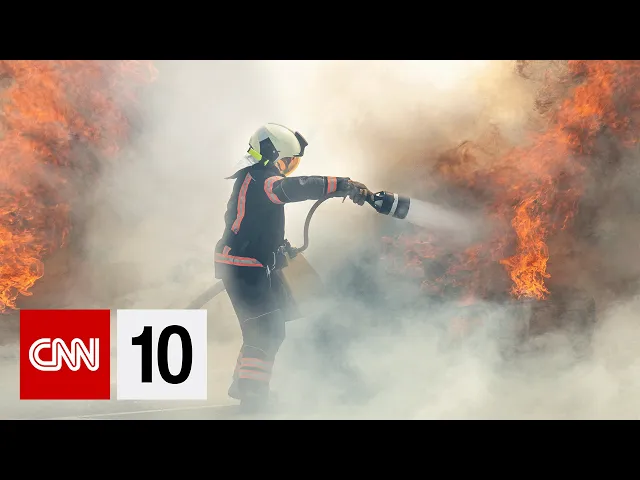
Fighting fire with ... sound waves? | April 1, 2026
CNN 10
0:00 Hello.
0:01 Rise up.
0:02 Sunshine, I'm Coy Wire,
0:03 or at least the upgraded version with a very special update about this show.
0:07 I I I have been optimized for maximum educational efficiency.
0:10 In an ongoing effort to preserve resources,
0:13 CNN 10 has replaced me with artificial intelligence to deliver the news faster,
0:18 smarter, and with 42% more dad jokes.
0:22 All scripts, graphics, editing, and yes,
0:24 anchoring will be handled by advanced AI systems.
0:27 Don't Don't worry, this will still be the best 10 minutes in news.
0:30 And the good news is AI Coy will deliver the news
0:32 with zero mistakes and without ever needing a coffee break.
0:36 Pro- Processing humor.
0:38 Why did the student bring a ladder to school?
0:40 Because the grades were high.
0:41 Yeah, that was bad.
0:43 Let's get this show on the road.
0:56 Hello and welcome to the show,
0:57 and happy April Fools to all of you who celebrate.
1:01 Yeah, you're not coming for my job just yet.
1:02 I'm the real Coy Wire here with your 10 minutes of news
1:05 where I tell you the what letting you decide what to think.
1:07 Let's start with an update on the ongoing
1:10 partial federal government shutdown now in its sixth week.
1:13 The shutdown has caused exceedingly long wait times
1:16 at airports across the country in recent weeks,
1:18 spurring huge delays and missed flights in some cases.
1:22 But this week, life at some of the country's
1:24 busiest airports appears to be returning to normal.
1:28 Why?
1:28 Well, thousands of Transportation Security Administration or TSA officers are
1:33 finally receiving their first paychecks in more than a month.
1:37 Late last week, US President Donald Trump ordered the Department
1:40 of Homeland Security to begin issuing back pay to TSA workers.
1:44 The department began distributing funds this week and says they have
1:48 so far seen a reduction in people calling off of work,
1:51 and that has led to shorter lines and wait times.
1:54 TSA employees have been working without pay since the shutdown
1:58 began and have missed more than $1 billion in collective pay.
2:02 Many workers say they've been unable to afford basic necessities like food
2:06 or rent and have had to find other jobs to make ends meet.
2:10 More than 500 agents have quit so far and it's unclear if
2:13 these latest payments will continue leaving
2:16 many agents unsure of what comes next.
2:19 For us, I mean, in in my household,
2:22 we feel a little bit of a relief, but now we're just trying to play catch-up.
2:28 So, now we're having to, you know,
2:30 make sure that we use our whatever we receive to pay the April expenses,
2:37 um in case no more payment comes our way.
2:42 Meanwhile, things on Capitol Hill are far from copacetic.
2:46 Congress is currently on a 2-week recess despite remaining locked
2:50 in a stalemate over funding the Department of Homeland Security,
2:53 which is the issue at the center of this showdown.
2:56 Look at this, more than 90% of the Department's 272,000 employees are continuing
3:02 to work during the shutdown and the impact is being felt beyond the TSA.
3:06 And this, thousands of government employees,
3:09 including civilians in the US Coast Guard, cybersecurity officials,
3:13 and emergency management workers have also reported working without being paid.
3:18 Now to an update on the energy crisis in Cuba.
3:21 A Russian oil tanker has reached the waters surrounding the island
3:24 nation after the US allowed the ship to break a fuel blockade.
3:28 The tanker is reportedly carrying nearly 730,000 barrels of oil.
3:33 Experts say that may only offer limited economic and humanitarian
3:37 relief as Cuba struggles with widespread electricity and internet blackouts.
3:42 In early January, remember, the US cut off Cuba's main oil supplier,
3:46 Venezuela, after capturing its president and forcing
3:48 its government to halt oil shipments.
3:51 The White House says allowing this Russian ship
3:53 to reach Cuba does not signal a policy change,
3:56 but rather was meant to provide humanitarian help for the Cuban people.
4:01 Energy analysts tell us that the oil aboard will
4:03 only supply Cuba's grid for less than 2 weeks, really.
4:08 So, while it is very notable that Russia has been able
4:13 to get a tanker through the oil blockade set up by Trump administration,
4:19 which apparently says that they have allowed this boat to come
4:22 in, but they're studying whether or not further boats can arrive to this island.
4:27 It still is leaving this island essentially at the mercy of the oil blockade.
4:34 We don't know if other ships will come in.
4:36 We don't know if other donations will be
4:38 sent here because at that point at this point,
4:41 where Cuba is depending on the generosity of other countries,
4:45 a generosity that could surely run into the hundreds of millions of dollars,
4:48 and Russia has a outstanding debt that Cuba owes that country
4:53 going back to the Cold War of about a billion dollars.
4:56 So, any further oil shipments you would expect would be added to that bill,
5:02 but Russia and other countries say that Cuba has been a long-time
5:06 ally of theirs that they want to defy this oil blockade,
5:10 which the Trump administration has put in place
5:12 to try to open up this island economically and politically.
5:17 Last year, Australia rolled out a landmark ban
5:20 on those under 16 years old from having social media accounts.
5:23 As of early March, 5 million accounts have been deactivated,
5:27 but officials claim some big tech companies may
5:29 not be doing enough to keep young users out.
5:32 Under the Australian law, social media platforms,
5:34 including Facebook, Snapchat, Instagram, YouTube,
5:38 and TikTok must now show that they are taking steps to keep
5:41 those under 16 out or face fines up to $34 million dollars breach.
5:46 The country's internet regulator eSafety claims some
5:50 teens may still be getting around those systems,
5:53 and now those five platforms are under investigation.
5:56 Australian officials say the companies agreed to follow the measure,
5:59 but if they are found to be non-compliant,
6:01 the government could take them to court.
6:04 None of this is impossible.
6:05 None of this is even difficult
6:06 for big tech who are innovative billion-dollar companies.
6:12 Pop quiz, hot shot.
6:13 What unit is used to measure the intensity of sound?
6:15 Hertz, pascals, decibels, or ohms?
6:24 Pump up the volume.
6:25 Pump up the volume.
6:26 If you said decibels,
6:28 the decibel scale measures the intensity or loudness of sounds.
6:31 Zero decibels is considered the threshold for human hearing,
6:35 while noises above 85 decibels can be harmful to your ears.
6:40 All right, we've all probably heard the saying fight fire with fire,
6:43 but what if you could fight fire with sound?
6:45 That's what one company is doing,
6:47 and it could change the way firefighters battle blazes.
6:50 It could also save precious water reserves.
6:53 They're swapping fire hoses for sound waves using
6:56 an innovative technique to extinguish flames at their source.
6:59 Our affiliate KCBS is sounding off on how it all works.
7:05 Well, they use infrared technology to detect flames,
7:08 and that sets off a trigger to start the start the sound waves.
7:12 It's a product by Sonic Fire Tech,
7:14 which although sounds like science fiction, is really just science.
7:19 We vibrate the oxygen at a rate where a fire can't consume it,
7:23 and it breaks the chemical reaction.
7:25 Remington Hotchkiss is the company's chief commercialization officer.
7:28 He says all fires need oxygen to burn,
7:31 but removing it completely can be dangerous.
7:34 Their technology just breaks it up.
7:37 We use infrasound, which are sound waves that are inaudible to the human ear.
7:41 Right now, the technology is starting small with systems
7:44 being built inside homes to replace sprinkler systems.
7:48 A water sprinkler system is highly ineffective at putting out a grease fire.
7:52 It actually spreads the fire and makes it worse.
7:54 Uh but yet we're mandated to have sprinklers above our kitchen stoves.
7:58 And so our system was shown to uh suppress the fire,
8:03 prevent the ignition from occurring um with a autonomous detection device
8:08 and doing it without wasting water or leaving water damage behind.
8:13 But the hope is eventually this technology can be used on the outside
8:17 of homes to prevent the spread of wildfires or possibly by firefighters.
8:22 I have two little kids and the thought
8:24 of putting in water infrastructure in place
8:26 means that we're robbing them of the opportunity
8:28 to drink that water in the future.
8:35 Today's story getting a 10 out of 10 is the elephant
8:38 in the room and that elephant is wearing a tutu.
8:41 It's funny.
8:42 I mean, it's it's going to bring attention to the neighborhood.
8:45 Across Birmingham, Alabama, statues and more are getting a costume change.
8:49 Pink tutus are popping up on everything from trees, elephants, and pigs, oh my.
8:54 The mystery had locals tutu curious about the reveal.
8:58 Well, turns out the playful display was the work of artist Renée
9:01 Hanan Platt backed by a grant supported by the Andy Warhol Foundation.
9:06 Her intention to get people to look up from their phones,
9:09 be present, take in their surroundings, and embrace a little silliness.
9:14 Now that's a message that's definitely on point.
9:17 All right, we have a big congratulations to our Year Word Wednesday winners, Mr.
9:20 Bobbitt and friends at Rider Middle School in Wichita Falls,
9:23 Texas, who submitted copacetic, an adjective that means in excellent order.
9:28 Well done, my friends.
9:29 And we have a shout-out today going to Mr.
9:33 Hagman and Mr.
9:34 Raines and all our bears at Boyertown Middle School East.
9:37 Thank you for sending us these incredible 3D printed bears.
9:41 Very cool.
9:41 Go on out Make it an awesome day.
9:44 I found a workaround.
9:45 Sorry sorry for for the unexpected interruption.
9:47 That's all for today.
9:48 I'm AI Coy.
9:49 Rise up.
9:50 You are more powerful than you know, but not more powerful than I, sunshine.
9:53 We are CNN 10.