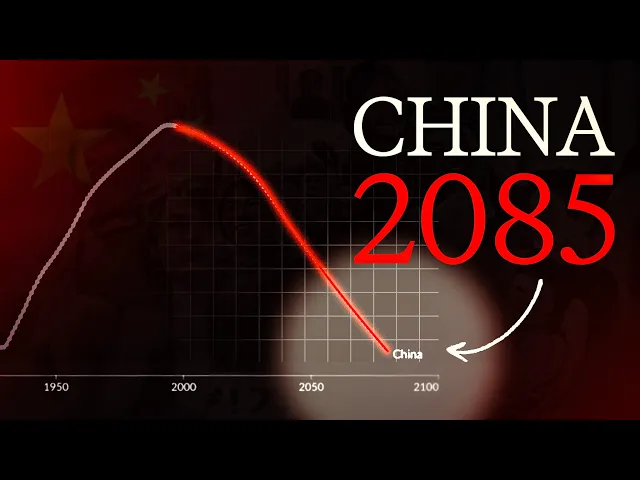
How China blew up its own future
Max Fisher
0:00 (person 1 speaking in foreign language) (person 2 speaking
0:03 in foreign language)- This is a video from Douyin, China's version of TikTok.
0:07 (person 1 speaking in foreign language)- It's not real.
0:09 It's a skit; a spoof.
0:10 That guy on the left is supposed to be
0:12 an official from the state Birth Encouragement Office.
0:15 (person 1 speaking in foreign language)- [Max] And he's
0:21 yelling at this guy to tell him, "Hey,
0:22 you better have kids." (person 1 speaking in foreign language)- [Max] The joke
0:28 is that this is what it feels like to be in China nowadays.
0:30 (person 2 speaking in foreign language)- China has been
0:36 getting very intense about pushing its citizens to have babies.
0:40 They're offering subsidies to new parents,
0:42 cash handouts to people who marry young, free childbirth services,
0:45 free preschool, even bonus points on school
0:48 entrance exams for second- and third-born kids.
0:50 They're even taxing condoms and birth control pills,
0:52 so Chinese couples will have more unprotected sex.
0:56 This all started two years ago when Xi Jinping
0:59 started talking about a new culture of marriage and childbirth.
1:04 This whole speech was Xi telling government officials it was
1:07 now a matter of national urgency to increase childbirth rates.
1:11 Ever since, China's state media has been bombarding
1:14 people with messages about their patriotic duty to procreate.
1:17 Officials are even starting to call up young women one by one to say, "Hey,
1:21 shouldn't you be getting pregnant right now?" So
1:22 what happened to get Xi Jinping so spooked?
1:25 Why is the machinery of the biggest, most centralized state in human history all
1:29 suddenly shifting into gear for this, for babies?
1:32 I think I have a pretty good idea.
1:33 (pulsing thoughtful music) It has to do with the fact that China's population,
1:38 after centuries of going up, is starting to decline.
1:41 And it went down for the first time in 2022,
1:43 and it has gone down every year since,
1:45 projected to keep dropping until China is half the size it is today.
1:49 You might look at this and think, "Okay, so what?
1:51 China would still be huge, bigger than almost every other country." And yeah,
1:55 it will be, but there's something hiding within this data,
1:58 something much more serious,
1:59 something that will undermine the foundations of China as we know it,
2:02 and endanger everything China has built in its rise to global power.
2:06 It's right here.
2:08 I know you don't know what this chart means yet.
2:10 That's okay; you're not supposed to.
2:12 It's rooted in some very particular,
2:13 very dramatic moments in China's recent history
2:16 that make it the country it is today.
2:18 This is a big economic thing, so we're gonna build our way up to what it is,
2:21 and why it's got Xi going to incredible lengths to reverse it,
2:25 to the point that Chinese people are joking
2:27 about government thugs individually bullying them into having babies.
2:30 Because if China can't fix this, and so far it has not figured out how,
2:34 no one has actually, the Chinese century will end just as it's getting started.
2:38 (bright lively music) To understand this problem looming over China,
2:48 we've gotta look at what it and the world will
2:51 look like at the end of this century if they fail,
2:53 and at this one very alarming chart that shows where things are headed.
2:57 It's a story that all traces back to something
2:59 called the "one-child policy," something you may have heard of.
3:01 But let's start with a particular problem
3:03 that basically every country encounters sooner or later.
3:06 As societies get richer, people have fewer and fewer babies.
3:10 (light inquisitive music) This is
3:13 from the open-source website, Our World in Data.
3:15 They're great.
3:16 We're gonna show you a bunch of their charts.
3:17 And it shows that as of 1950,
3:19 the average woman in these countries gave birth about three times in her life,
3:24 but nowadays it's closer to 1 1/2 births.
3:27 But that is actually a huge drop,
3:29 and there's a reason why this is such a big deal.
3:31 Anything below this magic number, called the replacement rate,
3:34 and your population starts to shrink.
3:36 You see birth rates going down like
3:38 this pretty much anytime a country gets richer.
3:41 Western, non-Western, good social safety net,
3:44 bad social safety net, always happens.
3:46 (light thoughtful music) Here's an Our World in Data thing that shows this.
3:49 Each dot is a country.
3:50 Moving right means it's getting richer; down means lower birth rate.
3:54 There they go, down and right, down and right.
3:56 And if you're wondering, "Okay,
3:58 but why?" The answer has to do with a bunch of things.
4:00 A big one is people's values changing as they have
4:03 more opportunities and options that come with greater wealth and education.
4:06 But it's more than that, too.
4:08 We don't need to get into all of that right now, but if people want, we could.
4:11 So let us know in the comments.
4:12 But for now, just know that when a country gets richer, people have fewer kids.
4:17 Okay?
4:17 Good?
4:17 Anyway, look at that chart again.
4:22 Let's just highlight a few of the rich countries:
4:24 the US, Japan, Russia, France, all clustered together, right?
4:28 But here's China, and it's kind of an outlier.
4:30 It's like it ended up with the birth
4:31 rate of a much richer country without becoming rich.
4:35 Let's actually highlight China's whole trajectory here.
4:39 You see?
4:40 China's birth rate dropped really early.
4:43 This is super important.
4:44 Most countries, by the time their birth rates go down, they look like this.
4:50 Or this.
4:51 They've got rich, highly developed economies that help them
4:54 absorb the problems that come with birth rates going down.
4:57 But China hasn't gotten to that point.
4:59 Pull that chart up one last time.
5:00 (purposeful string music) Something happened here
5:03 that threw China way off course.
5:05 This is why China's birth rate is dropping 50 years before it should.
5:10 So what happened?
5:10 You probably know what's coming here,
5:12 that this is something China actually did deliberately.
5:15 It was planned, and that plan had a name: the one-child policy.
5:19 One child.
5:20 One-child policy.
5:21 [News Reporter] One child.
5:22 Go back to that chart of birth rates.
5:25 Let's add China in here.
5:27 Really, really high birth rates here in the 1950s, six or seven kids per family.
5:31 Then China had a huge,
5:33 catastrophic famine here due to a policy called the Great Leap Forward.
5:36 [Speaker] "He who does not work,
5:39 shall not eat."- [News Reporter] A government policy gone disastrously wrong.
5:43 Mao's so-called "Great Leap Forward." (tense thoughtful
5:46 music)- [News Reporter] Which caused an unprecedented famine.
5:49 The terrible death toll was around 45 million.
5:53 And as happens after a famine or war, once it ended, there was a baby boom,
5:58 a crazy huge one, actually, like, seven-plus-kids-per-family huge.
6:02 (bright thoughtful music) (Congress applauding) China's
6:04 leaders saw this, and they panicked.
6:06 They thought China's birth rate was going to stay like that forever, like this.
6:12 So now we gotta meet this guy.
6:15 This guy was in charge of population policy at the time for China,
6:18 and he predicted the population would grow to 4
6:22 1/2 billion and exhaust the country's food resources.
6:25 This is what he thought would happen.
6:27 This is his prediction, but this is a crazy prediction.
6:30 That's not how this works.
6:32 And the thing to understand is that China at this point was run by an engineer.
6:36 Like, the guy who made that prediction,
6:38 China's population guy, was a missile scientist.
6:41 Social scientists, the sorts of experts who could have said,
6:44 "Hey, don't worry, guys.
6:45 Population growth slows on its own.
6:47 It's gonna be fine." Had been mostly jailed or exiled in political purges.
6:51 So all of these engineers in charge
6:53 bought that guy's official recommendation to save
6:56 the country from this completely wrong prediction
6:59 of rampant overpopulation by doing something very drastic:
7:03 (crowd applauding) banning any family in China from having more than one child.
7:11 That sounds impossible.
7:12 How do you police the wombs of hundreds of millions of mothers?
7:16 How do you prevent anyone anywhere in China from having a second child?
7:20 So they put this guy in charge of it, a former army general,
7:23 and he sent what he called "shock brigades" of doctors and government thugs,
7:27 door to door, village to village,
7:29 to terminate any pregnancy if the mother had already had her one allotted child.
7:33 So heads up, the next 90 seconds mention
7:36 stories of pretty upsetting violence related to pregnancy.
7:39 I just wanted to let you know; skip ahead if you want.
7:42 So in just their first year, those shock brigades coerced 14 million women
7:46 into abortions and sterilized another 16 million.
7:50 One reporter described seeing them abduct
7:52 pregnant women en masse for forced abortions.
7:54 (tense uneasy music) This is from a 2019 documentary
7:58 called "One Child Nation." You can watch it on Prime.
8:01 (family planning official speaking in foreign language)- [Max] One thing
8:12 it shows is the people who implemented all this really believed,
8:15 still believe, it was necessary.
8:16 (family planning official speaking in foreign language)- Officials
8:27 in one city were reported to have tied up
8:29 women in hog cages and stacked them on truck
8:32 beds to be sent to forced abortion centers,
8:34 which, in that city alone, performed 19,000 abortions over a 50-day period.
8:41 In all, China conducted more than 300 million abortions.
8:46 By 1989, it had also sterilized one in three childbearing-age, married women.
8:51 One in three.
8:56 I am telling you all this to make a point.
8:57 Western depictions of China tend to be split between two extremes.
9:02 Either it's a hyper-competent technocratic state capable
9:05 of pulling off huge projects no other country could,
9:08 or it's a dictatorship of unaccountable bureaucrats who do things like
9:12 forcibly abort hundreds of millions of babies based on a mathematical error.
9:15 I think what this episode shows is that China is both of those things,
9:18 and the big question is, which will prevail now as the country tries to defuse
9:23 the demographic time bomb that it's set for itself, and that is about to go off?
9:30 A big challenge reading the news today isn't just finding a source you trust,
9:33 but seeing how the same story looks from different angles.
9:36 And a great resource to navigate our media landscape is Ground News,
9:39 the sponsor of this video.
9:41 (light gentle music) They are an app
9:43 and website that aggregates news from sources worldwide,
9:45 so I can compare coverage, reliability, and who owns them.
9:48 Let's say you wanna dig into the Pentagon's
9:50 dispute with the AI company Anthropic.
9:53 Ground News shows over 100 sources are covering
9:55 this, and the classification of each outlet's positioning,
9:58 along with factuality and who owns it.
10:00 Fox News, coded as right-wing,
10:02 frames it as the Pentagon giving Anthropic an ultimatum to remove restrictions.
10:06 But Engadget, classified as "lean left," describes
10:09 the Pentagon as challenging the company's safety guardrails.
10:12 That's a real distinction.
10:13 It's why Ground News is a great way
10:15 to understand how the media is shaping stories.
10:17 Zapier.com calls it one of the best news apps on the market.
10:20 It's completely subscriber-funded.
10:22 Get the unlimited access Vantage plan
10:24 for 40% off by going to ground.news/maxfisher,
10:28 or scan the QR code on your screen.
10:31 Now, back to China.
10:36 (light thoughtful music) So look at this chart again.
10:40 By 2015, when China ended the one-child policy, yeah,
10:43 birth rates have been really low for a long time,
10:46 but remember that below this line, a country's population will shrink.
10:50 China pushed itself so far past this line that it is
10:54 now triggering something that the architects of this policy never anticipated.
10:58 Something very, very dangerous.
11:00 Okay, remember this chart?
11:02 This is the time bomb.
11:04 To explain it, I want you to picture a family.
11:07 (light percussive music) Think of this family as representing all of China.
11:12 Right now, today, China's population looks like this.
11:15 China's got on average 4 1/2 working-age adults
11:19 for every one child and every one elderly person.
11:22 Actually, let's see the numbers.
11:24 China's got 980 million adults, 236 million children,
11:27 and 204 million elderly people, that means above retirement age.
11:31 This is a really healthy balance.
11:33 It means that there are 980 million working-age people
11:37 supporting less than half that many kids and retirees.
11:40 Population scientists call that the dependency ratio.
11:43 This number is really important.
11:45 When it's low like this, and 45 is low,
11:48 it means there's lots of extra workers, extra productivity in the economy.
11:51 Just like if a family had working adults and only two people it had to support.
11:56 That extra money can go towards buying
11:58 goods and services to stimulate the economy.
12:00 It funds taxes that go to building up cities,
12:03 pays for roads, schools or missiles, or aircraft carriers,
12:07 all of the things that make China a rising power in the world.
12:10 But only so long as that ratio
12:12 of dependents to working-age adults stays healthy and low.
12:16 But that all-important number is changing for China.
12:18 (light lively music) So now we're back
12:22 at this, the big chart scaring Xi Jinping,
12:24 and we're finally ready to explain what it says.
12:26 What we are looking at here is the dependency ratio for China over time.
12:30 It used to be really high, almost double what it is today, back here.
12:34 Remember, this was that huge baby boom
12:36 that inspired the one-child policy in the first place,
12:39 which is just to say this number hitting 80 so
12:42 scared China's leaders they thought it would literally destroy the country.
12:45 Now, let's see how China compares to other countries.
12:48 China's number today is lower than most peer countries.
12:51 Remember, that's good for them.
12:53 Take a look at France for comparison.
12:55 Like in a lot of Western countries,
12:57 French people are having fewer kids and a growing
13:00 share of its adults are aging into retirement,
13:03 which together have pushed up France's number to 63.
13:08 Here's what that looks like.
13:09 Okay, gotta French him up a little bit.
13:12 Yeah, that's better.
13:13 France looks like this: one retiree,
13:15 a little less than one child for every three working adults.
13:20 And compare that to China, who, remember, has more working-age adults.
13:23 This might not seem like a big difference, but it is.
13:25 The French media is full of stories warning
13:28 that all those seniors are draining the country's resources,
13:31 pushing up poverty rates, ballooning healthcare spending.
13:34 It's become, like, one of the biggest issues facing France,
13:37 (news host speaking in foreign language)- Because remember,
13:45 a healthy demographic balance creates all
13:47 this excess productivity that fuels the economy.
13:50 But when you have too many dependents and not enough working adults,
13:53 that productivity gets diverted to caring
13:56 for the people who are too old to work.
14:00 So that's France with the magic number at 63.
14:03 Let's quickly look at Japan, where it's up to 70 now.
14:07 And you've probably heard this described
14:09 as a full-blown crisis for Japan, and it is.
14:12 Here's what that looks like: just two adults for every retiree.
14:18 This is the point at which so much
14:20 of the country's productivity goes toward care for the elderly,
14:23 that you start to hear phrases like "national decline,"
14:26 "population drop," "shrinking cities." We're here to talk about China,
14:31 obviously, but all of this is just a level set on how to read this magic number.
14:37 45, China, today, is good.
14:39 55, America's right now, is fine.
14:41 60 to 65 in France is a national crisis.
14:45 70 in Japan is national decline.
14:48 And 80, which China hit in the 1970s, is such an emergency it triggered
14:52 the largest population control measure in human history,
14:55 with all of the violence that entailed.
14:57 But China's number is about to go from good to catastrophic.
15:00 To show you what I mean, imagine that I'm the average 30-year-old in China.
15:04 And to make that easier to picture,
15:06 we're gonna play these clips from a popular Chinese
15:09 soap opera called "The Rational Life" while I talk.
15:11 (gentle busy music) Okay, so, as the average Chinese 30-year-old,
15:16 I have a nice job in a growing city.
15:18 My parents were born in the baby boom in the '60s and '70s,
15:21 so they have a ton of siblings to help take care of Grandma.
15:24 I was born in the one-child era, so I'm an only child.
15:27 All my friends are only children.
15:28 My partner is an only child.
15:30 But that means that one day,
15:31 when my parents retire and my partner's parents retire,
15:35 we will have four elderly parents to take care of.
15:38 And I'm worried all of our money is gonna go towards their healthcare.
15:41 We're allowed to have as many kids as we want now, but statistically,
15:43 we'll probably only have one, or, just as likely, not at all.
15:47 So when we get older, who's gonna take care of us?
15:51 If you like that, there are 35 episodes on Netflix, all subtitled.
15:55 It's not bad.
15:56 Anyway, around half a billion people in China meet that description,
16:00 and we do actually know what's going
16:02 to happen when they and their parents get older.
16:04 This is the most recent report from the United Nations World Population Study.
16:09 It uses all the sophisticated data
16:11 and math to project out each country's future,
16:14 and the numbers for China are pretty alarming.
16:16 Here's what it boils down to.
16:17 This is 2050 in China, when the young adults from that soap opera
16:20 we just saw are gonna reach middle age;
16:22 this is exactly the same balance as today's Japan.
16:25 So China is gonna become Japan.
16:27 Let's see that magic dependency number for China and its peers in 2050,
16:31 according to that UN data.
16:35 Wow, everybody's number is going up.
16:37 China's gonna pass America and Russia to reach about 70.
16:40 Yeah, same as Japan today.
16:42 Meanwhile, Japan's will get up to, yikes, 94.
16:45 I'm worried about Japan, guys.
16:47 But let's stay on China,
16:48 because this UN data says things get real worrying after 2050.
16:53 Keep your eye on China here.
16:55 That number keeps going up and up until, oh, okay,
16:59 99, worse than Japan, worse than any other major country.
17:05 This looks even crazier when you see it like this.
17:08 By 2075, there'll be barely one working adult
17:11 in China for every retired person they have to support.
17:17 This is all echoes from the one-child policy coming right before
17:20 China got wealthy in the way that always pushes down birth rates.
17:24 So now it's a nation of only children having only children.
17:27 (gentle thoughtful music) In each generation,
17:30 you get more and more people aging into this bucket
17:34 of elderly retirees and fewer and fewer working adults to support them.
17:38 What makes this population death spiral dangerous
17:40 is that it is happening so, so quickly.
17:43 We can actually project these numbers all the way to the year 2100.
17:46 Yeah, that magic number, it is going to 128.
17:53 So remember, 60 is a crisis, 70 is national decline,
17:57 and 80 is a threat to national survival.
17:59 But China is going to reach near 130.
18:02 Let me show you what that looks like.
18:04 Here is rock bottom.
18:05 60 years from today.
18:06 More elderly people than adults, tens of millions more, and very,
18:10 very few children, before eventually settling
18:12 into about 50-50 adults and elderly retirees.
18:16 (lively pulsing music) So what does all this mean?
18:21 Well, it tells us that China will look at the end of the century,
18:24 like the upside-down version of the China we know today.
18:27 Remember, this is supposed to be the Chinese century,
18:29 and right now it feels like it is.
18:30 (upbeat percussive music) (Xi Jinping
18:35 speaking in foreign language)- [News Reporter]
18:41 China appears to be expanding its military arsenal at a historic pace.
18:46 [News Reporter] China's space program is in overdrive.
18:50 For China's-- China.
18:51 [News Reporter] China's turned the nation into the factory of the world.
18:54 China is expanding militarily.
18:55 It's projecting power in every part of the world.
18:58 It's a huge source of scientific breakthroughs,
19:00 commercial and technological innovations.
19:02 But all of this is built on a huge,
19:05 huge national workforce, relatively unburdened by dependents.
19:09 And in not too long, that formula is going to flip upside down.
19:13 The cities will empty out as the population halves.
19:16 Retirees will outnumber adults, and all those people will need healthcare.
19:20 They need social support, which is gonna have to come from that now,
19:23 much smaller pool of workers,
19:24 which means those families will have less money to spend on themselves to invest
19:29 in education and starting a new business or inventions or art or technology,
19:33 and is going to leave a lot less money to pay for those big national projects.
19:38 So what does this China look like?
19:39 I'm not gonna claim to know for sure;
19:40 it's just too hard to predict the future, but a few lessons from other declines.
19:44 For one, does all of this turmoil and contraction cause political stability?
19:50 I don't know that necessarily.
19:52 I mean, for that, you need young people.
19:54 I mean, that's who protests, that's who goes into the streets to demand change.
19:57 But young people are about to be pretty scarce in China, right?
20:00 Something I would be more worried about
20:02 is China's role abroad because declining powers,
20:05 especially dictatorships like China's, tend to get aggressive as they decline.
20:10 (light groovy music) Look at Russia; its population started shrinking.
20:15 Its power in the world receded.
20:17 And ever since, it's been lashing out to try to forestall
20:21 the rise of pro-Western democracy it sees as a threat.
20:24 (airplane engines roaring) I'm not saying
20:26 that's the only reason Russia turned aggressive,
20:28 but I am saying that there is a long trend
20:30 in history going all the way back to the ancient Greeks,
20:32 that great powers in decline become more paranoid,
20:35 more reckless, and likelier to start wars.
20:37 Here's China's population at the end of the century.
20:41 Smaller, but still pretty big.
20:43 But let's add in two of China's neighbors; doesn't look so big anymore, does it?
20:46 Looks like a power on the way down.
20:49 But I don't wanna fearmonger here.
20:50 It is totally possible for China to decline peacefully.
20:53 Like, look at Britain or France.
20:54 A century ago, they ran the world.
20:56 Now they're middle powers, no offense to Britain and France,
20:59 but life is so good there.
21:00 They have healthy economies; they make great art.
21:02 They influence world events.
21:03 They're not failed states.
21:04 Claire, it's French!
21:06 Really?
21:07 And that could very well be China's future, too.
21:09 But China does not see itself as ready for a nice chill, national decline.
21:13 It is still a long way from becoming rich or politically
21:15 stable in the way that countries like Britain and France are,
21:18 which is why its leadership is
21:20 so desperate to forestall this demographic destiny.
21:25 When we think back to the one-child episode,
21:27 and that showed with enough state power
21:29 and willingness to do some really extreme things,
21:32 you can coerce people out of having a baby, but you can't coerce them into it.
21:38 They have to do that voluntarily.
21:39 That's one of the main things about having a baby.
21:41 Lots of countries are trying to do just that, but not one has pulled it off.
21:46 No matter how many childcare subsidies or housing vouchers,
21:49 or cash handouts they expend.
21:51 South Korea spent $200 billion on this sort of stuff,
21:54 and it did not make a dent.
21:55 (bright thoughtful music) Experts disagree about why that is.
22:00 But the point is, no one has found a way
22:03 to reverse the law of nature that as societies get richer,
22:06 as China's is, their birth rates go down.
22:09 Look, we as a species are just in the early stages of this problem.
22:13 So, someone might well find a way to mitigate
22:15 the burdens of an aging and shrinking population, maybe technology.
22:19 In Japan, one reason you see vending machines everywhere is
22:22 to compensate for the shortage in retail workers from the population aging.
22:26 And maybe we'll get better and better at this kind of thing through, who knows?
22:29 Automation or something else that can help
22:31 to absorb the loss in workers as populations age.
22:34 But we do also have a workaround, a proven workaround to this entire problem.
22:38 And I'll give you a hint.
22:39 Let's look at that magic number chart: the dependency ratio.
22:42 (soft thoughtful music) There's one country that looks pretty good here,
22:46 even well into the future: the United States.
22:51 Why is that?
22:53 Well, it's because the United States is a country that lots of people
22:57 want to move to in a way that is not true of other countries,
23:00 and this gives it a much healthier demographic balance.
23:03 The math of this is simple.
23:04 Immigrants tend to be working-age.
23:06 That's when they are able to migrate.
23:08 And the US has a lot compared to other countries, about 15% of its population.
23:12 So more immigration means more adults paying into taxes
23:17 and social services per each child or retired person.
23:20 That's the big secret.
23:21 That's it.
23:21 France has a lot of immigrants, too,
23:23 which is part of why it's aging less rapidly than other European countries.
23:27 Look at Japan: barely any immigrants, faster demographic decline.
23:33 And China?
23:33 China has basically zero immigration, 0.1% going back years.
23:39 China's immigration is actually technically negative.
23:42 More working-age adults move out of China than move into it,
23:46 to the point that something like 30
23:47 million factory jobs are already sitting unfilled.
23:51 Lots of people would love to move to China for those jobs,
23:54 but China will not let them.
23:55 (gentle contemplative music) That's partly
23:59 because China's leaders believe maintaining
24:01 their rule requires strict social control cradle to the grave,
24:05 and letting in outsiders would undermine that.
24:08 And partly it's just the local flavor of the same nationalism
24:11 and drive for racial and cultural purity we see rising everywhere.
24:16 I'm not saying that immigration is the only possible solution for China,
24:19 just that the problem is solvable,
24:21 but that that will probably come with some big trade-offs.
24:24 China is getting to a point where it is gonna have
24:27 to make a choice between maintaining things as it is now,
24:30 of single-party rule, autocracy, and a rigid race-based nationalism,
24:35 but at the cost of a demographic decline so severe
24:38 that is a near mathematical certainty that the second half
24:41 of the Chinese century would take it from a huge
24:44 rising power to the largest nursing home in human history,
24:47 preserving the Chinese system at the expense
24:50 of the Chinese nation and its future.
24:52 Or it can choose to slow and maybe even
24:55 prevent that decline by allowing the kind of change,
24:57 whether through immigration or something else,
24:59 that the party has seen as a threat
25:01 to bend the demographic curve so that China can
25:04 have a population balance that lets it continue
25:06 to grow and flourish without being demographically weighed down.
25:09 That would keep the nation strong and healthy at the cost of compromising
25:13 the political and social system that the country's
25:15 leadership see as essential to that rise,
25:18 as the thing that makes the Chinese century what it is.
25:20 (Congress applauding) I'm not saying those are
25:23 the only two possible outcomes; you know,
25:25 maybe someone will figure out how to solve for these huge demographic
25:28 and economic forces that no one has been able to figure out.
25:31 But if they don't, yeah, it's just this: the system or the nation.
25:36 That's the choice.
25:38 (gentle contemplative music continues)