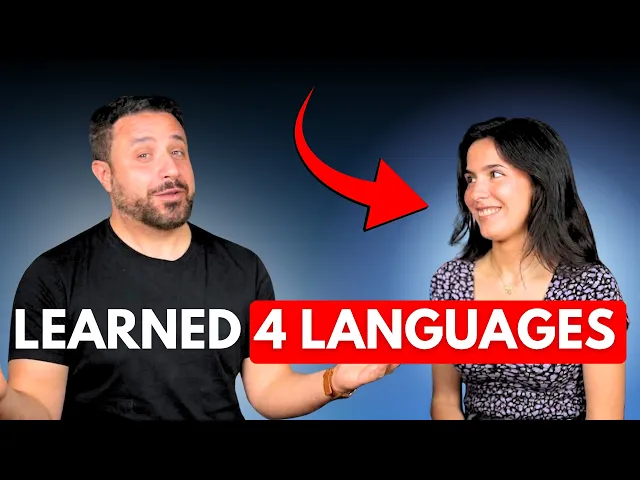
Do You Really Learn Languages Faster Through Relationships?
Luca Lampariello
0:00 Hello everyone!
0:01 I have the pleasure of having Sonia.
0:04 Sonia?
0:05 Sonia, you're from Rome.
0:07 Like me, but we're speaking English, right?
0:10 English for now.
0:11 So this is gonna be an interesting interview and we're going
0:14 to do this interview in English but also in our native language,
0:18 the beautiful Italian.
0:19 Sonia, how are you?
0:22 That's exactly right.
0:23 We're gonna confuse you people.
0:24 You're gonna confuse me.
0:26 I'm gonna confuse myself.
0:28 Anyway, so Sonia speaks a bunch of languages, right?
0:31 Kind of.
0:32 Kind of.
0:34 So what is the first language you learned?
0:36 Italian, because it's my native language.
0:38 Yes, the second.
0:39 English.
0:40 English.
0:40 Yeah.
0:41 I started in kindergarten, so really yeah, little.
0:46 Why is it that you have an American accent?
0:48 'Cause I like it.
0:49 So I've always loved rap music.
0:51 I love rap music.
0:53 So even when I was a kid, I was like, yeah,
0:55 Eminem, 50 Cent, da da da da da and I was studying.
0:59 That was before internet.
1:01 You know, like I'm thirty-five.
1:03 Thirty-five, okay.
1:04 You can't tell.
1:05 No, can't tell.
1:06 I thought you were like twenty-two.
1:08 Really?
1:12 24, come on, I'm kidding.
1:14 23, between 23 and 25.
1:18 It's true.
1:19 So, even as a kid, I would sit there with the paper
1:23 dictionary and I would study and listen to myself, then Eminem.
1:27 So in the end, then I took the American accent because I like it more.
1:31 Do you know how to do a bit of a British accent too, or no?
1:34 No.
1:35 Neither do I to tell the truth, I try, but Richard,
1:38 the famous polyglot, beats me all the time and says no.
1:43 Anyway, it's interesting because there's not
1:45 a lot of Italians to speak English well,
1:47 and on top of that you have a great accent.
1:49 So let's talk about that, because I think it's a very interesting topic,
1:53 apart from the fact that you speak English really well.
1:56 What happened that you developed the accent?
1:59 For example, something that happened to me
2:01 was that when I started speaking well, people were mocking me.
2:04 Like it's cool.
2:05 Oh yeah.
2:07 They were making fun of me like, oh, you think you're American.
2:11 Because I was like trying, right?
2:12 Like you gotta try.
2:14 I'm a native Italian speaker.
2:17 My parents are from Rome.
2:19 They don't speak English at all.
2:20 So I had to try.
2:21 And my friends were in like...
2:24 I didn't care.
2:25 I love music in general.
2:27 Like I'm a musician, so I studied like a lot of music, like music academy.
2:32 And I think that's why I have a good accent.
2:36 I think we're talking about the famous musical ear.
2:40 If you like music, because languages are music, I adore music, I adore it.
2:44 I also started by playing, for example, the piano.
2:48 Then I abandoned it, shame on me.
2:51 How do you say shame on me in Italian?
2:52 Wait, let me think: shame on me?
2:54 No, don't shame you.
2:56 No, I should be ashamed.
2:57 I don't know.
2:57 No shame, shame, shame.
3:00 It's important to stress that sometimes when
3:02 people talk about getting a great accent,
3:05 the problem is more psychological in my book, right?
3:09 And but you've overcome that in a brilliant way.
3:12 So that's that's fantastic.
3:13 Uh and the reason why we're having this interview
3:15 is like because we want to talk, she's...
3:18 you're also a polyglot, because I think a person who speaks three,
3:21 four, five languages is a polyglot.
3:24 But I'm also very interested in knowing how
3:26 you approach languages from a psychological point of view,
3:29 but also from a technical point of view.
3:32 Yeah, but I'm a singer, so I was a singer.
3:35 You know I used to sing with Orchestra Piazza Vittorio for like three years.
3:39 Fantastic.
3:41 Didn't know that.
3:42 Okay, so so no, I I mean this really helped.
3:45 Did this help you with pronunciation and identity, right?
3:50 Did you go to the United States or you
3:52 you learned most of what you know at home or...
3:55 I'd say mainly I learned in Italy because
3:58 I studied like Bachelor's and Master's here in Rome.
4:03 But then I did spend like an amount
4:05 of time in the US because my ex-husband was American.
4:10 Okay.
4:11 You're full of surprises.
4:12 I know, but this this is frustrating because
4:15 every time I say like oh I speak English.
4:18 Why do you speak English?
4:19 Oh, because I studied a lot, because I love music, because da da da da.
4:22 They were like, hmm.
4:23 And then I'm like, oh, so my ex-husband was American.
4:25 They're like, oh, that's why you speak English.
4:27 And I'm like, well no.
4:30 I said I was surprised that you had a husband
4:32 from the United States and where do you live in the States?
4:35 Colorado.
4:36 Colorado.
4:37 And Tampa.
4:38 And Tampa.
4:39 Okay, so it helped but it's not the main reason why I speak English.
4:42 I mean, I always say yes, I had an American teacher,
4:46 I spoke with a lot of friends, but...
4:47 It's the time, it's the effort, it's how much you like it.
4:51 Then I would sit down when I was little to do the translations of the movies,
4:57 of the movie subtitles.
4:59 There were like the crews,
5:01 the ones that made subtitles when there was no Netflix yet.
5:05 And I would get into it.
5:06 It does a lot, and then you learn a lot by teaching because you
5:10 arrive and you still know that you're
5:13 Italian and there is a giant imposter syndrome.
5:15 Enormous, gigantesque.
5:17 Giant, so you want to be as perfect as possible.
5:20 So, but even now I do English lessons, I mean...
5:26 Uh that that's true.
5:27 When you teach you also learn a lot.
5:28 You have to pay attention to details and pronunciation and intonation, etc.
5:32 Okay, but this is only the first language, right?
5:34 Yeah.
5:35 Now we got a few other languages.
5:36 So we start with English, your Italian.
5:38 Uh what other languages do you speak well?
5:40 And what does it mean for you to speak a language well?
5:43 I speak Spanish like very, very, very well.
5:48 I chose Gran Canaria and I thought I'd stay for a month.
5:51 But after a month I said, I like it here.
5:56 Very, very, very well.
5:59 Yeah, I mean, because I feel like nobody knows,
6:02 because I always speak Italian and English, but I speak Spanish really well.
6:09 Canarian Spanish.
6:14 I like the "Castizo" accent because I was born, well I was born,
6:18 born in Italy, but I've always spoken a lot, almost only with Spaniards.
6:22 So, that accent stuck to me, this strong accent, and it stayed there in my head.
6:28 Nothing.
6:28 But I can't do it like this.
6:30 What do you mean you can't?
6:32 This switch?
6:33 That's too much.
6:34 Three languages?
6:35 No, we're gonna do four now.
6:36 No, no, no, no, no, no.
6:37 I'm kidding, I'm kidding.
6:39 We haven't talked about Japanese yet.
6:40 That's gonna happen.
6:41 Anyway, two for now.
6:44 Everything said, just stop, let's go!
6:48 So, then, as we were saying then, you speak Spanish very,
6:52 very, very well because people don't know it.
6:57 Because I studied it at the university, both the Bachelor's and the Master's,
7:01 so in reality I have a degree also in Spanish.
7:03 And then I was in the Canaries for almost four years, three decades.
7:07 Three decades.
7:07 I mean, I had two ex-boyfriends, one Canarian and one Argentine.
7:13 Languages are learned in the cradle or in the bed, is it true?
7:18 No, we were playing with...
7:20 let's read like this, playing with the beards,
7:23 let's see what to cut and what not.
7:27 In Roman it's called "buttarla in caciara".
7:30 And so in reality yes, that Spanish was both study, a lot of study,
7:34 then I had abandoned it a bit because I didn't find the motivation to...
7:39 I was in the United States, I was working with English.
7:42 Then, when I went back to the Canaries, I found the motivation again.
7:45 I can imagine it, okay?
7:47 So.
7:50 I heard Swedes speaking that have been brought home and are partying, I mean...
8:00 Okay, so we were saying English, Spanish,
8:02 is there any other language that you speak well?
8:05 Not well, not well.
8:06 Okay, so English, Spanish, Italian,
8:08 I'd say like I can talk about pretty much anything.
8:11 Japanese, I'd say it's intermediate.
8:15 I cannot talk about just anything.
8:18 There are topics that I'm like, I don't have the vocabulary,
8:21 even though I lived there for three years.
8:23 It was very difficult for me.
8:25 I moved to Japan and I didn't know Japanese at all.
8:28 I knew like just like basic Japanese.
8:32 So I studied it for six months, but at the same time I was working part-time.
8:37 And I didn't really know much about the grammar.
8:40 So then I started working full time and I
8:43 learned Japanese with my roommates Because I had Japanese roommates.
8:47 So my Japanese now is like I understand it pretty well.
8:50 So you speak Japanese?
8:57 I can talk intermediate level,
8:59 but it took me a year before I could start speaking.
9:03 I was stuck.
9:04 That was new to me.
9:05 Like I was like, yeah, I'm so good.
9:08 English, Spanish, French, because I studied a little bit of French in school.
9:11 I was like, yeah, it's all good.
9:13 And in Japan I was like, oh my God.
9:15 I'm terrible.
9:17 The same thing happened to me when it comes to Japanese.
9:19 It's such a difficult language because it's different.
9:21 Right?
9:21 It's different.
9:22 The syntax is like words all over the place.
9:25 And that's why I dropped Japanese back in the day 14 years ago.
9:29 Now I'm back with a vengeance.
9:30 However, I understand that it's difficult and this is
9:33 an important thing to say that a lot of people think that if you're a polyglot
9:38 and you have a lot of languages under your belt,
9:41 so it's gonna be like a breeze just to learn yet another language,
9:45 and that is not necessarily true because if
9:48 you learn a language that is not, you know,
9:51 doesn't belong to the language families
9:52 that you know you've already gone through,
9:55 then you we got a problem, as they say.
9:57 And then it's...
9:58 It's a little bit more difficult.
9:59 But you made it.
9:59 Now you speak at an intermediate level.
10:01 And then you know, once you have an intermediate level,
10:04 you can already communicate.
10:05 I think it's gonna be relatively easy to bring it
10:08 to the next level if you have a chance of using it.
10:12 Did you have a chance of use it maybe also online or...
10:14 Japan like three months a year usually.
10:17 Three months in a row.
10:18 That's fantastic.
10:19 Yeah, and also like I'd like to start my company in Japan,
10:21 so I applied for a Japanese visa.
10:23 I don't know what's gonna happen now,
10:25 like they're still processing my visa, so I'm not sure.
10:27 Ah, quickly to be in Japan.
10:29 I want to go back too, go back?
10:30 No.
10:30 But I want to go there at least a couple of months.
10:33 I really want to go to go.
10:34 If you want to move, to really abandon this world and say Europe:
10:37 bye, we see each other in Japan.
10:39 Well, I want to do an interesting thing: I mean I want to open my own company.
10:43 So, I don't have to ask anyone for vacation time,
10:46 so when I want to go back to Italy,
10:48 if I want to spend 3-4 months in Italy, I can.
10:50 But I live in Japan, so I would like to do this thing,
10:53 because to work for a Japanese company I won't do it anymore.
10:56 Okay, so you also had a work experience in Japan.
11:05 Aggressive in the sense that...
11:07 I've heard, for example,
11:08 that in Korea and Japan you work too much and people are exhausted.
11:10 Yeah.
11:13 ten days off a year and I couldn't even take
11:16 the ten days off because my my boss wanted me to work,
11:19 so he was like, no, you can get eight,
11:21 but I'll pay for the like two days that you don't get.
11:26 No, well especially for us Italians,
11:28 I mean Italians live, Italians don't live to work,
11:32 Americans maybe live to work, sorry Americans, it's a crazy cliché, but...
11:35 if you think about it, many people in the world have maybe ten days of vacation,
11:39 we have two months or two months, now I don't remember.
11:42 I mean in Italy...
11:43 there are many things that don't work,
11:44 but the thing that works is that we enjoy life.
11:47 Then there was no flexibility.
11:48 One thing that I noticed is that I
11:50 was very flexible in my work in Japan because...
11:53 So much overtime, unpaid obviously.
11:56 But I would say: okay, one like "do out this", then you'll laugh at me.
11:59 Instead, when I asked my boss for 20
12:01 minutes to go and catch the train once, 20...
12:03 He thought about it for half a day and then...
12:10 Mmm.
12:13 He thought about it.
12:14 And then he told me that on Monday I would have to arrive half an hour earlier.
12:18 I was arriving anyway always half an hour earlier,
12:21 but the request really made me feel bad.
12:25 But I can imagine the whole thing.
12:28 Because in Japan, I've heard it's difficult to say no.
12:31 So you don't say no directly, you have to circumvent the problem.
12:36 Anyway, um so okay, these are the languages
12:39 in which you had a lot of experiences.
12:41 You speak well.
12:42 What about any other language that you...
12:45 You try to learn and maybe...
12:46 Yeah, I well I had to learn French because I studied it in school.
12:51 High school, five years, five hours a week.
12:55 That's like standard Italian language high school.
12:59 It was easy for me.
13:01 Didn't really like it, so I completely abandoned it when I could.
13:04 When I had the chance, I was like, bye.
13:07 Okay.
13:08 So the spark hadn't clicked with French.
13:11 The spark clicked!
13:13 And Chinese did, when I was 14 years old,
13:15 two years the school was in Via dei Mille,
13:17 the school, the only school that in Mille was doing Chinese,
13:21 it was interesting because it was the first tonal language for me,
13:24 so it was a new world and at the time I was going out,
13:27 my group of friends was all Chinese,
13:29 there were Italians but with Chinese parents.
13:31 so when I went to their house the mother and I...
13:34 what is she saying, I don't understand and so I did these two
13:38 little years that then I was even good and I lost almost everything,
13:41 I remember only a few phrases, I say: but why?
13:51 It happens, come on, not everything goes as planned, it's said, right?
13:55 20 years ago, but are you going back to Chinese or not, sooner or later?
13:59 I went back to it during COVID,
14:00 because there it had returned, like, wait, and we'll do it again.
14:05 But during COVID I don't know about you ever, I was working like this.
14:08 So much, so much, that then I didn't make it,
14:11 to keep up, so I abandoned it again,
14:14 it has been abandoned twice, my poor Chinese, poor Chinese,
14:19 poor Chinese, Mandarin Chinese is an important language to learn.
14:23 Anyway, okay, so uh is there any other language uh you want to learn?
14:25 I want to learn.
14:26 Well, I'd like to improve my Japanese because I love to have like a very,
14:32 very, very good high level level.
14:34 So good, in fact, that people mistake you for a Japanese.
14:36 Gotta be difficult because it'll look Japanese, but I'm pretty sure it could be.
14:39 Yeah, but next Chinese.
14:41 And then I'm thinking about Portuguese,
14:43 because Portuguese, like Brazilian Portuguese, is like so...
14:47 Yeah.
14:48 Okay, but uh you direct for this too.
14:51 Thank you Sonia, thank you for the interview, I hope you liked it,
14:55 I mixed a bit of languages for you, but this is the beauty.