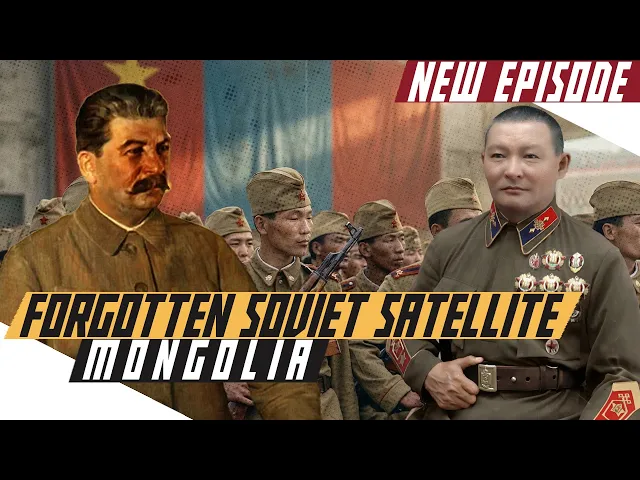
Mongolia's Cold War History
The Cold War
0:00 Mongolian history is absolutely fascinating,
0:03 but is dominated by that Teujin guy, understandably too.
0:07 He did forge an empire that stretched from the Pacific to Europe.
0:10 But Mongolia is more than just step warriors and their horses.
0:14 The story of Mongolia's existence under communism is
0:17 arguably one of the Cold War's most fascinating tales,
0:21 although one that seems to be
0:22 rather underexplored compared to the other welldocumented
0:26 histories of other countries like Vietnam
0:28 or North Korea in Asia's Eastern block.
0:31 I'm your host, David,
0:32 and today we are going to start looking at the 20th century history of Mongolia.
0:36 This is the Cold War.
0:45 When most people think of Mongolia, they think of its vast step,
0:48 the stunning mountains and forests, and nomadic traditions.
0:52 The more historically minded will, of course,
0:54 recall Timujin Chingaskhan, the ambitious leader of the Mongol Empire,
0:58 who wrecked havoc across Asia and Europe in the 13th
1:02 century and established the largest continuous territorial empire in history.
1:07 However, I am willing to bet that far fewer people are aware that the Cold War
1:12 saw Mongolia caught up in the very center
1:14 of 20th century geopolitics and great power competition.
1:19 Many even think that communist Mongolia was
1:21 merely a constituent republic of the Soviet Union.
1:24 But again, this was not the case.
1:27 So, what is the story of Mongolia's time as a communist state?
1:30 How did the Mongolian People's Republic come to be?
1:33 and why was it so integral to the story of the Cold War in Asia?
1:37 Let's now explore the history of the Mongolian People's Republic.
1:41 As we alluded to in the introduction, the history of Mongolia in the preodern
1:45 and early modern period is deeply rich and complex.
1:49 But for the sake of brevity,
1:51 after being conquered in the 17th century by the Manchus,
1:54 the land of the Mongols was divided into inner and outer Mongolia with most
1:59 of outer Mongolia forming what is today recognized as the state of Mongolia.
2:04 Outer Mongolia traditionally had much more autonomy than Inner Mongolia.
2:08 And after the 1911 collapse of theQing dynasty in China,
2:12 outer Mongolia began asserting its right to nationhood.
2:16 However, Mongolia was seized again by the Republic of China in 1919.
2:21 The same year, Bolshevik forces in civil
2:23 warstricken Russia had recognized Mongolia's independence.
2:27 So, Mongolian revolutionaries got in contact with Boleviks
2:30 in Siberia seeking assistance against the Chinese.
2:34 Subsequently, Russian soldiers arrived in Mongolia in the winter of 1920,
2:38 and by February 4th, 1921, Chinese forces had been driven out.
2:44 So the Mongolian revolutionaries in question were led by a figure called
2:48 Damdin Sukbatar who in 1920 founded the Mongolian People's Republic or MPP.
2:54 Following Mongolia's Russianbacked victory over the Chinese,
2:57 the MPP established a provisional government as its
3:00 first congress on the 1st of March 1921.
3:04 Later that year in July, Sukbatar, supported by Soviet troops,
3:08 gained full control of the territory and established the MPR,
3:12 the Mongolian People's Republic.
3:14 So far so good, right?
3:16 Well, caught between Russia and China and with its autonomy under threat,
3:20 the MPP was quickly marred by internal
3:22 divisions between staunch communists and nationalists.
3:26 With the help of the Soviets, though, in January 1922,
3:29 the leader of the nationalist faction, Doug Simon Bodu, was forced to resign.
3:34 In August, he was executed as a counterrevolutionary.
3:37 After Sukpatar's death in 1923, the MPP program was amended so that the party
3:43 could be completely purged of nationalist elements and by 1924,
3:48 the MPP was principally under the control of the communists.
3:52 The MPP was renamed the Mongolian People's Revolutionary
3:55 Party or MP and it joined the Common.
3:59 The capital Nommen Kuri was also renamed to Ulan Batar that same year.
4:05 Despite the purge, several nationalist figures did remain in the NP.
4:09 And in these early years, they managed to maintain considerable influence,
4:13 especially over Mongolia's economic affairs.
4:16 They initially promoted the slogan get rich to promote small-cale
4:20 business in a program similar to Lenin's new economic policy,
4:24 which characterized the Soviet economy at the time.
4:27 Obviously, the communists hated this, but luckily for them anyway,
4:32 they remained far more influential politically.
4:34 As a result, in 1926, the fifth party congress called
4:38 for the restriction and nationalization of private property,
4:42 while the seventh party congress in 1928 denounced what it
4:45 called the nationalists right opportunism
4:48 and subsequently dismissed several leaders.
4:51 By the late 1920s then the communist
4:54 control of the MPP was becoming increasingly solidified.
4:58 Relatedly by that point in time Joseph Stalin had gained
5:01 unopposed control of the communist party in the Soviet Union.
5:04 So the MPP increasingly looked to him for inspiration.
5:10 Stalin wanted Mongolia to transition from the democratic
5:13 to the socialist stage of the communist revolution.
5:16 And so in 1929, the Mongolian state began expropriating monastery property.
5:21 It also forced herdsmen into collective farms and communes
5:25 in a process akin to Stalin's collectivization of agriculture in the USSR.
5:30 This was unpopular enough that it resulted in several armed uprisings
5:34 against the leftist policies of the MPP from 1930 to 1932,
5:40 which became collectively known as the Huskll uprising.
5:43 Principally led by the llamas of the Buddhist faith.
5:46 It resulted in the deaths of over 1,500
5:48 people as Soviet-backed Mongolian troops quelled the uprising.
5:53 Over the duration of the Hooves uprising,
5:55 it's estimated that onethird of Mongolian livestock was decimated while over
5:59 800 properties belonging to the nobility and Buddhist church were confiscated.
6:04 Additionally, over 700 heads of noble households were executed.
6:08 In response to the uprising,
6:10 Moscow ordered the MPRP to curtail its unpopular initiatives
6:14 and pinned the blame on hardline leftists within the party.
6:18 This resulted in several more high-profile
6:20 expulsions from the party in May 1932.
6:23 Throughout the mid1 1930s, the MPRP scaled back its persecution
6:27 of religious leaders and its attempts at collectivization.
6:31 But the horrors quickly resumed as Horlujin Choan,
6:34 a leading figure of Mongolia's communist revolution of the 1920s,
6:38 sought to establish himself as the outright leader of the MPP.
6:43 With Moscow's assistance and again in lock
6:45 step with Stalin's own approach to governance,
6:47 the Soviet NKVD helped Chibbal son to instigate a series of purges
6:52 against leading figures in the MP in order to secure his own position.
6:58 As summarized by professor Christopher Kaplanssky, quote,
7:01 under the direction of his Soviet handler, Madv Petrovich Chopyak,
7:05 Chibbelan had internal affairs committee rules amended in May 1936
7:09 to facilitate the detention of high-ranking
7:11 politicians without first consulting political superiors.
7:15 Soon thereafter, 23 high-ranking llamas
7:18 were arrested following a year-long trial.
7:20 They were publicly executed in early October 1937.
7:24 In the 2-year period between 1937 and 1939,
7:28 anywhere between 20,000 and 35,000 so-called
7:31 enemies of the revolution were executed,
7:34 including numerous high-ranking government figures
7:36 and members of the intelligencia.
7:39 Though nowhere close to the millions killed under Stalin,
7:42 this still amounted to between 3 and 5%
7:45 of Mongolia's population at the time and is hugely significant.
7:50 Amid all the purging, Chibbal son decided he was stressed and spent
7:54 6 months relaxing in Sochi in the USSR,
7:57 mingling with senior Soviet officials, including Stalin himself.
8:01 When Chobal son returned to Mongolia and ended the purge in April 1939,
8:06 he did so as uncontested leader,
8:08 simultaneously holding the title of prime minister,
8:11 Minister of Internal Affairs,
8:12 Minister of War, and Commander-in-Chief of the Mongolian Armed Forces.
8:16 He also claimed that the purge had been
8:18 overzealously conducted while he was away in the USSR,
8:22 an attempt to absolve and distance himself of any guilt.
8:26 At this point, it does seem worth asking though,
8:28 if Chibalan and the MP were so close to the USSR in the 1920s and 30s,
8:33 why didn't Mongolia just join the USSR at the same
8:36 time the Soviets were expanding their influence in nearby Central Asia?
8:40 Well, the answer is actually fairly simple.
8:43 Effectively, the Soviets wanted to avoid a war
8:45 with China and to a lesser extent with Japan,
8:48 something whose chances would have increased significantly
8:52 had Mongolia been incorporated into the USSR.
8:55 As a result, the Soviets
8:56 enthusiastically supported Mongolia's communist development,
9:00 but stopped short of offering it full republic status.
9:04 Still though, questions regarding Mongolia's sovereignty
9:06 and its place in the world
9:08 came to the four with the Soviets entry into the Second World War.
9:12 Though Mongolia did not officially join the Soviet war effort,
9:15 it promised to provide assistance in the form of volunteers
9:18 and material and its economy was mobilized to reflect this.
9:23 The most important wartime development for Mongolia, however,
9:26 was almost certainly at the Yaltta conference in May 1945.
9:31 Indeed, at this time,
9:32 Mongolia was still broadly recognized internationally as part of China.
9:37 But with Great Britain and the US in particular
9:39 seeking the Soviets's help in the war against Japan,
9:42 the Soviets sought the recognition of the status
9:45 quo in Mongolia as a precondition for their assistance.
9:48 This was accepted by the allies
9:50 and Mongolia gained de facto international recognition.
9:53 The Soviets subsequently used Mongolia as a base for their war on Japan,
9:57 which saw around 650,000 Soviet troops stationed in the country.
10:03 Shortly after this, the Soviets persuaded the Republic
10:06 of China to recognize what was once outer Mongolia
10:09 as independent when Stalin promised not to support
10:12 the Chinese Communist Party in the ongoing Chinese civil war.
10:16 This resulted in the signature of the 1945 Sinos Soviet treaty.
10:21 An independence referendum was then held
10:23 in the Mongolian People's Republic in October 1945.
10:27 Oddly enough, 100% of voters, yes, you've heard me right,
10:32 100% opted for independence with zero votes registered
10:36 against the notion anywhere in the entire country.
10:40 Historian Sergey Rechenko described the referendum
10:42 as regarded by both sides as political
10:45 theater due to the peculiarity of a supposed unanimous 100% vote in favor.
10:51 Still though, these wartime developments were huge for Mongolia
10:55 and granted it legitimacy on the international stage.
10:58 Mongolia then entered the Cold War in relatively good shape.
11:01 It had avoided the devastation of war, secured its independence,
11:05 and the USSR was willing to support it economically and politically.
11:09 It's puzzling then that for all the vicious purges
11:12 against nationalists instigated by Choy Balsan and his predecessors,
11:17 many Mongolian politicians were seriously enthusiastic
11:20 about reuniting the MPR with Inner Mongolia.
11:24 However, when the Chinese Communist Party won the Chinese Civil
11:27 War in 1949 and proclaimed the People's Republic of China,
11:31 this made the MP's ambitions far more complicated.
11:35 As you would expect, Mongolia transferred its recognition of the Chinese state
11:39 from the Republic of China to the PRC.
11:42 But what would China's turn to communism mean for Mongolia's sovereignty?
11:46 Like Chibbalan, Chinese leader Ma Dong also
11:49 hoped to unify outer and inner Mongolia.
11:52 He, however, wanted Mongolia to join the new people's republic.
11:55 From their position of post-war strength, however,
11:57 Soviet leadership flatly refused when Mao tried to raise the question in 1949.
12:02 For example, during a secret consultation with senior Chinese officials,
12:06 Soviet diplomat Anastas Mikoyan told Mao directly
12:09 that Mongolia had quote long grown accustomed
12:12 to the taste of independence and was
12:14 unlikely ever to surrender that independence voluntarily.
12:18 According to the transcript of the meeting,
12:20 Ma backtracked and replied that he did not defend the great Han
12:23 chauvinistic line and would not raise
12:25 the question of Mongolia's reunification again.
12:28 It wasn't long after this that Stalin
12:30 and Mao signed the Sinos Soviet Treaty of Friendship,
12:33 Alliance, and Mutual Assistance.
12:35 On the 14th of February, 1950, Stalin wanted to limit the potential for the PRC
12:41 to encroach on the Soviet sphere of influence, especially in East Asia.
12:45 So, as part of the agreement,
12:47 Stalin made the PRC guarantee the MRP's independence from China.
12:52 But the treaty also recognized Inner Mongolia as part of China,
12:56 putting Choy Balasan's hopes of reuniting the NPR with Inner Mongolia
13:01 completely to bed as he was utterly reliant on Soviet support.
13:05 Despite this, after Stalin's death,
13:07 the Chinese twice more raised the Mongolian issue.
13:11 Once in a still classified conversation with Nikita Kushchoff in the fall
13:15 of 1954 and a second time in a conversation with Mikoan in April 1956.
13:21 According to Sergey Ranchenko, quote, "The record of Mikoan's April 1956 meeting
13:26 with senior CCP polit bureau member Liu Xiaoi
13:29 and Premier Xiao and lie shows how the Chinese
13:32 leadership hoped to connect Mongolia with the question
13:35 of Stalin's mistakes and thereby cancel its independence
13:39 in the wake of Krushch's condemnation of Stalin's
13:42 personality cult." Leu drew a parallel between
13:45 Mongolia and Ukraine with Mongolia being China's Ukraine.
13:49 Rechenko goes on to suggest that Chinese claims on Mongolia
13:53 did nothing to strengthen proletarian solidarity between the two parties.
13:57 In any case, Chib Balan died of cancer in Moscow
14:00 in 1952 and was replaced as prime minister by Yung Jayin Tendinbal,
14:06 the MPP's general secretary and had been second in command to Chib Balan.
14:11 Unlike Chibasan, however,
14:13 Tedenbal was enthusiastic about bringing Mongolia into the Soviet Union.
14:17 So he started raising this issue despite the fact that it
14:21 had been clearly off the table since at least the late 1920s.
14:25 Tedin both formally and informally asked the USSR
14:28 to annex it at least six times.
14:31 And every single time the answer was no.
14:34 And the reason well by this point even
14:36 though the USSR's issues with China had been mostly
14:39 settled the USSR was getting everything it needed
14:41 from Mongolia without the trouble of integrating it fully.
14:45 It got a buffer zone with China and Moscow could hold the Mongolia
14:48 issue over Beijing's head as a bargaining chip if it ever needed to.
14:53 Moreover, the MPP's leadership was largely bereft
14:56 of any real willingness to give up Mongolia's sovereignty.
14:59 This once again showed that tensions between nationalist camps and more
15:04 orthodox communist camps in the party had still not disappeared completely.
15:09 Still, these developments in the 1950s paved the way
15:12 for the MPR's relations with the PRC to improve somewhat.
15:17 During this period, the Chinese went on a charm offensive towards
15:20 the Mongolians with Mao receiving a Mongolian delegation in September 1956.
15:25 Mao said that our ancestors exploited you for 300 years and outlined
15:30 that the Chinese sought to repay our debt to the Mongolian people.
15:35 In 1949, the Trans Mongolian Railway was opened,
15:38 connecting Ulan Batar to Moscow via the Trans Siberian Railway.
15:43 This was then extended to the Chinese border
15:45 and was later linked with Beijing in 1955.
15:49 China promised to send between 100 and 300,000 workers to Mongolia.
15:54 But the prospect of this was daunting for Sedenb given
15:57 that Mongolia's population at the time was just 800,000 people.
16:02 was such a huge inflow of Chinese workers
16:04 intended as a fifth column against the NPR.
16:07 Rechenko suggests that the Sino Mongolian
16:10 friendship resembled a cat-and- mouse game
16:12 with Mao privately pushing levers to return the former province back to China.
16:17 Sedenbal's hesitation certainly suggests that the MP saw things this way.
16:23 Luckily though, China did not take immediate steps
16:25 and Mao instead encouraged the MPP to focus
16:28 on eradicating their nation's nomatic heritage and speeding
16:31 up industrialization before providing more tangible support.
16:35 Thus, though Sedenbal and the MP remained
16:38 wary of the nature of China's overtures,
16:40 at this point they were in a position where they could resist
16:43 Mao's more insidious ambitions under the protection
16:46 of Soviet support for Mongolia's sovereignty.
16:50 In the early 1960s, however, Mongol's relationship with China was characterized
16:54 by a sharp decline linked directly to the Sinos
16:57 Soviet split as the Mongolians had little choice but to back the Soviets.
17:02 Or did they?
17:03 In the same period, other communist countries,
17:06 namely North Korea, Albania, and Romania,
17:09 all exercised a degree of sovereignty within the international communist world,
17:13 maintaining arms length relations with both Moscow and Beijing.
17:17 Yet, given Mongolia's historical relationship with both Russia and China,
17:22 its choice was unsurprising.
17:24 As promised, Mao had sent some Chinese workers to Mongolia in the late 1950s,
17:29 albeit only 8 to 10,000 of them.
17:32 When Chinese Premier Jawan Lai met with Senbal in December
17:35 1962 for what turned out to be the final time,
17:39 they clashed heads and Jao withdrew the Chinese workers out of Mongolia.
17:44 But to suggest that Ulan Batar merely followed Moscow's
17:47 line on Beijing would be unfair to the MRP.
17:50 If anything, the Mongolian leadership was actually much more critical.
17:54 For instance, Khuchchev actually continued supporting China
17:57 on its ongoing border disagreement with India
18:00 amid the split much to the disappointment of Indian Prime Minister Jaral Nu.
18:05 Kushchev even said of China, quote,
18:08 "In relations between us, there is no place for neutrality.
18:11 This would be a betrayal.
18:13 We shall always be in one camp and share joys and sorrows.
18:17 Sedenbal by contrast wrote in his diary in 1963
18:21 that quote the Chinese are preaching feudal isolation.
18:24 However, their goal is different.
18:26 In reality, they want to make other countries into their satellites.
18:31 Nevertheless, Sedenbal,
18:32 who was caught between the great powers of the USSR and China,
18:36 was not really in a position where he could truly express the NPR's position.
18:41 Having said that, the split did make Mongolia's
18:44 role as a Soviet ally much more important,
18:47 and this yielded considerable benefits both internationally and domestically.
18:52 In July 1963, Mongolia thus applied for membership of the Warsaw Pact,
18:56 citing its desire for modern weaponry and technology.
19:00 While Mongolia was only granted observer status and thus not formally admitted,
19:05 this status nevertheless afforded Mongolia Moscow's tacet military support.
19:10 Indeed, a buildup of Chinese troops
19:12 on the Mongolian border in late 1965 prompted Sedinbal
19:15 to ask Leonard Brev for direct assistance
19:18 when he visited Ulan Fatar in January 1966.
19:22 This was granted in February of 1967 when the Soviet Polit Bureau
19:27 adopted resolution P23320 on stationing Soviet
19:31 forces on the territory of the MPR.
19:34 By March 1968, the USSR had stationed around
19:37 800 Soviet Army tanks and 100,000 troops in Mongolia.
19:41 In the context of the Cold War,
19:42 then Ulanbatar's close relationship with Moscow thus
19:45 afforded it both a guarantor of its
19:48 independence against an increasingly irudentist China and unprecedented
19:52 strategic importance in Moscow's split with Beijing.
19:55 So while Mongolia's foreign policy had developed in almost complete alignment
19:59 with the USSR's since the end of the Second World War,
20:03 its political system had taken a slightly different turn.
20:06 Indeed, unlike the post Stalin thaw in the USSR, the death of Cho Balasan,
20:11 who you will remember is the man who had instigated all the Stalinist purges
20:14 of the 1930s did not prove to be a watershed moment in Mongolian politics.
20:19 Though Choy Balan's personality cult did come under criticism
20:22 at the April 1956 plenum of the central committee of the MPP,
20:27 Sedenbal was cautiously negative about a Mongolian thaw.
20:32 Amid growing criticism of his leadership in the late 1950s and early 1960s,
20:36 Sedenbal instigated yet another purge against his rivals,
20:39 though he stopped short of executing them.
20:42 Instead, several high-profile political rivals were forced into exile,
20:46 including first secretary of the MPP,
20:48 Dashin Damba, in 1959 and fellow polit member
20:52 Damarin Tommor in 1962 on charges of nationalism.
20:57 In 1964, a whole host of others known as the anti-party group who were
21:02 inspired by Brev's coup against Khrushchev decided
21:05 to overthrow Sedenbal but were defeated and exiled.
21:08 Thus, when Brev visited Ulan Batar in 1966 to offer Moscow's military support,
21:14 Sedenbal presided unchallenged over the 15th Party Congress.
21:18 With these purges and Suddenbal was free
21:20 to build a cult of personality around himself,
21:23 one that would characterize both the lives of ordinary Mongolians
21:27 and the domestic political system until his fall in 1984.
21:31 But as we've seen in today's episode, until the mid1960s at least,
21:35 Mongolia's development was largely defined by its
21:38 relations with the USSR and with China.
21:41 Certainly, the NPR would likely not have survived without the Soviets help.
21:45 And the MP's ruthless approach to descent within
21:48 the party was largely facilitated by the Soviets.
21:52 Perhaps surprisingly, the Second World War and the subsequent Chinese civil
21:55 war catapulted Mongolia into the throws of Cold War geopolitics,
21:59 turning it from a mere Soviet satellite state into a key battleground
22:03 for influence amidst one of the communist world's most crucial turning points,
22:08 the Sinos Soviet split.
22:10 But as Ted Senbal's triumph against his opponents
22:12 in the 1960s eludes, in the aftermath,
22:15 Mongolia was increasingly developing its own political identity that would
22:19 set it on a somewhat divergent path from its Soviet neighbor.
22:23 By the early 1960s, Sedenbal had forced his opponents into exile
22:27 and essentially established himself as the unchallenged leader of the MPR.
22:32 Thus, when Leonard BRNV visited Ulan Batar
22:35 in January 1966 to provide Soviet military support,
22:39 there was nobody left to challenge Sedenbal and he
22:43 was free to develop his cult of personality.
22:45 The rise of British Navas as leader of the USSR in 1964,
22:49 just 2 years prior to his visit to Ulan Batar,
22:52 was a particularly fortuitous development here.
22:55 And why, you might ask?
22:56 Well, as you'll see in our video looking at the Usuzbek Cotton scandal,
23:00 Brev brought with him the stability of Cadre's doctrine.
23:03 This was characterized by Brev's desire to have
23:06 men in charge that he could trust,
23:08 meaning that he effectively devolved power to Republican leaders he liked
23:12 and gave them a blank check to rule as they saw necessary.
23:16 Though Mongolia was obviously not officially a Soviet republic, in practice,
23:21 Brev's stability of Kadres's doctrine extended to Mongolia given
23:25 how close the ties were between the two countries.
23:28 Though Mongolia was obviously not officially a Soviet republic, in practice,
23:32 Brev's stability of Kadres's doctrine extended to Mongolia given
23:36 how close the ties were between the two countries.
23:39 As such, Sedenbal's purges and unwillingness to liberalize the system
23:43 to the same extent as Krushchev had done didn't matter.
23:47 If he had BRV's trust and Suddenbal thought
23:49 he was taking the best course of action, his position was safe.
23:53 With this, Senbal wasted little time to begin his self agrandisement.
23:58 For example, on his 50th birthday in September 1966,
24:02 he was presented with the highest distinction
24:04 of hero of the Mongolian People's Republic
24:07 as well as an order of Sukbatar for his special services to the party,
24:11 state, and Mongolian people.
24:13 A decade later on his 60th birthday,
24:15 he received another order of Sukpatar and an exhibition
24:18 about his life was opened in Ulan Batar.
24:21 At the same time, Brev awarded him an order of Lenin.
24:24 In total, he received or gave himself
24:27 six order of sufatar awards throughout his rule.
24:31 Sedenbal also enjoyed wearing 11 rows of medals and an army
24:34 marshals star-studded baton with diamonds during his public appearances.
24:39 This image was hardly received well in private by ordinary Mongolians,
24:43 most of whom earned a pittance working in the factories
24:46 and fields which formed the backbone of the NPR's planned economy.
24:51 Sedenball's Russian wife, Anastasia Filotova,
24:54 was too a particularly unpopular figure.
24:57 Sedenbal's 1991 obituary in the New York Times
25:00 stated that she was widely seen as the power
25:03 behind the throne and Soviet influence on everyday
25:06 life and the Mongolian system was rife.
25:09 Senba's wife almost certainly played a role
25:12 in this, as well as the Mongolian leader ongoing sympathy
25:15 for the USSR's complicated relationship with China and his willingness
25:19 to allow Soviet troops to remain in Mongolia.
25:23 Despite Senba's obvious affinity for the Soviet Union, however,
25:26 his attempt to conduct education at all levels in Russian rather than Mongolian
25:31 was narrowly defeated in the early
25:33 1970s amid opposition from other party members.
25:37 In a way, this was a victory for any nationalist sentiment
25:40 that remained in the MP after the purges of the early 1960s.
25:45 Relatedly, and in the meantime,
25:47 changes were taking place within the MPP apparatus.
25:51 Communist Party membership had risen so much during the 1960s
25:54 that by the 16th Party Congress in July 1971,
25:59 82% of the delegates who attended were new.
26:02 Two years later in June 1974, however,
26:05 Senbal expanded his power even further when he resigned
26:08 his position as chairman of the council of ministers,
26:11 which was effectively the premiership and was elected
26:14 chairman of the presidium of the people's great kural, the national legislature.
26:18 This formally enabled him to become Mongolia's head of state.
26:22 Up until this point, Sedenbal's positions as general secretary of the MPRP
26:26 and as chairman of the Council of Ministers had been separate,
26:30 so his becoming head of state did little to quell
26:32 any claims he was not building a cult of personality.
26:37 You might ask yourself if there were parallels
26:38 with Senbal's leadership of Mongolia within the Soviet Union.
26:42 The case of Usuzbekiststan's Shahiff Rashidov could prove a useful comparison,
26:47 but overall there was certainly not a cult
26:50 of personality around either Krushchev or Brev after dalinization.
26:55 In fact, both leaders actively avoided it.
26:57 The extent to which the MPR centered around
26:59 Senbal himself therefore represented a notable departure from Mongolia's
27:03 tendency to follow the trends in Soviet domestic
27:06 politics which had hither too defined its political system.
27:10 The Mongolian economy too developed somewhat differently from the Soviet one.
27:14 Though the MPP introduced 5-year plans in the early 1930s,
27:18 the Hooves uprising and its fallout saw them quickly abandon this in 1932.
27:23 Annual plans were reintroduced in 1941 with a regular
27:27 schedule of 5-year plans not established again until 1961,
27:32 despite a one-off in 1948.
27:34 From 1961, 5-year plans were developed regularly
27:37 in line with those of the Soviet Union.
27:39 Accordingly, throughout the Cold War,
27:41 the Mongolian economy was largely based on agriculture and industry.
27:46 To a large degree, though, this was actually against BRV's wishes.
27:49 Whereas Brev wanted the MPR to provide
27:51 primarily agricultural goods and minerals for the USSR,
27:55 Senbal sought to develop a greater
27:57 balance between heavy industry and agriculture.
28:00 As such, by 1985, a reported 18.3% of national income
28:05 was derived from agriculture and a further 32.4% came from industry.
28:10 The remainder was mostly based on domestic
28:13 trade and services which accounted for 31.6%.
28:17 Moreover, in June 1962,
28:19 Mongolia joined the Council for Mutual Economic Assistance or Comic-Con,
28:23 which in general terms was similar to the Americans Marshall Plan.
28:27 But the 60s was nevertheless a pretty rough decade for the Mongolian economy.
28:31 Mongolia was plagued not only by bad weather like blizzards,
28:35 which in 1967 alone caused the loss of $37 million worth of livestock,
28:40 but its lack of raw materials for heavy
28:43 and light industry also hampered sectoral development.
28:47 Indeed, despite Senball's hopes for Mongolian industry, by 1986,
28:51 agriculture still accounted for almost 60% of the MPR's exports,
28:55 and the industrial goods they did export
28:57 were not considered competitive in the Eastern block.
29:00 China's withdrawal of economic support for Mongolia following
29:03 the Sinos Soviet split only dampened things further.
29:07 In fact, things were so poor that following the end
29:09 of the fourth 5-year plan for the period 1966 to 70,
29:13 the MP admitted that the economy had quote not
29:17 developed as rapidly as those of fraternal socialist states.
29:21 However, the fifth 5-year plan covering 1971-75 did
29:25 facilitate some net gains for the MPR's economy.
29:28 This was principally because the plan was underwritten by Moscow
29:31 and the economic investment from Comic-Con finally started to yield
29:35 results as specialists and their families poured into Mongolia
29:39 from every corner of the Soviet Union and Eastern block.
29:42 Among those who moved to Mongolia was Alexander Zalinski
29:46 and that surname is no doubt familiar to almost all of you.
29:49 Alexander is the father of Ukrainian President Vladimir Zalinski.
29:53 The Ukrainian president's father worked in the mining sector
29:56 in Erdinet where Vladimir lived for 4 years during his childhood.
30:01 Anyway, during the fifth 5-year plan,
30:03 Mongolia's gross industrial output rose by 45% compared to the fourth plan.
30:09 But the economic stagnation,
30:10 which characterized British Net's leadership of the USSR in the 1970s,
30:14 quickly jettisoned any hope that this was a sign
30:17 of more meaningful and prolonged growth among Mongolians.
30:21 Sedenbal subsequently became known as the Khan
30:23 of stagnation for his poor economic policies.
30:27 So with the USSR propping up the MPR's
30:29 economy and Senbal's cult of personality firmly in place,
30:33 life in Mongolia remained fairly stable throughout the 1970s.
30:37 But Brev's death in 1982 prompted the new Soviet leadership under
30:41 Yuri Andropov to consider alternative ways to manage the communist system.
30:46 Increasingly aware of the mounting external
30:49 and internal pressure on his position,
30:51 Zenbal did not miss the opportunity to enact
30:54 another purge of the party from 1981,
30:57 which saw a third of the central committee dismissed from their posts.
31:00 He also did not miss the opportunity to cover himself in glory once again.
31:04 At the 18th Party Congress,
31:06 he was praised as the best leader of party and state by fellow MPP members.
31:11 Sedenbal's good fortune would soon change though amid
31:14 the burgeoning atmosphere of reform in the USSR.
31:17 On the 9th of August 1984, when Sedenbal was on holiday in Moscow,
31:21 the Kremlin's doctor diagnosed him as being overworked.
31:25 Senbal had been suffering with health problems since at least 1973,
31:30 but his erratic behavior had since become a major concern.
31:34 The pilot bureau thus summoned other senior members of the MPP
31:37 to Moscow and told them that Suddenbal had to go.
31:41 Two weeks later on the 23rd of August,
31:43 the Mongolian Polit Bureau dismissed Senbal from all positions
31:47 due to his state of health and with his agreement.
31:51 By many accounts, Sedenbal's fault was
31:53 rather graceful despite how disliked he was.
31:56 But any personal hopes for a positive legacy
31:59 Senbal may have harbored could not have lasted long.
32:02 Indeed, in 1988, the MPRP officially blamed him
32:06 for the major shortcomings and emissions of the last 40 years.
32:10 And in March 1990, he was completely expelled from the Communist Party.
32:14 Suddenbal retired to Moscow where he lived
32:17 with his family until his death in April 1991.
32:21 Moscow handpicked Sedenbal's replacement, Jamin Baton,
32:25 a figure who had been prime minister of Mongolia since 1974.
32:29 By the 1980s, the stagnation
32:31 of the Mongolian economy was unignorable and Batmong, much like Gorbachof,
32:36 recognized that the overentralization of the economy was causing issues.
32:40 He began to reform the system slowly,
32:43 even going so far as to print a full translation
32:45 of Gorbachev's speech to the 1986 Congress of the CPSU,
32:49 demanding the liberalization of the economy in the MP's mouthpiece, UNE,
32:55 which played a similar role to that of Pravda in the USSR.
32:59 Batmon also proposed reforming the bureaucracy.
33:02 However, he was slow to replace cadres who resisted changes to the system.
33:06 Although the fact that he highlighted these challenges himself in a speech
33:10 to the MPP members in July 1987 suggests that his intentions were sincere.
33:16 Nevertheless, perhaps predictably, changes in the USSR under Grobachov would
33:21 hasten the process of reform in Mongolia.
33:23 As the USSR was facing its own economic difficulties amid pistroka,
33:28 it increasingly struggled to provide Mongolia with the fiscal
33:31 and human capital support it had become accustomed to.
33:35 Moreover, Gorbachov started pursuing a pivot
33:38 to the east after a speech in Vladivosto
33:41 in 1986 in which he outlined his concerns over tensions in the region.
33:46 By April 1987, he had withdrawn 25% of the Soviet forces stationed in Mongolia.
33:51 In response, Mongolia signed an agreement with the PRC in June 1987,
33:56 where they outlined the peaceful resolution of border disputes as well
33:59 as their intentions to increase trade again after the Senos Soviet split.
34:04 The same year, Mongolia also established
34:06 formal relations with the United States.
34:08 These moves represented in effect an indirect
34:11 acknowledgement that Mongolia would have to start
34:13 trying to stand on its own two feet without the protection of the Soviet Union.
34:18 As Mongolia slowly but surely lost the USSR's material backing,
34:22 criticism of the socialist system grew from within the MPP.
34:26 In 1988, key government leaders challenged communist policies and even
34:31 floated the idea of establishing a fully democratic system.
34:35 The next year in 1989, a commission appointed by the polit bureau
34:38 investigated the earlier purges of Chibbalan and Sedenbal,
34:42 concluding that at least 20,000 of the Mongolians who the state
34:46 had executed or exiled should have their names cleared of any crimes.
34:52 And then in a move that proved to be fatal for Mongolia's one party system,
34:56 the MP put on a celebration of International
34:59 Human Rights Day shortly after in December 1989.
35:03 According to historian Morris Rasabi,
35:05 the scene observers in government house witnessed on December 10th,
35:08 1989 both surprised and shocked them.
35:12 As snow drifted down gently,
35:14 200 people marched around with banners and signs calling for the elimination
35:18 of bureaucratic oppression as well
35:21 as a promise to implement Paristoka and Glasnost.
35:24 It was increasingly evident that the tides
35:26 were shifting perhaps irreversibly so.
35:29 Remarkably, on the 11th and 12th of December
35:32 at the 7th plenum of the 19th Congress of the MPP,
35:36 officials supported the demands for Paristoga and Glasnost.
35:39 The Mongolians were keen to avoid the gruesome
35:41 scenes of Tianan Square 6 months earlier
35:44 in neighboring China and wanted to prove
35:46 that they were not cut from the same cloth.
35:49 The December 10th protesters had also carried placards saying,
35:53 quote, "A multi-party system is essential.
35:57 honor human rights above all and freedom of the press.
36:01 So days after the Mongolian Democratic Union
36:03 was formed and held its first meeting.
36:06 By December 17th, its leaders had officially
36:08 submitted their demands to the ruling MPP,
36:12 specifying what Paristoka and Glasnost looked like in their minds.
36:16 But the process for the reformers from here was a bit more difficult.
36:21 MP officials did not specify a timeline for the reforms they proposed
36:25 and it could perhaps be argued that they only nominally supported them.
36:30 Those who protested and formed the Mongolian Democratic
36:32 Union were primarily from the intelligencia and to put
36:36 more pressure on the government they needed
36:38 to incorporate a broader cross-section of Mongolian society.
36:42 Reformers thus started petitioning across the country
36:45 in an attempt to appeal to dissatisfied workers.
36:48 They found particular success in Erdinet, the city where Zalinsky had grown up.
36:52 Workers were tired of being treated
36:54 like second-class citizens by the Soviets who
36:56 managed the factories and the reformers convinced them to turn on the MPP.
37:02 These workers were then incorporated into the Mongolian Democratic
37:05 Union and the protests against the government grew in size.
37:09 The December 10th protests attracted around just 200 participants.
37:14 But the next demonstrations on the 21st of January
37:17 1990 attracted thousands and the crowd was far more diverse.
37:22 By late April, the protests in Ulan Batar and other Mongolian cities
37:25 were drawing in tens of thousands of participants on a regular basis.
37:29 In the meantime, the MPP announced that an open election for the Hural,
37:34 Mongolia's parliament, would be held in June 1990,
37:37 agreeing that other parties could run.
37:40 These completely peaceful processes became known as the Mongolian Revolution.
37:45 While the peaceful transition to a multi-party
37:47 system was certainly a watershed moment,
37:49 the MPP was still at a massive advantage, namely because it had access to funds
37:55 which the Mongolian Democratic Union did not.
37:58 The MP began buying off Mongolians, increasing wages for poorly paid workers,
38:03 increasing student benefits,
38:04 and offering financial support to agricultural cooperatives.
38:08 Given that these were the constituent groups of the reform movement,
38:12 this spelled trouble and the NPRP was confident
38:15 that it would win in a competitive election.
38:18 Simultaneously, cracks started to emerge in the nent reform movement,
38:22 perhaps surprised by how quickly they had
38:24 managed to win over the MP's representatives.
38:27 The reformers did not have time to articulate
38:30 a proper political program which offered an alternative to communism.
38:35 Instead, they simply agreed that the regime should go.
38:38 But what precisely would it be replaced with?
38:41 Ahead of the election, the reformers had split into various camps,
38:44 among them the Mongolian Democratic Party,
38:46 the National Progressive Party, and the Mongolian Social Democratic Party,
38:50 all of whom had their own ideas.
38:52 Despite attracting workers early on, these parties suffered
38:56 from a lack of support in the countryside,
38:58 particularly amidst the MP's efforts to buy their support.
39:02 At the first Congress of the newly
39:03 formed Mongolian Democratic Party, for instance,
39:06 53% were intellectuals, 40% were workers, and only 7% were agricultural workers.
39:13 45% were also university educated,
39:16 which highlights how the reformist movement remained very
39:18 much one built by and characterized by intellectuals.
39:23 By the time of the election in June,
39:24 the reform parties only offered up candidates
39:27 for 346 of the 430 seats in the hural, leaving 84 MP members to run unopposed.
39:35 As a result of the aforementioned issues,
39:37 the MP won a huge majority of 357 seats,
39:42 while the reformers as a block won just 26 seats.
39:46 Though the popular vote revealed more positive developments,
39:49 60% voted for the MPP and 30% voted for the reformers,
39:54 it was clear that toppling the MP would not be
39:56 as easy as it had seemed just 6 months earlier.
40:00 But looking only at the results of the election
40:02 does not necessarily tell the whole story.
40:05 As it became clear throughout the 1980s that the USSR was in trouble,
40:09 Mongolia started to open up to the outside
40:11 world and Western organizations and government advisers poured in.
40:16 Correspondingly, the first deputy minister
40:18 and economist David Davad Dorjin Gambold had
40:21 been advocating for the input of advisers from the International Monetary Fund,
40:25 the Asian Development Bank, and the World Bank since the late 1980s to help
40:29 the country transition from a planned economy to a free market one.
40:34 As early as August 1990,
40:35 representatives from the IMF visited Mongolia and produced
40:38 a report outlining potential steps towards a market economy.
40:42 While in May 1991, an even more comprehensive study was conducted.
40:47 By late 1991, the Asian Development Bank had also issued its own report.
40:52 And the now infamous economist Jeffrey Saxs,
40:54 the man who many blame for the negative
40:56 effects of neoliberal shock therapy reforms in Russia,
41:00 had also visited Mongolia in March 1991,
41:03 outlining his support for Ganbul's vision.
41:05 Though there were some concerns about the negative
41:07 effects of free market reforms in the short term,
41:10 Ganbold decided to implement them with immediate effect.
41:14 He started by privatizing the ownership of around
41:17 25 million animals before turning to enterprises.
41:21 They split enterprises into large ones, enterprises worth more than $50,000,
41:26 and small ones, which mostly concerned domestic trade and service operations.
41:31 In an attempt to make the process as fair as possible,
41:34 each Mongolian born before May 1991 was given seven
41:38 vouchers for large privatization and three for small privatization,
41:42 in effect, enabling them to buy up stakes in stateowned enterprises.
41:46 However, much like Russia's voucher privatization system would be
41:50 hijacked by individuals who became known as the oligarchs,
41:53 Mongolia's privatization process was also beset with problems.
41:57 Namely, Mongolians had grown up in a socialist planned economy,
42:01 so had no conception of either the potential benefits of private
42:05 ownership or the value of what they could get with their vouchers.
42:09 Predictably, this left the scheme vulnerable to abuse.
42:13 One study later estimated that by 2003
42:16 just 1,500 individuals owned 70% of the shares
42:20 of the 330 companies that were considered
42:23 large enterprises during the initial privatization process.
42:27 The privatization process and the transition to a market economy
42:30 was further undermined by the absence of the rule of law.
42:34 There was an assumption among
42:35 western economic reformers that establishing private
42:38 property rights would spontaneously generate
42:40 the institutions necessary to protect it.
42:43 But as the examples of Mongolia and later Russia would prove,
42:48 this was simply not the case.
42:50 At the same time, other elements of the reforms,
42:52 namely the liberalization of prices,
42:54 were wreaking havoc on the Mongolian economy.
42:57 Amid price liberalization, inflation reached a rate of 325% in 1992 and remained
43:04 at 183% in 1993 with horrendous impacts on ordinary Mongolians.
43:11 Such inflation forced domestic industries out of business as they simply could
43:14 not afford neither the raw materials they needed nor their employees salaries.
43:19 Mongolian savings too were wiped out.
43:22 To again quote the historian Morris Wasabi,
43:24 "Consumers in the communist era had suffered shortages of goods and long lines,
43:28 but prices were low." After the mid1 1990s,
43:32 products were available mostly from abroad,
43:34 but prices were so high and salaries so low
43:37 that most consumers could only look longingly at store window displays.
43:41 Nevertheless, though the Mongolian economy was in ruins,
43:44 there were some positives.
43:46 After the December 10th demonstrations and the peaceful
43:50 transition to democracy, the following year, a small corral of 50 members was
43:54 instructed to start drafting a new constitution.
43:57 The entry of international economists was accompanied by a flurry
44:00 of political advisers with groups such as the Asia Foundation,
44:04 an American NGO funded by the US government and corporations
44:08 opening offices in Ulan Batar in the early 1990s.
44:11 Such groups promoted the development of civil society and also assisted
44:15 the Mongolian corral politicians in their drafting of the new constitution.
44:20 By January 1992, the new constitution was adopted by the Mongolian
44:24 government coming into force on the 12th of February the same year.
44:28 Consisting of 70 articles, it established a representative democracy
44:32 and enshrined the freedom of political speech, press, assembly, and movement.
44:37 Perhaps the most important element of the new
44:39 constitution was that it reduced the size
44:41 of the parliament dramatically to a single 76 member
44:45 democratically elected parliament known as the state great hural.
44:50 Elections were subsequently announced for June 1992.
44:53 Despite the massive economic problems,
44:56 the MPP still managed to capitalize on the disagreements and weaknesses
45:00 that had marred the reform movement in the June 1990 elections.
45:04 and the MP won almost 60% of the popular vote
45:08 and 70 of the 76 seats available in the new parliament.
45:12 Still though, by the time the next
45:14 parliamentary elections came round in June 1996,
45:17 the MP finally lost its majority to the Democratic Union Coalition.
45:22 With this, the 7 decade rule of the MP
45:26 finally came to an end and the transition was complete.
45:30 Overall then to consider the Mongolian People's Republic simply
45:33 as a Soviet republic in all but name would
45:35 be to overlook a number of important nuances which
45:38 characterized Mongolia's rather different
45:40 transition to democracy and capitalism.
45:43 Indeed, Suddenbal's cult of personality was quite unique
45:47 for a country so closely aligned with the USSR,
45:50 and the unified reaction against it within the MPP and Mongolian
45:55 society was likely what made Mongolia's transition to democracy so peaceful.
46:00 Since the early 1990s, Mongolia has remained one of the most democratic former
46:04 communist countries outside the former Eastern block in Europe
46:08 and has largely avoided the transitional challenges faced by most
46:12 former Soviet states in Central Asia and the Caucases.
46:15 We hope you've enjoyed this episode and to make
46:18 sure you don't miss our future work,
46:19 please make sure you subscribe to our channel
46:21 and have pressed the bell button before
46:23 it has the opportunity to award itself yet
46:26 another hero of the Mongolian People's Republic Medal.
46:29 Please consider supporting us on Patreon
46:31 at patreon.com/thecoldwar or through YouTube membership.
46:35 We can be reached via email at the cold war channel@gmail.com.
46:39 This is the Cold War channel and as we think about the Cold War,
46:42 please remember that history is shades of gray and rarely black and white.