Glenn Greenwald EXPOSES HORRIFYING Big Ag Plot To ABUSE Animals
Breaking Points
0:00 I want to turn to um these stories.
0:02 A two different stories, but let's start with the bill that passed
0:05 the house um that's made it into the farm bill
0:08 which enforces requires ma federal governmentmandated cruelty against pigs
0:15 in particular and could put F2 up on the screen.
0:17 And and Glenn, you can explain this certainly better than I can,
0:20 but California among other states had passed some legislation saying,
0:23 "Listen, what we do to these animals is horrific enough.
0:26 At least we can require that they're
0:28 in a cage large enough where they can turn around.
0:30 This bill being p that's already passed through
0:32 the House now heads to the Senate says no,
0:35 we're not going to allow states to carve out
0:37 even this level of humanity towards these highly intelligent animals.
0:42 So, can you give us a little bit of the background
0:43 here and what this uh bill would actually mandate?
0:47 Yeah, I read an article in 2017 for for the Intercept where there was
0:52 this case where animal activists went
0:53 into Smithfield uh farms where they have tens
0:57 of thousands of pigs held in the most
0:59 nauseating conditions you can possibly imagine
1:01 and they rescued two little piglets who are basically on the verge of death.
1:05 Obviously not stealing from Smithfield in a monetary way.
1:08 These the these pigs had no monetary value.
1:10 They were going to die.
1:11 but symbolically to kind of personalize the the pigs
1:14 and to show what the conditions were.
1:16 And the FBI went on a nationwide hunt in order to find these two piglets.
1:22 They went into uh refuge refugees and shelters and they
1:25 like clipped parts of the pig's ears to do a DNA test to try and find these two
1:30 piglets and then prosecute the activists because they're working
1:33 at the behest of this gigantic factory farm industry that's
1:36 led by Smithfield Farms which is owned in in large
1:39 part by by the Chinese but even before
1:41 that it it's it's a complete bastardization of farming values.
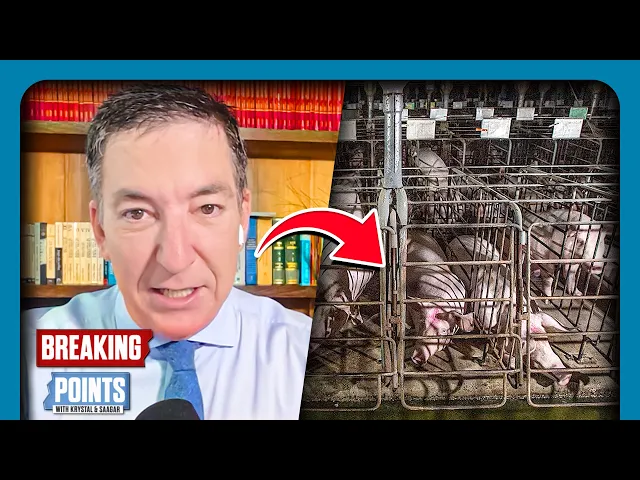
1:45 They as you were you were showed a picture of what's called a gestation crate
1:49 where the female pigs are put
1:50 into this tiny crate where they cannot turn around.
1:53 There's no space for them to turn around
1:55 and they live like that their whole life.
1:56 They're impregnated.
1:57 They have babies.
1:58 The babies are taken away from them after the minimal amount of time.
2:01 They often step on them.
2:02 They don't see them.
2:03 They go insane.
2:04 They actually start biting through the metal
2:06 cages and and losing all their teeth.
2:08 because I I have a a small farm with a bunch of farm animals.
2:12 And pigs are as intelligent as dogs,
2:15 as sentient and probably more emotionally complex.
2:18 And what they are above all else is extremely social animals.
2:21 It's just like if you put a human being in prolonged isolation,
2:24 of solitary confinement, they're going to go crazy because you've deprived
2:27 them of what they need as human beings, which is interaction with others.
2:30 Same with these pigs.
2:31 But it's done on a massive scale.
2:34 And so a lot of states and and it's
2:36 happened in Europe and elsewhere around the world have said,
2:37 "No, we're not saying you we're going to be vegan.
2:40 We're not going to stop eating meat." But there's a level
2:44 of sadism and cruelty and torture that we won't tolerate.
2:47 And these states democratically elected,
2:48 it was a referendum in California, others as well.
2:51 The Biden administration challenged it,
2:53 tried to get the Supreme Court to overturn these animal
2:55 rights uh these these animal abuse laws in California and elsewhere.
2:58 The Supreme Court upheld it.
3:00 And so now the industry is using their control over the Congress
3:04 and the Senate with their money to basically ban what voters
3:07 enacted saying we don't want in our state to consume products
3:11 that are a byproduct of the most sickening torture you could possibly imagine.
3:15 And is really all of this uh Glenn just at the behest of corporate profit.
3:19 Is that the entire drive behind the because it
3:22 doesn't see it doesn't even seem fathomable, you know,
3:24 that you could be against something like this unless I guess it's
3:28 what x more cents in order to moderately care for these animals.
3:33 Uh is that really the drive behind this entire thing?
3:37 Yeah.
3:37 Yes.
3:38 I mean, you know, farming for so long
3:40 has been based on organic and natural values.
3:43 You have freerange chickens and farm and cows and uh and and and pigs.
3:49 This is total industrialization of the process that disregards what the Bible
3:54 and religions teach is the inherent value of God created animal life.
3:58 The most majestic, one of the most majestic things we have on the planet.
4:01 It's designed to take it and completely
4:03 objectify it solely for corporate profits.
4:06 That's the only reason why they don't give pigs
4:08 a little bit more space before they're slaughtered so that they
4:11 can at least turn around and have like a minimally
4:13 decent life on their way to the slaughter house.
4:16 It is all about corporate profit.
4:18 And then they have these lobbyists and unfortunately there's
4:20 no counterveailing lobby that is for say animal welfare.
4:25 The interesting thing is that this has become genuinely bipartisan.
4:29 I think like dogs are kind of the gateway
4:31 into understanding the cruelty toward animals and there
4:34 have been now bipartisan efforts um and genuine
4:37 bipartisan movements to curb the worst of animal cruelty.
4:41 It might run into problems in the Senate, but you know,
4:43 I've watched Congress long enough to know
4:45 that you never place your bets against industry lobbyists.
4:48 They always seem to get their way.
4:49 Yeah.
4:49 And they frame it as they call it the Save Our Bacon Act.
4:53 And so they go after, you know, Americans love a bacon.
4:56 Oh, bacon's going to be too expensive if we don't,
4:58 you know, torture these pigs a little bit more.
5:00 And so I know that's the way I remember
5:02 when California was um looking to pass this legislation.
5:05 That was the way that they framed it.
5:07 the sort of fear-mongering tactics that they used um using,
5:11 you know, I mean, frankly, using the like exploitation,
5:13 desperation of the American people and their sensitivity
5:16 to prices uh against them in, you know, on behalf of of this large industry.
5:20 I also wanted to to get your reaction to we could put F4
5:23 up on the screen to the rescue of this um 1500 roughly beagles.
5:29 Um, I mean these images are just like how can
5:32 you not be moved by these adorable little dogs being,
5:35 you know, getting to go outside and run around after
5:38 being subjected to horrific conditions um and being used for tests.
5:43 Um, Glenn, give us a little bit of the backstory here
5:46 if you could about the way activists were able to um,
5:50 at great cost to themselves were able to secure this significant victory.
5:55 Yeah, you know, it's such a feel-ood story,
5:57 but it also has so many lessons for how activism can actually succeed.
6:00 I think sometimes we get jaded.
6:01 I even just said like, "Hey, I wouldn't put my money against, you know,
6:04 industry groups in Congress." But this is actually a success story,
6:07 but it's so long in the making.
6:08 The first time I wrote about Ridgand Farm was 2017 or 18.
6:12 And the only reason I knew was
6:13 because there were these activists kind of working,
6:15 you know, on the fringes about an issue that hadn't gotten much attention.
6:20 And if you looked at what happened with Ridgeland Farms,
6:22 they they breed dogs into the world purpose purposely beagles
6:26 because it's a very docil loving trusting breed of dogs.
6:29 That's purposely the the what they want in their labs.
6:32 And they sell them for these absolutely sadistic,
6:36 gratuitous experiments to research facilities or corporations
6:40 where that are funded by the US government.
6:42 And while they're bred, they're kept in these metal cages.
6:46 These just completely overcrowded metal cages.
6:49 They never see the light of day.
6:50 These dogs that just got released, it's the first time they went outside.
6:54 It's the first time they they were actually on ground.
6:56 They had spent their whole lives in metal cages.
6:59 And these activists, you know, there's Wayne Wayne Sun who's with the uh DXA,
7:03 the direct action uh everywhere uh group that does civil disobedience.
7:07 They're the ones who rescued those pigs that I mentioned uh before.
7:10 They have been working to get Gridland Farms closed.
7:13 And what finally enabled them to do it was that there's
7:15 been these bipartisan groups like White Coats Waist that have said,
7:18 "Hey, conservatives, you don't want your government money funding hideous animal
7:23 experimentation that have said to the left, you love animals.
7:26 You want to protect animals." And it kind of became this bipartisan movement
7:29 because they weren't picky or ideologically
7:32 pure about who their allies would be.
7:34 They just wanted to this to shut this facility.
7:36 And finally, it's getting shut.
7:38 It's saving thousands of these beagles who would
7:40 have been destined for the most horrific animal experimentation
7:44 and then they breed them into the world
7:46 just for experimentation and then they kill them after.
7:48 So that's their whole lives.
7:49 Ridgand is finally being shut down but it's still
7:51 a massive industry of dog experimentation that this kind
7:55 of symbolizes how to do successful activism both
7:58 in this area and I think more broadly.
8:00 Yeah.
8:00 And you know this just to make it bigger than
8:03 uh animal welfare because that's a key component of this.
8:06 This fits with generally if I think if you were to ask RFK Jr.
8:10 of 2 years ago, maybe 3 years ago,
8:12 he would have been vehemently opposed to things like this.
8:14 It fits also with some of the betrayals from the Trump administration
8:17 on the Maha movement of glyphosate
8:19 and of the prioritization of corporate profit,
8:22 let's say here in terms of pigs and animal welfare.
8:25 But generally, one of the more inspiring parts, you know,
8:28 you would think originally of MA was like,
8:30 okay, let's actually take our environment seriously.
8:33 what we put into our body, it's not just good for us,
8:35 but also in terms of regenerative agriculture.
8:38 Like many of these things have just not come to pass.
8:41 Not only not come to pass,
8:42 but have been outright rejected by this administration, Glenn.
8:45 And I know I'm just curious, you know, what you what you make of that.
8:48 Uh but at the same time,
8:50 I do think there's more heightened awareness because of the work
8:52 that you've done activists and and others on these things.
8:55 I'm just, you know, curious how you're thinking about it.
8:58 I mean, if you enter these facilities, which I have done,
9:00 you'll obviously be shocked by the animal cruelty,
9:02 but it's also physically repulsive, like the smell,
9:06 the conditions of these animals that then are fed into people's bodies.
9:10 They use massive amounts of antibiotics just to kind of mass treat
9:14 these these animals to prevent them from dying before they can sell them.
9:17 And these this mass use of antibiotics has a very high risk
9:21 of creating antibioticresistant infections that can be
9:24 a gigantic threat to the human species.
9:26 They dump this waste, this disgusting, repulsive.
9:29 These conditions go into poor neighborhoods where they just dump enormous
9:34 amounts of waste without any real studies of what the impact is.
9:37 There's all kinds of psychological effects on the workers
9:40 who are required to just slaughter and devalue human life.
9:44 They come out with all kinds of trauma, all kinds of psychological issues.
9:47 It's a multilevel sickness that this industry is producing.
9:51 But of course the problem again is you know our Congress
9:54 operates based solely on money and they are a very well-funded group.
10:00 If I could just quickly tell you like just one
10:02 short antidote which is in places like Montana and Idaho which
10:05 typically have a kind of libertarian free market ideology like
10:10 you can do what you want the government shouldn't tell you.
10:12 They just passed bills that ban lab grown meat,
10:16 which was the alternative for people who still want
10:17 to eat meat but don't want to consume animal products.
10:20 And the the re, in other words,
10:23 people who want to buy alternatives to factory farm meat are
10:26 now banned from doing so because these industries are p so powerful
10:30 that they got the legislators and the governors to ban their competitors
10:34 even though these are free market states of consumer choice and the like.
10:37 That's the level of power that we're talking about.
10:40 Incredible stuff.
10:41 Um, Glenn, thank you so much.
10:42 Thanks for breaking down all of these issues for us.
10:44 We really appreciate it.
10:44 It's great to see you.
10:45 Happy with you guys.
10:46 Thanks.
10:46 Talk to you soon.
10:48 Thank you guys so much for watching.
10:49 We appreciate it.
10:50 Friday show for everybody tomorrow.
10:51 See you then.
10:52 Hey, if you like that video, hit the like button or leave a comment below.
10:55 It really helps get the show to more people.
10:57 And if you'd like to get the full show,
10:59 ad free and in your inbox every morning, you can sign up at breakingpoints.com.
11:03 That's right.
11:04 Get the full show.
11:04 Help support the future of independent media at breakingpoints.com.