Is AI Hindering Your Learning?
Study Hall
0:00 Look, I know why you're all here.
0:02 You want to know once and for all if using AI in college is good or bad.
0:07 Because depending on who you talk to, AI
0:10 is destroying the age-old institution of higher education.
0:14 Or single-handedly hauling it back out of the grave.
0:18 It's ruining our critical thinking skills.
0:21 Or making us into better writers.
0:23 Or causing an epidemic of plagiarism.
0:27 Or making learning more accessible than ever before.
0:30 In other words, it's confusing.
0:33 But if there's one thing Study Hall's good for, it's
0:35 helping you wade through the confusing parts of college.
0:38 Hi, I'm Erica Brozovsky and here's what you
0:40 need to know about using AI in college.
0:45 [music] Okay, first things first.
0:53 When we talk about using AI in college, there's a lot to talk about.
0:59 We've got educational concerns, ethical concerns, environmental concerns.
1:04 And we'll get to those things.
1:05 But before we do, let's make sure we've got
1:08 a handle on the actual technology and terminology of AI.
1:11 Because AI is a really broad and kind of misleading term.
1:16 It refers to any technology that allows
1:18 computers to do human-like things like learning,
1:21 problem-solving, creating, and making decisions.
1:24 So, AI includes everything from the algorithm that showed
1:27 you this video to the app that predicts your weather,
1:30 to the video generator that made those weird Christmas Coca-Cola ads,
1:34 to the merciless robot overlords that will one day overtake us.
1:38 Kidding about that last one, hopefully.
1:40 What people are mostly worried about when it
1:42 comes to AI in higher education is generative AI, a kind of deep learning model
1:47 that can produce complex content like images, articles,
1:51 sounds, videos, books, and those emails you keep getting from the new HR guy.
1:55 They're worried about it because a lot of people
1:58 are using AI in a lot of ways in college.
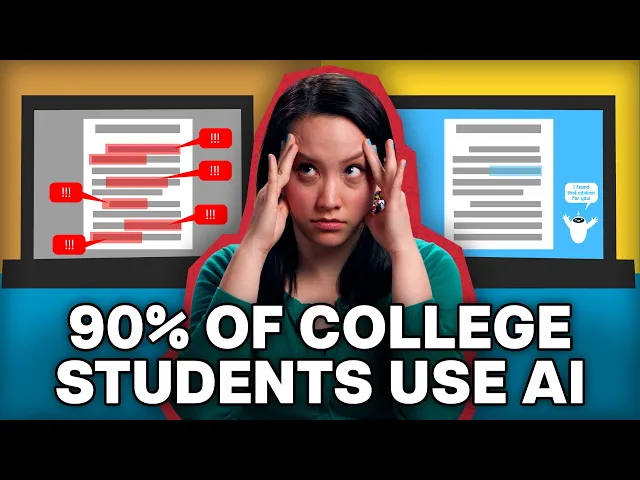
2:01 In fact, recent surveys show that around 90%
2:05 of students in the US have used AI for school.
2:08 But exactly how and how much they're using it varies widely.
2:12 Some have used it once, while others are using it weekly.
2:15 Some use it to check their spelling and grammar before turning in assignments,
2:18 and some use it to create study guides or homework plans.
2:21 Some ask for help summarizing long readings
2:23 or searching for information or simplifying complex ideas.
2:27 Some use it to generate research topics and ideas for papers.
2:31 And some are using it to write their papers,
2:33 answer their discussion questions, and even do their math homework.
2:36 It's not just students, either.
2:38 In 2024, about 61% of college professors were
2:41 using AI to do stuff like design curricula,
2:44 come up with new teaching strategies, grade assignments,
2:47 and scan your paper to determine whether you're using AI.
2:51 Whether any of that is actually helpful is up for debate.
2:55 For one thing, AI isn't designed to give you the right answers.
2:59 It's designed to give you answers that sound right.
3:01 See, asking ChatGPT to explain the connection between photosynthesis and Earth's
3:06 atmosphere isn't really the same as asking your college professor.
3:10 It's more like asking your gossipy cousin,
3:13 who heard it from an Instagram post, who heard it from Wikipedia,
3:16 who heard it from National Geographic,
3:18 who heard it from a textbook one time, probably.
3:21 That's because ChatGPT and other models like Gemini, Claude,
3:25 and Grok are what's called large language models or LLMs,
3:29 which means they're really good at generating natural,
3:32 smart-sounding answers to all kinds of different questions.
3:36 LLMs learn to do that by training
3:38 their artificial neural networks on tons of written data,
3:41 from academic papers to Wikipedia pages to fantasy novels to social media posts.
3:47 And they use that training to predict
3:49 how someone might answer the question you asked.
3:51 Lots of times they do give the right answers, but not always.
3:57 They're surprisingly fragile in stuff like math, science, and logic.
4:01 And lots of the writing LLMs train on contain bias like racism and sexism,
4:06 which means their answers can contain that bias, too.
4:09 Ultimately, LLMs can identify how words go together,
4:12 what concepts go with other concepts,
4:14 and what kinds of answers go with what kinds of questions.
4:17 But that's not the same thing as actually knowing the answer.
4:21 LLMs aren't knowledge databases or even search engines.
4:24 They're predictive text generators that spit out words based
4:27 on what statistically is most likely to come next.
4:30 In other words, they're kind of like sophisticated language calculators.
4:33 And so far, the evidence around how AI impacts learning is mixed.
4:39 A range of studies published in 2023 and 2024 have come up
4:42 with a variety of conclusions about the role of AI in learning.
4:45 Like some studies have found that ChatGPT actually makes a pretty good tutor,
4:50 letting you break down concepts, ask follow-up questions,
4:53 and dig deeper into any topic whenever you want.
4:56 Which is great if you're pulling an all-nighter and trying to finish
4:58 assignments when the library is closed and your professor is asleep.
5:01 Other studies show that getting AI feedback
5:03 on your writing might help strengthen your writing skills.
5:06 And then AI might be especially helpful
5:07 for college students with a variety of accessibility needs.
5:10 Some AI models can read text out loud,
5:13 transcribe audio in real time, generate descriptions of images,
5:16 and translate between languages,
5:18 which can make higher education way more approachable for more people.
5:21 There are even AI models designed to help students build
5:23 the social and cognitive skills they need to succeed in college.
5:27 On the other hand, relying too much on AI can
5:31 make you feel more distant from your professors and your classmates.
5:34 And those relationships can be really important for learning.
5:37 Studies also show that college students can use AI as a replacement
5:41 for higher-order cognitive skills like analyzing
5:44 others' ideas and creating your own.
5:46 Using AI to get answers or complete assignments without really understanding
5:50 them can keep you from actually absorbing and retaining the material.
5:53 And it can stop you from building
5:54 important skills like problem-solving and critical thinking.
5:57 So, all of that means that generative AI might be helpful,
6:01 especially for making certain tasks and information more accessible.
6:04 But if you're not actually engaging with the material
6:07 or reflecting on the answers AI is helping you find,
6:10 you might not actually be building helpful skills or learning much at all.
6:14 And that's true no matter what tools you're using to get through courses.
6:18 Okay, here's another way to think of it.
6:20 Say you join a gym and get a trainer.
6:23 But then, instead of learning how to do the exercises,
6:25 you just watch your trainer do them.
6:27 Sure, the exercises are done,
6:29 but you didn't gain any muscle or coordination because you didn't do the work.
6:34 Same goes for academics.
6:36 If you use AI to do your homework, the homework will get done,
6:40 but you haven't necessarily developed your mental
6:42 muscles or built your skills in research,
6:44 making connections, or communicating your ideas.
6:48 If you skip out on the work, you're skipping out on the results of that work.
6:52 And it's not just you who loses out.
6:54 Using AI comes with ethical considerations and consequences that can
6:58 affect you and people in places around the world.
7:01 For one thing, using AI might be considered academic misconduct,
7:06 which depending on your school's policies can mean you fail
7:08 the assignment or the class or even get kicked out of school.
7:12 But using AI can also be really disrespectful to the people who did do the work.
7:17 Now, the legal and institutional lines around who owns AI-generated
7:22 content are super murky and will probably keep on evolving.
7:26 But if you use AI to do work that you pass off as your own,
7:29 you're committing plagiarism.
7:31 See, like you, ChatGPT didn't write that paper all on its own.
7:36 And even if you're not using generative AI to write your whole paper,
7:39 any help you get from AI used data from tons and tons of articles,
7:43 studies, and books that were written by people.
7:47 People who usually have no idea that their work is being used
7:50 to train language models and no way to stop it even if they did.
7:53 LLMs are also notoriously bad at citing their sources.
7:57 So, even if they try not to plagiarize, they'll probably do it anyway.
8:01 Or just totally make stuff up and reference
8:03 books and journals that don't even exist.
8:05 So, along with the consequences to your grade and academic career,
8:09 when you use AI and pass off others' work as your own,
8:13 you risk misinterpreting results,
8:15 obscuring where the information came from, and spreading misinformation.
8:18 To be clear, that's bad.
8:20 On top of all of that are the environmental concerns.
8:23 AI produces electronic waste full of stuff like mercury and lead.
8:28 And the data centers that power AI models use tons of electricity and water.
8:32 Asking ChatGPT a question takes 10 times
8:35 the amount of energy as a standard Google search.
8:38 And according to one estimate,
8:39 AI-related infrastructure around the world could soon consume four to six
8:44 times the amount of water as the entire country of Denmark.
8:47 Meanwhile, we live in a world where
8:49 a quarter of humanity lacks access to clean water.
8:52 All those ethical quandaries have made lots
8:55 of people eager to get some regulations on AI.
8:57 And colleges are no exception.
9:00 Higher education has reached a huge moment of reckoning with AI.
9:03 Like you, they're asking a lot of questions about using AI in college.
9:08 Like should students be allowed to use it?
9:10 When?
9:11 How much?
9:12 Could they even stop you if they tried?
9:14 And so far, they haven't really come up with much consensus.
9:17 Usually, policies about AI use are left up to professors.
9:21 So, even different classes at the same school might have different policies.
9:24 Some say you can use generative AI however you want.
9:28 Some say you can't use it at all.
9:30 Most seem to fall somewhere in the middle,
9:32 saying you can use it with some considerations and restrictions
9:35 to try to keep it helpful and ethical and, you know,
9:38 avoid possibly failing the course.
9:40 Which brings us back to where we started, confusion.
9:44 Unfortunately, it's hard to say once and for all if
9:47 using AI is good or bad or, I don't know, some secret third thing.
9:52 AI has some really interesting potential benefits, but it also comes with risks.
9:57 Not to mention, if you're using ChatGPT to write
10:00 your paper and your professor's using ChatGPT to grade it,
10:03 well, then what are we even doing here?
10:05 AI is complex and it's changing by the day.
10:09 So, we don't even really have the whole picture yet of what it means
10:12 for you or the future of higher education or the state of the world.
10:16 As AI continues to develop,
10:19 the impacts and costs might change and so will the way we think about them.
10:23 So, for now, the question for college students, professors,
10:26 and really everyone to wrestle with isn't just is AI good or bad?
10:31 Instead, there's a range of questions we can ask now and in the future
10:35 to help us figure out when and how to use AI.
10:38 What do I think college is for?
10:39 And what do I want to get out of my education?
10:42 Is using AI building my thinking or replacing it?
10:45 What do I value?
10:46 And how do I want to interact with technology in the world around me?
10:49 And finally, how does using AI right now affect me,
10:53 other people, or the planet in the future?
10:55 Because ultimately, what we do now and what we choose to learn
10:59 is part of that question we've been wrestling with pretty much forever.
11:03 What does it mean to be human?
11:05 If you're currently in or thinking about going to college,
11:09 go to gostudyhall.com for more student resources
11:11 and check out our $25 college courses.
11:13 Thanks for watching.
11:14 See you next time.