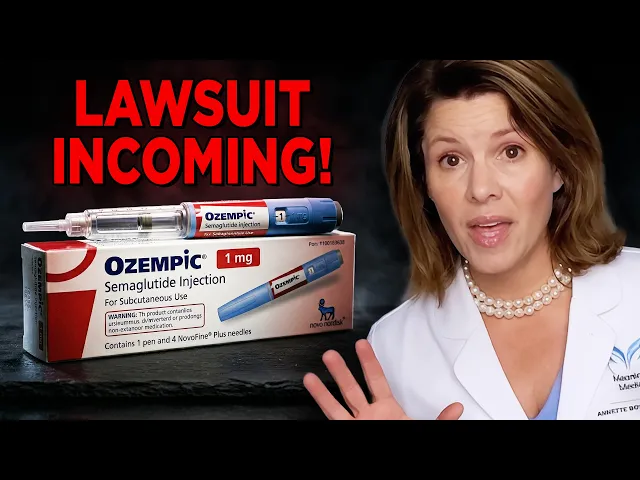
I'm BLOWING THE WHISTLE on Ozempic
Dr. Boz [Annette Bosworth, MD]
0:00 Were you or a loved one harmed by Ompic?
0:02 Get used to hearing those words because class
0:05 action lawsuits are going to be filed any day.
0:08 I'm a doctor and the way some
0:09 of my colleagues are prescribing these drugs scares me.
0:12 In the same way Oxycontton started an opioid epidemic,
0:16 Ompic is starting an epidemic of skinny fat
0:20 people with a metabolic disaster happening inside their body.
0:24 And many, especially older people,
0:26 will not recover from the damage caused by these drugs.
0:30 In this video, I'm going to break down once
0:32 and for all how Ompic and other GLP-1 agonist drugs work,
0:37 the real cost of rapid weight loss when using GLP-1s,
0:40 the only condition where I'd prescribe GLP-1s,
0:43 and how I minimize the risks associated with the drug.
0:47 Starting with how does it work.
0:49 To understand why this drug is dangerous in the wrong hands,
0:53 you have to understand that it's not just a weight loss shot.
0:56 It is a hormone.
0:58 You are injecting a hormone that manipulates the deepest signals in your body.
1:03 These drugs known as GLP-1 agonist didn't start as weight loss miracles.
1:08 They have a history.
1:09 We first started writing prescriptions for a drug called Biata back in 2013.
1:15 It was a diabetes medication intended to manipulate
1:18 how the body sensed fullness and how insulin worked.
1:22 Back then, it didn't cause massive weight loss.
1:25 Maybe one in 20 of my patients would lose weight.
1:28 Fast forward to today and we have drugs
1:30 like ompic called semiglutide or monero called trzepatide.
1:34 These drugs are much more potent.
1:37 Ompic mimics the hormone called GLP-1
1:40 that your body naturally produces in your gut.
1:42 And Mangerro takes it a step further by also mimicking GIP.
1:47 First, they scream at your pancreas to stop releasing
1:51 glucagon and to start increasing a bit more insulin.
1:54 Both of these lower your blood sugar, and that's great if you're a diabetic.
1:58 But the second thing it does is paralyze your gut.
2:02 Yeah, it slows down that gastric emptying,
2:04 so food sits in your stomach longer, making you feel full.
2:08 Third, and this is the big one, they hijack your brain,
2:12 they act on satiety centers in your brain to kill your appetite
2:16 and turn off that reward signal that you get from food.
2:19 It sounds like the perfect solution, right?
2:22 You don't want to eat, so you lose weight.
2:24 But there are hidden costs to the mechanism that nobody's talking about.
2:28 When you force a body to stop eating through chemical starvation,
2:33 but you don't fix the underlying metabolic brokenness,
2:36 you're creating a disaster.
2:38 Second, we have the real cost of rapid weight loss.
2:42 All right, the headlines have been screaming about the pounds dropping off,
2:45 but they don't tell you what kind of weight is being lost.
2:49 When you starve a body that is insulin resistant,
2:52 and make no mistake, if you are overweight, you are insulin resistant.
2:57 Your body is in crisis.
2:59 When you take a drug that forces you into a severe calorie deficit,
3:04 your body has to find energy somewhere.
3:06 If your insulin is high,
3:08 your body cannot easily access your fat stores where there's lots of energy.
3:13 That high insulin locks the doors to your fat cells.
3:16 So, if you aren't eating and you can't get to the fat,
3:21 where does your body get the fuel from?
3:23 Well, it burns your furniture to heat the house.
3:26 Yes, it burns your muscle.
3:28 Data shows that when people take these drugs without a specific intervention,
3:32 roughly onethird of the weight they lose is lean mass.
3:37 That's your muscle or your bone density.
3:39 In some cases, you can have about 50/50 split with fat and muscle loss.
3:45 But this is catastrophic.
3:46 That is not good.
3:47 By now, you've seen patients who develop ompic face,
3:51 which is really just facial muscle wasting.
3:54 It's a sign of what's happening all over the body.
3:58 They are becoming skinny fat.
4:00 They weigh less on the scale,
4:02 but their metabolic rate has crashed because they are
4:05 cannibalizing the very muscle tissue that drives their metabolism.
4:09 For my older patients, this is a death sentence.
4:12 Sarcopenia, the other word for muscle wasting,
4:14 is one of the leading causes of frailty and death in the elderly.
4:18 If you are 60 years old and you rapidly lose
4:22 15 pounds of muscle to drop 15 pounds of fat,
4:26 you might never get that muscle tissue back
4:28 and you've just accelerated your aging process by a decade.
4:32 And the tragedy is many people take these drugs and don't even lose the weight.
4:38 Let me tell you about a patient named Rebecca.
4:40 Her story perfectly illustrates why prescribing
4:43 this drug without fixing the metabolism is malpractice.
4:47 Rebecca had struggled with her weight for decades.
4:49 She had tried everything.
4:51 She had even had a lap band surgery years ago,
4:54 which mechanically restricted her food intake.
4:57 She lost some weight, but her insulin resistance smoldered in the background.
5:02 Eventually, she had to have that band removed
5:04 and the weight came back with a vengeance.
5:07 Desperate, she went to her doctor who prescribed
5:10 her OMIC and she injected this drug for 12 weeks.
5:14 She did exactly what she was told.
5:16 And do you know how much weight she lost?
5:18 Yeah.
5:18 A big goose egg.
5:19 Zero.
5:20 Not a single pound.
5:22 How is it possible?
5:23 How can you take the strongest weight loss drug on the market,
5:27 a hormone that manipulates the things we've talked about, and not lose weight?
5:31 Well, it's because of another hormone, insulin.
5:34 Rebecca's body was producing massive amounts of insulin,
5:37 a problem that started back when she was a teenager.
5:41 Insulin is the storage hormone.
5:43 It tells your body to store energy and not burn it.
5:46 Even though Ompic was screaming at her brain to stop eating,
5:50 her insulin levels were so high that her body refused to let go
5:55 of any of the fat and the drug could not overpower her endocrine error.
5:59 In fact, the drug stimulates the pancreas to make a little more insulin.
6:04 This stimulus is a risk that we are willing to take with a type 2 diabetic.
6:09 Their insulin is not working right.
6:10 But for someone like Rebecca,
6:12 who is already swimming in a sea of excess insulin,
6:15 adding the drug that squeezes the pancreas
6:18 harder is like throwing gasoline on the fire.
6:20 She didn't need more beta cell stimulation to make insulin.
6:24 She needed to lower her insulin.
6:26 And this is the epidemic that I'm worried about.
6:29 Patients like Rebecca are being prescribed a drug that costs a fortune,
6:33 risks their muscle mass, and doesn't even work because the doctor
6:37 skipped the root cause, insulin resistance.
6:40 So, do I hate these drugs?
6:42 No.
6:43 I actually think they can be a powerful tool,
6:46 but if and only if the patient earns the right to use them.
6:51 Yeah, I have a rule.
6:53 You must have a bed of ketones in your chemistry before you add this hormone.
6:58 You cannot take a metabolic shortcut.
7:01 If you're burning glucose or sugar for fuel and you add ozic,
7:06 you're starving the sugar burner.
7:08 Like that's misery.
7:10 This is where the nausea and the fatigue and the muscle loss come from.
7:14 But if you transition your body to burn fat for fuel first,
7:18 if you get into ketosis, you change the game.
7:22 Ketones are a clean fuel for your brain.
7:25 They also protect your muscles and they lower the inflammation.
7:29 I have another patient named Ian.
7:31 He's nearly 70 years old and has been insulin resistant for at least 60 years.
7:36 But unlike the typical patient,
7:38 Ian spent a year learning how to eat a ketogenic diet.
7:42 He learned how to lower his carbohydrates,
7:44 shorten his eating window, and get his body to produce ketones.
7:48 When we looked at Ian's numbers,
7:50 the blood sugars were stable, but he had hit a plateau.
7:54 Now, he had done the work.
7:55 He was metabolically flexible, using either fat or glucose,
7:59 and switching between the two.
8:01 This is when we added a low dose of GLP-1 agonist and the results were striking.
8:08 Because his body had already been fueled by ketones,
8:12 the drug didn't make him sick.
8:14 And again, we were using a very tiny dose.
8:17 It didn't eat his muscles.
8:19 Instead, it acted like a turbocharger for his fat loss.
8:24 I call it it put the fat forward.
8:26 It also quieted the food noise in his brain,
8:29 allowing him to fast a little longer and deeper,
8:32 which naturally lowered his insulin even further.
8:35 If you're going to use these drugs, or if you're currently on them,
8:40 you need to follow a protocol that protects
8:43 your body from the skinny fat disaster.
8:45 First, you got to check your numbers.
8:48 You need to know what your Dr.
8:49 Bos ratio is.
8:51 This is your glucose divided by your ketones.
8:54 And if your ratio is above 100, you are high risk for insulin resistance.
8:58 You're in storage mode.
9:00 You need to get that ratio under 80 and ideally under 40 to be
9:04 in the true fat burning state where your body
9:08 will harvest the fat instead of the muscle.
9:11 Second, you must prioritize protein.
9:14 The current data is clear.
9:15 If you do not eat enough protein and if
9:17 you don't do resistance training while on these drugs, you will lose muscle.
9:22 You need to be eating two solid ketogenic meals
9:25 a day to signal your body that it is not starving.
9:29 The third one is stop grazing.
9:31 This is the worst thing that I see people do while on ompic.
9:35 They eat small amounts of meals,
9:37 especially high in carbohydrates, and that keeps that insulin high,
9:41 dripping into their system and preventing
9:43 them from ever accessing the fat stores.
9:45 Rebecca, our patient we mentioned earlier, finally started to lose weight.
9:50 Not when she took the drug alone,
9:52 but when she switched to the sardine challenge and she
9:54 shortened her eating window to just a few hours a day.
9:57 If you want to know the rules for that sardine challenge, click here.
10:00 I will see you in the next video.