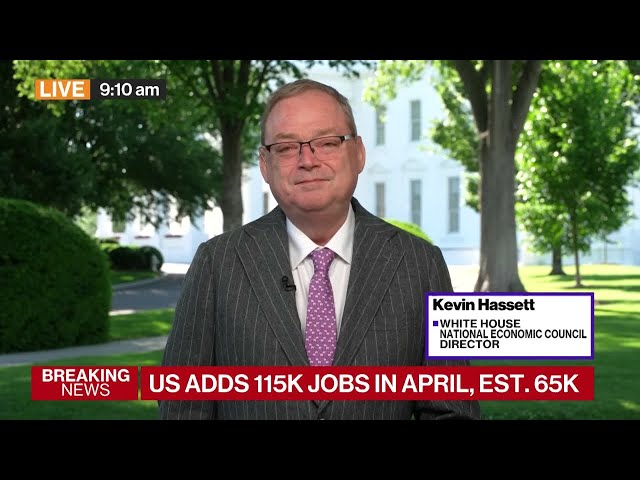
NEC Director Kevin Hassett Touts 'Rip-Roaring' Jobs Market
Bloomberg Podcasts
0:00 And we saw U.S.
0:01 jobs jumping 115,000 in April.
0:03 It beats estimates, marking the first back to back gain in nearly a year.
0:07 Joining us now, I'm pleased to say, is the white House director
0:09 of Economic National Economic Council, Kevin Hassett.
0:12 Director Hassett, thank you so much for joining.
0:15 A strong jobs number a beat.
0:16 Let me just get your initial reaction right.
0:18 Well you know two months in a row now we've had blockbuster jobs numbers.
0:22 And the really interesting thing is that we look
0:24 at these things that you guys do to I'm sure called heatmaps,
0:26 where you look by category, like where's the green and where's the red.
0:30 And pretty much it was green across the board.
0:32 And so what it means is it's a rip roaring jobs market.
0:36 And it's completely consistent with what we saw
0:37 with the claims data just a few days ago.
0:40 Right.
0:40 Like initial claims for unemployment insurance right now are the lowest since
0:44 we've ever been counting them all the way back to the 1960s.
0:47 And so the job market is really, really, really strong.
0:51 Um, Kevin, part of the issue, though,
0:53 that people would like to focus on is the fact that the jobs creation is narrow.
0:57 It's an issues like health care.
0:59 Meanwhile, we saw financial jobs down, tech jobs down.
1:02 These are exactly the type of categories you would expect
1:05 if I is having an impact on jobs in this economy.
1:09 Is there a plan from this administration to combat job loss over ISE impact?
1:14 Who are right now what we're seeing is the eye is creating job creation.
1:18 So there are a couple of new studies out
1:20 at the National Bureau of Economic Research that show,
1:22 and one at Stanford University that show that I adjacent jobs
1:26 and I adjacent professions are actually increasing faster than everywhere else.
1:31 But of course, in the medium to long term,
1:33 people are right to be concerned about what my I mean for them.
1:37 But right now, the very,
1:38 very best thing that you could do in order to protect yourself and protect
1:41 your career is start to use AI tools yourself to make yourself more productive.
1:45 And that's what we're seeing in the data.
1:47 I guess, Kevin, will there be a point
1:50 where the white House needs to address this?
1:52 I've talked to many, many people who say that 2028,
1:55 the election will be centered around AI
1:57 and what politicians are saying about it.
1:59 You already seeing hints of it in 2026.
2:01 Does there need to be a clear plan going forward
2:04 if there are huge economic consequences of what AI does.
2:08 Oh, absolutely.
2:09 It's something that's being very, very careful.
2:11 Study carefully studied by all of government.
2:14 Uh, we've got five, uh, different, uh,
2:17 work plans, uh, depending on which direction we're going,
2:20 what topic it is, whether it's AI of the workforce, AI security and so on.
2:24 And these have been underway since President Trump took office.
2:27 Really?
2:27 And so, absolutely, uh,
2:28 we are working through policy options as we watch the data evolve.
2:32 But right now, we're starting to see the AI
2:35 adjacent jobs are the ones that are growing the fastest.
2:38 So the story the AI is destroying people's
2:40 jobs right now is not anywhere in the data.
2:43 But we could imagine.
2:44 We could imagine things, especially once robots get better and better.
2:47 Uh, the then we're going to have to have, you know,
2:50 more policies to help people, you know, reskill and so on.
2:54 So in the meantime, as you say, the figures are strong for this jobs market.
2:59 Doesn't that essentially kill any hopes of a rate cut this year?
3:03 Uh, you know, for for me, I think that when we have a strong supply side
3:07 shock then that means that there's downward pressure on inflation.
3:11 And that's what we're seeing.
3:12 And in fact, uh, even with the oil prices going up,
3:15 excuse me for the big truck running,
3:17 uh, even with even with the oil prices going up,
3:20 you saw core inflation remain stable.
3:22 And you can even see that in the wage data today.
3:25 Jobs report where there there's strong wage growth,
3:27 but not anything that was a sign of kind of runaway
3:30 Phillips curve inflation that should make the fed want to lift rates.
3:34 Well I suppose Kevin,
3:35 last time you were on the show last Friday after the CPI report,
3:38 you mentioned that you were looking forward to a Warsh Fed
3:41 chair because of the independence it would bring to the fed.
3:44 Since then, we've learned more about the dissents coming from the FOMC
3:47 that one of the language of the statement changed to take out any bias,
3:52 any sort of easing bias.
3:53 It was three dissents you can make that for if you have.
3:56 Susan Collins adding as she spoke to Bloomberg,
3:58 saying that she agreed with that idea.
4:00 Do you think that this is an FOMC, at least those four members that are gearing
4:04 up to push back against a Warsh fed chair?
4:08 Well, I can tell you.
4:09 You speak specifically about Susan Collins.
4:11 I've known her since graduate school.
4:13 She's an A+ economist who goes where the evidence leads.
4:17 Uh, disappointed that these people made the decision that they did.
4:21 But I'm sure that when Kevin works as fed chair,
4:24 that he'll have lots of people that will
4:26 be open to argument and open to evidence.
4:29 He's a very persuasive guy.
4:31 I think, uh, Kevin believes, as I do,
4:33 that a supply shock is a time when you don't
4:35 have to lift rates just because you have high growth.
4:38 And I think that he'll bring lots
4:39 of evidence to bear and convince his colleagues.
4:41 So I think we're really likely to see rate
4:43 cuts this year because of Kevin worse elsewhere director.
4:46 Last night, the Court of International
4:49 Trade once again declared unlawful president's tariffs.
4:51 This time the 122 duties on imports.
4:55 When does the administration plan to appeal this?
4:58 Well, you know, I think that we're studying all our options right now.
5:01 And Jameson Greer will have a message on that probably later today.
5:03 Are there are there any mechanisms in mind to keep
5:06 those tariffs in place or any other stopgap measures?
5:08 I'm going to leave that to the trade lawyers for you.
5:11 Okay, fine.
5:12 I guess there is this bigger question then,
5:13 if we're going to leave that part to the trade lawyers.
5:16 But the economic talks with China, then,
5:18 does this put the white House at a disadvantage,
5:21 as the president goes to have those discussions with XI next week?
5:25 You know, I don't think so.
5:27 First of all, the that this affects, you know,
5:29 one corner of the trade, uh, policy, uh,
5:31 the strategy really is to finalize the deals
5:34 that we have negotiated over the last year with, uh, 300 tons and 230 twos,
5:39 two authorities that are basically ironclad in the courts.
5:42 And so the job has always been for Jamison Greer to get ready to sort of, uh,
5:48 finalize the deals with these much stronger authorities.
5:51 We believe the IP authority that we originally used
5:54 was a solid authority and disagree with the court's decision,
5:57 uh, that is forcing us to refund the tariffs.
6:00 But we have a backup plan that is going to make sure
6:03 that the president's trade policy is made a reality very, very shortly.
6:07 Okay.
6:08 So backup plan.
6:09 My we expect to hear something today.
6:11 Director Hassett, this is from Jamison Greer.
6:14 Yes.
6:15 Uh, you have to talk to him.
6:17 Okay, okay.
6:17 Fair enough.
6:18 I spoke with him yesterday about it.
6:20 Okay.
6:20 I know it is.
6:21 It is fresh news.
6:22 But again, to your point, the white House always looking for alternatives.
6:25 Um, what about when it comes to the Europeans?
6:28 The president sent this July 4th deadline to reach some sort of agreement.
6:32 Does this also complicate things?
6:33 Well, I don't know if it complicates things.
6:35 We've got lots of, uh, agreements with the Europeans,
6:38 and they haven't really kept up their end of the bargain.
6:40 And that has the president pretty frustrated.
6:42 But my expectation is by the 4th of July that they will.
6:45 And then we'll have these this pro-American, uh, pro worker, uh,
6:49 trade deal with Europe that has already been negotiated and agreed to.
6:54 Um, Doctor Hassett, before I let you go.
6:56 There's been this outstanding question of the debt piles in the United States
7:00 and what that means going forward and the need to service that debt.
7:03 Um, we heard from Dublin's Jeffrey Gundlach speaking to Bloomberg TV,
7:06 saying that he was positioning for a world
7:08 in which the government unilaterally lowers coupons on existing U.S.
7:13 debt in order to manage those internal costs.
7:15 I just wonder what you think of that.
7:17 Might that be the direction that we head?
7:21 There's not a chance in a million years that this administration would
7:25 ever do anything that looks in any way like a debt default.
7:28 We believe in the strong dollar and we believe in a strong fiscal,
7:34 responsible government.
7:34 And so that's why we reduce the deficit
7:36 last year by hundreds of billions of dollars.
7:39 We reduce federal employment by the most it's ever been reduced.
7:42 Actually, there are fewer federal employees right now in the US
7:45 than there have been in any year since World War two.
7:48 That's the kind of fiscal responsibility that lifts confidence in the debt.
7:52 And, uh, you know, we're not done yet.
7:54 Again, with the growth that we're seeing,
7:55 the growth that was echoed in the reports, uh, today and last month.
8:00 You know, we absolutely are seeing the kind of growth you need,
8:02 as you had in the 90s, uh, to get the deficit under control.
8:05 And that's our plan.
8:06 So, of course, no way to do debt default.
8:07 But might you look at restructuring it again in this way?
8:10 Maybe lowering the coupon, something like that.
8:13 Uh, there's absolutely nothing, uh,
8:15 that we're going to do other than be fiscally responsible.