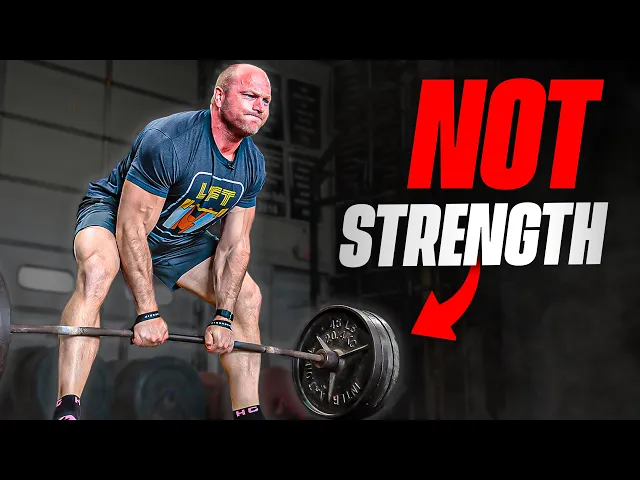
Most Men Over 40 Train the WRONG Way (Do This Instead!)
Garage Strength
0:00 Pretend that you're 55, 60 years old and you're walking down the street
0:04 and you trip on maybe you're in the sidewalk.
0:06 You trip on something that's on the sidewalk.
0:08 If you're faster, okay, you will have a stumble reflex that can react quicker.
0:14 It reacts quicker and you can brace your fall.
0:16 If you have things like flexibility and balance and you
0:20 have that relative that high degree of relative power,
0:23 you can brace yourself and you can absorb the fall.
0:26 We're going to go into groundbreaking concept around
0:29 longevity training and we're going to start right now.
0:33 So, we're diving deep into some serious research around longevity training.
0:36 And I want to cover a couple different factors here.
0:38 If we're looking at the classic metrics
0:42 that have been used for longevity training,
0:43 typically it's been looking at things like, you know, even V2 max, okay?
0:48 What's your aerobic capacity?
0:50 What's your peak oxygen consumption?
0:53 Okay, those are some real key things
0:55 that people look at with longevity training.
0:57 Another factor recently that's come to light is,
1:00 okay, let's look at grip strength.
1:02 Okay, and some of the issues that people have around looking at grip strength
1:05 is like if you're just hanging off of a bar or you're using a dynamometer,
1:10 it doesn't necessarily mean if you train grip, okay,
1:14 if I train just my grip and it gets really really strong,
1:16 that means I'm going to outlive everybody else.
1:18 really grip training is a proxy for how strong I am.
1:22 So, there's some interesting things happening right now in research
1:25 when we're looking at different facets that can predict mortality.
1:30 So, I'm going to go into some key things right off the bat around background.
1:33 We want to go into some key terms and definitions real quick.
1:37 Then, we're going to talk about
1:38 things specifically like muscle power, muscle strength.
1:42 We're going to talk through that.
1:43 Then, we're going to go into what the actual research says.
1:46 and then we're going to provide a baseline or a practical
1:49 way to apply this knowledge for you guys specifically.
1:53 Okay.
1:54 So, one of the big factors that I think we can all take
1:56 out of this is that once we get out of the sport world,
2:00 once we get out of sports performance, right?
2:02 We're all just trying to survive essentially.
2:05 We're trying to thrive.
2:06 We're trying to live as long as possible.
2:08 We want to be happy.
2:09 We want to be strong.
2:10 We want to train towards that long-term goal.
2:13 At least in my opinion, that's what most people want to do.
2:16 We want to thrive and be as healthy as possible.
2:20 And the more that we can determine
2:22 what tests are better indicators for long-term health,
2:27 the more we can train towards those tests,
2:30 which ideally should mean we should live longer and be healthier.
2:34 As long as everything is equal, you know, genetics are all equal, right?
2:38 I know genetics are not equal, but if we can control those factors,
2:42 then we can at least live as long as we possibly can.
2:46 So when we're looking at something like sarcopenia,
2:49 this is a term that I think is very very important to understand.
2:54 This is like the the first step go back to the 60s and 70s when
2:59 research science was starting to figure out okay as we age we lose muscle mass.
3:05 Okay.
3:05 So, sarcopenia is defined as a reduction in skeletal muscle mass,
3:10 muscle strength and function.
3:12 So, if we can understand that's the definition of sarcopenia,
3:17 we were able research and science was able to prove
3:21 out over a long period of time that as we age, we lose muscle mass.
3:25 Okay, so that's that first like ding that goes off where everybody's like,
3:29 okay, these things happen as we age.
3:32 Okay.
3:32 So that's that's some consistent things that we have to understand.
3:35 Now recently there's been a couple studies around investigating
3:39 the role of muscle power compared with muscle strength.
3:43 So the big thing here is we have to look
3:46 at what is muscle power and what is muscle strength.
3:51 So we understand that sarcopenia can be something negative.
3:54 Now something negative at least as we're aging
3:56 right now I would say negative in general.
3:58 If we go back further, we can understand that over time,
4:03 people have looked at things how doctors,
4:06 how researchers have viewed longevity training,
4:08 they've used things like your aerobic fitness.
4:10 Okay, right here.
4:12 And that goes again quantified by peak oxygen consumption.
4:16 It's a very powerful predictor right here.
4:19 Very powerful predictor of cardiovascular disease.
4:22 So that's one way that we can look at longevity.
4:25 And then as we go further,
4:26 we can start looking at things like they have looked at muscle strength,
4:31 they've looked at flexibility, they've looked at balance.
4:34 Okay, these are all really good predictors for the risk of premature death.
4:40 Okay, so if we're looking at flexibility, strength, balance,
4:45 uh V2 max, these are ways that we can predict premature death.
4:49 These are going to be if if you have a low score on these, you are
4:53 likely going to die before the dude next
4:55 door who has a higher score in all likelihood.
4:59 Okay?
4:59 It doesn't it's not a guarantee, but it's in it's a higher likelihood.
5:03 Now, then we can start to look at this and start
5:07 to think through if we want to think about longevity,
5:10 we know that there has to be some resistance-based training.
5:13 Okay?
5:14 We know that we have to probably do some endurance work.
5:17 Okay?
5:18 we know that we have to do some type of uh balance and flexibility work.
5:24 So these are some some key factors and then
5:28 we start to see some research around muscle power
5:32 and so we can start to look at these things
5:34 and we can see what is a better predictor.
5:36 So we're going to look at what is muscle power versus what is muscle strength.
5:40 So when we're looking at relative muscle power
5:43 so this is going to be relative muscle power.
5:45 Okay.
5:45 So how much or how explosive are you poundfor-pound?
5:50 And they're going to compare this with relative muscle strength.
5:53 Okay, so relative muscle power.
5:55 And this specific paper was assessed by an upper
5:58 row movement using a fitrodine, a digital device.
6:01 Okay, whereas the relative muscle strength was
6:04 measured by the commonly used hand grip test.
6:07 And for those of you who might be a little bit confused,
6:09 if you think about the fitradine,
6:11 it's essentially putting something on the on a bar.
6:13 you're doing some type of rowing, you know,
6:16 an upper body row that's going to show you
6:17 the speed uh of the barbell and what that looks like.
6:21 Now, what ends up happening is that we can look
6:24 at these things and we can think about relative strength.
6:27 It'd be like a pound-for-pound deadlift.
6:29 Okay, that would be, you know, if you can deadlift two times body weight,
6:33 that's a really solid pound-for-pound strength movement.
6:37 Now, if we're looking at relative muscle power,
6:40 I would factor this into uh if we would be looking at something a bit
6:44 more explosive like a power clean or a vertical jump based off your body weight.
6:50 Uh possibly a broad jump um based off
6:53 your body weight because then we're going to have
6:54 some type of factor based off of how much you weigh and how far you're jumping.
6:59 And then that's going to give us that relative number.
7:01 So, we're going to make those comparisons.
7:03 And what we're going to be looking at now is we're going to break down
7:07 what they actually find in two different papers
7:10 based off of relative strength versus relative power.
7:13 And then further we're going to discuss what that means for your own training.
7:18 Before we get to the actual nitty-gritty of the research paper,
7:20 I want to talk to you guys about our own strength training app, Peak Strength.
7:24 Peak Strength is a strength training app focused on your goals,
7:28 focused on your routine, focused on how regularly you can train,
7:32 what type of equipment do you have access to.
7:34 And the coolest part about Peak Strength is
7:36 that you have access to a regular warm-up.
7:38 You have that prescribed workout, and you have consistent mobility workouts.
7:43 We're trying to increase your balance, your flexibility,
7:46 your strength, your explosive power, and then even your endurance.
7:50 If you want to focus on all of these things, I want you guys to click the first
7:53 link in the description or the pinned comment.
7:56 Head over to peakstrength.app, the Google Play Store, or the Apple iOS store.
8:00 Download Peak Strength.
8:02 Okay?
8:02 And then once you download it, enter your email.
8:05 I recommend getting into the athletic fitness program.
8:08 Okay?
8:09 Once you get in there,
8:10 you can tell Peak Strength how many days a week that you want to train.
8:13 You can tell Peak Strength your specific goals and we're going
8:16 to help you build towards that longterm vision of living a healthy life.
8:22 And the coolest factor here is we've done podcast
8:24 with some of the biggest names on fitness YouTube.
8:27 We've done podcasts with some of the biggest
8:29 researchers and they all say the same thing.
8:32 You've got to be consistent.
8:34 And that's why when you guys sign up for one year of training on Peak Strength,
8:39 you're going to get 38% off.
8:42 Click that first link.
8:43 Head over to peakstrength.app.
8:44 Make sure you download it.
8:45 Put in your email.
8:46 Let's get in the athletic fitness program and start making those gains.
8:50 Now, when we're looking at this paper,
8:52 the coolest part here is that they're looking at a cohort of 3899 participants.
8:59 Okay?
9:00 So, this is typically it's going to be about close to 70% men age 46 to 75.
9:07 Okay?
9:08 And the awesome part here is they were observed for 11 years, 10.8 years.
9:13 And they're comparing muscle power with relative muscle strength.
9:18 Okay, so this is, you know,
9:19 we're looking at the the the muscle power was done with the the fitrodine.
9:24 The muscle strength was done with the commonly used hand grip test.
9:28 Now, what did they find?
9:30 Okay, they went through and they're looking
9:32 at different aspects here and they're saying the authors
9:35 found that relative power was a significantly stronger
9:39 predictor of all cause mortality than relative muscle strength.
9:44 And I want to get into this a little bit deeper.
9:46 I want to double click on this because the big aspect comes back to right here.
9:51 Okay.
9:51 Risk prediction analysis also found that relative power provided
9:55 a significantly greater improvement
9:57 in predictive accuracy over relative strength.
10:00 So if you're a little bit more explosive, if you can generate more power, okay?
10:04 If you can express strength at a higher speed,
10:09 you're probably going to live longer.
10:12 And I want to paint this picture, okay?
10:14 So imagine, pretend that you're 55,
10:17 60 years old and you're walking down the street
10:19 and you trip on maybe you're at the sidewalk,
10:21 you trip on something that's on the sidewalk.
10:24 If you're faster, okay, you will have a stumble reflex that can react quicker.
10:30 It reacts quicker and you can brace your fall.
10:33 Now, if you have things like flexibility and balance
10:37 and you have that relative that high degree of relative power,
10:41 you can brace yourself and you can absorb the fall.
10:44 Now, imagine you haven't trained since you were 22 years old, 23 years old.
10:49 You're 50 lbs overweight.
10:51 You're walking down that same exact sidewalk and you trip and you
10:55 fall and you're not able to even you don't even feel it.
10:59 you haven't trained your your your skills,
11:01 your reaction, your capability to ground without hurting yourself.
11:06 And all of a sudden, the person who could be 55 to 60 years
11:10 old that's trained versus the same exact person who's untrained,
11:14 that person who's untrained, you breaks a shoulder,
11:18 blows out a humorous here, they break their hip,
11:21 uh they they tear their knee apart,
11:23 then they become sedentary, they have to get surgery,
11:25 and it's this compounding issue.
11:28 So we start to see some different trends here.
11:31 This is particularly true in men as we can see right here.
11:36 So the interesting part here if you look at the the specific
11:39 data is that when we get into it the superior predictive power of relative power
11:46 ironically strongly indicates that the dynamic
11:48 aspect of muscle function the ability to generate force quickly.
11:53 Okay.
11:54 And we've talked about this for years.
11:56 impulse force over time.
11:59 Now, we're seeing that this is a huge predictor.
12:03 Okay, this is a huge predictor for long-term
12:05 health is how quickly can you generate force.
12:09 Okay, that dynamic aspect is key.
12:12 And they go into a couple reasons why.
12:15 It's more critical for long-term survival
12:17 and functional independence than static maximal force alone.
12:21 This doesn't mean that getting stronger,
12:23 being a powerlifter as you age, that's extremely healthy.
12:26 That is fantastic.
12:27 That is absolutely great.
12:30 Resistance training alone is fantastic.
12:33 But what's interesting is that relative power,
12:36 which describes the ability to perform movements not just with force,
12:39 but also with speed and efficiency, tends to be something that might actually
12:45 decline earlier and more rapidly than strength.
12:49 And this is something I want to bring up personally.
12:51 If you watch the video where we went over
12:53 my test results after the 90 days of cultivation,
12:56 one of the things that dropped off for me was my vertical jump.
12:59 I dropped about an inch in my vertical jump.
13:02 And the thing I wanted to bring up is my back squat improved,
13:05 my 5K time improved.
13:06 So, I was focusing on things like my my cardio output, my respiratory output,
13:11 I was focusing on my back squat strength, my pull-ups went up, I lost weight.
13:15 All of those things were great.
13:17 But my vertical jump went down and I didn't focus on that during those 90 days.
13:22 I didn't focus on that as much as I wanted to.
13:25 It was also cold outside.
13:26 I wasn't outside.
13:27 So reading through this, a lot of what I started to think
13:31 through was we've got to start working on this on a regular basis.
13:35 Now they get into some more details
13:36 here where essential activities such as daily living,
13:40 uh quickly rising from a chair, climbing steps, all of these preventing a fall.
13:44 uh they all demand force production at a high degree.
13:48 It's not just strength.
13:50 And so if this functional reserve is higher as far
13:54 as being able to generate force at a high speed,
13:58 then that means that we're going to prevent adverse events such as fractures,
14:03 inability to perform daily living, and reduce physical activity.
14:07 That's the big factor here is that if we can avoid sedentary living,
14:13 if we can avoid the inability to perform regular tasks,
14:17 if we can avoid that, if we can stay healthier, it's going to be huge.
14:21 Now, what I want to go into because
14:23 there's another study I want to break down because
14:25 I want to talk about this a little bit
14:26 further is that we have to think about one, how often can we train?
14:31 Remember, we're talking through this and we
14:33 know that uh mobility and balance is key.
14:36 That's why we have PVC pipe walks in every single warm-up, right?
14:39 So, PVC pipe walks, fantastic for balance, fantastic for flexibility.
14:44 Okay?
14:44 So, we want to make sure we're doing mobility three to four times a week.
14:48 That's why we put that into our 90 days of cultivation challenge.
14:51 We want to make sure we're staying hydrated.
14:54 Okay?
14:54 We want to make sure that we're
14:56 resistance training minimum of three days a week.
14:59 We want to make sure that we're getting
15:00 about 180 minutes of some type of endurance work.
15:04 That could be going for a walk at a brisk pace.
15:07 That could be going on an assault bike,
15:09 going for a swim, walking up hills backwards, right?
15:12 Like getting going out for a run.
15:14 Uh being being on a rower, going on a treadmill,
15:17 anything like that is going to be beneficial for that for that aerobic capacity.
15:23 Now, when we get into this further,
15:25 if we're looking at this and we're we're trying to figure this out,
15:29 they clearly challenge the decision and emphasize the urgent need
15:32 to further investigate the role of muscle power compared with muscle strength.
15:37 So, these researchers are like, look,
15:39 so what we're seeing here is that out of the 3,899 people,
15:43 it is very clear that the hazard ratios, remember I painted the picture.
15:49 Go back, think about tripping on the sidewalk.
15:53 The hazard ratios for mortality comparing
15:56 to the lowest versus highest categories
15:58 were substantially higher for relatively relative
16:02 power output than for relative strength.
16:05 So you could fend that off.
16:07 You could fend off those hazardous problems, right?
16:10 Especially for men.
16:12 So if you're more powerful, if you're more explosive,
16:15 you are less likely to get hurt.
16:17 you are less likely to be sedentary.
16:19 You are less likely to deal with any of those things.
16:22 And if power is a better predictor of mortality than strength,
16:26 then a definition of sarcopenia that excludes power might be
16:29 a mi that might be missing a critical component of functional decline.
16:34 And so what I think we need to challenge ourselves
16:36 on when we're looking at this research and when we're
16:38 analyzing this is that this is providing us with a very
16:43 very clear idea of how can we be more functional?
16:49 How can we be more explosive?
16:51 And if we know that based off of sports performance,
16:55 based off of training throwers, wrestlers,
16:59 swimmers, any football player, the more explosive you are,
17:04 the stronger you will likely also be.
17:06 I, you know, thinking about the podcast with triple
17:09 jump Olympic champion two times over Christian Taylor,
17:12 he could power clean 1.7 times body weight and he could
17:17 also back squat at a very tall height over 500 lb.
17:22 So we know that explosiveness and that power output
17:26 is a huge component of strength whereas strength doesn't
17:30 necessarily it plays a role in explosiveness but not
17:33 as strong of a role as that power output does.
17:37 And so we can start to think about
17:38 that then from our our time constraints and we can
17:42 start to think through like okay if I'm going
17:44 to be in the gym three to four days
17:45 a week and I also know I need to go out and do some aerobic work and I'm
17:49 going to do mobility at home while my you
17:51 know while we're watching TV or whatever it might be.
17:54 We know that we can check all of the boxes.
17:56 And so I wanted to go in this last paper before we really dive into because
18:00 I want to give you guys a a split that you can follow for this.
18:03 So now what I want to get into is I want
18:04 to help you guys figure out what that training split could be.
18:07 And again, this is what we do specifically
18:09 inside of peak strength inside that athletic fitness portion.
18:13 It's laid out very very clearly,
18:15 especially if you have some type of aerobic work and explosive work.
18:19 And what I recommend and what I did during
18:21 the 90 days of cultivation is on day one,
18:24 I would try to do some like 30 minutes of aerobic
18:27 work that for anyone could be just go outside and walk.
18:30 If you've got a little extra time,
18:31 you could walk on a treadmill or get on get on a rower,
18:34 a little bit higher intensity.
18:35 That's 30 minutes right there.
18:37 And then use that day one to do some type of explosive leg work.
18:42 Okay, that could be a dumbbell snatch, a trap bar jump.
18:45 You could learn how to do a muscle snatch or a power clean.
18:48 Okay, you could do anything like that.
18:49 And then you could build the strength component by doing a goblet
18:52 squat or a single leg squat or a back squat, anything like that.
18:56 and then some accessory work to support wherever you might be sore
19:00 or fatigued or weak that day two that you're getting into the gym.
19:04 Well, now you can start to focus on let's
19:07 say it's some upper body work in the gym,
19:10 but we have a little bit of extra time where
19:11 we want to go out and do some cardio potentially.
19:14 So, you can sort of pick maybe day two is cardio day,
19:16 then day three is when we do our upper body day.
19:19 But when we do upper body day, let's do some clap push-ups.
19:22 We know that's a component of power output.
19:24 Okay, we know that being explosive will help us there, right?
19:27 So, we want to do some explosive work.
19:29 Let's say five sets of five clap push-ups.
19:32 And then we can do some upper body work like a incline bench and some pull-ups.
19:37 Maybe we do some back work to work
19:38 on our our posture and things like that, some core work.
19:42 And then we want to make sure that we're doing some mobility.
19:44 Let's say day three or day four now we're getting into So,
19:48 day one was a leg strength, day was some endurance.
19:50 Day two, let's just say we do all endurance.
19:52 Day three, we do upper body work.
19:54 Let's say day four, we take off.
19:56 Day five, we have athlete day.
20:00 Okay?
20:00 So, we can do either athlete day or impulse day.
20:02 And that's where we're going to try and think
20:04 about moving weight fast or learning how to do jumps,
20:08 learning how to do skips, jump on a low box,
20:12 go skips for height, skips for distance, side skips, easy stuff.
20:16 Okay?
20:16 So, you can do that on that fourth or fifth day.
20:19 And then on the sixth day, you can add in one more day of cardio
20:22 or one more day of lifting depending upon your schedule.
20:25 And we also need to remember these are things that you can do with body weight.
20:30 So you can go skip out in the front road.
20:32 You can go side skips, back skips, uh forward skips, skips for height,
20:36 little easy box jumps onto the side of the curb,
20:39 jump step ups, anything along these lines.
20:42 So that now we're training that explosive capability
20:45 and we're also factoring in uh some body weight manipulation.
20:49 We're moving freely in space and we're checking the box in this specific paper.
20:55 And so if we look at this and we say we've got a resistance train,
20:58 we got to power train.
20:59 So this day the power training that could be the first
21:02 lift on leg day one and it could be the athlete day.
21:05 Okay, we want to train with big time strength.
21:09 So that's the back squats.
21:10 Maybe it's the incline bench or pull-ups.
21:12 Okay, we want to move more.
21:14 We want to go out, go for a walk at least twice a week for 30 minutes.
21:17 I want to improve my my my peak oxygen consumption.
21:22 Okay, those are the two days.
21:23 Maybe one day we do highintensity interval work.
21:25 One day we go out for 60 minutes on on a bike.
21:29 Okay, and then we want to make sure that we're building lean muscle mass.
21:32 Okay, so we're improving that body comp.
21:35 So what does that mean?
21:36 Well, we need to make sure that we're
21:38 doing some hypertrophy exercises as our accessories.
21:42 And then we need to make sure that we're probably in about a 400 to a 500
21:45 caloric deficit on the vast majority of days
21:48 that we're actually attacking on a given month.
21:52 Okay, so that's the big factor here, the big takeaway.
21:55 Relative power is a tremendous indicator of living longer.
22:01 Okay, relative strength is important, but it's clearly not as important.
22:05 V2 max is also important.
22:07 Grip strength is also important.
22:09 Balance and flexibility are also important.
22:11 So, as we get older, past that age of 40,
22:14 we can now take these lessons from the sports
22:17 performance world and now start to implement that longterm
22:22 to help everyone to help you guys live as long and as happy as you possibly can.
22:28 If you need help with your training, click the first link in the description,
22:31 go to peakstrength.app, download peakstrength.
22:34 Let's start building that relative muscle power.
22:37 If you like content like this, click
22:39 on this card right here because remember freaks,
22:42 if you want to become a champion, you've always got to cultivate your power.
22:47 Peace.