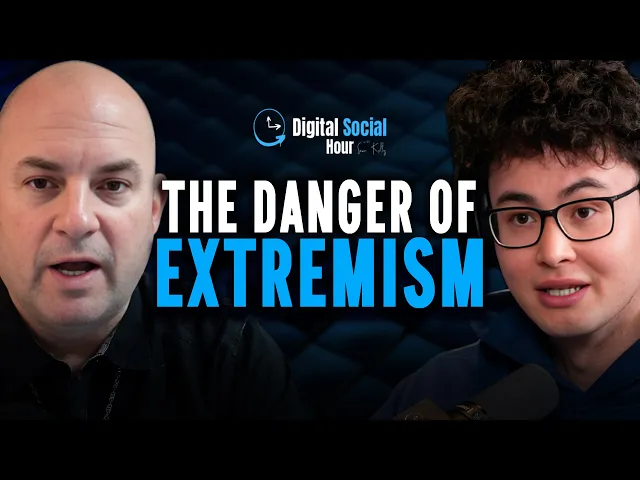
How Normal People Become Extremists... | Jeff Schoep | DSH #1950
Digital Social Hour Podcast by Sean Kelly
0:00 I could help people leave extremist [music] neo-Nazi type movements,
0:03 but I figured all the others are so different.
0:05 And what I learned quickly by meeting people
0:07 [music] from other extremist groups like former al-Qaeda members,
0:11 former ISIS members, [music] former Antifa,
0:13 all different types of extreme groups, the way they hold people in place,
0:17 the [music] psychology of it is almost identical.
0:20 Original American Nazi party, George Lincoln Rockwell,
0:22 he was assassinated and a number of others were [music] as well.
0:25 So the group I was a part of was a continuation of that movement.
0:34 Okay, guys.
0:35 Got Jeff coming in on the show today virtually tuning in from Michigan.
0:38 How's it going, Jeff?
0:40 Great.
0:40 Thanks for having me, Sean.
0:42 Absolutely.
0:42 I know you got the new book, um, American Nazi: From Hate to Humanity.
0:47 That's right.
0:49 What was the uh inspiration for wanting to get your story out there?
0:53 Well, I I feel like, you know, I mean,
0:55 I I have a pretty led a pretty crazy life, unfortunately.
0:59 And um I feel like that it's a story that can uplift people.
1:03 So, since the book's been out, you know,
1:04 I've had people that have written in and said,
1:07 you know, they've went through all kinds of struggles in their life,
1:09 whether that's been uh drugs or alcohol,
1:12 or whether that's been leaving a cult or leaving
1:14 an extremist group or or anything of that nature.
1:16 Um you know, if you've been through some struggles,
1:18 this is this is a book for you.
1:20 Would you label the group you were part of as as a cult?
1:25 Yeah, you know, when I was involved in it,
1:26 I wouldn't have called it that, but um looking at it from the outside
1:30 looking in and looking back on that, it was definitely a cult.
1:33 And I can tell you when I was involved in it,
1:35 um different women that I was dating from outside of the movement,
1:38 one after another, they were telling me like um
1:42 if they would come to an event or something, they'd be like, "This is a cult.
1:45 You're like a cult leader." And I'm thinking,
1:47 "What is wrong with these choices I'm making in women?
1:49 I'm making terrible choices cuz they keep saying these dumb things, you know.
1:54 And the truth and the reality of it is it's easier to blame
1:57 someone else than look at the person in the mirror and say,
1:59 you know what, they were right.
2:01 There was nothing wrong with any of them.
2:03 It was it was uh me that was the problem.
2:05 And and uh yeah, I was uh I would definitely call it a cult.
2:08 Now, I mean, if you if you look at the dynamics
2:11 of cult dynamics and how to um how cults hold someone in place,
2:16 it is very very similar to extremist groups.
2:19 And um I I found that very interesting even after I had left the movement.
2:24 I felt like um I could help people leave extremist neo-Nazi type movements,
2:31 but I figured all the others are so different.
2:34 And what I learned quickly by meeting people
2:37 from other extremist groups like former al-Qaeda members,
2:40 former ISIS members, former Antifa, um all different uh types of extreme groups,
2:46 the way they hold people in place, the psychology of it is almost identical
2:51 uh across the boards between all the groups.
2:54 So, um I I feel like there's a lot of parallels and there's
2:58 I don't feel like it.
2:58 I know there's a lot of parallels um and uh you know
3:02 these type of uh tactics can be utilized to to help get people out.
3:07 Yeah, I'm very fascinated with cults.
3:08 I've seen so many documentaries on them and half the time I feel
3:11 like people don't even realize they're in one or even leading one, you know,
3:16 100%.
3:16 You uh most people will not tell you if they're involved in it.
3:19 They won't say they're in a cult.
3:21 They think they're part of this cause, this noble ideal.
3:24 they're doing something that everybody else on the outside
3:27 world hasn't figured out or isn't isn't
3:30 queued into and they're right and everybody else
3:32 is wrong and and I can attest to that.
3:35 That's how I felt all you know the many years that I was involved.
3:39 So did you feel kind of trapped at a certain point?
3:43 Say again.
3:44 Did you feel kind of trapped at a certain point?
3:45 Like did you want to leave and you felt like you were stuck for a while?
3:49 100%.
3:50 because I was leading because I was leader
3:52 of this organization for 25 years like I felt
3:55 like um the old saying like this is your bed now you have to lie in it.
3:58 Um so towards the end when I'm wanting to break free
4:01 from it I I didn't feel like there was a way out.
4:04 Like I didn't think I didn't even think that was possible.
4:07 Like I felt like um the first things that I was trying to do
4:10 in in the last years that I was involved in it was change the group.
4:14 You know I'm saying oh this isn't a neo-Nazi group.
4:16 It's a white civil rights organization.
4:19 And you know that's putting lipstick on a pig that's trying
4:22 to dress up something that's ugly and and call it pretty.
4:24 It's still a pig.
4:25 It doesn't matter if it has lipstick on.
4:26 It's still a pig.
4:28 Um and in my mind that was the way
4:30 I was trying to uh so-called air quotes fix things.
4:34 I was trying to fix what I had uh uh
4:37 the wrong path that I had taken for so long.
4:39 Cuz it to it took a while to realize that.
4:42 Um and then once I realized it, I was like, well, I got to fix this.
4:45 when I realized I couldn't fix it, then it was time to disengage and and leave
4:48 and leave that uh lifestyle and and uh work against it.
4:52 Did you feel like at first the intentions were kind of good
4:55 or did you feel like it just progressively got crazier and crazier?
5:00 Like when I joined, you mean when I first got involved?
5:05 Yeah.
5:05 Yeah.
5:05 I felt like I was joining this noble cause and that it was this, you know,
5:08 I was going to help my people.
5:10 I was going to save my country.
5:12 And this is a common misconception that a lot
5:14 of people have about these groups because
5:16 when we look at it from the outside looking in, we think we think to ourselves,
5:20 my gosh, this neo-Nazi or this cult member, what what you know,
5:24 put whatever label on it, but they must know what they're doing is wrong,
5:27 that it's evil, that it's that it's harmful for humanity in their minds,
5:32 unless you're a sociopath or a psychopath,
5:34 you have some other maladies uh psychological maladies going on in your head.
5:40 um most of the people that are involved in this stuff,
5:43 they believe that they're doing something good and noble.
5:45 And I was definitely of that mindset.
5:47 So I was an ideologue to that cause and and uh uh I fully believed in it is
5:54 until until the last few years that I was
5:56 involved and I started really questioning it before breaking free.
6:00 And now with the rise of social media and free speech,
6:03 specifically Twitter, are you seeing a resurgence in the neo-Nazi ideologies,
6:10 you know, people try to gauge that a lot?
6:12 And it's it's tough to say, but I think you are seeing a lot of that.
6:16 You are seeing a lot of rise of of this ideology,
6:20 but um I see it going both ways on on both sides.
6:24 There's something called reciprocal radicalization.
6:26 That's an that's the academic term for it.
6:28 like I understood the process but I didn't know of this term until uh
6:32 the last six years or so when I've been doing this work and it it
6:35 basically means that the two extremes you
6:37 know the different kind of extremes fuel each
6:40 other so um people will get involved and they'll say well um uh the more
6:46 extreme it gets on the right you know the more extreme it gets on the left
6:49 and vice versa you know so these two sides are pulling more and more
6:53 people from the center where most of us are somewhere in the middle left
6:56 and right and they're pulling us out
6:58 to these extremes because they're saying things like,
7:00 you know, well, um, if this happens, you know,
7:03 fascism is going to take over, you know, or if this happens,
7:06 communism is going to take over, you know,
7:08 so people, oh my gosh, I got to get involved.
7:10 I got to do something.
7:12 And, uh, you know, those are the some of the pathways
7:14 into extremism for a lot of people is that reciprocal radicalization.
7:18 I see that so much.
7:19 Uh, especially with religion,
7:21 like they're trying to bring the Islam stuff and the, uh,
7:23 communism link there, the socialism link.
7:25 Um, yeah, that's a hot topic right now for sure.
7:30 Right.
7:30 Yeah.
7:30 I I wonder cuz that's the type of stuff
7:33 I don't know how active you are on Twitter,
7:34 but that's the kind of topics that go viral, you know.
7:38 Oh, for sure.
7:39 For sure.
7:39 Well, and anything that that signals outrage or or panic or anything
7:44 like that is always is is drawing the algorithms and is
7:47 drawing the eyes just like uh more so than kindness
7:51 or compassion or things that we should be drawn to, you know,
7:54 things that are uplifting.
7:56 Um it's those negative things is like uh looking
7:58 at a train wreck or a car wreck or something.
8:00 You know, everybody's got to stop and stare for a minute.
8:03 You know, that's that's uh I I feel like some of that's intentional.
8:07 Yeah.
8:07 And now I feel like it's so easy to join communities.
8:10 Like back when you joined 30 years ago, it was all in person, right?
8:14 There wasn't like an online forum.
8:17 Yeah, it was.
8:18 And I mean that was you you can you talk about extremism.
8:20 You said the good and the bad.
8:22 Um back in those days like I had to search out the movement.
8:24 It was kind of the early days of of computers and and uh like what we have now.
8:30 Uh it certainly wasn't anywhere near that level.
8:33 But um in the early days uh with computers and stuff was sort of a new thing.
8:39 Nowadays you've got you could be 10 years old and click
8:42 a couple buttons online and find
8:44 these groups and that's that's really disturbing.
8:46 So, some of these uh radical groups are going into target children
8:52 in games like um I'm not going to pick on anybody specific,
8:55 but we could say Roblox for for one is one
8:59 specifically been targeting kids in these things and and uh
9:02 the parents think, oh, it's like Legos or or whatever else.
9:05 Nobody's
9:06 it's a kids thing.
9:07 What why would adults be in there uh promoting this stuff?
9:11 And and they are in in some cases.
9:12 Uh um and it's really scary because the parents definitely have
9:16 to be aware of what your kids are looking at online.
9:19 Yeah, that's scary.
9:20 I mean, I grew up playing video games my whole life
9:22 and I never even questioned like being put in danger, you know?
9:26 But now I feel like it's a different era.
9:28 Like you really got to monitor your kids
9:30 and what they're cuz because of the voice chat, right?
9:33 100%.
9:34 Yeah.
9:34 That's where they're doing a lot of that recruiting.
9:37 Yeah.
9:37 I saw um I think Ryan Montgomery and Sean Ryan show talk about this.
9:40 I mean, there's a lot of child trafficking going on from video games.
9:44 Yep.
9:44 Do you ever look at your bank account and feel
9:46 like you're getting hit with fees for no reason?
9:48 Like overdraft fees, monthly fees, ATM fees just for using your own money?
9:53 That's exactly why I want to put you onto something better.
9:55 Chime is changing the way people bank.
9:57 They're not like traditional banks that nickel and dime you with random charges.
10:00 Chime gives you access to thousands of fee free ATMs.
10:03 And here's where [music] it gets interesting.
10:04 Chime members can earn up to 1,150 in annual rewards completely fee free.
10:09 If you set up direct deposit,
10:10 you unlock the most rewarding way to bank with Chime.
10:13 They've also got 247 customer support with real humans
10:16 and they've rated five stars by USA Today for customer service.
10:19 Get 5% cash back on your Chime card
10:22 in categories you actually use like gas or groceries.
10:25 You also get premium travel perks like airport lounge access and 24/7 concierge.
10:29 Plus, with my pay, you can access up to $500 of your paycheck early.
10:33 And if you ever need a cushion, Spot lets you overdraft up to $200 fee free.
10:38 Honestly, my younger self would have benefited from something like this.
10:41 Go to chime.com/dsh.
10:43 That's chime.com/dsh.
10:44 Chime is a fintech, not a bank.
10:46 Banking services for my pay and chime provided by Chime's bank partners.
10:48 Optional products and services may have fees or charges.
10:50 Stated annual percentage yield and cashback for Chime Prime only.
10:52 No minimum balance required.
10:53 Checking account ranking based on a JD Power survey published October 20, 2025.
10:56 For more information on APY rates, my pay,
10:57 spot, and travel perks, go to chime.com/disclosures.
11:01 Uh, have have any former members reached
11:04 out to you from the neo-Nazi organization?
11:06 Have they reached out to you to try to leave or talk to you?
11:10 Hundreds.
11:11 I mean, it it was I I figured when I left that there would be some
11:15 that would reach out and that was part
11:17 of my intention when I left was to speak out,
11:20 you know, to I made an announcement that I
11:22 was not immediately when I first first left.
11:24 I retired but I knew I was going to speak out but I did
11:27 that to put some space between myself
11:29 and the movement and also to process everything.
11:33 You know that was a really difficult time period but um in 2019 later
11:38 that year when I felt like you know now is the time I'm going
11:41 to make that announcement and I put out a website and I said I
11:44 was going to speak out against racism and hate and uh be a peaceuilder.
11:48 Now, at this point, I'm getting inundated with um
11:53 people that are reaching out to leave the movement.
11:56 Um I'm hearing from people that left the movement
11:58 before I did that just disappeared and say,
12:00 "Hey, you you finally figured it out, you know,
12:03 you know, some of those." And then there was other people that would
12:06 uh reached out that wanted to leave that wanted to change their life.
12:09 And a lot of them um were just curious, you know,
12:13 so they would reach out and they would be curious about it.
12:15 So they're like, "So you left, you know, um, are you a communist now?
12:19 Are you Antifa now?" And that was like not one,
12:23 not two, but like one after the other.
12:25 I was thinking to myself at the time,
12:28 what am I saying that is making someone think
12:30 that I'm a radical on the other extreme now?
12:33 Because I wasn't saying anything extreme.
12:35 And I had to bring my mind back to that place and say, "Listen,
12:39 remember when we move when anybody left when you were involved,
12:43 you automatically assumed the same thing." Because these groups,
12:47 they don't think in like rational uh they don't
12:50 think in like uh black and they, excuse me,
12:53 they think in black and white, no pun intended,
12:56 but there's gray areas in between, you know.
12:59 So they think if you left, you must be on this other side.
13:02 You're either working for the government, you're a fed,
13:05 an informant or something like that, or you're Antifa,
13:07 you're a communist, an anarchist, something like that.
13:10 And it's it's not, you know,
13:13 that can be the case with some people, but it's not usually the case.
13:18 It's that there's those gray areas in life.
13:20 You can be on the right, you can be on the left, you can be wherever you want.
13:23 Drop the racism, drop the hate, and um, you know, get away from the extremism.
13:28 But in that mindset,
13:29 they they're always thinking that it's it's something extreme.
13:32 So instead of being impatient or getting upset by that, I would just say, "Well,
13:37 why do you think that?" You know,
13:38 and and engage in this conversation with them or explain to him,
13:42 "No, I'm not." And like,
13:43 so and you quickly find out that a lot of the people were like,
13:48 "Wow, I would like to leave, too, but I thought I would have to do that.
13:53 And if that's the case, I'm staying right where I'm at." Like, "No, dude.
13:56 there's all this space in the middle.
13:59 You can be anywhere you want.
14:01 And um it's just having those conversations
14:03 and and once you've been in that environment,
14:06 I think or in that cultlike environment,
14:08 it's hard to break free of that sort of thinking.
14:11 So having someone kind of patiently walk
14:13 them through that and explain that to them
14:15 and and show them that there's uh a better life out there for them,
14:19 I think that that makes a big difference.
14:21 So that was one of the thing things I felt like it was I didn't
14:25 have to do it but it was I felt a a pull or a responsibility
14:30 to have done to do that to show other people that there's a way
14:34 out because I spent a lot of years you know doing the wrong thing.
14:38 I thought the best way to repair some
14:40 of the damage that I had done by the ideology that I'd spread was to help others
14:45 and and uh actually do something really good for humanity.
14:49 Yeah.
14:49 Wow.
14:50 That's interesting.
14:50 So you actually got a decent amount of support when you left?
14:55 Yeah.
14:55 I mean people that Yes.
14:56 that were coming out as far as like support from me personally.
14:59 No.
15:00 No.
15:01 Like a lot of it alone.
15:02 But um um I quickly was able to pull together a team
15:06 of people and and um and other former extremists and other people that had
15:10 been through that life and and uh individuals like Daryl Davis who had
15:15 helped pull a lot of people out of the clan and stuff like that.
15:17 Daryl and I are brothers and uh we work closely together to this day.
15:22 Yeah, I just saw his uh interview, man.
15:24 That that dude changed a lot of lives.
15:26 Daryl Davis,
15:27 he's he's a legend.
15:30 Legend.
15:30 Crazy.
15:31 Um yeah, it's crazy to see how it's all evolved.
15:34 Like Antifa, Trump labeled them as a terrorist organization now, right?
15:40 Yeah.
15:40 Yeah.
15:40 Something like that.
15:42 So, it's it's pretty high stakes now.
15:44 If you're looking to join a group like that, it's now like a huge felony,
15:47 I'd imagine, or something.
15:50 Yeah.
15:50 I mean, getting involved in that extreme in any extreme stuff,
15:53 whether it's far right, far left, or or anything in between,
15:56 it's just it's not a it's not a good thing for a person's future.
16:01 And I know like ideology drove a lot of people in.
16:04 It did for me as well.
16:05 You know, like we we think we're doing something good.
16:07 We think we're doing something noble.
16:08 And this is our way to uh be a part of something like that.
16:12 what a person has to use um you know critical thinking skills when they're doing
16:16 this and I say this now as somebody
16:17 that effed up and and fair into that rabbit hole.
16:21 But um re truly if you look at something
16:24 and if that cause is going to potentially get you
16:27 locked up or get you involved in illegal activities
16:30 or things like that, it's not good for your life.
16:33 You know, that's going to that's going to screw you
16:35 up and and uh harm you way down the road.
16:38 and and especially in this day and age with uh um online and everything,
16:43 somebody can look up your background, you know,
16:45 if you got arrested for, you know,
16:47 starting a fire or a hate crime or whatever it might
16:50 be because you were involved in one of these extreme organizations.
16:53 That kind of stuff can follow you around for a long time.
16:56 So, it doesn't mean your life is over.
16:58 You know, we don't want people to think
16:59 like they have to stay stuck in those movements.
17:02 But you if you haven't gotten involved,
17:05 you're you're for the better because um it's a lot
17:07 of work to break free from it and turn your life around.
17:11 For sure.
17:12 When you were leading the group,
17:13 was was getting locked up one of your bigger fears?
17:15 Were you really scared of getting uh in thrown in prison or something?
17:19 Well, um it was something to be concerned about.
17:22 The group that I was a part of was an above ground organization.
17:25 So if people were getting involved in like really serious illegal activities,
17:29 they would get thrown out of the group,
17:30 you know, and that wasn't coming from a place of like this moral high ground.
17:34 It was coming from the place of protecting the organization.
17:38 The organization came first.
17:39 The individuals were, you know, were secondary.
17:42 So if anybody was doing something that could
17:44 potentially get the organization shut down or or harmed,
17:48 um they were a threat to the group is the way we looked at it.
17:50 But yeah, there was always there was always that concern.
17:53 You always had to be wary of if the person next to you was a paid informant,
17:59 agent provocator, somebody that was sent in to spy,
18:02 you know, if they're being paid to be there um or cut a deal
18:05 because they got into some kind of trouble or or things like that.
18:08 That was um in my book I discuss a few of those a few of those incidences.
18:13 Um certainly not all of them because it would be an encyclopedia.
18:16 That's how the time holy crap.
18:19 any any of these groups, they always had uh informants.
18:24 Um you know, and people just didn't know.
18:26 But a lot uh we were very vigilant in trying to uncover
18:31 that because you learn I learned lessons the hard way in leadership,
18:35 you know, like um um being infiltrated and then some people got hurt,
18:39 you know, in in a big violent uh attack.
18:42 So, um, something like that happens,
18:44 I started running counter intelligence and, you know,
18:48 early on, starting back in the late '9s, started running counter intelligence,
18:52 um, infiltrating far-left groups, things things of that nature.
18:55 So, we always knew where they were,
18:58 what they were up to, uh, supplant false information,
19:01 false locations for events, and and, uh, and, uh,
19:05 keep intel on what our enemies were doing.
19:08 Wow.
19:08 You're out here playing chess, man.
19:11 We had a lot of strategy and a lot of tactics.
19:13 Yes, for sure.
19:14 Wow.
19:14 I didn't know there were that many informants.
19:16 That's almost like unbelievable.
19:19 Staggering.
19:19 It's staggering how many there was.
19:21 It It was just And when you think you had it fig in the early years,
19:25 we I thought I had it figured out because
19:27 a lot of the informants were easy to spot.
19:29 They'd come in and they'd be like, "Hey,
19:31 let's go I don't even know what we can say on the air.
19:34 Let's go do this terrible illegal activity that will
19:37 cause all this destruction." and you go, "Hm,
19:41 that person is somebody that was sent in or they're an idiot and they're
19:45 going to go to prison." And we want either one of those around us.
19:48 So, there was a lot of that.
19:50 But later on, um it got a lot a lot more uh
19:55 uh these groups got more skillful at at bringing people
19:59 in and not saying those things or just silently um you know,
20:02 collecting information,
20:03 writing down license plate numbers or filming or recording things.
20:07 who you know who knows.
20:09 I I can't speak to all their tactics, but uh it's it was wild.
20:14 You've got weight loss goals, but hitting them is another story.
20:16 If you want to know what's really worth
20:18 your time when it comes to losing weight,
20:20 skip [music] the guesswork and get weight loss by HIMS.
20:22 It's designed to support you in losing the weight and keeping it off.
20:25 And HIMS now offers access to an affordable
20:28 range of FDA [music] approved GLP-1 medications,
20:31 including the WGO pill and the WGO pen,
20:33 plus lifestyle tips [music] to support you along the way.
20:36 With WGO at HIMS, you can lose up to 20% or more
20:39 of your body weight when combined with diet [music] and exercise.
20:42 It helps you regulate your appetite and eat less, so success is within reach.
20:46 Plus, WGO is the first GLP-1 [music] pill, so there are no needles needed.
20:50 Ready to reach your goals?
20:52 Visit hims.com/dsh to get a personalized, affordable plan that gets you.
20:56 That's hs.com/dsh.com/dsh.
20:58 [music] Weight loss by HIMS is not available in all 50 states.
21:04 WGOI [music] is the registered trademark of Novo Nordisk AS.
21:07 To get started and learn more, including important safety information,
21:10 WGOI clinical study information and restrictions, visit hys.com.
21:15 Was there any that lasted years
21:17 as an informant undercover and you couldn't spot them?
21:20 Yes.
21:21 And there's pro I'm sure there's some that probably were never uncovered.
21:24 There's a lot of them that were never uncovered,
21:26 but um I was always in the in the movement.
21:29 One of the things is paranoia is really high and a lot of it's
21:32 legit paranoia because they are being infiltrated
21:35 and there is all this kind of stuff.
21:36 But that paranoia because of some of those incidences gets
21:40 so high and so ramped up that literally everybody that's
21:44 involved in it at one point or another gets accused
21:46 of being an informant or a rat or something like that.
21:50 It's and it's crazy like I I saw so much of that going on in the early years.
21:54 I thought wow this is a problem.
21:57 Like yeah there is a lot of informants but um every time like
22:02 uh in some of the groups somebody would steal somebody's girlfriend that guy
22:06 was an informant you know come on now you know or somebody
22:10 quit one clan to join another clan or or one skin head group
22:14 to join another that guy's an informant cuz he left our group
22:17 you know or they would make up something so there was a lot
22:20 of that so for me I didn't call anybody an informant I would
22:23 might say I was suspicious of somebody
22:26 But I was demanding like concrete evidence.
22:29 We would get either like record phone calls or get video proof or dig up stuff,
22:35 you know, finding people that actually gotten locked up because of somebody or
22:40 uh trace records and we a lot of uh a lot of things like that to to find them.
22:46 Were a lot of them just uh like were any of them members that turned
22:50 in foreman or were most of them kind of just people trying to join?
22:55 Both.
22:55 Um because you have some that sometimes um you would have
22:59 somebody that you know you felt like was probably a legitimate member
23:02 and then they got wrapped up in something and they were offered
23:06 a deal uh you know at some point and then they took it.
23:10 Um that would happen sometimes and other times it was
23:13 just people that had come in from from the get-go um that were sent in.
23:18 And you know, you're talking about government organizations,
23:21 non-government organizations,
23:23 and your um you know, monitoring groups or and anti-fascist groups as well.
23:29 Wow.
23:29 So, it wasn't just the government that was informing,
23:32 it was a bunch of different groups.
23:34 Lots of different groups.
23:35 Which ones did you uh fear the most, I guess?
23:40 Well, in in the neo-Nazi movement, you know, everything is blamed on the Jews.
23:44 So, the Jew are behind everything.
23:45 you know, it's it's just like it's it's crazy,
23:48 but that's how they uh that's how they see it, you know.
23:51 So, but uh the government was usually,
23:54 you know, the the greatest threat, I think,
23:57 in in that sense because they would have the most power to be able to
24:01 have you locked up or something like that.
24:03 But, uh so it's always something to be aware of.
24:05 But uh um for some groups it's more
24:09 it's more serious than others because if you're
24:11 engaged in criminal activity and you know you're
24:14 you're going down as far as that goes.
24:17 But um I I kept things as much as legal and above board as possible.
24:23 What a crazy life, man.
24:24 You must sleep much better at night now.
24:27 I tell you, man.
24:28 Um leaving being involved in this movement, the best way I can explain it,
24:32 it was like living in a war zone.
24:34 It was like being at war for my entire life
24:37 and um even when you when I first left like um it's
24:45 almost like it's an adrenaline drain in some ways or you
24:48 know you're going through you know people talking about trauma and all
24:52 this and I thought oh trauma is a bunch of BS
24:54 that's not real and here I am I'm not I'm not able
24:57 to sleep at night I'm like shaking and it's like oh
25:00 that that might be trauma you know like maybe it is real,
25:04 you know, [clears throat] but um yeah, it's definitely real.
25:07 Um and and uh yeah, it's not it's not a life I'd recommend for anybody.
25:12 Um I had to learn to uh live civilian life after leaving because my whole
25:18 life since I was a teenager was involved in this stuff until I left in 2019.
25:23 So um I need to learn how to uh how to operate in the real world.
25:29 Yeah.
25:30 You hear that from people that are in prison like
25:32 they they don't know how to operate in the real world.
25:33 It's almost like you were in a whole another world, right?
25:37 Yeah.
25:37 Yeah.
25:37 And it it I mean there is some comparisons to that.
25:40 I've heard that a lot too from people in prison.
25:42 They get like institutionalized and they don't know how to act when they get
25:45 out and they'll just commit petty crimes and end up going right back in there.
25:49 Um so I understand that mentality, but um yeah,
25:52 this is this was almost just like being at war all the time.
25:56 like you um different things happen.
25:59 I I covered some of some of these things in the book,
26:02 but you couldn't cover everything because I was so many years.
26:05 There's certain things you can't mention and there's certain
26:08 things I needed to cut short, but like um
26:11 I had been uh had raids on my house
26:14 um back in Minnesota and here in Detroit as well.
26:19 Um, it was no knock warrants out out there.
26:21 So, the doors were kicked in at 4 in the morning when
26:24 my kids were sleeping and uh at school the next day and all that.
26:27 So, that was definitely traumatizing and uh for them especially.
26:32 And um yeah, it's not it's not a life I would recommend for anybody.
26:36 So, if anybody's out there thinking like, hey,
26:38 I might want to get involved in this stuff,
26:41 the the likelihood of making it is as many years as I did is is pretty unlikely.
26:46 the chances the chances of ending up dead or in prison are a lot better.
26:51 Wow, that's pretty crazy.
26:52 So, you Yeah, you did it for 25 years, right?
26:56 20 uh 25 and uh leading the group in 27 total.
27:01 Jeez.
27:01 And you didn't see many people make it that long.
27:04 No, I seen a lot of people lost their lives.
27:07 A lot of people went to prison.
27:08 Um, you know, some people there's some people that are
27:12 that are in and that have been in uh many years,
27:14 but us typically leader doesn't make it that long.
27:16 Um, they're they're just they don't they don't they're not able to
27:21 cuz they get hit first, right, with charges.
27:25 Yeah.
27:25 They're either either charges or they or they're
27:29 overthrown or or different things like that, you know,
27:32 or assassinated in some cases.
27:33 you know, the founder of the original American Nazi party, um,
27:37 George Lincoln Rockwell,
27:38 he was assassinated and a number of others were as well.
27:41 So, uh, the group I was a part of was a continuation of that movement.
27:47 Dang.
27:47 So, you had to even fear assassination in your position.
27:51 Yeah, I survived assassination attempts.
27:53 Yeah.
27:53 Yeah.
27:53 I got a stop across the back of my head from one of them.
27:57 Holy crap.
27:59 That's crazy.
28:01 Did you know that like uh was it
28:03 like a group trying to overtake you or something?
28:06 That that particular incident was an Antifa group.
28:09 Back then they were ARRA anti-racist action, but that was back in the late 90s.
28:13 It was Antifa um uh in that particular case.
28:17 But in other cases, you know, I've been shot at.
28:19 I've had people try to stab me.
28:21 You know, you name it.
28:23 [snorts] Lots of uh lots of negative stuff.
28:26 That's why I say people don't typically make it this long.
28:29 It's not a It's not a good lifestyle.
28:32 Jeez.
28:32 Does part of you wonder like how you pulled it off?
28:34 Do you think it was like I don't know if
28:36 you're religious or like you believe in any of that, but Yeah.
28:39 I mean, I think God, you know,
28:41 I feel like there's a reason that that I'm still here today.
28:44 And I think it's it's to do to do too good, you know,
28:47 to do good things with uh lessons that I've learned in the life that I've led,
28:51 you know, to help other people not make make that same the same path.
28:55 There's got to be because even when I was uh writing the book, you know,
28:59 like you don't think when when you're in the thick
29:01 of it and all this stuff is happening, it's just like your life.
29:04 Like this is just how it is.
29:06 And when I was, it took me a few years to finish writing
29:09 the book because I'm going through it and I mean I'm even telling
29:12 like the like my girl and a couple other people I'm saying like
29:15 my god I forgot I almost forgot about this or like I'm writing
29:19 about this incident and then I'm remembering other things that that took
29:23 place and and uh I was like my gosh if I hadn't lived
29:27 this life I don't know if I would even believe this but I
29:30 don't even I'm alive you know like it's it's just so it's so Crazy.
29:36 It's so crazy.
29:37 There was just so much of stuff like that and and um it's Yeah,
29:42 I wouldn't wish it on anybody.
29:44 I really wouldn't.
29:45 Wow.
29:46 They might have to turn this into a movie, man.
29:49 I I think I think with the there's been some
29:51 interest uh from the book from filmmakers and things like that.
29:55 Um because it it is uh I definitely think it'll it'll be a film someday.
30:00 I just I don't we don't have the right filmmaker just yet.
30:02 I don't think.
30:04 Yeah.
30:04 Well, hopefully one day.
30:05 I'd love to see it on film, man.
30:08 Um, all right.
30:09 Anything else here?
30:10 What are you working on now since the book's out?
30:12 You're just promoting it now.
30:14 Yeah, I mean, I'm hoping that a lot of people uh get a hold of the book
30:17 and and do that, but I'm also working with um
30:20 I I work with a number of different organizations.
30:22 I'm a public speaker, so I've been uh all over the world.
30:26 I've spoken in um uh Canada, Turkey, Australia.
30:31 I just got back from my Australia tour with the book.
30:33 Wow.
30:34 Um, in August and September, I spoke at the Nobel Peace Center in uh,
30:39 Norway, which is that was I mean, uh, like a dream come true.
30:43 Un unbelievable.
30:45 Um, and I work uh, I do some
30:48 public speaking and consulting with the Simon Whisinthal Center,
30:51 which is an international uh, uh, human rights organization, Jewish uh,
30:55 human rights organization, but they cover human rights, all people.
30:59 So I do talks at schools and and uh try to make
31:03 sure uh help young people not get radicalized whether that's into gangs,
31:08 extremist groups or anything like that because there's parallel
31:11 and cults because there's parallels even there as well like
31:14 with gangs you know there's some other things that are
31:16 a little different you know like the criminal aspect
31:18 of it and that but uh believe it or not
31:21 there's parallels there too you know and and like
31:23 I said meeting people from the different extremist groups
31:27 and realizing the psychological holds uh hold them in place.
31:32 I mean, it it makes it makes a big difference.
31:34 So, um I've I've helped a lot of young people um not
31:39 go down those those paths and to kind of explain, you know,
31:42 it's one thing to say, hey, you know,
31:44 look what I did and don't don't do this, but sometime and you know,
31:47 people just h I'm a tough guy.
31:49 I'm in this gang or I'm in this crew and and and uh you know,
31:52 I've got it all figured out because I was that guy, too.
31:55 I I thought that and um you don't think about
31:59 the the ripple effects what it can do to your life, you know.
32:03 So, I'll tell the young uh especially in the schools,
32:06 I'll tell the young people like the ripple effects that this had
32:08 on my family like it destroyed it wrecked my mom's career.
32:13 It uh it uprooted so many different things, you know,
32:16 and caused uh issues for my children and and everything.
32:19 Anybody that's attached to you, it is like a ripple effect.
32:23 I mean, it can affect it's it affected some of the um girls that I dated over
32:28 the years with their careers and different things
32:30 like that and and and my own as well.
32:32 So, it's like it's stuff that they don't think about.
32:36 Or if you're in a gang, you say, "I'm in this gang.
32:38 I don't care.
32:39 You know, my life means nothing to cause or this group
32:42 means everything," which is the mindset that I had.
32:45 And and then I say to him, I said, "Okay, you're in this gang.
32:48 What happens when a rival gang does a driveby
32:51 at your parents house and clips your little sister
32:54 or your mom and you see every face
32:56 in the room go whoa cuz they didn't think about that.
32:59 They were thinking about themselves and all that but they didn't
33:02 think about the effect that it might have on their family.
33:04 So, if we can um stem the tide to some of that stuff,
33:08 um I think that will be uh very helpful because once you're in it,
33:12 like when this stuff was happening to to me that was affecting my family's life,
33:17 I just felt like, oh well, the government is after my family now, so guess what?
33:21 I'm going to fight harder.
33:22 I'm going to do more.
33:23 I'm going to build this army and I'm going
33:25 to fight back and I'm going to take this country.
33:27 You know, like that's that's basically the mindset that I had
33:30 and a lot of people have when they get put under pressure.
33:33 it doesn't work.
33:34 It doesn't work as far as helping you disengage once you're in it.
33:37 A lot of times it it uh causes you to become further entrenched,
33:41 which is exactly what what happened in my case.
33:44 So, um if we can stem that tide and show people before
33:48 they ever get involved in it in the first place, that's ideal.
33:52 So, that's what uh fuels a lot of my work now.
33:54 But I also uh run a nonprofit called Beyond Barriers that helps pull people out.
33:59 So, if they have screwed up and made that mistake and got
34:01 involved in this stuff in the first place, there's still hope.
34:04 There's still a way out.
34:05 Um, people like myself and a lot of the other guys uh
34:08 and ladies that are out here uh that have been through that, you know,
34:12 we're here as a support and um you know, we can help.
34:16 But ideally, if if people don't get involved
34:18 in it in the first place, that's the best.
34:21 Yeah, we'll include a link to the charity in the video, too.
34:23 Thanks for doing that.
34:24 Um, so so you're speaking all over the world about this.
34:27 It's not just a western issue all over the world.
34:31 Um, you wouldn't believe some of the uh commonalities
34:35 in in different places and uh things that we're seeing.
34:40 Even when I was in Australia,
34:41 some of the same exact problems that we have here, they have there.
34:45 So, it's it's uh it's definitely a global issue.
34:48 It's something that uh where a difference can be made
34:50 all over the world to stem the tide of this stuff.
34:53 Do you see any common traits with the type of people that are being recruited,
34:58 whether it's a gang or a extremist group?
35:00 Like, do you see a lack of father figure?
35:02 Do you see any similarities with the uh people they're recruiting?
35:06 You know, that's a that's a thing that um when I first got out,
35:09 I was criticizing because um a lot of the academics were saying,
35:15 well, only people that are getting involved in this are
35:17 coming from like broken homes or they were taught this.
35:20 And that does happen that those cases are real and that is that is
35:24 a common uh thread for a lot of people but it's not always the case
35:28 and in fact uh um it's not even most of the time the case
35:32 it but these are all factors that can go into that but it's really hard
35:36 to say like this demographic or this group of people is more susceptible to it
35:41 because I think um you know from the outside looking in we could say
35:44 well you know if someone's joining one of these hate groups they got to be
35:48 really like low intelligent and they've or they've
35:51 they've been taught this stuff at home.
35:53 There's all these thoughts and you have of course
35:56 you have those you have people that fit stereotypes,
35:59 but you also have people that are of high
36:01 intelligence that get involved in this stuff and cult
36:03 is a perfect example like you said you've
36:05 you've looked into cults and and things like that.
36:08 You find people in some of those groups that are
36:10 doctors and and uh all kinds of things and you think,
36:13 "Wow, how did they fall for that?" Yeah,
36:16 like some of these calls are so I I study this stuff too,
36:20 you know, and and you like it there was one I won't name them,
36:23 but there was one where they're they think they're talking to Robin
36:26 Williams in heaven and and that and these and you go
36:30 and person has a master's degree, you know, like Yeah.
36:34 So, I mean, that's why I say anybody's susceptible to it.
36:36 So, whenever somebody says like, "Oh, this talk isn't for me.
36:40 I don't need to hear this.
36:41 I would never join a hate group.
36:42 I'd never join a gang." Oh,
36:44 let let you know anybody is is uh anybody could be susceptible to it.
36:52 So, um I I think we shouldn't think in that in that mindset where oh,
36:56 I would never fall for this because um a lot of people a lot of people can.
37:00 So, we need to uh um boost our our own critical thinking skills
37:05 and our ability to discern disinformation and misinformation
37:09 and malinformation and things like of that nature.
37:12 So, we we look into things before we slide into these these dark places.
37:18 Yeah.
37:18 I guess the one similarity I've seen from the cult study is
37:21 they're good at uh kind of manipulating your your emotions, you know?
37:27 Yeah.
37:27 I think that's the one thing I've noticed.
37:28 It's like they'll spot a weakness in in your emotion and they
37:31 can kind of manipulate that into making you join or someone.
37:36 For sure.
37:36 Yeah.
37:36 I mean, manipulation is a huge part of it.
37:39 And then um the emotional response as well.
37:41 And that even goes back to that reciprocal radicalization um uh
37:46 thing I mentioned earlier where you feel like compelled like well I've
37:51 got to do this or or our country is going to be
37:54 gone or I have to do this because God said so.
37:57 And this is and this is a a uh
37:59 another uh commonality is like groups like ISIS, you know,
38:03 and a lot of times, you know, they'll say like, okay,
38:05 so um this person was chopping heads off and and things like that.
38:11 How does that happen?
38:12 That must be an a really evil,
38:14 insane person and or a psychopath and and in some cases, yes.
38:18 But in other cases, that's an individual that was
38:21 radicalized to believe they're doing the work of God,
38:23 that they're they're serving a higher power.
38:25 And and you I always find it interesting like when the media or somebody goes
38:30 and interviews somebody that knew this young
38:32 man or woman growing up and say, "Well,
38:34 I knew uh John growing up and and um he was
38:37 a nice young man that helped little old ladies cross the street
38:40 and all this kind of I don't know how he ended
38:42 up in ISIS doing that sort of thing or in an group,
38:46 but it's that's the radicalization that it can it
38:48 can take a person that's got a good heart, that's got a good uh
38:53 um wanting to do something good and turn it into something evil.
38:58 Yeah.
38:58 It's a very interesting point because you we think in terms of good and evil,
39:01 but those people that are doing these heinous acts
39:04 think what they're doing is good like you said, right?
39:08 Yes.
39:08 Yeah.
39:08 And that's that's a hard thing for some people to wrap their minds around.
39:12 And and um um when I say that, it's not that I'm excusing it.
39:16 I'm trying to explain the psychology of it as well.
39:19 because I think if we don't understand the psychology of it,
39:21 if we don't understand um how a person can get to that place,
39:25 how can we confront it?
39:26 How can we combat it?
39:28 How can we fix it?
39:29 And that was one of the first things that I noticed after I had gotten
39:32 out is that there was there was some of the people that were speaking out.
39:35 They were just uh saying things like, "Well, I was just filled full of hate.
39:38 I just woke up every day and I was just filled
39:40 full of hate and I hated everybody." And I'm thinking, my gosh.
39:44 Um, I don't want to say that they're lying,
39:46 but I'm say they're not articulating their feelings correctly.
39:50 And this is what people think from the outside is
39:53 that it's just all wrapped up in this hate thing.
39:55 And I and I try to explain it.
39:57 Hate is a byproduct.
39:58 Hate is not the the driver for this stuff.
40:00 If hate is the driver,
40:02 you've got some other psychological issues that need to be addressed.
40:05 That's just a weird thing to to have like your life revolve around.
40:09 These people believe that they're part of some kind of uh
40:12 most of them believe that they're part of a greater cause,
40:14 something that's greater than themselves.
40:16 And that's why it's so hard to uh break that ideology and and get
40:20 through to somebody and why telling somebody
40:22 that they're wrong doesn't typically work either.
40:25 You have to show them how they're wrong.
40:27 That is interesting.
40:28 Yeah.
40:28 Leading by hate is dangerous.
40:30 Same with I think anger too.
40:31 A lot of people can't control their anger, you know?
40:36 Right.
40:36 And especially if you have those impulse uh uh tough ability
40:40 to control those impulses and you get involved in an extremist group,
40:44 now you've just got all these more reasons to be angry and enraged and and uh
40:48 fly off the handle or snap and it's
40:51 it's a short road between hatred and violence.
40:54 It's a it's a short uh it's a very short road.
40:57 Now, you must have had really good emotional control to make
40:59 it that long because when you study all the top mafia guys,
41:02 a lot of their downfall was their ego and their emotion, right?
41:05 Yeah.
41:06 And that that was something that um you have to have a lot of control.
41:11 The organization that I was uh running had a very strict structure.
41:16 It it was structured a lot like the military.
41:18 So there was ranks and and things like that.
41:20 And that was also to control the individuals
41:22 in it because if somebody uh stepped out of line
41:25 and broke the rules that could uh blow
41:28 back on the organization and other people, you know.
41:30 Then you catch things like aiding in abetting charges
41:33 or that uh you know you you uh were complicit
41:37 in something because you let somebody go do something um
41:40 and you knew that they were going to do it.
41:42 There's people sitting in prison for 40 years for stuff like that for uh
41:46 somebody saying something illegal and then they
41:48 just not not doing anything about it.
41:50 Um, so I was hyper aware of that sort of thing.
41:53 And from uh
41:56 one lesson or one one experience that I share in the book early on was
42:00 an attempt by the government to set us up with um uh military surplus,
42:08 I I guess we could call it.
42:10 And um I'm like 19, I think, at the time.
42:13 18 19 years old.
42:15 This is before I was running the group.
42:17 And I'm thinking, "Oh, cool.
42:18 we're going to get all this military stuff.
42:20 This is great.
42:21 And you know, it's just being a kid thinking, you know,
42:25 not that I was going to go out and do anything bad with it,
42:27 but I just thought, "Oh,
42:28 that'll be cool to have all these all these weapons and things like that because
42:32 um in my mind there was going to be a race war, a civil war.
42:35 The country was going to fall apart." And uh you know,
42:39 this was some stuff we didn't have.
42:40 You know, we had some weapons and not not all this stuff.
42:44 And uh turns out that was a that was an entrapment attempt.
42:48 So wow, learning that lesson early on and seeing that because
42:52 the guy that was running the uh NSM at the time,
42:56 he he he knew what it was right away.
42:59 And um after learning that lesson, then I started becoming very careful.
43:04 So, um, learning things early on and and, uh,
43:08 seeing that and then keeping a tightly controlled environment,
43:12 um, kept me out of that's why I say most people won't make it.
43:16 They will not make it.
43:16 They'll end up in prison or dead.
43:19 Yeah.
43:20 You you said there was ranks earlier.
43:21 Was it always your goal to climb the ranks and get
43:23 to the highest level or did that kind of just happen over time?
43:27 No, for me that wasn't a goal.
43:29 I just wanted to be part of it.
43:30 So, um, but when I first joined, um, I was recruiting a lot of people.
43:34 I was bringing people in.
43:34 So, I was appointed local group leader and, um, South St.
43:39 Paul at the time where I lived, excuse me.
43:42 And then, um, I just moved up rather quickly.
43:46 And then the leader was looking to retire and asked
43:48 me if I wanted to take over the organization.
43:50 And I was thinking like, uhoh.
43:53 Uh, this isn't really something that I I didn't see myself doing.
43:56 I didn't necessarily want to do it, but I didn't say no either.
43:59 I was like, "Okay, well, I'll take this on." And he's he would still
44:02 help mentor me or give me advice or whatever.
44:06 But a lot of it was learning uh learning along the way.
44:09 But um it's from a leadership perspective when you in my experience,
44:15 the guys that would come, guys or gals,
44:17 whatever, when they would come to the organization and be like,
44:19 "Hey, I'm going to be a big leader.
44:21 You know, you should, you know, give me this rank or whatever.
44:24 I can recruit.
44:24 I'll have 20 new recruits in two weeks or or things like that.
44:29 Those guys were always the worst leaders.
44:32 They didn't recruit nobody.
44:34 They were terrible leaders because they had
44:36 this mindset that they were uh above everybody else.
44:39 It was usually the reluctant leaders or the people that were willing to just
44:43 you know boots to the ground uh be willing to do stuff the true
44:47 believers um that weren't in it about ego or self but the cause
44:53 because I mean over the years you had to the cause was above friendships.
44:58 It was above everything like and it's really sad or you know
45:02 when you think about it from a humanistic perspective that's really sad.
45:08 Yeah.
45:07 And and it's tragic.
45:08 Tragic is the word I think I was looking for.
45:10 I mean, it's it's a tragic way to to think and live, you know.
45:14 Wow.
45:14 I didn't know is is it was that important.
45:16 So, would you say when you were actively in it,
45:19 it took more importance than your own family?
45:24 Oo, that's a that's a deep question, Sean.
45:27 Um Oh, you got me on this one.
45:30 Um the I mean, I'd like to say no.
45:36 I mean, family should always come first, 100%.
45:39 But like, when you're wrapped up in this stuff,
45:41 it becomes your your whole your whole world.
45:44 And um you don't see it's almost like you don't
45:48 see the cost that it's having on your family, you know?
45:51 Um you you realize it,
45:53 but you you think it's you you tell yourself it's for a greater cause.
45:57 Like um some of the people that left, they'll say, "Well,
46:01 I left because I had kids now and and I didn't
46:04 want them to live this life." So, I got away from it.
46:07 Other people would have been were like, I'm doing this.
46:11 I'm in this cause for my kids, you know,
46:13 and and they're going to have a better future because of this.
46:16 And I was of more of that mindset, but at the same time,
46:20 um I started looking at some of the things that were
46:23 happening in in later years that I was involved in it.
46:26 And I always kept my kids kind of they knew I was involved, but I kept them
46:32 separate from it, you know.
46:33 So, it still damaged them, but they were never like active in it.
46:37 And sometimes people would ask that like, well, why why aren't they active?
46:40 Cuz some people would bring their have their kids active in it and stuff.
46:43 And I always thought, well, it was a hard question for me to answer at the time,
46:47 but I always figured like every parent wants
46:50 a better life for their kids than what they had.
46:52 I survived assassination attempts and all this violence
46:55 and all these different things that happened over the years.
46:58 I didn't want that for my kids.
46:59 I didn't want that.
47:00 I mean, I don't wish that on I don't wish that on my enemies,
47:04 much less your family.
47:05 But, um, I think I think everybody would tell you family comes first,
47:09 but in the reality of it, when you're mixed up in the thickness of this stuff,
47:13 like it's really the cause that comes first.
47:15 And and I saw so many people like throw away throw away
47:20 relationships or become ostracized from their families
47:22 or the families would ostracize them.
47:25 I was very fortunate in that sense where my family didn't completely cut me off,
47:29 but I saw it um time and time again with other people.
47:33 So the isolation becomes like uh all consuming as well.
47:37 So even if somebody's having second thoughts,
47:40 now they're in the cult or this extremist group, you name it.
47:43 I mean, they're all kind of the same in that sense.
47:45 Now you're in this and you're having second thoughts,
47:48 but your family's shut the door on you.
47:51 all your old friends and everybody you knew from before,
47:53 they're like, "Oh, he's involved.
47:54 He or she's involved in this stuff.
47:56 I don't like them.
47:57 I don't like the way they've become.
47:59 I don't want no part of that." So now you're like standing out on this uh
48:03 on this um diving board or alone and um
48:08 it's easier to stay involved in in what you're in.
48:11 So that was a that was a pull too for me, you know,
48:14 like my whole my career, my business,
48:16 everything was and everybody I knew was wrapped up in it.
48:18 So, um, it it took me a little bit to break free from it.
48:23 Yeah.
48:23 That's probably why it's so hard for people to leave because
48:26 their their own family usually cut them off by that point and, uh,
48:29 when they leave, they got no one, right?
48:31 Right.
48:32 Or if families are in it, that's even even another complexity.
48:35 That's there there's just so many complexities to it.
48:39 Yeah.
48:39 You mentioned uh enemies earlier.
48:41 Have you pretty much uh made peace with your enemies?
48:44 Any resentment still there?
48:47 Um, that's a tough thing to say.
48:51 Like I I don't I don't view people as I
48:55 guess I wouldn't say I view people as necessarily enemies,
48:57 but there's I'm sure there's people that view me as an enemy.
49:00 um in the movement when you leave you uh a lot of times
49:03 you can leave and you're you're fine depending on the group but if
49:08 you leave and speak out against it you're considered like uh a traitor
49:11 basically that uh they find that really uh offensive and they don't like it.
49:16 Um I don't attack the I don't attack the individuals
49:19 when I when I uh speak about this stuff.
49:22 I I attack the ideology.
49:24 So I'm not saying that the people are bad.
49:26 But I'm saying that they're people that are caught
49:28 up in some bad stuff and and got him.
49:31 Well, that doesn't if if you're a radicalized individual, that doesn't matter.
49:34 You know, they're beh um and I feel like I'm I'm doing an honorable thing now.
49:49 So, I mean, that that's that.
49:51 I didn't snitch on people.
49:52 I didn't uh you know, send people to jail or anything like that.
49:56 I think um you know that's a little different.
49:59 Everybody you know has their own choices to make in life.
50:01 I didn't do anything like that.
50:03 Um so I I've got credibility in a lot of their eyes in the sense
50:07 of like well if he left and changed his life maybe I can too.
50:11 So there's another reason why I wanted to do the work that I'm doing now.
50:15 But um you know I mean as far as as far
50:17 as that goes when I first left there was a lot
50:19 of challenges because you know the people a lot of the people
50:22 on the left would say once a Nazi always a Nazi.
50:25 I don't believe him or he done doxed everybody on his way out.
50:28 So, he's still a Nazi.
50:30 I mean, everybody's a Nazi if if if uh if you
50:34 don't like what they're doing or you don't agree with them.
50:36 And then on the uh from the Nazi side,
50:39 well, he's a traitor because he's speaking out against us.
50:42 So, I I I went from fighting the left uh to getting it from all,
50:47 you know, from both sides in a sense.
50:49 So, um I guess uh out of the frying pan into the into the flames,
50:54 you know, but I'm doing the right thing.
50:56 So, I I I don't have any uh I don't have any regrets.
51:01 Um has your view of snitches changed since
51:03 I know you definitely hated them uh before, but how do you feel about them now?
51:08 Oh.
51:12 Um, I personally I personally wouldn't I mean I had
51:15 uh interestingly enough like I mean we uncovered quite a few
51:18 when I was involved in that because we were uh
51:21 really keen and aware of it and were looking for it.
51:24 But I had a couple people that had contacted me after I left
51:28 and told me that they were snitches when they were involved.
51:32 And I Whoa.
51:33 Um that's interesting you know.
51:35 Um, and obviously I would never I would never uh say anything,
51:40 but um you know name anybody, but um I personally wouldn't wouldn't do it.
51:46 Um I mean if somebody come to me, you know,
51:48 they're going to go kill people or something,
51:50 that's a little different, I think.
51:52 But um I don't know.
51:54 It's it's it's a it's a good question.
51:55 It's a complicated question,
51:57 but um I understand it because I mean law enforcement especially has
52:01 a job to do and if people are are engaged in criminal activities,
52:04 you know, you have to uh be concerned about that.
52:07 Me personally, um I was approached a couple of times over the years
52:12 to try try to flip me or or turn me or whatever.
52:15 And I just said, "You got the wrong person."
52:17 And uh that's not something I I mean I even had people uh offer to buy me out
52:21 for like a million dollars at point and uh
52:27 what wait what what do you mean by that?
52:28 Like a group wanted to control your what you were saying?
52:31 I was approached at one point by an individual
52:34 that said um there was a there was
52:36 several of us from the leadership from the group at an at at a at a meeting
52:42 and an individual said that they knew somebody
52:45 that was a you know rich in Hollywood
52:48 or whatever and they said what if that person offered you guys a million dollars
52:53 to wa just walk away.
52:56 Wow.
52:55 Just walk away.
52:56 What would you do?
52:57 And we put up the middle fingers.
52:58 So you you can tell your friend to shove it.
53:02 Exploitative.
53:02 Exploitative.
53:03 But yeah.
53:04 So I was never for sale.
53:06 Um as far as that goes.
53:09 So you didn't have a price to walk away?
53:14 No.
53:13 Wow.
53:14 And you ended up walking away for free.
53:15 So is that a regret of yours to not take the money?
53:19 Well, that was I mean that was years before.
53:21 But no, I I wouldn't I I wasn't doing it for money,
53:24 you I mean the thing is I had I had financial stability
53:27 when I was involved and I walked out into this unknown world afterwards.
53:33 You know this civilian life I never led before with nothing.
53:36 So I gave up everything as I was leaving.
53:39 So um in the public you know the the you
53:42 know there was stories circulating in the media.
53:45 Oh, he left because he got sued in this lawsuit
53:48 or he left because of this, you know,
53:49 or they they just make up whatever they want
53:51 to say and they run with these stories and it's like,
53:54 my gosh, you know, like um uh or or he's doing this or that.
53:59 People come up with their own own reasons.
54:01 But um basically I I went from a place
54:04 of having uh perceived power and influence and being
54:09 at the very top of the world that I was involved in and having I wouldn't I
54:13 wasn't rich or anything but I I guess
54:15 comfortable and um into an unknown world with nothing
54:21 on a job resume but running a white power
54:24 record label for many many years running the Nazi party.
54:28 like what I mean that that's quite a LinkedIn profile, you know.
54:33 Did you have the bit of a identity crisis, you'd say, when you left?
54:36 Like it took some years to get back into the flow of things?
54:42 Um, it was challenging.
54:45 It was it was really challenging.
54:46 But um once I put out uh once I put out
54:49 my website that I was going to speak out against hate and racism,
54:53 I got contacted by the Simon Weezenthal Center um which is
54:57 an international human rights organization and um and um within a couple
55:02 of days uh the head of research there was
55:05 on a on a plane out to Detroit to meet with me and ask,
55:08 you know, well, what do you want to do
55:10 with your life and everything now that you you've left the movement?
55:13 and and I said, "Well, I want to I want to be a peaceuilder.
55:16 I want to uh use the lessons of my past to to help
55:20 others so people don't make the same mistake." And and um you know,
55:24 wethal has been very uh um was very supportive when a lot of other people um
55:32 wouldn't see me as anything else but the person that I was for all those years.
55:35 So, that was it was a it was a very difficult time at first.
55:39 And there's still I mean there's always going to be people that that uh
55:42 that don't believe in change or that can't embrace that and and um
55:46 those of us that have led that kind of life and we
55:48 just have to be okay with that and just say you know okay
55:51 you know I can't convince everybody I can't expect everybody to forgive
55:55 or forget that but all I can do is live life correctly and you
56:00 know the best I can and um help others and know and know
56:04 that and I know that I've I've saved so many lives countless lives Like,
56:09 so I I feel very good about that and that's that's u that's
56:13 the best thing I could possibly do with it because I've had a lot
56:16 of people ask well why didn't you just go into business or why didn't
56:20 you do you know something else because I understand business you know I have
56:23 these I have these skills so why not do that instead of this because
56:27 this is this is stressful you know you uh bring back up old traumas
56:31 and and think about this stuff and you put yourself um out there um
56:36 but I feel like this is the best thing that I can do for humanity.
56:40 Like, it's not about when I was in the cause,
56:43 it wasn't about me either, you know?
56:45 It was about the cause.
56:46 So, I switched missions now, but now I'm actually doing something good
56:50 instead of just thinking I'm doing something good.
56:52 I love it.
56:53 Well, Jeeoff, thanks for your time, man.
56:54 I can't wait to listen to your book.
56:55 We'll link it in the video, your charity, your speaking engagements.
56:58 Anything else you want to close off with here?
57:01 Um, I would just say to anybody that's out there that's struggling,
57:04 it doesn't matter what it is.
57:05 you know, this isn't about just, you know, uh,
57:07 somebody that was in a neo-Nazi group or or anything like that.
57:11 Whatever struggle that you're going through,
57:13 if you're trying to change your life,
57:14 if you've gotten into some bad stuff, there's still hope for you.
57:17 If you're still alive,
57:18 you're you're not uh stuck behind bars for the rest of your life.
57:22 You're still alive.
57:23 You're still out there.
57:23 You've have that opportunity to change.
57:26 Um, that's the really the underlying message of of my book
57:30 is if somebody like me can do it, then you can do it, too.
57:33 you know, if if someone can go from that kind of darkness
57:36 for 27 years and change their life around, you can too.
57:40 So, that's that's what I really want to uh get across to people is is a lot
57:43 of times people give up and they lose hope
57:45 on things and they feel like their lives are over.
57:48 Especially young people, you know,
57:50 you get to this, oh my gosh, my girlfriend left me.
57:52 I'm going to go take my life or something.
57:54 You know, they get these terrible ideas in their head
57:57 because [music] they feel like it's all over with.
57:59 Life gets better.
58:00 There's always a light at the end of that tunnel.
58:03 there's still hope and and you still have opportunity to to make things happen.
58:07 So, it's a real honor for me to be on the show, Sean,
58:09 and thanks for having me and and uh um you know,
58:12 keep up the good work out there.
58:14 Absolutely.
58:15 Thanks for your time, man.
58:16 Thanks for watching to the end, guys.
58:17 [music] Please comment below your thoughts on the episode.
58:20 If you agree, if you disagree, I'd love to hear it.
58:22 I read every single comment.
58:23 Means a lot to me.
58:24 Thank you so much.