Final days full of life - Hospice stories | DW Documentary
DW Documentary
0:09 I enjoy each day now, take things as they come,
0:12 and appreciate every special moment.
0:22 You never know how much time you have, and you should use it well.
0:31 Are you feeling better now?
0:33 Is the air okay?
0:34 It was all the excitement, wasn’t it, it was a bit much.
0:38 Dying is important, but it's a taboo subject.
0:41 Dying's become anonymous, and honestly, we can do better than that.
0:49 For Paul Buchholz, the hospice at the South City Hospital in Rostock,
0:54 is the best workplace in the world.
0:56 Good morning!
1:00 Paul, who hails from the region, has been a nurse here for 15 years.
1:05 Did you sleep well?
1:06 Yes
1:07 Super.
1:07 Shall we open the curtains?
1:08 I think it's worth it today.
1:12 Ralf Löwenhagen moved in here four weeks ago.
1:18 Let's get you at eye-level, so we can look deep into each other's eyes!
1:22 The 62-year-old has pancreatic cancer.
1:25 You old rascal!
1:29 Somehow the day has to start.
1:31 Yes, with a bit of humour and fun.
1:34 And the highlight is the sun.
1:37 Of course.
1:38 Shall we start with the teeth first, so the mouth is fresh
1:42 when your mouth's fresh, everything else follows.
1:49 Okay, I have the toothbrush kit.
1:54 Then let's see how you manage.
1:56 Well, you can do a bit yourself.
1:59 Do it with you, then after you, then better!
2:02 Do it yourself!
2:04 With me, it’s do it yourself!
2:06 I'll pass the baton...
2:10 and then you clean those choppers.
2:16 The motto is to live your life till the end.
2:19 As much as possible.
2:22 Tears are part of it.
2:24 And laughter’s central of course.
2:26 But the needs of the residents are always our priority.
2:32 Okay, we can go to the disco now.
2:34 Not so fast.
2:35 I think we still have to shave, right?
2:39 Yeh, here.
2:45 The morning program is like running a marathon.
2:49 And you're under time pressure too.
2:52 When I'm here, I have time.
2:56 I'm there for you.
2:57 And I won't run away.
3:00 You can't, I've pinned you down!
3:09 Okay, hands on my shoulders.
3:12 One, two, and three.
3:16 Push from the knees, yes.
3:18 great, and a little dance, slowly, we still need a bit more.
3:26 A little more.
3:31 The wheelchair is behind you.
3:33 And now you can sit.
3:38 Even at 11 AM, no one gets woken up.
3:41 The residents set their own daily rhythm.
3:45 Good morning.
3:47 Would you like lunch, or breakfast instead?
3:53 Breakfast.
3:54 So both, one after another.
3:59 The hospice is directly connected to the hospital.
4:02 A doctor is on call round the clock.
4:05 Jan Patrick Roesner is an anesthetist and medical director.
4:09 He shares the shifts with two colleagues on a 4-week cycle.
4:18 Hello, everyone!
4:19 Hi, nice to see you.
4:21 So what do we have?
4:27 Mrs. Polchow was at the eye clinic today,
4:31 and she fainted and collapsed.
4:37 Doctors’ visits, a stroll through town,
4:38 a visit to a café;
4:39 the staff here do what they can to
4:42 maintain the residents’ quality of life,
4:44 till the very end.
4:45 Are you feeling better now?
4:48 Is the air okay?
4:50 It was all the excitement, wasn’t it, it was a bit much.
4:53 But the good news is everything is fine with your eyes;
4:56 we can check that off.
4:57 Would you like to sleep a bit longer?
4:59 Yes, looks like it.
5:01 Here, I can fill in what's missing in a standard clinical practice.
5:07 You’ve more time, or rather you have to take the time,
5:11 and you can achieve a lot with simple things.
5:13 Often that’s a conversation.
5:15 Sometimes the dying person can't let go
5:18 because there's an unresolved conflict,
5:20 which can only be settled by bringing together the two people
5:23 who at some point had a falling-out.
5:25 Dying is important.
5:27 But it's a taboo subject that no one wants to look at these days.
5:31 We don't learn about it anymore.
5:33 In the past, in the extended families,
5:35 the great grandchild would sit at the bedside when Greatgrandma died.
5:40 We don't have that anymore.
5:41 Dying has become anonymous and, honestly,
5:44 we can do better than that.
5:51 Well, do you have your tissues?
5:54 Right, I'll just tidy up the hair there at the back.
5:57 Yes, now I'm getting dolled up.
6:00 Yes, ready to go out.
6:03 Right, sorted.
6:06 It's just a joy to see Ms. Kühl smiling and walking with me to lunch.
6:12 Yes, we're going to lunch now.
6:14 We’re starving!
6:15 Yes, now we're hungry.
6:20 The hospice has 27 employees.
6:23 And 10 residents.
6:25 Hello!
6:29 Here come the late risers.
6:31 Look who’s talking!
6:39 You can't help being happy with this staff.
6:43 It brings tears to my eyes.
6:49 The employees are all so helpful.
6:53 This kind of care really lifts your spirits.
6:57 A bit closer, or is that okay?
7:04 90 kilometers north lies Bernstorf Castle Hospice.
7:12 A crew has been filming in and around the castle for three weeks.
7:16 The title of their movie:
7:17 I'm dying.
7:18 Are you coming?
7:21 They had to fight long and hard to make this film.
7:24 Death is not exactly a big draw at the box office.
7:28 The film tells the story of a seriously ill young mother
7:32 who lives in a hospice and is fighting
7:34 with her ex for a little more time
7:35 with her son.
7:37 For Mecklenburg director Benjamin Kramme,
7:40 it’s a project close to his heart.
7:45 My background is in acting.
7:48 From early on I was doing social work alongside acting,
7:51 and at some point I thought I’d like to work in a hospice.
7:54 I didn't exactly know why,
7:56 but realized something was pulling me in that direction.
8:00 I probably just wanted to deal with the subject of dying myself,
8:03 and that's what I did.
8:05 I worked at the Schwerin hospice on the Aubach
8:08 as a nursing assistant for a while,
8:09 and that's where I got the material for this,
8:11 because I kept a diary,
8:13 so most of the characters that appear in it and the situations
8:16 are actually things that I experienced myself
8:18 or that were inspired by them.
8:24 Bernstorf Castle is a family-run hospice.
8:29 Its founder, Wolfgang Röhr wanted to create a dignified place to die.
8:34 His first wife died of cancer in 2006 at the age of 48.
8:40 He was left with four small children.
8:42 So when the film crew approached him about the project,
8:45 he immediately agreed.
8:49 I thought it was a great idea from the start.
8:52 It's an important step in raising awareness of the issue
8:55 and perhaps helping people overcome
8:57 their fear of their final days.
8:59 So we were really happy to support it.
9:06 At the moment, there are 16 guests
9:08 as the residents here are called
9:10 at the Bernstorf Castle hospice.
9:13 Many residents follow the filming from a distance
9:16 and some have even taken on small roles.
9:18 Like Carola Kumpe.
9:21 The hospice has been her home for two years.
9:24 The 48-year-old from Schwerin suffers from two rare autoimmune diseases.
9:29 The film crew is a welcome distraction.
9:36 A nurse wheeled me into the hall and there were cameras on all sides.
9:42 It was very interesting to see how much
9:44 work goes into shooting just one scene.
9:51 So much work, so much precision, over and over again,
9:54 in different locations.
9:56 It was so interesting.
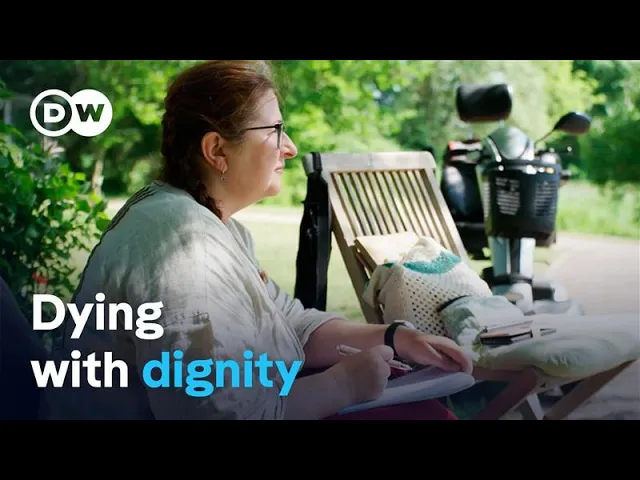
10:02 Every spare minute she has,
10:03 she sits in her favorite spot and writes down her life story.
10:08 As a legacy for her adult son.
10:10 She feels prepared for death.
10:17 To maintain a certain quality of life, I’d recommend accepting it.
10:21 But still, even if you have accepted it and feel good about yourself,
10:26 there are of course days when you say:
10:28 Why did this happen to me?
10:34 That's just how it is.
10:36 You struggle and simply want it over and done with.
10:45 But that's changed for me.
10:47 I enjoy each day now, take things as they come,
10:50 and appreciate every special moment.
11:00 The hospice at the South City Hospital in Rostock opened in 1998.
11:06 Ninety-five per cent of the costs are covered by health insurance companies.
11:11 The remaining 5 per cent is financed by donations.
11:15 Many residents leave a memento here.
11:20 The lady is in bed.
11:24 Nurse Paul Buchholz is showing Birgit Witt the ropes.
11:28 She’s one of nearly 50 volunteers.
11:31 Her husband had cancer and spent his last days here.
11:36 Is Mr. Löwenhagen still on his afternoon nap?
11:39 He didn't want to go to bed after lunch,
11:42 so he's sitting in the armchair in the living room.
11:44 He was talking about playing Ludo this morning,
11:47 I think he'd be up for that.
11:49 Yes, let's do that.
11:51 All employees have additional training in end-of-life care.
11:56 It's work with a calling.
11:57 By the age of 12, Paul already knew this was what he wanted to do.
12:06 When my grandparents were getting older
12:08 and I saw how they were taken care of,
12:10 I realized pretty early on, as a young person,
12:13 that I wanted to do something in that area,
12:15 and when the time came, that was the field I chose.
12:25 I'm getting impatient.
12:27 Zack!
12:28 Back!
12:31 Birgit is a retired teacher.
12:33 She volunteers here once a week.
12:35 Playing games, going for walks, reading aloud.
12:39 Despite her own experience with loss,
12:41 she maintains a positive outlook on life.
12:44 I've actually been very lucky in my life,
12:48 and now I'm just giving something back.
12:52 At the moment, death is still a way off for Ralf Löwenhagen.
12:57 I try to distract myself.
12:59 It is what it is.
13:01 You can't change it.
13:07 And the next morning, you're sitting at the table,
13:10 and everything's fine again.
13:12 Then you supress it too.
13:20 Paul has just come from room 10.
13:23 The resident has died.
13:25 He lights a candle in the lounge.
13:27 That way, everyone knows.
13:30 Every death affects him deeply.
13:33 But there are moments when it is particularly hard.
13:41 We also have very young residents; at just 19 years of age
13:45 they get diagnosed with these illnesses,
13:47 and you just think that's not right at all,
13:49 and when you take on the care of someone so young, it affects you.
13:54 I always find that...
13:56 When you have the parents sitting at the bedside,
14:00 siblings or even their own children, it's just terrible.
14:11 Ralf Löwenhagen has visitors
14:13 his brother Frank and his wife.
14:15 No one takes you seriously when you make a joke.
14:20 There are no fixed visiting hours here.
14:22 Anyone can come and stay as long as they want.
14:25 We tried it at home for six to nine months.
14:30 But it wasn't working anymore.
14:32 The chemo made things worse.
14:34 We stopped that in February.
14:36 He was still at home with us until April.
14:39 But we're not able to care for him the way they do here at the hospice.
14:44 And he has 24-hour care here too.
14:46 And he likes it here, you hear that from him.
14:51 The worst thing for Ralf was the pain.
15:00 When he first came, he was a bit anxious,
15:03 so I said we’d try something to ease the pain,
15:05 and after that he was alright.
15:10 We’re really pleased with how he’s settled in.
15:12 He’s always saying that this is home.
15:15 He likes to visit Langsdorf,
15:16 but then he wants to come back home again.
15:20 A lot of people who’ve never been to a hospice
15:22 before arrive here with certain fears.
15:25 They’re thinking,
15:26 this is a place to die, so I’ll lie down in bed and my life is over.
15:30 But that's not what it is.
15:32 I'm often asked:
15:34 How long do I have to stay here?
15:35 And I tell them, Nobody has to stay here, but you can stay here.
15:39 And I've seen it all.
15:41 Anything's possible, from half an hour to over a year.
15:46 And once someone was even discharged,
15:49 because they suddenly seemed to recover.
15:56 At the Bernstorf castle hospice, the film crew moved up to the attic,
16:01 which has yet to be renovated,
16:03 but which will eventually be converted for hospice guests.
16:07 After filming, Benjamin Kramme begins the editing process.
16:11 Then, on to international film festivals.
16:15 And a theatre and television release.
16:22 The film's main role is played by Benjamin's wife.
16:30 It's special because we wrote it together.
16:34 That's why I thought I could deal with it pretty well.
16:39 But I'm realizing now it's quite intense.
16:45 It would be intense even if it weren't my wife,
16:47 but it's even more intense because of that.
16:49 Definitely.
16:54 Filming in the hospice has had a humbling affect on the director.
17:03 You never know how much time you have,
17:06 so you should use it well and carefully.
17:08 Sometimes there’s also a feeling of:
17:10 maybe you can let go a little,
17:12 because as a human being you tend to want to control things,
17:16 to have security.
17:17 But then you get the feeling that maybe those aren't the things
17:21 that count in the end, maybe they're not so important.
17:24 Perhaps, in general, you should have a more relaxed approach to life.
17:30 That's what you try, but you don't always succeed.
17:41 Back at the hospice in Rostock, the schedule changes every day:
17:45 there's occupational and physical therapy, hairdressing, and pedicures
17:50 whatever the residents feel up to.
17:52 But two sweaters are fine.
17:54 When you're moving around, it's warm.
17:57 Ralf is heading outside for some garden therapy.
18:00 Paul knows what his guests want:
18:02 some like peace and quiet, others, a variety.
18:08 Nice front yard here.
18:09 Yes, it was specially designed like that.
18:13 The boss is already there.
18:16 Designed by the garden therapist.
18:19 Hello, Mr. Löwenhagen.
18:20 I’m ready for work!
18:22 Then let's get started.
18:23 Thomas Hentschel comes to the hospice once a week.
18:26 We can lower the knees.
18:29 That fits quite well height-wise.
18:32 It's good for work.
18:33 Can I take your feet down, so now your knees fit underneath.
18:39 Yes, Mr. Löwenhagen,
18:40 I thought we could plant a flower pot today.
18:43 You know a lot about that.
18:44 You used to be something of a gardener.
18:50 I worked more with animals, but we had a garden at home.
18:54 We've already done plenty together.
18:56 I know you can do it.
18:58 Very nice.
19:00 Then we have to see how they're doing here.
19:03 Do you want to take them out?
19:13 I'm happy to see Mr. Löwenhagen out in a wheelchair today.
19:17 Otherwise I'd have worked with him on the terrace by his bed.
19:20 That works too.
19:21 You swing the bedside table over.
19:23 Then you put the work tub on it, and if they can sit up a little,
19:26 you can also do garden therapy in bed.
19:28 The garden comes to the patient, not the other way around.
19:33 We'll check back later to see if they've grown.
19:36 It’s looking good.
19:38 Very nice.
19:41 We'll put them on the terrace outside your room,
19:44 and then you can check on them and water them if they get too dry.
19:51 Right, let's go.
19:53 We’re lucky with the weather.
19:56 Oh yes, last Tuesday the weather was awful…
20:02 Everyone will be jealous!
20:04 And you can say you made it yourself.
20:13 At Bernstorf Castle,
20:14 doctors and therapists from Grevesmühlen
20:17 or Wismar come when needed.
20:19 Today the 'Wish-mobile' is coming.
20:23 Carola Kumpe has already taken it twice to the Baltic Sea,
20:26 which is the most popular destination.
20:29 Today it's Hans-Bernd Scholz and his wife Monika's turn.
20:34 Hello, my name is Sandra, and it’s your day today,
20:36 so I’ll be accompanying you.
20:39 Volunteers Uwe and Sandra help fulfill
20:42 the last wishes of the seriously ill.
20:45 There he is
20:48 We’re off on our adventure!
20:50 They’ve wished for a trip to Hamburg to visit Hagenbeck Zoo.
20:58 I'm not excited, but I'm happy.
21:04 Hans-Bernd Scholz has terminal cancer.
21:07 His wife Monika also needs care due to a stroke.
21:11 They’ve been living in the hospice for 8 weeks.
21:16 Since I haven’t been to the zoo in
21:18 ages, I thought Hagenbeck would be nice.
21:20 The last time was maybe 30 years ago, so I wanted to go there.
21:29 And he loves penguins.
21:31 The Wishmobile team is prepared for any emergency.
21:36 Uwe Hain is a retired firefighter.
21:38 Sandra Schmidt is a medical-technical assistant at the hospital.
21:42 Today is her day off.
21:44 The wishes come in many forms:
21:47 They are all different.
21:49 That sounds like a diplomatic answer.
21:52 But no, each one has a special appeal.
21:58 Some just want to go home again,
22:00 others want to go to a musical or the
22:02 stadium to see their favorite team play.
22:08 What do they weigh, 2 tons?
22:16 There were 127 Wishmobile tours last year.
22:20 That's a record, made possible by donations.
22:24 And, of course, trips include meals.
22:30 We plan around our guests of course.
22:32 Sometimes it’s eating out at a restaurant,
22:35 sometimes we take a picnic basket with us.
22:38 It all depends on what they want and how we’re spending the day.
22:41 It’s standard procedure.
22:44 Yes, there they are!
22:48 The penguins.
22:49 The 68-year-old's favorite.
22:58 They just look so funny, even just their walk!
23:13 For Uwe Hain, there are always very special moments on these trips.
23:19 Today, it was when our guest suddenly stood up
23:23 and leaned over forgetting everything else;
23:26 the penguins were all that mattered and he was simply happy.
23:30 That’s the highlight.
23:36 Giving up is not an option; that’s always been my life-motto.
23:43 Do what you want to do.
23:44 That's why—if I don't have too long to live now, that's okay with me.
24:03 The hospice at the South City Hospital
24:05 in Rostock has also registered
24:07 a trip with the Wishmobile.
24:09 To Rostock Zoo.
24:10 What you planted, that fancy thing.
24:15 …For Ralf Löwenhagen
24:17 health permitting.
24:19 A third of the trips are canceled at the last minute.
24:25 I’ll hold you here, and you push up with you legs on 3.
24:29 1, 2.
24:32 And up.
24:35 Very good.
24:36 Yes, it's difficult when your legs have been resting for a long time.
24:43 I'm trying to get back into exercising a little.
24:46 That’s with the physical therapist who’s coming tomorrow.
24:50 Yes.
24:51 Landed.
24:51 Perfect!
24:54 What does Paul wish for Ralph Löwenhagen?
24:56 That he has more wonderful days ahead with us,
24:59 that he can enjoy them and look forward to waking up every day.
25:11 And for himself?
25:13 That I can continue doing this for many years to come.
25:17 That society becomes more aware of this work,
25:21 and there's someone to advocate for it.
25:24 Dying is part of life.
25:26 We should keep in mind that every human life ends at some point.
25:32 We need room for that and consideration,
25:34 so that dying people can be accompanied
25:37 on their journey with dignity.