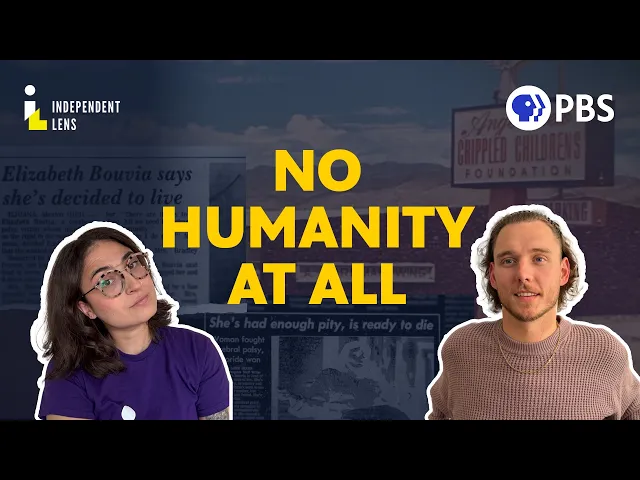
What Do Disabled People Think of Assisted Dying?
PBS Documentaries
0:00 I think that when a disabled person has the camera,
0:02 When a disabled person has the narrative,
0:04 it's far more powerful and palpable Because if you're
0:07 going to judge our quality of life, know it fully.
0:10 Hey, everybody, I'm Marissa Pina.
0:11 I work at PBS, and I'm so excited
0:14 to welcome you to our very first video podcast.
0:16 Today, we're going to talk a little bit about medical assistance in dying.
0:19 And the disability community.
0:21 who gets to make the decision about a person's quality of life?
0:23 And if it's worth living.
0:24 A conversation that's been spurred
0:26 by the Sundance Award winning film Life After.
0:29 The filmmaker, Reid Davenport, focuses on our northern neighbors Canada,
0:33 where Medical Assistance In Dying, otherwise known as MAID, is legal.
0:37 Canada, has expanded the scope of eligibility
0:39 from people for whom natural death was reasonably foreseeable,
0:42 to including individuals with conditions where natural death isn’t imminent,
0:47 including some disabilities.
0:48 However, there are people in the disability community who have said that they're
0:51 interested in this program because the cost of long term care is too much,
0:55 or what they're being offered just isn't enough.
0:57 the film made me contemplate if the system
0:59 for assisted dying has developed into one
1:01 where making life and death decisions is based
1:04 on finances or pressure from others over compassion.
1:07 this is a nuanced conversation and one we
1:10 wanted to facilitate with members of the community.
1:12 Joining us for that conversation is Imani Barbarin,
1:15 a writer, speaker, and prominent disability rights and inclusion activist.
1:19 And if you're chronically online like I am,
1:21 you probably know her as Crutches And Spice.
1:24 Cole is most known for his work on YouTube and online,
1:26 sharing his life with his wife, Charisma.
1:28 They started Roll with Cole and Charisma.
1:30 After an accident in 2011 left Cole paralyzed from the chest down
1:34 with the goal of educating and showcasing life as an interabled couple.
1:38 And last but certainly not least, we're joined by Anna Sarol.
1:41 Anna is a model, content creator, and disability advocate.
1:44 She uses her platform to raise awareness
1:46 about the disabled community and promote inclusion.
1:49 I'm so excited to have you all here.
1:50 Thank you so much for joining us, and let's get started.
1:54 Who should be helping to guide these conversations around ethics
1:58 and and trauma and these medical spaces for disabled people?
2:03 I mean, I think it should be disabled people ourselves,
2:06 particularly disabled people of color,
2:07 who are at the access of both racism and ableism.
2:11 I think that when we're talking about systems playing,
2:15 using our bodies as playgrounds, that's kind of ground zero.
2:19 And so that's who I'd like to see leading
2:21 a lot of these conversations around inclusion of disabled people.
2:25 But whether or not there's a willpower to make that happen is another story.
2:28 Yeah.
2:28 And I'm worried that with the wrong people,
2:31 that's where the slippery slope gets slipperier, you know.
2:35 Because there's definitely a...
2:36 there is a cohort of the disability community that's dead
2:40 set on making sure that disabled people are treated, quote unquote,
2:47 equally and in an, an unequal sense,
2:50 trying to prove value to non-disabled people when in reality,
2:54 you know, they could use the same accessibility we could use.
2:58 And we are a very large and diverse
3:00 community and there's so many different viewpoints I,
3:02 like Cole said, I do worry the wrong people will have the mic.
3:06 I don't know who, which activist, said this, but he said it best.
3:11 He said, “Nothing about us without us.” And it's something that's
3:15 so simple that you would think that people are- I mean,
3:18 like that, it's a no brainer.
3:19 But we don't see it applied.
3:23 And that's the unfortunate reality.
3:25 I think it's so important to hear from people who are part of this film.
3:28 So let's take a look at a clip showcasing one person's story,
3:32 whose finances impacted all of their decision making around their health.
4:24 That's so devastating.
4:26 I mean...
4:29 I hate how it seems like for disabled people,
4:32 it's always the choice between two lesser evils.
4:35 Why does that need to be the case?
4:38 Yeah, and I think his fear of long term care is also very founded as well.
4:43 every Western society is never really fully funded the balance
4:47 between independence and interdependence in the home and community based
4:52 services versus institutionalization and institutions are not great places
4:57 for, for, particularly for a lot of disabled people, disabled adults.
5:01 So, I completely understand his logic on that, but it's just devastating.
5:06 He has to make that choice based off of money.
5:09 That's hard.
5:10 I mean, I we all know what it's like to pay for this life.
5:15 And being disabled is incredibly expensive and not financially feasible.
5:20 And to repeat what he said, that he didn't want to die,
5:23 but this was, in his mind, the only choice.
5:27 And again, that's a harsh reality that we face as people see
5:31 our lives and they sometimes think surface level in the sense of like,
5:35 oh, all you have to do is pay for a chair
5:39 and then it stops at that, or a mobility device, and it stops at that.
5:43 When it's so much more complex than grabbing
5:47 a mobility device from a shelf at Walmart.
5:50 He's just talking about care.
5:52 I mean, I've written an article years ago,
5:55 and the research showed the disabled people spend about 30% more
5:58 of our income for the same quality of life as non-disabled people.
6:02 He's not just thinking about just care.
6:04 It's every little thing that needs to be
6:07 accessible in his life so he could survive.
6:10 think it's a, you know,
6:11 a glaring inditement on our health care systems that it's a better choice,
6:17 it's easier to not live in the system like you'd really literally
6:22 rather not live in the system that we currently have in place.
6:26 How is that not like that should be sirens to people, you know.
6:31 It should be so obvious.
6:32 Wait a minute.
6:33 People.
6:33 People would rather die.
6:35 Then deal with our system.
6:38 We're really giving these people such little support that...
6:43 I don't know...it...
6:44 That just blows my mind.
6:45 And also, people need to realize this is them.
6:49 This is not just disabled people talking about our quality of life.
6:52 You will inherit this system should you become disabled.
6:55 And there's nothing stopping you, right?
6:57 Do you want to choose between being locked away and being able to live or dying?
7:03 That's not a choice that anybody should have to make.
7:05 it seems to be about disability erasure and erasure of identities that exist.
7:10 That able bodied people would rather not see or think about disability.
7:14 how has this feeling impacted you?
7:17 It's so frustrating.
7:18 I don't know, it's very, it's, it's mind boggling.
7:22 To be a part of such a large population
7:24 of people like we represent 27.2% of the U.S.
7:29 population.
7:29 And yet every single time you bring it up,
7:31 even with people who have good intentions,
7:33 it's a, “Oh, we don't claim that.” Oh, we don't see you any differently.
7:38 Oh, well, it's, it's you're complaining.
7:40 You, you know, you just rise above.
7:42 There's all these excuses to erase disability and the ways
7:45 in which our society's not designed for us.
7:48 But there are very few concepts and ideas
7:50 coming from these communities to include us.
7:52 And that's the most frustrating part,
7:54 is that there's this almost, I want to say, almost belligerent.
7:59 It's the inclusivity that we have in our society where everybody
8:02 is treated exactly the same when that's not what disabled people need.
8:06 We do need support.
8:07 We do need intra-community.
8:09 We do need, power, political power.
8:14 It's not just about us looking nice, looking like lawn ornaments.
8:17 to Imani’s point, it's still hard to really get through to people because like,
8:21 I see so many comments on our videos like,
8:24 oh, I just love y'all's content so much.
8:26 Like,I don't even see Cole’s wheelchair anymore.
8:29 And I'm like, well, that's that's not really the point.
8:32 You know, you can that's a huge part of who I am, my identity.
8:35 I'm like not ashamed of it or something.
8:38 So for someone to just be like,
8:39 I don't even see that as if it's it's like a great thing.
8:42 It's like, well, then you don't really see me.
8:44 That's, that's part of me then.
8:46 And I want you to see that, and I want you to have
8:50 the awareness from watching my videos of me doing things in my wheelchair,
8:54 talking about issues, you know, around disability.
8:58 so, Judy Heumann has this quote and I'm going to butcher it.
9:01 But essentially the sentiment was people say we're invited to the table,
9:07 but no one ever asks if that table is accessible.
9:10 And I think that just encompasses everything that we have all mentioned.
9:15 Yea, and I think it has a lot to do with the infantilization of disabled people,
9:18 they don't really see us as political actors or community members.
9:21 They kind of see us as...
9:23 for lack of a better word, pets.
9:25 like, oh, we can get to those needs a little bit later, keep them fed,
9:28 keep them housed, keep them healthy,
9:29 and then they’ll be happy and do whatever they want.
9:32 But we want full purchase of our full autonomy.
9:35 I don't care if I can make it into a party as much as I can,
9:39 have equitable rights to be paid equally,
9:42 to get to my grocery store, in a, in a timely manner,
9:46 to be able to afford my doctor's appointments, and my medication.
9:50 Like there's all this emphasis on this, like very tertiary surface level
9:56 inclusion rather than the actual political purchase we demand as a community.
10:02 Marissa, you said that you’re able bodied.
10:05 But, are your glasses prescription?
10:07 They are.
10:07 Right, so you have a disability, your disability is just accommodated.
10:11 So, your ability to make decisions about your quality
10:13 of your life are completely different than ours.
10:15 I think that you guys are bringing out really great points that are
10:18 something I kind of want to dive a little deeper into, in particular,
10:23 while we talk about, the medical system and access to care.
10:27 Was there ever an event in your life that led to your first
10:31 realization that maybe the system is not as equitable as you might have thought?
10:36 Being born, you know, I, you know, I was born with my disability.
10:39 And so I've been in advocacy spaces, in disability spaces my whole life.
10:45 Even from my childhood,
10:46 I went to a school that was designed for disabled children,
10:50 to prepare us for the world.
10:52 And, you know, I try to tell people that you know,
10:56 for a lot of people, their home is their safe space.
10:59 It’s the place where they can relax and everything.
11:02 But simply just waking up in the morning is
11:04 my first realization that my world is not built for me.
11:08 You know, I'm lucky enough to try to make my space as accessible as possible,
11:13 but even the height of a bed or the height of a mattress,
11:17 like every little decision I have to make,
11:19 is based off of standards and policies.
11:21 So, I acquired my disability, when I was 14.
11:25 And, as I reflected back on specifically attending or going to hospitals,
11:32 one of the things that seems like an example I'll
11:35 give that might seem insignificant is how inaccessible body scales are.
11:41 And again, this seems seemingly insignificant.
11:44 But when you consider that body scales require for a patient to stand on it,
11:51 you recognize that being able to weigh yourself is a privilege.
11:56 In that capacity where you know it,
11:59 it became inaccessible to me and we recognize that, That’s
12:03 a, a piece of data that kind of just disappears.
12:07 I mean, oftentimes I'll go to a hospital and go for a follow up checkup,
12:13 and doctors will come to me asking, what's, what's your weight?
12:17 And I'm just supposed to make the assumption of what my current weight is.
12:21 Things like that needs to change.
12:23 And when it comes to physical barriers that exist for disabled people.
12:28 And I wanted to add too, that that adds danger to your life,
12:31 because if you ever have to go under the knife or you have to have surgery,
12:35 they need to know your exact weight to dose you properly.
12:38 Right.
12:38 And so you're in a setting that is quite literally designed for disabled people,
12:42 medical settings that are not designed for you.
12:45 In my experience, I think graduating college
12:50 and realizing that for me to start earning money,
12:53 it's going to be a long, long uphill battle.
12:56 Just knowing that all of the benefits that I was
12:59 relying on, that my family was relying on, Were just,
13:02 were slowly going to dwindle away.
13:04 The more I started to earn, it made me not want to go earn, you know?
13:09 And even when I, you know,
13:11 made that choice to to go earn it was very convoluted and a very murky system.
13:16 And I had to have an expert hold my hand through the process.
13:19 And I feel like I'm a pretty bright guy.
13:21 You know, it's just so difficult the way that it's set up right now.
13:25 And then to make matters worse, once I,
13:27 you know, found Charisma and I wanted to get married,
13:30 I knew that, that was going to be the end of the road for benefits right there,
13:33 because there isn't marriage equality.
13:36 And that, that's not equitable.
13:39 That is not an equitable system at all.
13:41 Cole, talking about community and how inside influences impact the lives
13:46 of those with disabilities reminds me of a clip from this film.
13:50 So let's take a look at a clip where our filmmaker,
13:52 Reid Davenport, explores the interest form for MAID.
15:39 I can relate to what he mentioned of, I don't know where I would be.
15:44 I think that they have shielded me from so much and have also
15:48 empowered me to be able to determine the life that I'm going to live,
15:53 and not let societal views and assumptions and stereotypes creep in.
15:58 when people are thrust into a new life
16:00 of disability like that quickly with a spinal cord injury.
16:04 There are...
16:06 people who don't have the community and you can see the difference in outcome.
16:10 It's very, very apparent.
16:12 In fact, I moved into a gentleman's room at my rehab hospital who passed away
16:17 not shortly after that because he was trying
16:20 to get onto a public bus by himself.
16:22 He didn't have a caregiver with him,
16:23 and he got a mucus plug in his ventilator, and he died.
16:28 And like, there's there's no way that that ever would
16:31 have happened to me because I always had people around.
16:33 I always had caregivers.
16:34 I never had to get on the, the public, transportation.
16:38 And that's, that has always stuck with me because
16:41 it made it very apparent how privileged I am,
16:44 and how much community and support matters in people's health outcomes.
16:49 So I wanted to ask all three of you what
16:51 it meant to you to see a film from Reid, who is a part of this community.
16:55 I think that when a disabled person has the camera,
16:57 when a disabled person has the narrative,
16:59 it's far more powerful and palpable to understand our experiences,
17:04 to understand who we are, rather than making assumptions based off of ideas
17:09 that we didn't even have a hand in creating.
17:11 And so I really hope people understand the importance
17:15 of disabled storytellers and disabled narratives and put more,
17:19 resources and time into making sure that we
17:22 have the capacity to tell our own stories.
17:25 Because if you're going to judge our quality of life,
17:27 know it fully On a more like,
17:30 just basic level, the little moments where Reid's rolling around town.
17:34 You know, he's showing his wheels,
17:36 going over the curbs and sidewalks and stuff like that.
17:38 It makes it so just, like, relatable and, and makes you feel like, okay,
17:42 I'm really watching one of my people out
17:45 there trying to tell me about this and inform
17:48 me about this, and that gives me a lot of like, trust in the film.
17:53 So those little shots meant something to me.
17:56 I was curious to ask all of you,
17:58 What was something that you learned from some of the participants?
18:01 And how has that shifted maybe you're thinking
18:04 towards certain things like disability justice or MAID.
18:08 I think Reid really kind of encouraged people
18:12 to understand that disability is not a monolith,
18:16 and that we're all looking at this from different perspectives,
18:20 both through a bodily autonomy lens
18:22 as well as through a systemic oppression lens.
18:25 And I think a lot of people don't want
18:27 to look at the fact that disabled people are systemically oppressed.
18:31 And it's, it bears itself out in every single interaction we have,
18:35 every single barrier we face.
18:36 And I think that that's what the film really kind of highlights very,
18:39 very well is that we are all just trying to make it work.
18:43 Realistically, we are just really trying to make
18:45 it work and we don't have the tools
18:49 and a lot of ways that have been promised to us to survive our own lives.
18:55 And I think that that's kind of the hardest thing to contend
18:58 with is the, the core question of the, of the film,
19:01 which is who gets to make that choice when quality
19:04 of life is out of our hands to begin with?
19:07 That’s so good I think the only thing that I
19:10 would like to add is that one thing that I
19:13 really appreciated about the film was how it offers
19:15 an accurate and humanizing representation of an often overlooked population,
19:21 and I think they do a good job at bridging that gap
19:27 of what society thinks disability is and what it actually looks like.
19:31 And I mean, I it's one thing that as a viewer, I loved seeing.
19:37 And made that gap abundantly clear.
19:39 Right.
19:41 And also, it's really interesting to what non-disabled people will engage with.
19:45 And like we've been talking about social media,
19:48 for much of our, our lives, disability representation has not been in our hands.
19:53 Much of our population's existence.
19:56 And so they're making very off assumptions about us,
20:01 based off of narratives that are not even in our hands to begin with either.
20:05 Is not just that our autonomy isn't in our hands?
20:07 Is that the media that they are specifically seeking
20:09 out on disability also isn’t in our hands either.
20:13 And so like things like this are really crucial so
20:16 that people understand who we are and what we're about.
20:19 I'd love to hear about how you first
20:21 got involved in the topic of disability justice.
20:24 Sure.
20:25 So around 2014, I had just graduated college,
20:29 and it was really difficult for me to find a job.
20:32 Every single time I disclose I had a disability could not find one.
20:37 And then as soon as I stopped disclosing, I started getting offers.
20:41 And, while a lot of people think that it's, like, fake because,
20:45 “it's supposed to be equal opportunity.”
20:47 We all know that's not necessarily true.
20:49 But it it really kind of spurred me to start my blog, Crutches and Spice.
20:56 com, because there there's no guidance on being an adult with a disability.
21:01 There's also very little representation of Black
21:03 people with disabilities that also claim their disabilities.
21:07 And so I wanted to kind of just share
21:11 who I am and share my experiences with the world.
21:14 And I learned very quickly that I couldn't do this in isolation.
21:17 I had to form and build community with other disabled people.
21:21 When Charisma and I are posting our videos.
21:24 And as time progressed,
21:25 we started seeing more and more people sharing from the hospital
21:29 where they were rehabbing because they were just injured.
21:32 And they're like, okay, seeing all of your videos,
21:34 I have an idea now what my life could look like.
21:37 And that makes me feel, feel really good.
21:40 I find that really rewarding.
21:41 And I, and I want to, I want to be
21:44 a part of that and, and, and kind of reshape people's perspectives,
21:48 especially when they're at the lowest of lows.
21:50 when I broke my neck.
21:53 I did ask my brother to kill me.
21:55 I was like, I didn't really see the point.
21:59 You know, I didn't even know my disability at the time.
22:01 I hadn't even fully processed.
22:03 And my mind immediately was like, I don't want to be disabled.
22:09 And that moment really hung with me a long, long time.
22:12 Yeah.
22:13 And especially in your situation too, like you said,
22:16 you didn't have a lot of exposure to disability before your injury.
22:19 I wonder what your thought process might be if you
22:23 did have a lot more exposure before your injury, right.
22:25 If you could see what it looked like to live
22:28 a life with, with a disability before you got injured,
22:34 if that would be your automatic, you know, desire, you know what I mean?
22:38 I think similar to what Cole said, We know what it's like to transition
22:43 from non-disabled person to a disabled person,
22:46 and that transition was really hard.
22:48 And I think if I had support in the way of in the form of representation,
22:57 I think that transition would look a lot easier.
23:01 And at the time when I got injured in 2014,
23:05 there wasn't a lot of videos out there that translate to what I was experiencing
23:12 in those early injury days and how
23:14 to navigate this life that I'm very unfamiliar with.
23:17 And so that led me to wanting to pick up a camera and essentially,
23:24 like, talk to early injured Anna in that capacity.
23:27 And I mean, she needed to hear a lot
23:31 of the lessons that I'm bringing in my content nowadays.
23:36 And I wish that I could just go back to the hospital
23:40 bed and say everything that I'm saying online and give it to her.
23:44 So what is it like being a social media creator
23:47 and potentially being seen as representative of the disabled community online?
23:51 I think that's a great question.
23:52 And it actually has been a bit of a challenge.
23:55 As, as Charisma and I have developed our business and grown.
24:01 At times I wonder if I am a relatable, you know, representation for some people.
24:08 You know, we we have a great marriage and, you know,
24:12 we have the capacity to go out and like,
24:15 you know, do a lot of trips and a lot of things all the time.
24:19 And, I don't know, it's interesting because a lot of people,
24:23 that's not their experience.
24:24 It's not their experience at all.
24:25 And representation is important and people are
24:28 looking for representation that they can relate to.
24:32 I think it's very nerve wracking to kind
24:34 of be a a large creator with a disability.
24:36 If I'm being honest,
24:38 I always get really nervous when I get a huge influx of followers.
24:42 Because I have to, like, temper it every single time.
24:45 So people, one, know that they're not talking to a child and then two,
24:50 know that I'm not the one.
24:52 So I think that when it's, you know,
24:56 having a huge online presence is also very difficult because
24:59 I try to be as humble as I can and understand,
25:02 like my experience is just my experience.
25:04 And I try to let people know that whatever,
25:06 whenever I'm talking from an individual lens, it's just me.
25:09 But I try to draw things out to more systemic ideas around disability,
25:14 ableism, and eugenics, because those that's what everybody experiences,
25:18 no matter whether they can put a name to it or not.
25:22 And so that's kind of how I try to frame things,
25:25 is through a more intercommunal societal lens so
25:30 that people feel more included in these conversations.
25:34 And of course, there's always non-disabled people
25:37 and even sometimes a lot of disabled
25:39 people that will try to position disability as some sort of fringe issue,
25:46 where, you know, our needs are already taken care of.
25:49 I saw this TV show and you all are lying about benefits.
25:53 You all are lying about the inequality you experienced.
25:55 And no, this is very real.
25:57 This is very real to us is something we live every single day.
26:00 And I think that those are the most irritating comments because everybody,
26:08 wants representation.
26:09 And when disabled people want to represent themselves,
26:12 we're not seen as, like I said before,
26:16 reliable in talking about our experiences.
26:18 And so that's what I always have to deal with.
26:22 Yeah.
26:22 I mean, it's it's difficult and it's hard.
26:25 I mean, everything that they had already mentioned,
26:28 sometimes I feel like I experienced a little
26:31 bit of imposter syndrome That’s a really good point.
26:33 All of a sudden now you’re speaking on everything,
26:36 And I’m not an expert in law, you know, I’m not an expert in, health care.
26:41 I have my lived experience,
26:42 and I try to make it individual like Imani was saying.
26:45 But it does, it does start to feel after awhile like
26:48 You’re supposed to be the voice for everybody, and I can’t...
26:52 I can’t speak for everybody, I’m figuring my own stuff out, you know.
26:55 I think that’s where we all,
26:57 as creators, have, like, a responsibility to, repost,
27:00 share the voices of other disabled people whose experiences we can’t speak to.
27:05 I want to share one more clip with you all this time.
27:07 We're going to hear from Reid as he talks to Elizabeth Bouvia’s sister.
27:12 Elizabeth Bouvia was a disabled individual
27:15 who fought for medical assistance in dying,
27:17 and was a huge inspiration for the creation of this film.
27:22 Reid is trying to uncover what happened to Elizabeth
27:24 and why she might have wanted to die.
28:25 Yeah, it's very, very scary thing.
28:26 I mean, in talking to the sister of someone who was going through this program,
28:31 I imagine she felt the energy from these doctors and, you know,
28:34 and she's nodding your head saying, yeah,
28:36 they probably just want to get rid of it.
28:39 That's very scary.
28:41 Yea and to Reid’s point, you know,
28:43 doctors seek to eliminate, because disability is the deficit.
28:48 It is the difference.
28:49 It is to be eradicated.
28:52 But how, how much are you treating when
28:56 you're trying to get rid of a disability?
28:59 And if you're only seeing disability as a deficit
29:01 while treating it does eradicating it mean eradicating us too.
29:07 I think something that this clip does a beautiful job
29:09 at is emphasizing just how ableist those power structures are.
29:14 And so Reid did a great job at highlighting that.
29:17 in your opinion, what would an ideal
29:20 support structure for something like MAID look like?
29:23 I have an idea I kind of want to throw out first to get y’all’s opinion on it,
29:26 I'm not an expert at these things, but perhaps it would make sense,
29:31 And I kind of formed this, opinion around Michal's experience in the film.
29:36 How, like, he was pretty set on, you know,
29:39 going through with the, the MAID program.
29:42 And once he had all the support and the care
29:45 that he needed and all of the accommodations that he needed,
29:48 he changed his mind.
29:50 I'm wondering if for those who would like to go through with the program,
29:56 maybe there's like a waiver or something.
29:58 I know when I was first injured,
30:00 I was put onto a particular waiver that gave me certain benefits.
30:04 Perhaps there's a waiver that we could make this like
30:06 6 to 12 months where someone can apply be brought on.
30:11 Maybe they have all of the their needs covered for that window.
30:15 And that includes, you know,
30:16 meeting with the counselor, therapist, whatever that may be.
30:19 And then at the end of that program,
30:22 if they still feel like they want to move forward, they can.
30:26 I don't know.
30:28 This is just a loose thought.
30:29 I'm throwing it out there.
30:29 What do y'all think?
30:30 No, I agree, I think that...
30:32 Well I think that a lot of people's desire for things like
30:36 MAID and medical assistance in dying is basically more systemic than individual.
30:42 And while I think, and while I do think that 6
30:45 to 12 months would be a good stopgap for those situations,
30:50 I think we also need like legislation for universal
30:53 health care and, universal basic income for disabled people.
30:59 And Canada is an interesting case because while they do have a lot
31:03 of like medical care and a lot more supports than, you know,
31:08 a very pay to play version of the United States,
31:12 the issue is also that they went through
31:14 a lot of austerity measures at the same time.
31:16 That reduces that ability to get that care.
31:19 I think that within the United States,
31:21 we don't really do too much education in the community
31:24 around what it is you have access to.
31:27 And we also don't let people know what works for us.
31:31 I think that once we start addressing some of the systemic issues,
31:36 I think for longer than those 6 to 12 months,
31:38 I think that I would at least be a lot
31:42 more comfortable with medical assistance in dying and under,
31:45 and, you know, having people have more access to that tool.
31:50 When you look at the system as a whole, it's less about choice and more about
31:57 convenience and cost and just discomfort with difference.
32:02 And I think one thing that I thought about was if
32:07 we could start at the foundation with medical providers in education,
32:12 and get into, humanizing disabled people in the context of, like,
32:22 what they're reading in books and lectures and, pretty much just
32:27 draw out the point that there is a social model of disability.
32:32 And then there's a medical model of disability,
32:34 and the social model isn't oftentimes talked about.
32:39 And that, I believe, is what reflects the whole picture of living
32:44 life with a disability rather than the medical model,
32:46 seeing us as a diagnosis or something to cure or, etc..
32:52 And so I think there's something to be said about that.
32:57 Yea, we're a financial burden on society.
33:00 I think that's a great, great point.
33:02 And part...
33:02 Isn't that kind of what Reid was trying to point out too is
33:06 like when you have people making the decisions based off of stats on paper,
33:10 there's no humanity there at all.
33:13 And that is going to be, you know, that's a slippery,
33:16 dangerous slope, that we got to be careful about.
33:20 And I think we’ve all had the experience where you, even in doctors’ offices,
33:24 even in front of medical providers, they're not even speaking directly to you.
33:28 You know, it's always the mom,
33:29 your mom or your dad or like to somebody you brought with you to take notes,
33:33 and you're not even declared,
33:36 an authority over your body while you're talking to your own medical provider.
33:40 I've had situations where they didn't see my crutches right away,
33:45 and they were talking to me normally.
33:46 The second they saw them, I started getting baby talk.
33:49 That's not somebody I want dictating what my quality of life is
33:52 supposed to look like when they are determining my quality of life.
33:55 They don't really realize as medical professionals,
33:58 just how far reaching their jobs are.
34:02 And I think that that's kind of devastating to realize as well.
34:05 I wonder if you guys had a, have an idea, an opinion on, how we can practice
34:11 an accessibility mindset around medicine that could
34:14 benefit all people or even just change the way that medical providers are,
34:20 talking to those with disabilities and actually talking
34:23 to them and not around them or to somebody else.
34:26 Yeah, I think the key is getting people
34:29 with these, with our perspectives in the right positions.
34:33 I don't think there are enough disabled people that are
34:37 making these decisions or placed in a hospital system to train,
34:41 you know, everyone there on disability etiquette and understanding those things.
34:47 Although you would expect medical professionals to be
34:50 the ones that get it, you know.
34:52 But, yeah.
34:54 Yeah, I think that doctors and medical professionals need
34:57 to go through some social work training as well.
34:59 While I do think that speaking
35:02 to and with other disabled people is extremely valid,
35:05 and I want to see that done more often.
35:09 I think also they need to understand,
35:10 like the far reaching impact of what happens in their doctor's offices.
35:15 There are so many doctors that have no clue
35:17 that if you write something down on my chart,
35:19 it could determine whether or not I have access to my life.
35:23 Getting into my home, getting into my my car.
35:26 Like they have no clue just how far reaching, their jobs actually are,
35:32 and they need to have a lot more awareness of just how much power
35:36 they actually hold over the population of people that they see every single day.
35:40 when I was watching the film,
35:42 I couldn't help but think about what the future could look
35:46 like here if it became as accessible as it is in Canada.
35:51 And to me, that kind of seems a little scary.
35:56 And I wanted to know how how you all felt about
36:01 that, because I think I was really struck on, like, how,
36:06 what we talked about at the beginning,
36:07 but also while I was watching the film that a lot
36:10 of this is used as like a financial, fix.
36:14 And so I, I thought that it was kind of scary to think,
36:17 like, if we bring it to the U.S.
36:19 I think it's going to really stigmatize it very badly.
36:22 Particularly in medical settings.
36:25 I fear that people, instead of getting actual treatment,
36:28 will just be shoved over to MAID, and those types of things, many,
36:36 many disabled people in Canada have come forward
36:38 to say that, like their doctors have been
36:41 openly suggesting them and suggesting to them medical
36:45 assistance in dying and in lieu of treatment.
36:49 And so that's what I fear the most,
36:51 is that and like I said, in, in particularly in such a racialized society,
36:55 as the one we have, that’s my greatest fear,
37:00 is that people will be pushed to this instead
37:03 of actually getting the care they need.
37:06 I would, I would agree with that completely.
37:09 I mean, to keep it short and sweet, I think I fear that.
37:13 How quickly people are to push a cure onto us
37:16 is how quickly they would be to push on MAID.
37:21 I tend to agree with both of you.
37:23 I mean, just the fact that when I broke my neck,
37:25 I immediately went to I went there, you know, like, I don't want to do this.
37:29 And I had little idea of disability.
37:31 Like, I can only imagine if like I had
37:34 seen stuff in the news cycle about MAID and how,
37:37 you know, disabled people want to just die and stuff,
37:40 and then I sustain my injury.
37:41 I would have been like, there's no shot I’m gonna do this.
37:44 I want to do what they did.
37:46 So I have a lot of concerns with with how it
37:48 will impact the stigma that we've been fighting so hard to combat.
37:51 And I think that in a country
37:53 where we are reluctant to have disability representation,
37:56 reluctant to have universal healthcare,
37:58 reluctant to have universal basic income, reluctant to have rental protections,
38:03 and all of these systemic,
38:06 all of this systemic welfare people will automatically choose that.
38:11 And that's my fear.
38:13 I wanted to be able to bring in a little bit more of a lighthearted
38:17 mood and kind of play like a little rapid fire game with you guys.
38:21 My first question is what do people think you spend your day doing?
38:24 And what do you actually do?
38:26 I think people think that as a content creator, all I'm doing is hitting upload.
38:31 And pretty much that's as far as my 40 week work looks like.
38:38 What I'm actually doing is being,
38:41 producing a one woman show where I'm working on pre-production,
38:46 production, post-production, managing social media,
38:48 and there's just so many roles within that.
38:51 I think people think I'm just like laying around all day,
38:53 which is fair because I am in my pajamas a lot.
38:56 But, I'm also a consultant, a writer.
39:01 I'm editing my book.
39:02 I'm a friend, a girlfriend, all these different things.
39:07 So I'm doing a lot of things all the time.
39:10 I think people assume that I, I'm doing what's in my content,
39:14 which is like gallivanting around with my wife.
39:17 When in reality, I'm probably editing or responding to emails or mustering up
39:23 the energy to get back to texts that I haven't responded to in several days.
39:27 Next question.
39:28 if you could choose a different profession, what would it be?
39:31 Anna, let's start with you.
39:32 I'd probably say a wedding planner.
39:36 I probably would say a screenwriter.
39:38 I’d probably just, like,
39:39 be a peer mentor in a hospital or, like, a patient advocate.
39:43 What's one misconception that you always hear about
39:48 your community that you would like to disprove?
39:51 This is probably coming into mind because
39:53 it's most relevant in my life right now.
39:55 But people don't think disabled people get married.
39:59 But is that why you want to be a wedding planner?
40:02 Partially.
40:03 I'm also in the season of planning my own wedding.
40:05 So, like, all of this is just very, up in front of my face, so.
40:11 Relatable.
40:12 Imani?
40:13 Disabled people’s desire is to be non-disabled.
40:19 Which I've never wished for that, but, I mean,
40:22 at least for me personally, And I just want access to my life fully.
40:28 I don't want to be non-disabled.
40:30 I think I have two.
40:32 One is that quadriplegics can't move their arms.
40:36 That's really frustrating.
40:37 I had people tell me all the time that I'm
40:39 not a quadriplegic because I can move my arms, which is not the case.
40:44 And then it's similar to Anna's point.
40:46 Just the fact that, disabled people can be in loving relationships,
40:51 even if it involves caregiving.
40:54 Is there a story that sparks joy or optimism found in the work that you do?
41:01 I think any time that, newly disabled person or disabled person who
41:06 has felt a lot of shame feels more comfortable in their own skin.
41:12 To then go out and get the mobility aid,
41:13 to then go out and get the help they need.
41:16 I'm always really encouraged and I love watching my comment sections.
41:20 I will try not to get teary-eyed, but like,
41:21 I always watch my comment sections and I see like two disabled people
41:26 like going back and forth teaching each other how to advocate for themselves.
41:30 Like, I love that I'm a part of that space or that I'm creating that space.
41:34 And that's what matters the most to me out of anything that I could do.
41:39 And that's beautiful.
41:40 I’ll trying not to get teary-eyed myself.
41:43 I recall a message we got from either a mother or father of a very young,
41:48 disabled girl who used a wheelchair.
41:51 And the message was, sharing how when they put our video on the TV,
41:55 the daughter looked up and said, whoa, that's just like me.
41:58 It’s just like, he uses a chair, just like I do.
42:01 I was like, oh my gosh.
42:05 That means a lot to me.
42:08 We've been talking about representation and how important that is.
42:10 So...
42:11 and this will be like the first generation that's
42:13 growing up with social media and like the representation
42:16 that we've been able to create and, being a part of that is dear to my heart.
42:22 I recently did some peer mentoring
42:25 with, another early injured spinal cord injury individual,
42:31 and their story seemed so similar to mine
42:35 in the sense of like when they were injured,
42:38 when they acquired their disability, what their disability is,
42:41 even down to their name and the way that, I mean,
42:48 she didn't have to say anything.
42:49 I can tell that even just looking through her eyes,
42:53 that she knew that she was going to be
42:55 okay was so touching and beautiful to see.
42:58 And it, I mean.
43:01 It's the reason why, why I do what I do.
43:04 Unfortunately, our time has to end.
43:07 But, thank you all so much for such a great conversation.
43:11 And, to the viewers at home, or those of you who are watching this conversation.
43:16 If you want to learn more about this topic, take Cole’s advice.
43:19 You can watch the film Life After on the PBS YouTube channel or PBS app.
43:24 It's streaming now and the link is, of course, below.
43:27 Thank you so much.