Who Built These Ancient Skyscrapers?
The Present Past
0:00 Somewhere in the desert there's an ancient city that seems unreal.
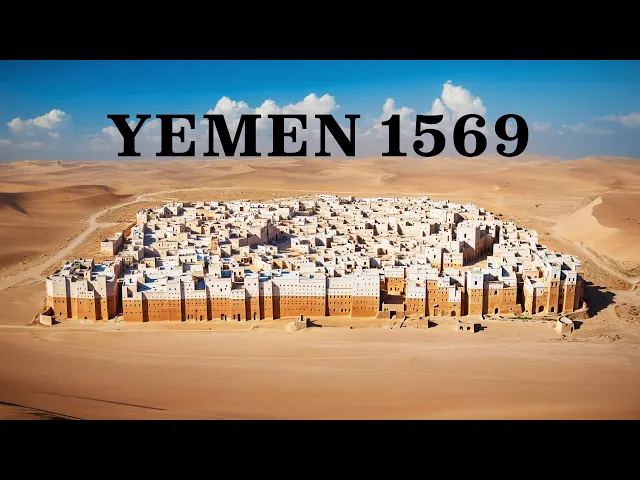
0:05 This is the oldest skyscraper city in the world.
0:09 Hundreds of apartment buildings dominate the skyline.
0:13 Some go up to 11 stories.
0:16 Modern skyscrapers are made of concrete and steel.
0:19 But this city is 2000 years old and made of mud.
0:23 Who built this city?
0:24 Why are the buildings so tall?
0:27 And how did they do it?
0:29 This is the old world city of Shibam.
0:34 I've been fascinated by the city ever since I saw this picture.
0:42 At first I didn't believe my eyes.
0:46 This ancient city just looked too modern.
0:49 Even comparing it to a modern place like Manhattan,
0:52 part of the city of New York, Shibam is special.
0:56 The city is 330 by 240 meters.
0:58 This is about the size of three apartment blocks on Manhattan,
1:02 part of the densest city of the United States.
1:06 With a population of 7,000, Shibam is way more densely populated.
1:10 And it's way older.
1:12 They were already building tower houses in Shibam during the Roman Empire.
1:17 It's also special when you compare it to its surroundings.
1:21 People use mud brick across the region.
1:24 But nowhere do they build as tall as in Shibam.
1:27 I thought that was strange.
1:30 What I found even stranger is how abruptly the city ends.
1:33 It just sits there in the middle of the desert.
1:36 There seems to be plenty of space around it.
1:39 There are even other buildings close by.
1:41 So why did they build so high?
1:45 Going into an investigation on a city like this starts with curiosity.
1:51 It's about wanting to know more about the world around us.
1:55 If you're also curious, I think you're going to like the sponsor of this video.
1:59 Imprint helps you to turn your doom-scrolling device into a learning tool.
2:02 Imprint helps you to take small moments of time
2:05 during the day to really build a learning habit.
2:07 Imprint has taken the most important concepts from disciplines like
2:11 philosophy and psychology and turned
2:13 them into these beautiful bite-sized lessons.
2:15 Everyone learns in a different way.
2:17 But I'm convinced that visuals are extremely
2:20 important to really help you understand the topic.
2:22 And that's why I'm in love with the beautiful design of this app.
2:26 It makes me want to come back to it.
2:28 Each course is designed to get to the core,
2:30 so you can easily get an idea about the topic.
2:33 There are courses on finance, on productivity,
2:35 and even on the science of happiness.
2:37 It's no wonder that this was 2023 Google's App of the Year.
2:41 I'm really enjoying it.
2:42 If you want to try Imprint yourself and get a free 7-day trial,
2:47 you can scan the QR code on screen or go to the link in the description.
2:51 With that, you also get 20% off an annual premium subscription.
2:55 And now, let's get back to those skyscrapers.
3:02 Shibam is in Yemen, a place you've probably only heard mentioned like this.
3:07 As fears grow over wider war in the Middle East,
3:11 explosions rocking the capital of Yemen.
3:13 It's one of the worst humanitarian crises we've seen in almost a century.
3:18 Yemen's Houthi rebels say they've attacked another cargo ship in the Red Sea.
3:22 14 million people that are sort of at risk of famine.
3:25 But I wanted to show you a different side of this country.
3:29 So instead of going there,
3:30 I reached out to every filmmaker from Yemen I could find.
3:33 And eventually, I got in touch with Mohamed.
3:38 Mohamed visited Shibam and talked to the locals.
3:41 What we found was a story of humans adapting to a harsh environment.
3:46 Of an ancient city with a vibrant community.
3:49 And why this city might be in danger.
3:57 But before we let the locals tell their story,
3:59 why even build a city in the middle of the desert?
4:04 The geography of Yemen gives us the answer.
4:09 In this map, orange and red is where people live.
4:13 Most of Yemen is empty.
4:15 The majority of the population lives in the west.
4:18 In the mountains, where you can find the capital Sana'a.
4:21 And on the coast, in places like Aden.
4:23 The middle of Yemen is a big desert where almost no one lives.
4:28 But here, in the cracks of a plateau, you can find human settlements.
4:34 Settlements like Shibam.
4:35 These cracks have been created by something humans can't live without.
4:39 Water.
4:40 Shibam is located in a valley of the wadi Hadramout.
4:43 A wadi is a riverbed that is dry for most of the year.
4:47 But in the rainy season, the river flows.
4:50 That water can be stored to drink and can be used for irrigation.
4:54 People have been settling close to wadi's all over desert areas.
4:58 Because of this water,
5:00 Shibam became an important step in a huge caravan network.
5:04 A network that carried spices and incense between Africa,
5:07 the Middle East and India.
5:09 It's a strategic location.
5:17 Shibam was mentioned in Greek sources and was part of many kingdoms and empires.
5:21 But it was completely unknown to European explorers.
5:24 It took until 1893 for the first western travelers to visit.
5:30 They saw a city that rose from the desert, like the steep side of a cliff.
5:35 But it wasn't a cliff.
5:37 It was Shibam.
5:40 500 houses all crowded together in a narrow space in the middle of the valley.
6:11 I found it interesting that some of the first
6:13 travelers compared this city to Chicago instead of Manhattan.
6:16 Maybe because this building from 1885 in Chicago
6:19 was seen as one of the first skyscrapers.
6:22 A building that had a skeleton made of steel.
6:25 But in Shibam, all buildings are made of mud.
6:33 The people that settled here had to do with extreme circumstances.
6:36 It is often hotter than 40 degrees Celsius.
6:39 There are not many trees to use for construction.
6:42 And the desert stone is so tough it can only be used for foundations.
6:46 So the people here have to rely on other local materials.
6:50 They mix sandy soil with some clay and straw to make bricks that dry in the sun.
6:55 16 workers can make 8,000 bricks a day.
6:57 A house they build can stand for 300 years.
7:00 And maintaining this city is a constant process.
7:15 The material they use influences the design of the buildings.
7:18 To support the weight, the foundation of the homes is wider.
7:22 The walls can be one meter thick at the base,
7:25 tapering to 30 centimeters at the top.
7:27 After laying the bricks, they are then covered with mud plaster.
7:31 This can be a challenge for higher floors.
7:33 The top parts of the buildings are then covered by white lime plaster.
7:36 This helps to make them waterproof.
7:38 This construction is perfect for the climate.
7:41 The high buildings act like trees, limiting sunlight from hitting the walls.
7:45 The thick mud also acts as an insulator, keeping the heat out.
7:50 And the white lime has good reflective properties.
7:53 Why wouldn't you just put white lime on the whole building then?
7:57 Well, lime is expensive, so it then becomes a status symbol.
8:00 The most important buildings are completely covered in them,
8:04 like these mosques in the city.
8:05 But there are other ways to show status.
8:08 To personalize these apartment blocks,
8:09 the doors and frames are made from carved wood in the most beautiful patterns.
8:14 But building so high also has its challenges.
8:17 The houses don't have elevators, so how do the locals deal with this?
8:40 But it's not only residents that have to get up.
8:43 The city may be ancient, but Shibami residents want modern amenities
8:47 like refrigerators and air conditioning units.
9:08 The different floors also have very specific uses.
9:11 The ground floor is used for storage or shops.
9:14 It was often closed off for defensive reasons.
9:16 The first floor can be used to keep animals.
9:19 The second floor is for the men as a formal reception area.
9:22 The third floor is for women, it's the main family area.
9:25 And also where you'll find the kitchens.
9:28 The floors above that are for sleeping arrangements of different family members.
9:32 But the question remains, why did they build so high?
9:40 Ancient people liked to settle on elevated mounds.
9:43 They were easier to defend from wild animals and invaders.
9:46 When the space is limited, you have to go up.
9:49 According to archaeological excavations,
9:51 people were already building four-story houses in this region 2,000 years ago.
9:56 And still, Shibam is much higher than other cities.
10:19 There was a lack of space because 500
10:21 years ago something happened that changed Shibam forever.
10:27 Two floods in 1298 and 1532 washed away huge chunks of the city.
10:47 It is these floods that shape the city we see now.
10:50 From then on, the only place that was
10:53 considered safe was on this elevated mound.
10:56 For 500 years, the people have had to resist temptation to build a bigger city.
11:00 So it was built by the people that have been living here all along.
11:04 This has led to a site that's so special
11:07 it was placed on a 1982 UNESCO World Heritage List.
11:11 But there are dangers to this peaceful community.
11:16 In 2008 a huge cyclone approached Yemen.
11:20 This led to severe flooding.
11:22 This image shows where the flooding happened.
11:25 Some buildings collapsed and people died.
11:27 But it could have been much worse for Shibam.
11:30 The age-old knowledge of only building on high ground helped.
11:35 Another threat to the city is the raging war in Yemen.
11:47 In 2009 a terrorist killed four South Koreans and their guide.
12:10 The dangers to the city withstanding, it is still around today.
12:13 It's a city where locals are extra proud.
12:41 It's so connected.
12:42 There are even passageways that link individual houses.
12:53 It's easy to forget there are so much more
12:56 to place in the news than whatever the current headline is.
12:59 Shibam is an amazing example of the way humans adapt to their situation.
13:02 Living in a harsh region with limited resources
13:05 in a climate not really suitable to humans.
13:08 But still making it work.
13:10 Keeping alive an ancient tradition to preserve a beautiful city.
13:14 Making buildings that are fit for the climate
13:16 instead of making the climate fit the buildings.
13:19 It's no wonder that this place is a World Heritage
13:22 Site and has a special place in the hearts of citizens.