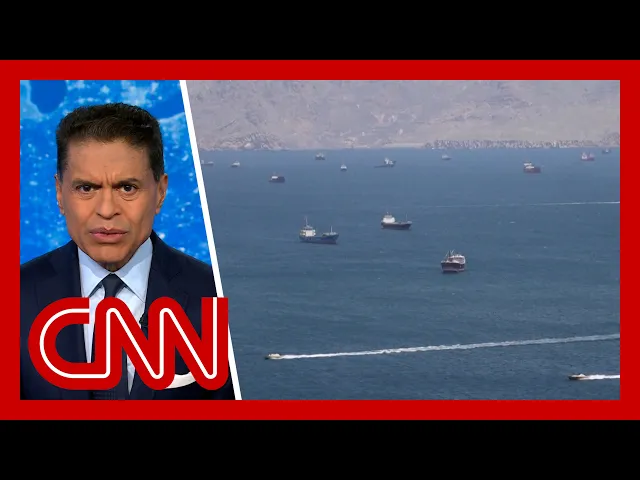
Trump 'can't imagine' Iran peace plan 'would be acceptable'
CNN
0:00 The war with Iran has entered its third month.
0:03 And while a shaky ceasefire holds,
0:05 diplomatic efforts between the US and Iran look like they're at an impass.
0:09 Last night, President Trump posted on True Social that he
0:12 would soon be reviewing the new peace proposal sent by Iran,
0:15 but that he could not quote imagine that it
0:18 would be acceptable in that they have not yet paid
0:21 a big enough price for what they have done
0:24 to humanity and the world over the last 47 years unquote.
0:28 The Straight of Hormos remains a central
0:30 flash point in the conflict with both sides
0:33 blockading the crucial trade route choking the global
0:36 economy as the price of oil has skyrocketed.
0:39 Joining me now is Anmirie Slaughter who will soon step
0:42 down from her role as CEO of the think tank
0:45 New America and become dean of the school of public
0:49 policy at the London School of Economics in early 2027.
0:52 And of course, retired Admiral James Stavitus,
0:55 the former NATO Supreme Allied Commander.
0:59 Um, Anmarie, it feels like both sides are dug in.
1:03 And when these things happen,
1:05 usually the question is who can bear the pain longer?
1:09 What's your sense?
1:10 Yeah, this really is a game of chicken, right?
1:13 Who's going to who's going to blink first?
1:16 I think the US is in a really risky
1:19 position because it's actually and ironically like Russia and Ukraine.
1:24 Ukraine Russia needs to win.
1:26 The US needs to win.
1:29 Ukraine just needs not to lose.
1:31 And Iran just needs not to lose.
1:35 And Iran has tremendous capacity to take pain.
1:38 Uh it's got an authoritarian government.
1:41 It's got a people who are now much more allied in favor
1:45 of that government than they were back in January with all the protests.
1:49 Uh, and it is the little guy against the big guy.
1:52 This is, you know, the US has been here before, like Vietnam or Afghanistan.
1:57 I really think the US is more likely to blink first than Iran.
2:02 And to add to that, like Russia, Ukraine, for the little guy, it's existential.
2:09 Exactly.
2:09 for the superpower.
2:10 It's one of many things.
2:13 Exactly.
2:13 Um Jim, when you look at the um the at the naval blockade, uh you know,
2:20 how how easy is it for the United States to keep this going indefinitely?
2:26 Um how is there a path for Iran to get some of its oil out?
2:31 You know, they've been talk about hugging the coastline
2:34 uh and and getting the oil out that way.
2:37 What is your sense?
2:39 I've sailed the straight of Hormuz close to a hundred times
2:44 as a sea captain and I have participated in several blockades around the world.
2:49 Um my conclusion is blockades are inherently very difficult to maintain.
2:55 Uh this is a thousand miles plus of coastline that we're blockading.
2:59 It's an act of war, by the way.
3:02 And and there's always going to be leakage.
3:04 Think the movie Gone with the Wind,
3:07 Rhett Butler showing up with beautiful cigars and silk scarves
3:11 from Paris through the Lincoln blockade of the American South.
3:15 Having said all that, I agree with my good friend Ann Marie.
3:19 Congratulations on the LSC, by the way.
3:22 And I would I would simply add I think in the White House they are now starting
3:27 to look at additional military options because this tale
3:31 of two blockades is going to be difficult to sustain.
3:35 So to conclude Fared I think the president's looking
3:38 at a probably a package of three different military options.
3:42 One go after more leadership try and take
3:45 out some of the intrigent members the revolutionary guard.
3:49 Number two, perhaps go after the oil infrastructure.
3:53 Quite risky, could lead to retaliation.
3:55 And third, let's call it strategic preparation of the straight
4:00 of Hormuz in case you have to open it militarily,
4:04 which may be the next move on the chessboard.
4:07 And if if this negotiation gets going, um it feels like the key issues are,
4:14 you know, straight or foremost has to be opened,
4:17 what to do about the enriched fuel,
4:20 and then the length of the suspension where Iran agrees not to sus.
4:24 And it feels to me like all Trump is looking for is
4:27 a deal that he can say is better than Obama's nuclear deal.
4:31 I think that's right,
4:32 but I think that's going to be incredibly hard to do because honestly,
4:37 had he kept Obama's deal, we would not be in this situation.
4:42 Uh, and it's very easy also for Iran
4:45 to just slow walk things uh and divide the issues
4:49 so that the hormu straight of hormuz issue is
4:52 one then they want to do nuclear talks later.
4:55 it's going to be hard for that to Trump to get
4:58 to a place where he can say I achieve my objectives.
5:01 And that's in part also because his objectives keep shifting.
5:05 He says it's about the nuclear energy,
5:07 but he also just said it's about originally
5:10 about getting the Iranians to overthrow their government,
5:12 which he says it's about 47 years,
5:15 which of course Iran's nuclear program is not 47 years old.
5:19 On Friday, the Pentagon announced that it
5:22 would withdraw roughly 5,000 US troops from Germany.
5:25 The decision comes after President Trump's
5:27 recent public clashes with the German Chancellor
5:30 Friedri Merittz over the German leader criticism of the US war with Iran.
5:34 Trump has warned that this could be just
5:37 the start of troop withdrawals from the long-standing American ally.
5:40 The announcement has drawn criticism from both sides of the political aisle.
5:45 And Marie, um, talk about this the the state of US European relations.
5:50 Just when you think it can't get any worse, it does.
5:54 Um, how significant is this?
5:56 Is it just symbolic that the US is withdrawing these troops?
6:00 It's it's retribution on a for personal diplomacy.
6:04 And honestly, I think Chancellor Mertz's perception of of the president
6:09 being humiliated in the in the Iranian war is is accurate globally.
6:14 Um, this is cutting off our nose despite our face yet again.
6:19 Uh, our troops in Germany are hugely important for US power projection.
6:24 And you you hear that whenever wounded Americans are flown back,
6:29 they're flown to Rammstein in Germany.
6:31 That's a very important base.
6:33 But also, we not only run uh
6:36 our European operations and everything in Ukraine from Germany.
6:39 We also run our African operations.
6:42 Afric is headquartered in Germany.
6:44 So, this is it's 5,000 troops is symbolic.
6:48 Uh, but to the extent this is going to be
6:51 the administration's reaction to Europeans not liking what he's doing,
6:55 we're hurting ourselves more than anything else.
6:57 And it's unusual.
6:58 I mean, the Europeans criticize the Vietnam War.
7:00 The French criticized the Iraq war.
7:03 This is I mean, we've usually viewed this as among democracies,
7:07 you're you know, you're allowed to criticize each other every now and then.
7:12 Yeah.
7:12 In 1982, the US approval rating in Germany was 4%
7:16 because of the fight over the intermediate nuclear forces uh deployment.
7:20 But what's different this time is you're seeing
7:24 uh Britain and France mobilize 40 to 50 countries
7:28 on a plan to open the Straits of Hormuz
7:32 and guarantee shipping after forces after there is a lasting ceasefire.
7:37 Now, they don't have the power to force that ceasefire,
7:42 but you're actually seeing the 50 countries and again Europe
7:46 in the lead acting as neutrals in a war between the US,
7:51 Israel on one side and Iran on the other.
7:54 That's not that's not the indispensable nation anymore.
7:57 Uh Jim, as as a former Supreme Allied Commander in Europe,
8:02 what what is your reaction to this uh announcement to withdraw troops?
8:08 I'm tracking in Marie.
8:10 I'm going to broaden the argument and say um
8:14 there are other critical bases in Spain for example.
8:18 We have many guided missile destroyers based in Italy.
8:22 Our rapid reaction infantry uh is there in Poland.
8:26 Um we shouldn't rattle this one because um yeah we have a lot of troops there.
8:33 Total 100,000.
8:34 So you're right, Marie's right.
8:36 It's symbolic, but it could easily broaden and it could
8:40 also generate kind of a whiplash from other European countries.
8:44 And and finally, um, in one sense, this may cause Europe to pull together,
8:50 but they may start pulling in a different direction from the United States,
8:55 working more with China, working more with uh, India and other countries.
8:59 So, we're going to potentially pay not only a military price here,
9:03 but an economic and diplomatic one as well.
9:06 Yeah.
9:07 The idea of encouraging Germany to become
9:09 the the strongest military power on the continent
9:12 of Europe strikes me as something
9:14 that uh that lacks a certain historical memory.
9:17 Um Jim, you have this terrific new book out.
9:20 You've been putting out these series of books on, you know,
9:24 future the future of war.
9:25 Now, you're up to the end of the 21st century.
9:28 So tell us when you look at what's going on in the Middle East with Iran,
9:33 what what part of this is early premonitions of what
9:37 the future of war is going to look like.
9:41 Let's add Ukraine to it.
9:43 So if you look at the military operations in both Ukraine and the Middle East,
9:48 one word pops into your mind, drones.
9:51 So unmanned, huge part of this.
9:53 But what's coming which has not arrived as yet are lasers
9:58 which could change the balance of power between missiles and defenses.
10:03 It is higherend cyber perhaps the result of quantum computing coming very soon.
10:10 It's potentially biotech.
10:13 Think uh think human performance enhancement.
10:17 And finally, it's new forms of energy, perhaps fusion energy to the battlefield,
10:24 all overseen by artificial intelligence.
10:27 Just to conclude, the novel also looks at two immutable things in war.
10:32 One is human character and the other is geography.
10:36 Those are still with us, but the technologies are shifting rapidly.
10:41 That's what 2084 ultimately is about.
10:43 The fusion of those three