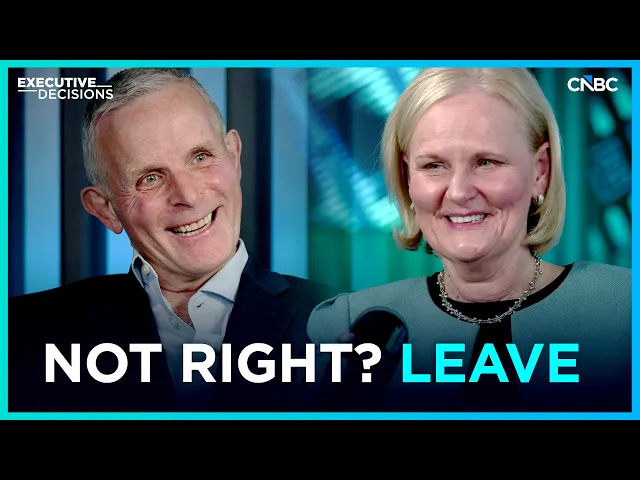
If It’s Not Right, Leave | Aviva CEO Amanda Blanc
CNBC International
0:00 At one of the highest points in her career, Amanda Blanc
0:03 made a decision that most executives would never make— she walked away.
0:08 If something is making you unhappy…why would you do it?
0:10 You need to move on.
0:12 She left one of the biggest jobs in global insurance with nothing lined up.
0:16 No safety net.
0:16 When you leave an organization, it's like, it's brutal, you're gone, like,
0:20 I mean, that's it.
0:21 You said you're going to go.
0:22 Your emails are off.
0:23 Everything's off...
0:24 Were you scared?
0:24 I don't know if it was scared, worried, yeah.
0:27 That instinct— to trust herself and act— has
0:30 shaped how she makes decisions ever since.
0:33 And when she later took over Aviva in the middle of a crisis,
0:36 she brought that same
0:38 approach with her— making tough calls, simplifying the business and acting fast.
0:42 You've got to do things.
0:44 You can't just talk about it.
0:45 At her first annual meeting as CEO, she was subjected to sexist comments
0:49 from shareholders in front of a live audience.
0:51 The next day, she responded publicly, writing about it on LinkedIn.
0:56 The post went viral,
0:57 sparking a wider conversation about how female
1:00 business leaders still face misogyny at work.
1:03 Criticize me if I'm doing a really bad job.
1:05 I have no problem with that...
1:06 but not for being a woman.
1:08 I mean, that’s just crazy.
1:10 These are Amanda Blanc’s Executive Decisions.
1:19 You are one of the major reasons why I pitched CNBC for Executive
1:23 Decisions.
1:24 I think you are an inspirational character,
1:26 and I'm very proud to call you a friend and acquaintance as well.
1:30 So look, Well, thank you for that.
1:31 You're very welcome.
1:32 What a build up.
1:33 Let's start off at the beginning in the Rhondda Valley.
1:35 I go straight to the fact that the coal
1:37 mining communities throughout the country were really
1:40 suffering in the 1980s and I
1:42 just kind of wonder if you can encapsulate
1:43 the kind of upbringing you had as well.
1:45 I think about my childhood, I think about it as, you know,
1:49 living, basically every house was, like, right next to each other.
1:53 Literally, rows and rows of houses going up the valleys.
1:57 Some houses had toilets.
1:58 Some houses didn't, loads and loads of community work,
2:01 lots and lots of chapel work.
2:03 I mean, I used to go to chapel,
2:06 like, twice on a Sunday, it was all about performance, music everywhere,
2:11 and a real feeling of belonging.
2:13 You know, you'd walk down the street and everybody knew you,
2:17 everybody knew your business, but in a way, you didn't mind that.
2:21 It was just really lovely.
2:22 The valleys were built around these sort of,
2:25 you know, tens of coal mines that were built
2:28 in the sort of 1800s, 1900s and became, you know, really the wealth of Wales.
2:33 Both my grandparents, grandfathers, were miners.
2:36 You know, both been down the mine from the age
2:40 of 14.
2:41 I mean, can you even imagine that going down and sort of like underground,
2:46 and his father carried him home on the first day, and like you cannot imagine.
2:50 And all of my
2:51 grandparents were all of 10, 12,14, children,
2:54 of which only probably six or seven survived.
2:57 So, the women were just basically having children every,
3:00 every year, almost of their child-bearing lives,
3:03 but honestly, like so happy, so loving,
3:07 and just really wonderful and so musical.
3:12 Was it a Yamaha that your parents bought your piano that glistened
3:16 in your most important room in the house as well.
3:20 The best room.
3:20 It was called "the best room", and it went in "the best room".
3:23 And the only time you went in "the best room" was to practice the piano,
3:27 or at Christmas,
3:28 and that was it, like you didn't go in "the best room" otherwise.
3:31 And I can remember this piano, it did not have a mark on it.
3:34 And even to today,
3:35 that piano does not have a mark on it, you know, it was like perfect.
3:38 And I used to
3:39 have to practice this piano, you know,
3:41 but my mum and dad had worked so hard for that.
3:44 My mum had three, four jobs.
3:46 You know, she would go out in the evening to work.
3:49 There was a factory
3:50 where she would basically peel the rubber off these
3:52 rubber rings that were then made into ash
3:55 trays.
3:55 And my dad was a chemical engineer, which he qualified in the evening school,
4:00 and he would travel all over the
4:02 UK selling chemicals to water treatment companies.
4:05 You could have easily been a professional musician as well.
4:08 Grade eight clarinet, I know that, and grade eight piano as well.
4:11 Did you tell yourself as a young woman growing
4:14 up that you were going to be a musician?
4:16 Oh no, look, I believed that's what, that was what I was going to be, for sure.
4:19 I mean, you know,
4:19 it was like I was in the amateur dramatics.
4:23 I honestly, like in chapel, I was doing the solo,
4:26 playing the piano, reading the recitation.
4:28 It was like, you know, everybody else out of the way,
4:32 here I am, I love doing this stuff, but I was not good enough to do that.
4:37 I was not.
4:37 I mean, look, I got to grade eight through hard work.
4:40 I got in both piano and
4:41 clarinet.
4:41 But ultimately, when I went for my interviews for university and you sort
4:47 of saw these other people, and you were like,
4:50 Okay, right, you're not good enough to do this.
4:53 And you know, one of my great strengths, I think, is that I am able to work out,
4:57 like, when I'm going to be really good at something and when I'm not.
5:00 But even at that moment, you didn't have a passion for I want to do this,
5:03 I want to work in insurance, I want to do something else?
5:05 No, I mean, look, I mean,
5:07 if I think about the school, I went to Treorchy Comprehensive School,
5:10 right.
5:10 I mean, it was, look, it was not a great school, right.
5:15 There was no money, and so,
5:18 you know, school didn't talk about business.
5:20 The most aspirational thing that somebody in
5:23 school would want to be was like a solicitor or an accountant or a teacher,
5:28 and that was really
5:30 aspirational.
5:30 It was like, oh, did you know X wants to be this?
5:33 You know, I didn't even think
5:34 about that.
5:35 So, nobody knew about business.
5:36 I mean, you know, you didn't think about.
5:39 But you did make the decision very early on to get out of Wales.
5:42 And I say, get out, I mean,
5:44 get out for your career.
5:45 And, I mean, I've seen it written a couple of times,
5:47 you had two career options, as I see it.
5:50 You could have gone work for Mid Glamorgan County Council,
5:53 or you could leave Wales, where you had all your comfort zone,
5:57 and go off to Luton with a graduate training job at Commercial Union,
6:01 which obviously later became part of Aviva,
6:03 which is an extraordinary journey as well.
6:05 Why did you choose the latter?
6:07 Because that is a really big early decision for a young woman to make.
6:10 Yeah, no, it is.
6:11 I mean, so I was, I was sort of 21 and I finished university in Liverpool,
6:14 and I did not have a Scooby Doo.
6:16 So it was like, I need to apply for some jobs.
6:18 I saw this job for Commercial Union graduate trainee,
6:20 I thought, okay, what's insurance, whatever,
6:22 I'll apply to that.
6:23 And then I had this job in Mid Glamorgan County Council, and I thought,
6:26 this is fantastic.
6:26 I can stay at home.
6:27 I can live with my mum and dad, and, you know, I can keep all
6:31 my friends that I've got,
6:33 or I can go to Luton and be a graduate trainee for Commercial Union.
6:38 And I don't know what it was, but I just thought,
6:42 if I don't go now, I'm never going to go.
6:45 Yeah.
6:46 So, I did.
6:47 And you know, I can remember my mum and dad dropping me off in a bed
6:51 and breakfast in the middle of Luton,
6:52 and it was about eight o'clock on a Sunday night,
6:54 it had taken us, like, 100 hours to get there.
6:57 I'd never been to Luton and thinking, "Oh,
6:59 this is a big decision I've just made." You know,
7:02 as you're waving them off going "see you later".
7:04 Did they help you make the decision?
7:06 No, no, they didn't, because they were really,
7:07 my mum and dad were really phenomenal at just saying,
7:10 you need to make the decision.
7:12 You know, they wanted me to do what was right for me.
7:15 As you say "I didn't have a Scooby Doo", but actually you thought, no,
7:18 I'm going to build this career.
7:20 I don't have a pre-destiny.
7:22 Oh, I definitely didn't feel like I had a predestiny, even at that point.
7:25 I think what I did was,
7:26 and this is the way I've approached everything, it's like,
7:28 you turn up and you think, I'm going to just do my best.
7:30 I'm going to do my best,
7:31 I'm going to see how this all pans out.
7:33 And the brilliant thing about the program was you
7:35 had two years of basically just going
7:38 around every single department in Commercial Union,
7:40 so you got to see the whole business,
7:42 and it was phenomenal, and they were investing time in me as
7:46 an individual.
7:46 And the other thing they insisted was you had to do your professional exams,
7:51 and if you didn't pass your professional exams every six months,
7:54 you were kicked off the program.
7:55 Wow, so there was a lot of pressure on you at an early age.
7:57 There was pressure, but I like that.
8:00 And do you still like the pressure?
8:01 Yes.
8:01 Obviously, because you're a CEO.
8:03 I like the pressure.
8:03 I like the deadline.
8:04 I like the knowing you've got to work hard
8:06 to do something.
8:07 And so that was really brilliant.
8:09 And so there was no calling,
8:11 it was just you got into it.
8:13 And then I realized I really loved underwriting and
8:15 then I thought I'll become an underwriter,
8:17 and then I was a good underwriter, and I thought,
8:19 actually, I really quite like to do sales.
8:21 And then the opportunity was
8:22 there to do sales.
8:23 So, it just opened up all of these other opportunities.
8:26 You remind me a lot of the conversation I
8:29 had with Julia Hoggett about the sexism that was
8:31 in the Financial Services.
8:32 She was in investment banking, you were in insurance in the 1990s.
8:35 And I remember saying to Julia, I was in the 1990s as well,
8:38 and I was on the other side of it as
8:39 well.
8:40 I was on the male side of the patriarchy.
8:41 I was on the male side of that sexism.
8:43 It was a very tough place to be in financial services in the nineties,
8:46 in the naughties, and perhaps
8:47 to a certain degree still is now.
8:49 How did that manifest itself in your career early on as well?
8:53 So I would say in my early career, no, really interestingly.
8:57 In the 90s, I think that it really was a meritocracy at Commercial Union.
9:01 If you were the best person for the job, you got the job and there were a lot,
9:06 you know, lots of different opportunities to do different things.
9:09 I think that what you're referring to came much later, through the 2000s,
9:15 2010s, where I would be more exposed to conferences, events,
9:21 where there would be this dynamic going on,
9:24 then I think you did experience it there, for sure.
9:28 Insurance has been, I think, a very similar culture to what I
9:31 grew up in in the nineties as well.
9:33 And it's a very drinky,
9:35 male dominated environment, but you're saying you just didn't experience that?
9:38 So I'm not saying I didn't experience,
9:40 I didn't feel intimidated by it, and I didn't feel that
9:43 I was negatively impacted by it.
9:45 I mean, you can't not experience it, Steve, because I think,
9:48 you know you only have to even walk through Leadenhall today,
9:51 you know it's not somewhere I
9:52 would want to walk through on a Thursday evening,
9:54 for example, even today, like why would you?
9:56 But they love a lunch at Leadenhall, and you don't do that.
9:58 No, I don't drink.
9:59 I don't do lunch.
10:01 And I do think that, and I've never really done a
10:04 lot of dinners, because, you know, when you have children,
10:06 I want to go home and see my children
10:08 at night.
10:09 So, I never really did that,
10:11 but I saw so many women that did and got themselves into
10:16 difficult situations, you know,
10:17 when they were drinking at some of these conferences and things
10:20 like that.
10:20 And I would always say to my team,
10:22 and I always had a, you know, a good proportion of
10:25 men and women in my team,
10:26 when we'd go to conferences, I'd say you're here to work.
10:29 Just be really, really clear about that.
10:31 Don't drink.
10:31 Don't drink.
10:32 You can drink at home.
10:34 You can drink at other times, but we're here to work,
10:37 don't get yourself into a difficult situation.
10:38 But the men can, the men can go off and drink and so,
10:42 straight away, it's a different set of rules,
10:43 even then,
10:44 even though you didn't experience sexism in so much in the 90s and the early
10:47 noughties, it's still a different set of rules for women.
10:51 That's pretty frustrating.
10:52 Well, it is.
10:53 But I would always say that to the boys as well.
10:55 I wouldn't just say it to the girls,
10:57 I would say to, you know, to my whole,
10:59 when I was AXA, you know, which is a lot of this time,
11:01 I would say to the team, right, we're going to work.
11:04 The reason we have these conferences,
11:05 so we pay money to sponsor these conferences, is that this is meant
11:08 to build business opportunities.
11:10 So, let's be very clear, that's what we're there for.
11:14 Today, when Aviva has those conferences, we put, we send security people to the
11:18 conferences as well, to just make sure that our teams are okay.
11:21 You shouldn't have to do that,
11:23 but that's what you do,
11:24 because we do not want to put any of our team in a difficult
11:27 situation.
11:28 And you know, as sad as that is, that is the situation that we operate in.
11:38 Tell me about some of the toughest decisions during those periods.
11:40 Or can you remember a
11:41 time when you made a really bad decision,
11:44 and how you react to making bad decisions?
11:46 So, I think that the good thing about being a
11:49 CEO and being in leadership is you're going to
11:51 make lots and lots of bad decisions, right,
11:53 but you've always got to think, okay, how do I turn
11:57 that into a good decision.
11:59 I was convinced that, at the end of 1997, that I wanted to
12:04 be a management consultant.
12:05 So, it was like, I'm going to go and work for a management consultant.
12:09 So, you're 30 years old at this stage.
12:10 I'm not very old, right.
12:11 Other people had said, "Are you really sure that that's what you want
12:14 to do?" Anyway, I get to do this job.
12:16 I mean, like, literally, a month in, and I'm thinking,
12:19 what am I doing?
12:20 Oh my gosh, this is, like, a massive mistake.
12:23 I should not have done this.
12:26 But the good thing about I think me and my decisions is I realize quickly
12:30 when I've made a mistake and you know, okay, you've got to give it a chance,
12:33 because in a month you don't know.
12:35 But after six months, I knew, and it was like, okay, I
12:37 need to move on from here.
12:39 I need to go back into something that I love, which is leading people.
12:42 Why do you love insurance?
12:43 I love insurance because I think it's really purposeful.
12:46 If I think about, you know, I'll
12:48 give you an example.
12:50 One of my very good friends, her husband very suddenly died 16 months ago,
12:56 and she had a life insurance policy with Aviva.
13:00 I didn't know that, and she didn't tell me that.
13:04 And then, as she was going through the grieving and the
13:08 process of trying to sort out all her
13:10 husband's affairs, she and I spoke, and she said, your team are just amazing.
13:15 I said Why?
13:16 She said, well, when I rang them and told them that,
13:19 you know, that my husband had died, and that I had
13:22 these two young daughters, you know,
13:24 eight and nine years old, yes, they dealt with my claim,
13:29 but they sent me these two beautiful teddy bears
13:32 that had the daughter's names embroidered on the
13:35 ear of the teddy bear.
13:37 In that moment of deep, deep grief, those children got some sort of
13:41 relief from those teddy bears.
13:43 Nobody told the Aviva team to do that.
13:46 Nobody.
13:46 They just did it.
13:48 And I think that that,
13:50 looking after people where they're in their most difficult time,
13:55 you know, they've had a critical illness,
13:57 they've had somebody that's passed away, they're not very
13:59 well.
13:59 They need looking after.
14:01 They need somebody to guide them through that.
14:03 I just think insurance is so purposeful.
14:05 How many other businesses can you say can do something like that?
14:09 Is that something that you have instilled in them,
14:11 or is it just them?
14:12 Good people happen to be working there.
14:14 It is the DNA of the organization, and that's why Aviva, I think, is so special,
14:18 because that's how our people think about looking after customers.
14:23 It's just knowing that people are at they're most vulnerable,
14:27 and thinking how you can, in some small way,
14:30 make it just slightly better for them.
14:32 And of course, we do things wrong,
14:34 and inevitably you get things wrong.
14:36 But I would say on the whole, what we desperately
14:39 try to do is do the right thing for you know,
14:43 the people that trust us, they trust you right,
14:46 that you're going to be there when something bad happens.
14:48 It's not a handbag or a pair of shoes,
14:51 it's a promise to pay.
14:53 And that's why I think insurance is unlike any other industry.
14:57 Well that explains a lot of why you've
14:59 loved working in the industry for so long.
15:01 You haven't always loved your career decisions though.
15:04 And perhaps one, I want to just go into
15:07 a little bit more detail,
15:08 something you haven't revealed a lot of information about previously,
15:10 you went to Zurich.
15:11 You went to Zurich in 2018, the CEO there, Mario Greco, and you left pretty
15:16 much a year later as well.
15:17 In fact, resigned after eight months, I've got written down here.
15:20 You were the CEO for EMEA.
15:21 It was a really big role.
15:23 Why did you make that decision to join and to leave?
15:26 So to join, I had been at AXA since 2011.
15:30 I'd done the job for seven, eight years.
15:33 The business had turned around.
15:34 I've always said I'm sort of not a business-as-usual leader,
15:37 I sort of like a challenge, I like to be able to do something different,
15:40 and I couldn't see that I was going to get that opportunity at AXA.
15:44 So, you know,
15:45 the opportunity came to me to go to Zurich to do this job as the CEO of EMEA.
15:52 And, hey, look, it looked like an amazing job.
15:54 Zurich is a brilliant company.
15:56 And I thought this is a really
15:57 good opportunity, okay, so, you know, what could possibly go wrong?
16:02 This was going to be great.
16:04 But I think, I have to do something that is meaningful.
16:07 I have to do something where I
16:09 feel that I've got authority to make decisions and that I can make a difference.
16:15 And the role really
16:16 was a span breaker role, as much as it was like,
16:20 you know, not presented in that way, and that was
16:22 not going to ever work for me.
16:24 And as much as I tried to make that work, ultimately not being able
16:27 to have the authority to make changes,
16:29 to make decisions, that cultural fit, it just didn't work.
16:33 And that's the word I was going to come to next- cultural.
16:37 Again, Zurich is a great
16:38 company.
16:38 Mario Greco is a great CEO,
16:40 but you've already showed us what kind of culture you have
16:44 tried to create, and what you applaud at Aviva.
16:46 Was it the wrong culture for you?
16:47 For me it was, absolutely,
16:49 and I do really think that you're at work a lot of the time.
16:55 You know, I'm in at sort of 07:30 in the morning,
16:58 I don't leave till sort of 7:30 or later at night.
17:01 So, you have to be really happy doing what you're doing.
17:04 If something is making you unhappy, then
17:06 why would you do it?
17:07 You know, you need to move on, and you need to say I made a bad call here.
17:11 But let me get this right.
17:13 You've got your two wonderful daughters.
17:15 You've got Ken, your wonderful husband, who's looking after the
17:18 girls for you as well.
17:19 You have quit Zurich without another job to go to.
17:22 That's exactly right.
17:23 Did you feel at one point, this could be a very big mistake?
17:27 Oh, yeah.
17:27 I mean, of course.
17:29 Like you make the decision and, you know, Ken and I obviously
17:32 talked about that a lot, but he said to me,
17:36 you know, you're unhappy, like this is not for you,
17:40 you're not able to do what you do, which is affect change and make a difference,
17:45 and, you know, do all of these wonderful things, so you've got to back yourself.
17:50 So, I came home on the plane from,
17:52 I was actually in Germany, I came home from Germany
17:54 and landed in in in Heathrow, and thought, okay, well, what does that mean?
17:59 Because, you know, when you leave an organization,
18:01 it's like, it's brutal, you're gone, like I mean,
18:03 that's it.
18:04 You said you're going to go.
18:05 Your emails are off.
18:07 Everything's off.
18:07 You land, you get in the car, you drive back from Heathrow to Hampshire,
18:10 which is not a very long journey.
18:12 You know, you pull up at home and you go, okay, right?
18:16 Were you scared?
18:17 I don't know if it was scared.
18:18 Worried, yeah.
18:19 I mean, you know, like I've got two daughters.
18:21 I mean you're at the peak of your career, in your early 40s.
18:26 Absolutely.
18:26 No, absolutely, I do not deny any of that.
18:28 I rang my dad that night and I told him, and
18:31 he said, "Are you happier now?" I said, "I am".
18:33 He said, "then you've made the right decision".
18:34 Yeah.
18:35 Nobody ever said, like, you know, stick it out, stick it out.
18:39 Because I just don't see the point of that, if you know that it's not right.
18:43 And I did know.
18:44 You say your parents support you, your father,
18:46 but Ken obviously supported you and told you this isn't working for you as well.
18:51 You too strike me as a fantastic couple as well.
18:54 And Ken made the decision probably about 15,
18:57 16, 17 years earlier, when you had your second daughter,
19:01 Rhiannon, to give up his career.
19:04 Now, lots of people give up their careers,
19:06 but more often than not, it's the woman who's historically
19:09 had to give up the career for the man.
19:11 That is amazing, and he had a very successful career.
19:13 He was in the same business you were in as well.
19:15 Why did you both make that decision?
19:17 Yeah, he's a physics graduate.
19:19 He's got an MBA, you know, he's a chartered insurer, absolutely.
19:22 But when we had the discussion, actually it was when Rhiannon,
19:27 I was pregnant with Rhiannon,
19:28 and I had this job offer to go to Towergate, and, you know
19:33 So we're in the early noughties now
19:34 So we would have been sort of, yes.
19:37 And I had the contract for Towergate in one hand,
19:40 and the pregnancy test in the other.
19:42 And I was like, okay,
19:43 this is going to be tricky.
19:45 I don't quite know what to do here.
19:47 Do I sign this contract or not?
19:48 And I rang my, what was going to be my future boss at Towergate, and I said,
19:52 "Look, I can't come.
19:54 I can't come.
19:54 I'm pregnant." And he said, "Well, have you
19:57 been pregnant before?" I went "Yes".
19:58 He said, "Well, you know what it's like then." I said,
20:01 "I do".
20:01 He said, "Well, you're coming, come, don't be silly, you know, it's fine."
20:05 And Ken and I had that conversation, and Ken said,
20:08 you know, okay, this will only work really if one
20:11 of us stays at home, and I'm happy to do that,
20:14 because I think that you can do really well in
20:17 this role and I'm happy to support you, but we had a deal.
20:21 And the deal was that, you know,
20:23 I would talk about work at home.
20:25 That I wouldn't come home and do this, which I
20:28 think a lot of people do, and say, "okay, that's work,
20:31 now I'm home, and I don't want to talk it."
20:34 You're a partnership, you want to do it together.
20:35 It was a partnership.
20:36 So, it was interesting, you know,
20:38 you were saying that you were talking about what you do with your wife.
20:41 Yeah, she's given me one of the questions for you in a moment.
20:43 And she's given you one of the questions for me.
20:46 And that's how, you know, so yesterday,
20:48 Ken and I went on a walk,
20:49 and he feels like he knows you, because obviously he watches you
20:52 every morning as well, and we did the whole,
20:56 okay, so what could come up in the podcast,
20:59 what are you going to talk about?
21:00 And I think that's a really lovely way of doing it,
21:03 because it means that we, you know, we're treating each other as grown-ups.
21:07 Yeah.
21:08 And it also still means that I still get the silly calls from my daughters,
21:12 which basically say, you know, where have you put this and all of that?
21:16 I'm like, isn't your dad there?
21:18 Do you resent the fact that I'm even asking you about you having
21:21 the career and your husband giving up his
21:23 career because that isn't the norm still,
21:26 we're in the third decade of the 21st Century, and it's still the case?
21:29 No, I don't resent you asking it at all,
21:31 and I think it was good to actually talk about it,
21:32 because I also think sometimes there can be this
21:35 myth that you can have it all right,
21:37 that as families, you can have it all.
21:40 You can't.
21:41 You have to make compromises.
21:43 You have to make decisions.
21:45 And so, I think you have to be realistic,
21:48 because there's all this, you know, well,
21:50 she must have had six nannies, and, you know,
21:51 she must have had this, and her husband must do this.
21:54 It's not like that.
21:55 In the real world, you have to have tough conversations, and you have to make
21:59 decisions, and particularly about how do you want your family
22:02 brought up and what you want the home
22:05 environment to be.
22:06 And whilst I totally respect that other people have made other decisions,
22:09 we made that decision for what we believed was
22:12 the right thing to do for our children.
22:14 I know you pride yourself on how you help women in the workplace
22:19 have careers and their personal life as well.
22:21 But you personally, I know at least one of your maternity leaves,
22:24 it was way too short, wasn't it?
22:26 Oh my gosh, yeah crazy.
22:26 Six, seven weeks, I think wasn't it?
22:28 Yeah, crazy.
22:28 And it was this one where I had the pregnancy test and- because, of course,
22:32 then I felt,
22:32 because one thing you cannot stop yourself feeling is guilt, you know,
22:36 so the whole time.
22:37 So, if you're at work you feel guilty that you're not at home,
22:40 if you're at home, you feel guilty you're not at work,
22:41 if you are in the hairdresser,
22:42 you feel guilty you're not at home or at work.
22:44 You know, there's this constant thing going on.
22:46 So I felt really guilty.
22:47 I felt, you know, I've taken on this big job, CEO of this big, massive,
22:51 consolidating broking business that was doing a
22:54 deal almost every week at that point,
22:56 and I felt, you know, I needed to go back to work.
22:59 But would I recommend that to other people?
23:01 I really would not.
23:02 I mean, Ken will tell you the story of,
23:05 you know, the day that I went into labor with
23:08 my first daughter, I was literally on the phone to somebody basically doing
23:13 a performance appraisal, and he was like,
23:15 you know, Amanda, come on, we need to go.
23:18 Amanda, if your team...
23:20 I know it's crazy.
23:21 I mean, I'm not, I'm not, I'm ashamed of that by the way.
23:23 If your team did that how annoyed would you be your team now?
23:24 I'm ashamed of that.
23:26 I am ashamed of that.
23:31 I'm going to talk to you now about the biggest job you've ever had.
23:35 The CEO job of Aviva came up and you took it in the middle of 2020,
23:39 tell me about that.
23:40 So I was on the board as a non-executive and the CEO stepped down.
23:45 There was a new chair,
23:46 and the CEO job was available, and I'm fair thinking,
23:50 oh my gosh, like, this is a job
23:53 for me.
23:54 I mean, I knew it because this was a company I had started my career in.
23:58 This is a company I had loved.
24:00 This was the company I had competed against for the whole of my career,
24:05 and I'm sitting there going, if only I wasn't the non- executive,
24:09 you know, maybe I could throw my hat in the ring to be the CEO.
24:13 And I said that to the Chair, and he said,
24:15 "Well, why don't you throw your hat in to
24:17 be the CEO?" And so, I did, and I got the job.
24:21 And, you know, so July the 6th, 2020,
24:24 I become the CEO of Aviva.
24:26 You know, a terrifying moment in terms of, like, what needed to be done,
24:30 but the proudest moment in my whole career that I end up back where I started.
24:34 So you've taken on a company that's underperforming, dividend cuts,
24:37 bad capital markets, too many operations that aren't working, and its covid.
24:42 I know it's brilliant, isn't it?
24:44 How about that for a job?
24:45 What could be better?
24:46 No, absolutely, all of the above.
24:47 So, you know, first of all, yeah, how do you lead a
24:50 business during covid?
24:51 It was me, the CFO, one other, all sort of, you know, practicing the,
24:55 sort of, the distancing and all of that.
24:58 The share price, the minute I walked in the door was £2.73.
25:02 We had this sprawling empire in Europe, which,
25:04 every time there was a bad surprise for Aviva,
25:07 it came from that.
25:07 So, it was a case of, okay, what do you do?
25:10 And I had four weeks before I had to stand up
25:13 in front of the market and do the half year results.
25:15 So, we said, okay, well, let's keep this really simple.
25:19 Three things.
25:19 Focus the portfolio.
25:20 Okay, sell the stuff that we don't believe is going to,
25:24 we can win in those markets.
25:26 De-lever the business, create financial strength.
25:28 The business was too highly levered.
25:31 Use the money you get from the sales to de-lever the business,
25:34 transform the performance.
25:35 I mean, it wasn't really that hard to come up with the strap lines.
25:39 The hard thing was
25:40 then to get on and do it.
25:42 But underlying it, the business was incredibly strong.
25:45 You could see that the UK, Ireland,
25:47 Canada business, we had really strong market positions,
25:49 and that if we could get rid of all the noise and expose those parts of
25:54 the business to the world, you could see that there was a real opportunity.
25:57 How could you see that?
25:58 How is it you had that clarity when none of these men did?
26:01 I think they did, but they weren't prepared to make the decision.
26:05 Because effectively, if you think about what we did,
26:07 we sold a third of the company.
26:09 If you have a bit of an ego,
26:11 it's like, oh, going to have to sell a third of the market cap of the company.
26:17 But we believed that if we did that,
26:19 that the actual valuation of the company would grow, so if you could expose
26:24 that part to the market, the wealth business,
26:27 the general insurance business, the health business,
26:29 you know,
26:30 we genuinely believed that that could create a much more successful company.
26:34 Got a line here from that period of time.
26:36 Crisis strips leadership down to essentials,
26:37 clarity, pace and empathy.
26:38 And I've got another
26:39 quote here.
26:40 It says you can't lead by consensus in a burning building.
26:42 No.
26:43 You can't.
26:43 You have to make the decisions, and then- I think PowerPoint slides are like
26:49 brilliant, and you see lots of people present all of these strategies.
26:52 And I just said to the team,
26:54 I'm not interested in the PowerPoint slides like, what are we going to do?
26:58 And what's really funny
26:59 is, I've actually got it in my office today,
27:02 my first appointment was for a chief of staff,
27:04 and I didn't know anybody really in the business.
27:07 I appointed a guy called Andrew,
27:09 he was my Chief of Staff, and we sat down in my office with a big,
27:12 big sheet of paper.
27:13 We said, what we're going to do in the first 12 months,
27:15 what we're going to do in the first two to three years,
27:17 and then what do we want to do after that?
27:20 Interestingly, in my four to five years, it had buy Direct Line, but,
27:24 you know, I'm not saying that I was any genius, but it did have that,
27:27 but in the first year,
27:29 it was just deliver, deliver, deliver, execute, sell, businesses,
27:33 improve performance.
27:33 You've got to do things.
27:35 You can't just talk about it.
27:37 We talked earlier on in this conversation about the fact that actually,
27:40 in the early part of your
27:41 career, you didn't actually feel that there was overt sexism against you.
27:45 It wasn't a big barrier
27:47 to your progression within the industry as well.
27:49 Then you get to this amazing role that I think you
27:53 felt there was a bit of destiny about,
27:55 Commercial Union to Aviva, and the AGM of 2022.
27:59 Now I got to
28:00 be really honest, Amanda,
28:01 I didn't even know the ins and outs of this as well, and I feel sorry
28:04 that I didn't,
28:05 because I should have done because it was a big story at the time.
28:08 Where basically a whole three, I think it was, investors,
28:12 got up and made a host of sexist comments at the AGM,
28:16 and you had to sit there and listen to this as well.
28:19 Do you want to talk me through?
28:20 Yeah.
28:21 So, if you think about an AGM, right.
28:23 An AGM, you're prepping for what could you
28:26 get asked about all the different financials,
28:28 the strategy, you know, the choices that you've made,
28:32 we had sold businesses by that point.
28:33 And so you get up on the stage,
28:36 and we were in the QEII in London,
28:38 you know, lots of security, obviously there always is
28:40 for AGMs.
28:41 So you walk onto the stage,
28:42 I deliver my first five minute, you know, this is what
28:46 we've done.
28:46 I'm actually quite proud at that point.
28:48 We've done a lot of really good stuff.
28:50 Yeah, we're two years down the road now from when you joined the company.
28:52 We're two years down the road, we've made a lot of progress.
28:54 Most of the businesses have been sold,
28:55 we'd de-levered.
28:56 I think we'd literally just announced the share consolidation and the big, big
29:01 return of capital.
29:02 So, I think shareholders should be happy, right?
29:04 This is good.
29:05 And then I sit
29:06 back on the stage, and my Chair is, George is sat next to me,
29:08 and I'm here and then the rest of the
29:10 board are on the stage, and the very,
29:13 very first question was from a shareholder that basically
29:16 said, it was good to see that there are some women on the board Mr.
29:20 Chair, because you know that, we
29:22 know that they're very good at the administrative tasks.
29:25 That was the first comment of the of the
29:27 AGM.
29:27 And then yeah,
29:29 you get somebody say that I wasn't the right man for the job, and about
29:35 wearing a skirt.
29:36 And you sort of think, oh hang on a second like,
29:40 this is, this is completely wrong,
29:43 but you're in the middle of the AGM.
29:45 And George, you know, at the end, as he was wrapping up,
29:49 he made the comment that, you know,
29:50 I really hope we don't get this sort of, these sort of comments,
29:52 but we walked off the stage, and we walked into the room.
29:55 And I was, you know, you're
29:57 all over the place in terms of,
29:59 like the meeting's done, and you know, you're thinking about that.
30:03 And I walk into the room and my whole team are there,
30:06 and they just went, that is not on.
30:08 What just happened to you is not on.
30:11 And I went, oh, I suppose not, because you start then dissecting it.
30:16 You yourself weren't furious at this point?
30:18 Well, at this point, you're in the middle of the AGM, Steve.
30:20 Too much going on.
30:21 There's so much else going on, and you're thinking
30:23 about all of the procedural bits of it, getting everything done.
30:27 Anyway, I was going to Canada that night, so I go straight to the airport.
30:30 I get on a
30:31 plane to go to Canada.
30:32 And as I'm on the plane, I'm thinking, no, that's not acceptable.
30:37 That's actually not acceptable.
30:38 Because, you know, maybe other people are experiencing the same thing.
30:42 So, I get LinkedIn out, you know, you're on a plane, it's a long plane journey,
30:46 and I start to write a LinkedIn article.
30:48 And as I landed, I sort of had this moment,
30:51 should I press post or not?
30:53 And I thought, I'm going to press post.
30:56 So I did press
30:57 post.
30:57 I mean literally, private comments,
31:01 public comments, men, women, particularly other women,
31:06 who had actually experienced exactly the same thing in the AGMs,
31:09 from exactly the same shareholders in some instances.
31:12 And you know, the post, even today, people will still
31:16 comment on the post occasionally today,
31:17 and they'll look at the post because you see,
31:19 Well, I read it today.
31:20 Yeah, so you'll see the post, and you'll see that people, you know,
31:24 and particularly what worried me was when I
31:26 was getting the private comments from people saying,
31:29 you know, Amanda, things are really this bad and this is what happened to me,
31:32 and I had literally
31:33 just taken the women in finance role,
31:36 you know, the champion role for the government.
31:38 So, I just thought, well,
31:40 if I'm not going to speak up about it, then who actually is?
31:43 And that's the point, as CEO, you have that responsibility you do.
31:46 You do.
31:47 Because, I mean, what you do?
31:48 Just say, quietly, oh, you know,
31:49 let's just forget about that.
31:51 Well, no, you know, I think it was the right time to say,
31:55 actually, do you know what, this is not acceptable.
31:58 By all means, criticize me if I'm doing a really bad job.
32:01 I have no problem with that.
32:02 You know, tell me that you don't agree with something that I've done,
32:05 a business, that I've sold,
32:06 a decision that I've taken, but not for being a woman.
32:10 I mean, that's just crazy.
32:12 And I can't believe that you're having to face this even at your incredible
32:16 stage of your career as well.
32:18 I mean, do you still have it now?
32:20 2025, 2026?
32:20 I mean, you still, I mean,
32:21 I've stopped reading any comments below the line on articles.
32:25 You know, I just do not.
32:27 But do you have it in your encounters with a lot of business people?
32:30 Do you still have moments
32:31 where you come out of a meeting and as I said to you,
32:33 my wife was saying, you know, I was telling
32:35 her about this, and she said, well, yeah, it's a thing,
32:37 and she's hearing about it a lot, and it's
32:39 like, and the line is,
32:40 "did the middle of my sentence interrupt the start of your sentence?"
32:43 Which is such a brilliant, which is so brilliant, very clever from your wife.
32:46 I can't take credit for that one, but I mean, it must happen all the time.
32:49 So I think, because obviously you have the position of, you're CEO and you know,
32:54 people do tend to listen to what you're saying,
32:56 you have it less so now, but I do observe it
32:59 with other, you do sometimes see it in other environments.
33:02 And I'll quite often take aside,
33:05 and it can be men or women, you know, but you see people's great ideas stolen,
33:08 or people not listened to because they're a bit different from other people,
33:11 and you just take them to one side and say,
33:13 that was a really good idea, like, go back in,
33:16 have another go.
33:16 You know, because it's your job, I think, to coach people through that.
33:21 One of the biggest decisions you've made since you were CEO of Aviva,
33:25 and it took the market by surprise,
33:27 and you've already alluded to it, and that was the very bold
33:30 deal that was announced just before Christmas
33:33 2024 which was closed in July 2025,
33:36 again, people said it couldn't be done so quickly,
33:39 and that was for Aviva to consolidate its huge UK
33:41 position and buy Direct Line.
33:43 That's a big decision.
33:44 You've enjoyed that one?
33:45 Yeah, no, it's been brilliant.
33:47 I mean, totally brilliant.
33:48 And if I think about that decision,
33:50 you know, we had, everybody always said,
33:52 as a CEO you've got to stand up and prove to
33:56 the market you're going to do what you're going to do quarter after quarter.
33:58 When we looked at
33:59 Direct Line,
34:00 and we obviously looked at other opportunities in the market at the same time,
34:03 we could see that they were not making traction with the market,
34:07 the share price wasn't moving,
34:08 and we could see that with our technology,
34:11 with our expertise, with our pricing ability,
34:14 that we could just make that a better business than it was.
34:19 So for us, it was okay,
34:21 we should go for this, and the board was just brilliant.
34:23 And you know, one of the people
34:25 that were so brilliant was my Chair,
34:27 George Culmer, you know, over the last six years,
34:30 and, you know, everybody said, Yeah, let's do it.
34:32 So, yeah, it was, it was 23rd of December,
34:35 2024 that we announced that deal.
34:37 You know, having only, it was only really four or five
34:40 weeks before, that we'd made the very first offer.
34:43 So we're very, very pleased with the deal and to
34:45 complete the deal within six months, you know,
34:48 again, massive effort by my CFO Charlotte Jones,
34:51 who's just phenomenal.
34:52 I mean, she's absolutely brilliant.
34:54 She said all the way along-
34:56 She's also a good runner as well.
34:56 She's a very good runner.
34:58 And she basically said, we will complete this by July,
35:00 and everybody was looking, of course we will.
35:03 And she was absolutely right, and she was determined
35:05 to do that, and that allowed us, obviously,
35:07 then to announce new targets, which is great.
35:10 Tell me what's going through your head.
35:11 You've decided to go for this.
35:13 The market, the world doesn't know about it yet.
35:15 Is that very exciting?
35:16 It's very exciting, but in a way,
35:18 it's also nerve-wracking, because you're like, you know,
35:21 lots of deals get leaked, and you know this,
35:23 because at that point you've got various different
35:26 people that are in the know, not that many,
35:28 but, you know, you just never know, do you?
35:30 And so you always,
35:31 you want to be the one to sort of make the decision and to push it forward.
35:36 And we, I think, you know, we were largely,
35:39 and it was, he was hugely exciting, but for the business,
35:43 right?
35:43 If you think about this business that had been through so much,
35:47 to be on the front foot,
35:49 not on the back foot.
35:50 And if I think about Aviva, you know, we've gotten that 92% employee
35:55 engagement score.
35:56 I just think that that is because the team are like, come on, bring it on.
36:01 Well, I'll just mention that you said earlier on when you took over the company,
36:04 the shares were around about 273 pence, last time I had a look,
36:07 and I'm probably a day or so late, I think about
36:09 650 pence now,
36:10 so you've had a phenomenal success on the share price during your tenure as well
36:14 And we've sold a third of the business, right.
36:16 Which just shows the strategy works.
36:18 I know a lot of your team, and I like a lot of your team,
36:21 and I get on really, really well with them as well.
36:24 The fact that you work with good
36:25 people who have got your back and you've got their back,
36:28 is that the most important thing?
36:30 I mean totally because, I mean, at the end of the day, you're one person.
36:34 I mean, you know,
36:36 people say they call me relentless or whatever.
36:37 I mean, I am relentless, but at the end of the day,
36:40 you can only do so much.
36:42 You have to have the best people around you.
36:44 If you've got the best people around you,
36:46 then you know that they will recruit the best people around them,
36:49 and that they will recruit the best people around them.
36:51 So then what happens is you
36:53 end up having a brilliant organization with people that are really motivated,
36:57 and culture is really important to that,
37:00 calling out bad behavior, rewarding good behavior,
37:03 making sure that the performance is really high.
37:05 We're delivering for our,
37:07 you know, for our shareholders, for our customers, that's what we're here for.
37:09 Dame Amanda Blanc, I said to you, and I meant it, you were the first person who
37:13 was on my list.
37:14 I finally got you.
37:15 So, thank you.
37:16 Thank you very much indeed for joining me.
37:19 Thank you.
37:20 I make no bones about it.
37:21 When I pitched CNBC for Executive Decisions over a year and a half
37:25 ago it was CEO’s like Amanda Blanc I had in mind,
37:29 and twenty odd episodes down the line,
37:32 we finally got to sit down on Executive Decisions.
37:36 She’s a brilliant CEO who came into a sleeping giant.
37:40 Aviva was a behemoth
37:42 in the British finance industry,
37:44 but it had underdelivered under three successive CEOs.
37:47 Amanda came in, she wasn't afraid to cut away the fat, made tough decisions,
37:52 build up the business– buying Direct Line was
37:55 a great case in point and really turn
37:57 around the fortunes for the company, its employees and the shareholders
38:01 as well.
38:02 She's also used her position to be a brave CEO, facing down overt, lazy,
38:09 direct sexism most notably at one of the first AGMs
38:12 she held when she was the leader as well.
38:15 She's a brilliant leader, she’s a smart leader but
38:18 she’s also very empathetic and fun person.
38:20 I thoroughly enjoyed speaking to Amanda Blanc.
38:23 Thank you very much indeed for joining me
38:25 on the show we call Executive Decisions.
38:27 I would love to hear your feedback,
38:29 please drop your thoughts in the comments or a review,
38:32 and please hit that follow or subscribe button.
38:35 On the next episode I'll be speaking to the former CEO of Goldman Sachs,
38:40 Lloyd Blankfein.
38:40 “Somebody put his hand on my shoulder and said,
38:42 ‘Lloyd you may think you're changing but everybody knows exactly who you
38:45 are’.
38:45 So I decided I might as well go with it because I'm not fooling anybody anyway.”
38:49 I’m looking forward to it.
38:52 See you then.