Alton Brown Cooks Food | Episode 7: All The World's A Soup
Alton Brown
0:00 soup is just a way of screwing you out of a meal.
0:05 Or so quipped Jay Leno once supposedly.
0:09 I however do not agree uh with this uh sentiment.
0:16 Um though humble stuff u the word soup comes
0:19 from sop meaning a piece of bread soaked with broth.
0:23 Soup is to my mind the alpha and omega [music] the primordial ooze
0:27 from which all culinary life springs
0:30 and the highest expression of its eventual evolution.
0:33 You know without soups we might not even have restaurants
0:36 as we know them seeing as how the uh the word
0:39 came into use restaurant [music] in 18th century France based
0:43 on restorative which was the common name at the time for soup.
0:48 Uh today, of course, soups can be clear and thin or thick and chunksome.
0:53 Although once you move past a 1:1 chunk liquid ratio,
0:57 you're going [music] into stew territory, which is a subject for another show.
1:01 Um, the best thing about soup besides being, you know,
1:05 comforting and nutritious and all of that jazz
1:08 is that although there are classics,
1:10 okay, and recipes are helpful for those, but if
1:13 you follow a simple and highly flexible formula,
1:16 darn near anything can become soup.
1:19 Okay, my own um supus operandi [gasps] is really a kind of uristic approach
1:26 wherein I combine foods from six categories
1:30 following a typically specific order of operation.
1:33 Now the categories are as follows.
1:35 Aromatics cooked in fat, herbs and or spices, flavorful liquids,
1:42 assorted chunkies, a source of acid and a garnish.
1:47 always.
1:48 Since I add salt to literally everything I cook,
1:50 I'm not even going to mention it as a category.
1:53 Now, let's begin with the aromatics.
2:00 We're going to talk about any bunch
2:02 of little vegetable things or flavorful things
2:05 that can be cooked in fat to provide a flavor base for the soup.
2:10 Now u this can mean chili peppers um any member
2:13 of the onion family including garlic and leaks um carrots risomes like ginger
2:18 grasses like lemongrass um I try to always have three aromatics
2:24 in my soups okay and having been raised culinarily speaking in the European
2:29 tradition I typically reach for a 2:1 um ratio of uh chopped
2:34 onion chopped carrot and chopped celery aka mir pua So common is
2:40 this mixture in my kitchen that I keep small little bags um
2:45 of about two cups total um in my freezer at all times.
2:49 So soup, you know, can literally happen at any
2:52 time and no freezing really doesn't hurt the mirror plot.
2:56 Okay.
2:57 Now, when fabricating, I tend to cut the uh carrots, which are harder,
3:01 into slightly smaller pieces just to help them cook
3:04 at roughly the same rate as the other bits.
3:08 Not that this really [music] matters too terribly much in in soup making,
3:11 though uniform bits do tend to look a little more polished in the final bowl.
3:16 All right, into the pot, right?
3:18 Um along with uh some fat.
3:20 And I'm just going to use avocado oil here.
3:23 Um just there.
3:26 Of course, it's not going to get that hot.
3:27 So, technically, you could use extra virgin olive oil if you wanted.
3:30 I just wouldn't really.
3:33 Sometimes I render little bits of uh bacon or other
3:37 salt fat or whatever in there, but not today.
3:39 Not today.
3:39 So, um I also add a hefty pinch of salt at this point.
3:43 They say it helps to pull moisture out,
3:46 but I really think it's just about building in the flavors
3:49 uh because salt does interact uh with certain flavor compounds.
3:53 Um thus salting throughout the process uh typically results in using less
3:58 [music] salt overall if you were to add it all at the end.
4:01 You get my point.
4:02 Now, we turn the heat to medium low.
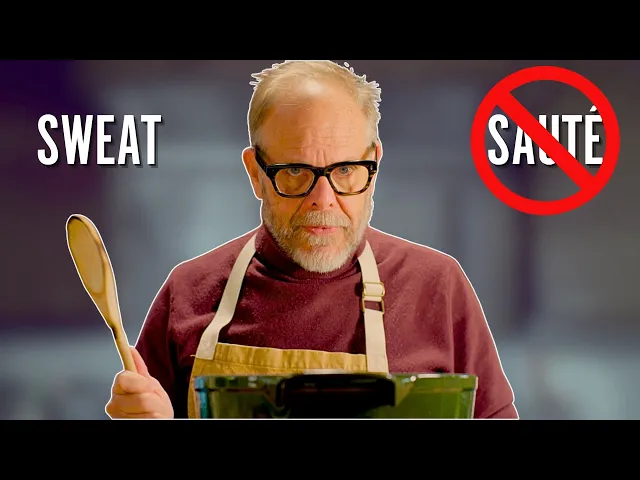
4:04 You'll notice I don't preheat the pot because I want to sweat the aromatics.
4:09 Okay?
4:09 I don't want to sauté them.
4:11 Okay?
4:11 Um, [music] sweating softens without browning.
4:14 Sautéing always browns and I don't want that.
4:17 All right.
4:18 Medium low.
4:19 Um, and um, I'm going to let this cook for probably 5 minutes.
4:22 Oh, now is also when you should consider adding dry herbs.
4:30 And uh I'm using um a little bit of oregano, about a teaspoon.
4:36 Oh, it's actually more than that.
4:37 Uh and I always use two herbs at a time
4:40 so that [music] one doesn't just come through.
4:42 You know, they need to be more of a duo.
4:43 So, uh that is oregano and this uh a little bit of thyme,
4:48 which is my favorite for soups, but I'm going light on that.
4:51 Only about half the amount of the uh of the oregano.
4:57 They do need to hydrate a bit, right?
4:59 So adding them at this point makes a lot of sense and they smell good.
5:07 All right, let's uh ponder a flavorful liquid.
5:10 Um, and unfortunately we're not talking about martinis here.
5:13 We're typically talking about a stock or broth um
5:17 in which some other edibles foods um have been cooked.
5:22 Chicken, beef.
5:23 Um, ideally these would be stocks, okay?
5:25 liquids in which bones and connective tissues have
5:28 been simmered for a long period of time and as such uh will be full of lip
5:33 smacking gelatin which can which delivers a lot of flavor.
5:37 Um now I have homemade I like homemade because
5:41 I've always got bits and pieces of necks and wings
5:44 and backs of chickens as well as old chunks
5:46 of onions and carrots uh to make stock out of.
5:48 But we'll get into stocks in a in another episode.
5:51 Just know that there are some quality commercial versions available.
5:56 So, always keep [music] those around and you'll
5:58 you'll always have soup coming at you.
6:00 Uh broth, by the way, is typically a liquid that meat has been cooked in.
6:05 So, there's usually a lot of flavor,
6:07 but you're not guaranteed to have that gelatin.
6:10 Now, I've got um basically a quart of liquid for each cup of the aromatics.
6:15 But you notice I'm a little light here.
6:17 Um I'm actually almost a cup light.
6:19 Um, so I'm going to add another flavorful liquid in the form of of white wine.
6:26 Maybe as much as a cup.
6:31 That's good.
6:31 Um, the reason that I like cooking with wine so
6:34 much is that I like drinking wine while I cook.
6:38 I don't think there's anything wrong with that.
6:40 You're the one doing the cook.
6:41 There ought to be some more.
6:42 Okay.
6:43 Um, I've got some sizzling here and I
6:45 don't really want to hear too much sizzling.
6:47 So, I'm actually going to turn down the heat.
6:49 Please notice, and this is important, your soup spoon.
6:52 You must have a wooden spoon for your soup.
6:55 This one is very old.
6:56 I've had it for a lot of years.
6:57 I've set it on fire accidentally [music] at least 12 times.
7:01 And I think that that adds a little bit of flavor to the soup.
7:04 So, hearing a little bit of this is okay.
7:07 If you Now, that still sounds a little too hot.
7:09 I don't want browning here,
7:11 unless it's from the [music] burned parts of the spoon.
7:16 Okay, fine.
7:17 We're going to let that completely soften.
7:20 All right, our aromatics are fully sweated.
7:24 Uh, so it's time now to add the flavorful liquid.
7:27 I'm making a big batch of soup.
7:29 So, yes, I'm using two quarts.
7:32 I am now boosting this heat all the way up to medium
7:36 high because I want to bring this flavorful liquid to a simmer.
7:41 Go, go.
7:48 That takes us to our chunkies.
7:51 [music] Not chunks.
7:55 Chunkies is what I call them.
7:56 Always have.
7:57 I use three chunkies um in each and every one of my soups.
8:00 And today uh I'm going to use some leftover
8:03 turkey that I have uh from the uh the holidays.
8:05 This was smoked turkey.
8:06 So that's going to be delicious.
8:08 I like beans um in my soups.
8:10 Uh this is just what do we have here?
8:12 butter beans.
8:14 I could use white I could use any bean that I want to.
8:16 [music] Canoli.
8:17 Um, was that even a bean?
8:20 Canoli beans?
8:20 No, I could use chickpeas.
8:22 I could use white beans.
8:23 I could use kidney beans.
8:24 That's what I was trying to say.
8:26 And I'm going to use whole can.
8:27 I've drained them.
8:28 I've saved the starch water though because I could use it as a thickener.
8:31 I'm also going to use in this um this particular example of soup uh tomatoes.
8:36 I'm going to use whole tomatoes.
8:37 This is not an advertisement for that brand, by the way.
8:39 Um, I like whole because I want to be able
8:41 to chop them up myself and let them break down.
8:43 Uh, so I almost always use canned for that.
8:46 So, aromatics, herbs, we got we've got our flavorful liquid.
8:51 We've got our chunks.
8:52 Now, I want to point out I mentioned acid, right?
8:55 I mentioned acid.
8:55 Well, we've got acid in the tomatoes and we've got acid in the wine.
8:59 So, we've already got some acid.
9:00 As for um a garnish, I'll figure that out later.
9:03 I'm not going to worry about that.
9:04 As soon as I've got bubbles uh breaking [music] the surface,
9:07 I bring forth the uh the chunkies.
9:10 Uh here I have the uh the leftover uh turkey going in.
9:14 Any protein, you don't need protein, okay?
9:16 You don't have to.
9:17 Um I'm adding the uh the beans.
9:20 And you know what?
9:21 I like having a starch in here uh to to help to thicken.
9:25 Um also it gives the uh the soup a bit more heartiness.
9:29 You could use leftover pasta here.
9:31 You could use rice here.
9:32 [music] Wouldn't matter.
9:33 and the tomatoes.
9:34 Now, I don't know that I want all these tomatoes in here,
9:37 so I'm just going to kind of add them one at a time.
9:39 And yes, I'm I'm using a cocktail strainer, a jeulip strainer, in fact,
9:45 which I find to be uh perfect uh for this kind of duty,
9:48 you know, when it's not making martinis.
9:50 Uh so, I'm going to go about six of these.
9:53 And I'm going to hold back.
9:54 I might need the rest of them in the juice later, but we'll wait and see.
9:58 Stir and kind of break up some of those tomatoes.
10:02 Odds are they'll break up on their own.
10:06 Go.
10:08 Give a stir and lid on.
10:13 Heat down just to maintain a simmer.
10:16 I'm going to guess that's going to be about medium low again on this one.
10:21 I'm going to walk away for 30 minutes just to let everything in here
10:26 come together to let the turkey kind of break down a little bit.
10:29 some of the flavors, all the flavors kind of doing in a little intermingling.
10:33 I'll be back.
10:36 It's been half an hour.
10:38 Time to take a look.
10:39 [sighs] There, things have come along nicely.
10:43 However, I noticed that some of my tomatoes uh
10:45 did not pop the way that I had planned.
10:47 Now, I could chase them around with my soup spoon,
10:50 but uh why would I do that when I have a potato masher, which is perfect.
10:54 So, I'm just going to get in there and teach those tomatoes
10:58 whose boss tip that just break those up a little bit.
11:04 [laughter] Now, taste very important.
11:08 I've got a tasting spoon here cuz this is
11:11 the point where we would want to uh adjust the seasoning.
11:13 I am going to drop the heat all the way to its very lowest setting.
11:17 Now, remember, haven't added a lot of salt to this, just the uh the sweat,
11:20 but then there's salt in the tomatoes, there's salt in ingredients, right?
11:31 definitely is going to need salt,
11:33 but I plan on garnishing it uh with a little bit of salt.
11:36 Still, it's going to need more.
11:37 So, I'm going to give it about a teaspoon,
11:40 assuming that I'm going to add a little bit more in my garnish.
11:44 Stir that in.
11:48 Taste again.
11:50 Yes, I'm double dipping.
11:51 Why?
11:52 because this is basically a boiling liquid.
11:54 And number two, I plan on eating all this myself.
11:56 If you're serving to guests, you would just do this when no one's looking.
12:02 Ideal.
12:04 Perfect.
12:04 Now, uh we're ready to uh serve the soup.
12:06 Or of course, you could simply uh lid on and and wait hours uh to serve.
12:12 But uh I'm hungry now.
12:13 I do like a wide bowl so that I can kind of really see the soup.
12:18 It also will cool a little more quickly that way.
12:25 there.
12:25 Now, finishing touches.
12:27 Uh, I'm going to bring a little bit more acidity to the party.
12:30 Remember, I mentioned acidity as one of the prime um ingredient groups,
12:35 and it's where a lot of folks kind of go wrong with soups because as soups cook,
12:39 brightness, acidity tends to reduce.
12:42 Now, we could simply add lemon, right,
12:45 which is a really great source of acidity or or vinegar.
12:48 Um, any number of vinegars would work fine,
12:51 but I have kind of a secret, well, it's not a secret weapon.
12:54 I use a spice called sumac.
12:57 And sumac is a spice that uh was used a lot in the uh the Middle East
13:02 and was originally used uh before there were lemons
13:05 in the Middle [music] East uh to put in things.
13:07 And I like to add that directly to the soup.
13:11 People won't be able they'll be like, "What is that?" They'll be like, "Well,
13:13 the acidity is there like lemon,
13:15 but there's no citrus flavor there from lemon." So, that's perfect.
13:20 I like to do that at the table.
13:21 And a little finishing of salt, which we need, right?
13:25 And I'm going to get that uh from this hunk of uh Pecorino Romano.
13:30 Again, I like to do this at the table
13:32 uh because then people see it happening and they go,
13:34 "Ooh." [music] And they get to watch the cheese
13:36 melt in the soup and that's very sexy.
13:39 And then you kind of tap it before you
13:41 go and everybody thinks that you're like a professional waiter.
13:44 Finally, a garnish.
13:49 Now, I could count the cheese as a garnish certainly,
13:51 but then uh I could also consider croutons to be a garnish.
13:55 And I like croutons because they'll break down
13:57 in the soup and take us back to that original definition.
14:01 Sop.
14:01 I like a little crouton in my soup.
14:03 There we go.
14:04 greenery.
14:05 Sure, if you want, but uh this works perfectly well for me.
14:09 I like watching as the croutons slowly soak in the soup.
14:14 It's something to be contemplated soup.
14:16 I mean, sure, you can look at it as just something to gobble up,
14:18 but take a moment and look around.
14:20 Look at what's going on.
14:21 You've got these beautiful vegetables.
14:23 You've got the little pieces [music] of uh of herbage.
14:26 You've got little bitty bubbles of fat.
14:27 We didn't use much fat at all.
14:30 Just a little bit of the oil, which is now floating around in there.
14:33 I can see [music] the turkey in there.
14:35 And I decide where I get to take my first bite from.
14:37 I want this piece of turkey.
14:38 So, I'm going in, OJ Leno.
14:48 I just feel bad for you.
14:52 I mean, I'm jealous of all the cars, but you could really use some soup.
14:58 See you next time on