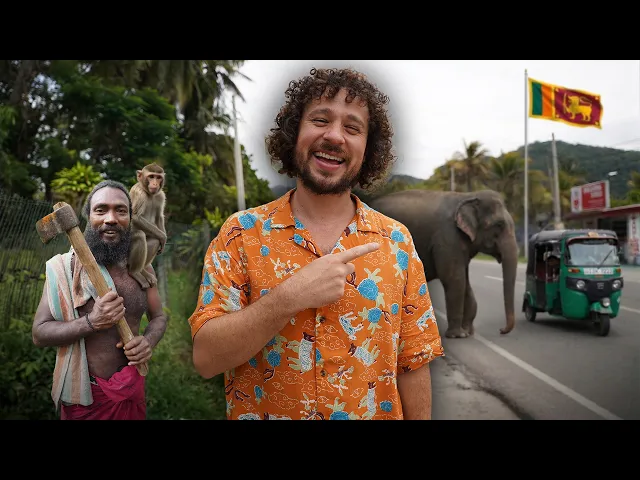
ASÍ ES SRI LANKA: el país “más barato” de Asia | ¿Cómo viven? 🇱🇰
Luisito Comunica
0:00 Imagine yourself driving one day and you
0:02 come across an elephant blocking the street,
0:04 asking you for bananas to let you pass.
0:08 Then you go up in a tuk-tuk,
0:09 drive through an extremely dense city with the tallest tower from South Asia,
0:13 to finally arrive in villages where there are more monkeys than pigeons,
0:17 where men live in the middle of the jungle.
0:21 You move a little further and a leopard passes a few centimeters from you,
0:25 and finally you come home to learn that the president has resigned by email.
0:30 All this and much more is possible possible in this country.
0:33 Welcome to Sri Lanka.
0:47 We are in Sri Lanka, a fascinating country historically known as Ceylon,
0:53 Serendib, the Pearl of the Indian Ocean, or the Tear of India.
0:58 Here nowadays, more than 22 million people live here,
1:01 and in this video we're going to see a little bit of everything,
1:06 from big and lively cities to striking natural beauties.
1:09 With a little luck, we might even cross some elephants, leopards, some sloths.
1:14 Say no more, let this adventure begin!
1:18 Normally I would say let's go for it,
1:20 but we're in Sri Lanka, so I'll say happy amudem.
1:23 We begin in the city of Colombo,
1:25 undoubtedly the largest and noisiest town in the country,
1:29 about 6 million people live throughout the metropolitan area.
1:33 And yes, it's very busy.
1:34 You can feel it.
1:35 It's really noisy.
1:36 There's a lot of buildings.
1:38 There's street commerce everywhere.
1:40 It has that charming and pleasant atmosphere typical
1:43 of big cities from all over the world.
1:46 Something we've noticed is that these streets are full of tuk-tuks.
1:50 I would say this is the most common vehicle that you see everywhere.
1:53 I mean, everywhere.
1:55 They even call them crazy tuk-tuks because they drive crazy, my friend.
1:59 They go for it.
1:59 Actually, you know what, let's continue to provide information from a tuk-tuk
2:03 ride to feel the ambience of Colombo, of the metropolitan area.
2:07 How do tuk-tuks work, which I tell you is the most common way of transportation,
2:11 is that they usually have a taxi meter.
2:14 Here's the taxi meter, but my friend didn't turn it on.
2:17 Okay, it happens a lot everywhere in the world, right,
2:19 that the taxi driver has his taxi meter
2:21 and everything but then he doesn't turn it on.
2:23 Just ask beforehand that how much,
2:25 and you need to be able to negotiate, my friend.
2:27 The tuk-tuk is very popular,
2:29 firstly because the traffic in this city becomes heavy and Secondly,
2:33 because it's very cheap.
2:35 For normal distances, say 15-20 minutes,
2:38 you can spend the equivalent of $1, $1.50.
2:41 Besides, let's talk about currency in Sri Lanka.
2:45 Here they use the Sri Lanka rupee.
2:48 I believe that's the correct pronunciation,
2:50 which at the date of me filming this video,
2:52 it's approximately 310 rupees for a dollar.
2:56 And this is one of the most affordable countries on the entire Asian continent.
3:01 Really, here as a foreigner coming from the other side of the world, world,
3:05 we find prices like nowhere else in terms of transport,
3:10 food, daily expenses in general.
3:13 The low prices that we can find here are really, really impressive.
3:17 Although be careful, because for locals it's a very different reality.
3:22 We're talking about the minimum wage in this country,
3:24 which is generally, according to many factors, about 20,000 rupees per month,
3:29 which is equivalent to $70— actually less than $70.
3:34 And it becomes even more complicated when we consider For example,
3:37 the prices of vehicles, motorcycles, tuk-tuks.
3:41 Later we will talk about this, but yes,
3:44 these things are usually very, very expensive.
3:46 If we approach the question of languages,
3:49 you should know that this country has 3 official languages.
3:53 These are Sinhalese, Tamil, and English.
3:55 In fact, everywhere all the signs you see will be in that order because
3:59 they correspond more or less to the percentage
4:02 of the population who speaks them.
4:04 At the top, Sinhalese, which by the way has an alphabet which is magnificent,
4:08 splendid, it is syllabic, certain characters accentuate sounds.
4:13 Tamil also has its own alphabet, which is completely different, and English,
4:18 a result of the fact that for many years
4:20 Sri Lanka has been a colony of the United Kingdom,
4:24 so that's why it's also everywhere,
4:26 and the majority of people who went to school
4:28 in this country will speak at least basic English.
4:32 This really impressed me, by the way.
4:34 Everywhere English is very easy as long as you Tarzan it.
4:37 English should be Tarzaned as a common
4:40 courtesy for more effective communication.
4:42 For travelers, it is very convenient.
4:45 It's quite easy to get around on your own.
4:47 And yes, I think this is good introductory
4:49 information to know a bit of the country.
4:52 Oh my God, the traffic is really intense, like rarely elsewhere.
4:56 It feels a lot— well, yes, like when you visit New Delhi, for example.
4:59 It feels that atmosphere, Goodbye, my friends, goodbye!
5:03 Next time, eh, next time!
5:04 Good guy, good driver, and yes,
5:06 it's not for nothing that they call them the crazy tuk-tuk,
5:10 because they go hard, they sneak everywhere.
5:13 It is estimated that there are nearly
5:16 1.2 million tuk-tuks registered in the country,
5:18 plus those who are not registered, imagine,
5:20 maybe a million and a half of these little cars.
5:23 We're currently walking in the Peta district,
5:25 which is, let's say, the most commercially active center.
5:29 There are really stores for everything: clothes,
5:31 suitcases, hair salons, shops, food, everything, absolutely everything.
5:36 It's really full movement here.
5:37 This is where the working population is located.
5:40 Fun fact about Sri Lanka: did you know that this is the country
5:43 with the most public holidays in the world?
5:47 That's because every full moon here is a day public holiday.
5:50 That is, at least once a month you will
5:52 have a public holiday and people really don't work, they don't go to school.
5:56 And this, the fact that there are so many public holidays,
6:00 is explained by the fact that this country is predominantly Buddhist,
6:03 and the presence of Buddhism Buddhism is noticed everywhere.
6:07 You just have to keep your eyes open in the streets.
6:09 For example, there are Buddhist flags galore, really everywhere, everywhere.
6:13 You see a multitude of Buddha statues scattered everywhere,
6:17 sporting every color imaginable.
6:19 Buddha in a variety of distinct postures, they are everywhere.
6:23 Just take a quick stroll down any street keeping your eyes
6:26 open and you will come across something related to Buddhism.
6:30 And it's very beautiful to see the diversity in the streets.
6:33 You see a lot of people,
6:34 of course a lot of veiled women, right, following followers of Islam,
6:37 but you also see a lot of women wearing beautiful saris, divine,
6:41 a typical garment not only from here but from this entire region.
6:45 It's nice.
6:46 We're going to a gala, for example, something elegant,
6:49 and the girls wear their saris, but like impeccable.
6:52 Today there is no more civil war or war with other countries.
6:55 Today we can say that Sri Lanka is at peace,
6:57 and let us hope that it stays there for a long time.
7:00 I want to ride in a public truck, a public bus.
7:03 The designs are really amazing.
7:05 Let's see, in many parts of the world we see the typical minibus,
7:08 the bus well painted, very pretty.
7:10 We saw some beautiful ones in Guatemala for the channel,
7:14 in Pakistan, very beautiful ones.
7:16 However, here, frankly, the designs are just as impressive, if not superior.
7:20 And you have to be very keen, that is to say,
7:23 I see that people even come down with the bus moving.
7:26 We have witnessed situations where passengers get
7:28 on and off as the bus continues on its way, with people hanging on the outside.
7:33 Fares for a bus ride start at ₹30,
7:35 which is equivalent to approximately 2 Mexican pesos or 10 cents on the dollar.
7:40 And depending on the distance and your honesty to tell the driver where you go,
7:44 the price increases.
7:45 Let's get in one, no?
7:46 Let's see, to get the right experience.
7:49 Okay, let's take this bus.
7:51 Frankly, we don't know its destination, but let's go.
7:54 Hanging there, hope for the best.
7:55 It's cool, there's a speaker.
7:57 Oh, that's great.
7:58 The design doesn't stop there, the design extends to the interior as well.
8:02 Yes, it's rush hour indeed, as we observe in many places.
8:06 During working hours, point, it is necessary to remain standing.
8:09 This is a complete reality.
8:11 Reality.
8:12 In fact, the bus constitutes the most
8:14 efficient mode of transport for local population,
8:16 surpassing the tuk-tuk, which is a private service and therefore more expensive.
8:21 In addition, there are no subway or cable cars here.
8:24 The bus is what there is, the bus is what remains.
8:27 And frankly, it's nice but full.
8:29 You can feel the atmosphere of the lively area of the city.
8:32 I love that the guy comes around collecting money with his money rings,
8:35 just like in Mexico.
8:36 It's the same, the same.
8:37 He comes with his wads of bills as if they were rings.
8:40 The driver here has like his figurines,
8:43 I think it's Hinduism, excuse my ignorance.
8:46 He has a little lamp that moves.
8:48 No, no, honestly, Mexicans and Sri Lanka,
8:51 same persons despite their distinct beliefs.
8:54 Traveling to India, Sri Lanka, or the cities of Mexico, it's very similar.
8:59 Orale!
9:00 Mission accomplished, really nice, but damn, we sweat a lot in there.
9:04 No, it was hot.
9:05 That thing was really, really hot.
9:07 Listen and let's see, we're currently in the big city as I told you.
9:11 Later we will explore more nature and wildlife and so on.
9:15 Don't get but it's always good to know the capital.
9:18 By the way, the capital of Sri Lanka is not Colombo.
9:21 The capital itself, I'm going to read it to you because it's very difficult.
9:25 Sri Jayawardene Purakotte, which is actually a town right next to Colombo.
9:30 It's practically the same thing.
9:31 It's the metropolitan area.
9:33 My advice to residents would be to rename
9:35 it Colombo or simplify the name because that's cool.
9:39 When they ask about the capital of Sri Lanka,
9:40 yes, oh, it's— I already forgot, already forgot.
9:43 Wow, what about this guy that we just met here in the street?
9:47 How are you, my boss?
9:48 Good.
9:48 Okay, okay, okay.
9:49 Good life, my life then.
9:50 I mean, just look at his flow, his jewelry, his clothes.
9:54 He's truly a genius.
9:56 We're told that he works in the transportation industry
9:58 and people know him a little bit on social media.
10:01 It's cool.
10:02 He's a crack.
10:03 Nice time, my brother.
10:04 Check all the billboards on the street.
10:06 It reminds me a lot of the first time when you go to Tokyo, doesn't it?
10:09 And you're impressed by all the neon signs and letters,
10:13 things that you don't understand.
10:15 But obviously much more chaotic.
10:17 Indeed, here to cross the street you have to dare
10:19 and have faith that you will not be hit.
10:22 Absolutely, it is undoubtedly a city in details, full of life.
10:26 I have never considered Sri Lanka from this angle.
10:29 Usually we associate Sri Lanka with nature, elephants, and Buddhism,
10:34 but never to such busy and noisy streets, and I like it a lot.
10:37 Something that unfortunately continues to happen here in Sri Lanka and which is
10:42 even completely legal is that they have
10:44 elephants to offer walks for tourism purposes,
10:46 for entertainment purposes, let's call it as we want.
10:49 It's having the little elephant chained right here.
10:52 Look, in the middle of the street we found
10:55 ourselves with this elephant that they chained in this place.
10:58 I want to make this clear,
10:59 this is not an invitation to do so when you come here to Sri Lanka.
11:02 On the contrary, I invite you not to do it at all.
11:04 It's unfortunate, isn't it, for such a majestic species?
11:07 And yes, they sell the rides, and the most unfortunate thing is
11:11 that the law authorizes the sale of these elephants,
11:14 which are also sold at very high Theoretically,
11:16 as the law regulates it, the government,
11:19 is that to be able to buy one of these elephants,
11:22 you must demonstrate that you have a large space to keep it.
11:25 They check your family background,
11:26 that there isn't a record of animal abuse or something,
11:29 that you're going to treat them well, between quotes,
11:31 not so bad, and that you're going to take them for walks not too much tiring,
11:35 like a limit of kilometers per day, etc., etc.
11:38 In more or less told, it's not like you buy them from private traders,
11:42 but you buy them directly from the government.
11:45 And the way they manage to train them is that at a young age
11:48 They put them very heavy chains and spikes that hurt them if they use force.
11:53 And that's how the little elephant develops a kind of a fear.
11:56 And that's why such a strong species, because let's be honest,
11:59 if he wanted out, he could make a disaster, kill us all and run away.
12:03 But since they are little ones, they instill fear in them.
12:06 They put these spikes on them which hurt their legs when they move.
12:10 And this is how they manage to train them.
12:12 It's very sad.
12:13 It's very ugly.
12:14 I guess when you come, frankly, don't support that.
12:16 And it's not hard to find them.
12:17 I mean, now on a random street like that, we found them,
12:20 and as if nothing was happening.
12:22 But yes, personally, I would tell you, when you come to Sri Lanka, don't do it.
12:25 But if it's possible, yes, it is, it's possible.
12:27 We are staying in a very cool but very
12:30 pretty hotel which could well be called the Monkey's Den.
12:33 Look at that.
12:34 Look how many little monkeys there are.
12:36 And they're everywhere, but really, really everywhere.
12:38 We saw them from breakfast, like on the roof.
12:41 And you see them playing, you see them chasing each other,
12:43 they throw themselves off the roof.
12:46 At one point an iguana came and they were fighting a bit,
12:49 like they wanted to ambush him, but then the monkeys got scared.
12:53 And then there's another part from the swimming pool.
12:56 You see monkeys running, but "genomel" monkeys, like really big ones.
13:01 A fight with one of them, I think you'd lose.
13:04 There are peacocks too, they really are everywhere.
13:07 They are very used to humans.
13:08 Obviously they advise you, it's a bit of an order, brother,
13:12 don't try to touch them or feeding them
13:14 because it can be dangerous and it's not cool.
13:17 Look, 2 meters away, there they are taking care of each other,
13:20 taking each other off leaves.
13:22 It's cool, really.
13:23 This resort is very,
13:23 very pretty and it's like a hotel in the middle of the marshes.
13:26 Really, it's very, very pretty.
13:28 Exactly.
13:29 I have the impression that this is the face that we see the most of Sri Lanka,
13:32 no, as through the world,
13:34 as if there were monkeys everywhere, nature beyond crazy city.
13:37 Don't be afraid, little one, we are safe here.
13:39 We went up a little towards the north and we sailed here on Lake Talcoté.
13:44 It's very cool that by law it is not allowed to have
13:48 motorboats to reduce noise pollution and also to protect the water, no?
13:52 So everything must be done here by rowing.
13:55 We just hired a strong guy, so he's a brother who really, really, really got it.
13:59 And our guide of the region explains
14:01 to us some very beautiful things about here.
14:03 They take great care of nature, they take great care of animals.
14:08 To fish, you must have a special license, which by the way,
14:11 fishing is the main economic activity with the rice crops.
14:15 And from here we see a lot of birds, a lot of monkeys too, we saw some there,
14:19 many beautiful flowers, fruits of everything,
14:21 and we are told that we can even see crocodiles.
14:25 Watch out for crocodiles, okay?
14:27 Really, it's very pretty, we breathe very well here,
14:29 it smells like rain, you know, like that good smell of rain.
14:33 It's beautifully pretty here.
14:34 We moved on from the noise of the city, the horns,
14:37 the very high density of population, to this quiet paradise.
14:41 We breathe deliciously.
14:44 Yes, Sri Lanka has a bit of everything.
14:47 Wow, we fly over with the drone and it's crazy that we are alone here.
14:51 I don't know what happened today, people said I won't go,
14:53 or maybe because it's raining a little bit, I don't know.
14:56 I mean, look at this shot, it's really impressive.
14:58 We are the only little boat here.
15:00 I see there like a mattress floating in the water and that's all we see.
15:04 And it's really about divine, divine, divine.
15:06 No, frankly It's beautiful that they take so much care
15:09 of nature around here because that is something very precious, a paradise.
15:19 Here I'd like to introduce you to the good Porramala.
15:22 Porramala welcomes us here in his field, on his land,
15:25 to give us a walk in the jungle.
15:28 Porramala belongs to the Vetta ethnic group,
15:31 which is an indigenous group that lives here in Sri Lanka.
15:35 Currently there are perhaps 3,000 to 4,000 betta distributed across the country.
15:41 We're currently in the Ratugala area where there are about 400.
15:46 Mama, catch your hondamaya.
15:47 He already taught me to say thank you and more
15:50 or less hello and what a pleasure and stuff.
15:53 It's very interesting.
15:54 As we see, this is how they live without shoes,
15:58 covering themselves only the private parts.
16:00 They let their beards grow, they let themselves grow hair.
16:04 This is an ax.
16:05 Okay, the ax is important.
16:06 He will explain different explains things to us later.
16:09 They hunt to eat, they fish,
16:10 they have their own crops, their own language, of course.
16:14 This is very interesting and we are grateful for this opportunity.
16:18 So let's go!
16:19 He taught me to say let's go and it's mangachamu.
16:22 Oh, and by the way, I didn't even tell you,
16:24 to come here we obviously went quite far from the city.
16:27 We're currently in the central part of the country, but rather in the south.
16:31 Yala, yes, it's crazy, like their feet don't hurt, like nothing at all.
16:35 And to establish contact, all it took was our guide,
16:38 as if I told him a few words.
16:40 Obviously, we also offered him to give him a tip,
16:43 and it's up almost to everything.
16:45 Me, all stupid, saying, "We're going to the jungle,
16:48 I'll put on long socks." No, brother, we have to cross the river.
16:52 So let's go barefoot like the good porra mala.
16:55 That's cool, there you go, huh?
16:57 We're ready for what's to come.
16:58 So come on, here we go.
16:59 Imagine a Komodo dragon shows up here.
17:02 The water is cold, and it's even good
17:04 for refreshing us because it is really very hot, honestly.
17:07 And now what I'm going to do is I'm going to put my shoes
17:10 back on because You never know if there's a sharp branch here or a centipede,
17:14 or what else do I know?
17:15 We clearly don't have the powerful souls of the good Porramala.
17:19 Porramala shows us how to make a little joint out of the jungle.
17:22 They make a cigarette with this, it's called the bidi.
17:25 Just look at this, it's a little joint,
17:27 and if I've learned something about traveling so much
17:29 is that people love to get high as fuck.
17:32 Really, all of them, all of them.
17:34 Look, here we can see that an elephant has clearly passed by.
17:38 Do you see that?
17:39 Because everything is crushed there.
17:41 Yes, elephant passed by.
17:42 Says my brother.
17:44 Yes, it's daily.
17:44 Here, more evidence of an elephant.
17:46 Here's a big, massive, and heavily piled of dung.
17:49 Okay, he might be close.
17:51 Let's keep our eyes peeled.
17:52 Look, he's showing us something very interesting.
17:54 Every time they venture here into the jungle,
17:56 they leave an offering here for the deities.
17:59 Let's see, they're animists.
18:00 So today, in modern times,
18:01 you will come across many who might also be Buddhists or Hindus
18:05 because there's already syncretism and the influence of religions and so on.
18:09 But traditionally, let's see,
18:10 the Vedda are more than 10,000 years old, their culture.
18:13 So they're animists.
18:15 As they believe in their ancestors, in the spirit of the earth,
18:18 the tree, the stone, etc., etc., which is very cool.
18:21 And here they leave as an offering a few leaves
18:24 so that the divinities protect them and watch over them.
18:27 So as if to say, okay,
18:28 protect me so I don't fall or I don't get hurt by an animal,
18:32 so I don't run out of water, whatever, whatever.
18:36 Wow, that was super beautiful and moving.
18:46 Ceremony.
18:47 And basically now they explained to us what it was.
18:50 He made a song, poetry, as for the ancestors, as for their spirits,
18:54 as if he had connected to the earth,
18:56 gave thanks for the fruits, for the trees, for insects, for everything.
19:00 It was a deep connection.
19:01 And it's a way of thanking the deities who are here,
19:03 the divinities who give them food, who give them life, who protect them.
19:07 So honestly, very beautiful.
19:09 I feel, wow, very, very moved.
19:10 Okay, then now we just have to put our leaf here and this way,
19:14 on the Maya, on the Maya, and ready.
19:16 We thanks them all.
19:17 How pretty that is.
19:18 Our brother Ramallah also explained to us here
19:21 that in his generation it wasn't very normal to go to school.
19:24 Very few people of his generation and previous
19:26 generations know how to read and write,
19:29 but nowadays this area is actually much more modern.
19:32 They have more roads, they have electricity,
19:35 young people are starting to have a telephone.
19:38 There's no phone signal, no, they are quite disconnected in this regard,
19:41 but young people are already going to school,
19:43 and about 80% perhaps of young people know how to read,
19:47 know how to write, which is very cool.
19:49 But he told us that the school of him and his ancestors,
19:52 it was more like the countryside.
19:54 It was more like learning how to hunt,
19:56 learning how to make medicine with plants,
19:58 because yes, they didn't really go to hospitals.
20:00 They were giving birth here in these communities, which, let's see,
20:04 although they have certain structures, are still very, very, very rural.
20:07 Oh, look, he's showing us his arm.
20:09 He says he fought with a bear here for honey,
20:11 because yes, these brothers collect honey to make alcohol and stuff.
20:15 Oh, he bite him!
20:16 Yes, he really did.
20:17 Wow, wow, wow, it's crazy.
20:19 They got bitten for honey, literally.
20:21 Ask him who won the fight.
20:22 He won, he won because he had the ax.
20:24 He won.
20:28 He says he didn't kill the bear but just scared him, like, uh, go away, go away.
20:32 And that is why it's important for them to always carry their ax,
20:35 because they never know when a risk may arise.
20:37 In fact, our guys tell me that here on social medias.
20:41 Not a long time ago, a case of a Hueta leader went viral,
20:44 which was supposed to fly elsewhere for a trip.
20:47 So he didn't know that he can't take his ax into the airport,
20:50 so he got a special permit because he wanted to get on the plane with his ax.
20:54 And for reasons of his culture,
20:56 they granted him a special permit only for this occasion,
20:59 because yes, the brother said, what if a bear came out of nowhere on the plane?
21:03 And yes, look at him where he goes with his ax.
21:06 In fact, his name Porramala means one who handles the ax,
21:10 and they tell us that is a very common name for them.
21:13 That's it, we say goodbye to the good Porramala.
21:16 Mama, get you gondamaya.
21:19 Really interesting to know more about his lifestyle.
21:32 Look at this, we just found some kids here
21:35 playing cricket in a And let me tell you,
21:38 here football is not the most popular sport.
21:41 Here the king is cricket.
21:43 People play it everywhere.
21:44 That's what you see.
21:45 It's the most popular sport, the one who sells the most,
21:49 the one who is consumed the most.
21:51 Just like in India, for example.
21:53 I actually thought it was like baseball.
21:55 No, frankly, the truth is that it doesn't have too much to do with it.
21:58 In fact, on the date we are visiting here in Sri Lanka,
22:01 the World Cup of Cricket is happening and there are advertisements everywhere.
22:06 Everywhere.
22:06 In bars you see the match schedule, advertisements.
22:10 In sports stores they sell cricket uniforms, cricket bats.
22:14 Yes, cricket is the king here.
22:16 It's the sport that moves the economy.
22:18 Children aspire to be professional cricketers,
22:20 and it's very funny to see street cricket that, well,
22:24 as it happens in all sports, it's normal for the ball to fly, to go away.
22:29 Here too, the kids see the ball fly away, but look at this.
22:32 I mean, here they put a Fence with spikes
22:35 and kids jump like that for the ball with that?
22:37 Better build them a fence because someone's going to get hurt here.
22:41 We can see that children are playing with a tennis ball,
22:44 for professionals it's different, and we also see that in the absence of sticks,
22:48 they put a chair, hehe, they're creative, I like that.
22:51 You have to be resourceful, see, for example,
22:53 when I was a child I played football
22:55 with a simple plastic bottle which served as a ball,
22:58 and the goalposts were made of two flip-flops.
23:00 And it's actually very nice to see street cricket,
23:03 it's the sport that animates the country, the one who people are passionate.
23:07 We're currently driving on a road where we are
23:10 informed that it's possible that we could find some elephants.
23:13 In fact, there are signs suddenly like elephants crossing.
23:17 We got ready and stopped at a store
23:19 before setting out the trip, a small local shop,
23:22 and we bought a few bananas there because we're told that they love bananas,
23:26 that they often even block the roads,
23:28 and that they don't move until you give them a banana.
23:31 By the way, the men who ran the banana shop were also hueta.
23:35 It was very interesting to see, yes, there's the huetas in the modern world,
23:39 owners of their own little shop and so on.
23:41 And on this road we have already seen deer as well as a kind of a lizard,
23:46 particularly long and unique.
23:48 We also saw buffaloes, a lot of water buffaloes,
23:51 that's the name of this species, of which I am told that here they consume
23:54 a lot of their milk and they eat their meat.
23:57 We'll see if we see anything else, like a big elephant.
24:00 Oh my God, look, look, look, we see one there, there it is!
24:04 We'll to get closer.
24:06 Oh, look how crazy it is!
24:08 Yes, we found an elephant here on the street.
24:10 Oh my goodness, it's absolutely gigantic!
24:13 Here, have a banana, my friend, a banana.
24:15 Orale!
24:16 It feels— how can I put it— the hand is rough.
24:19 And look, he devours them in one go.
24:21 Eh, bye, beautiful elephant!
24:23 Wow, well, the myth was true.
24:25 See, on some roads here in Sri Lanka, you actually come across some elephants.
24:30 It's magnificent.
24:31 No, seriously, Seriously, it's incredible.
24:33 I loved it, I really did.
24:35 It's splendid.
24:36 I believe this is how human-elephant interaction should unfold.
24:40 The elephant approaches you because he knows how to get a big banana,
24:43 knowing that the human hand will offer fresh fruit.
24:47 I loved it, how sweet.
24:48 We'll see if we see any others.
24:50 Look at another one here, an impressive specimen.
24:53 This one seems smaller, by the way.
24:55 Wow, it's fantastic.
24:57 Hello, kid, we're here, we're here with the banana.
24:59 Here, little one, a banana for for you.
25:01 See you, brother.
25:02 Bye.
25:02 There you have it, 2 elephants in like no time.
25:06 Further on, we see another one.
25:08 Hey, these tuk-tuks are crazy.
25:10 The elephant can clearly overturn the tuk-tuk.
25:14 Well, us too.
25:14 Yes, no, all of us.
25:16 Hola!
25:17 That one's size is really massive.
25:21 Those in the tuk-tuk were scared to death, that's for sure.
25:25 Another one, look, another!
25:26 Hello, elephant!
25:27 Hello, little one, we bring bananas.
25:29 They are peaceful.
25:33 How sweet that we were able to see the elephants like that.
25:36 Well, I mean, in the streets.
25:38 I don't know how we hear about Sri Lanka,
25:40 not just chained together like we saw before.
25:42 Good, good, very, very cool.
25:44 And let's see, this elephant thing in itself is already very cool,
25:48 frankly, very impressive.
25:49 But also it called my attention a lot to the fact
25:52 that in the streets we see a lot of peacocks crossing signs.
25:55 Yes, like elsewhere there are chickens or Ducks, here they are peacocks.
26:00 To prevent them from being crushed, they put up these signs.
26:03 We see them everywhere.
26:05 And look, this whole animal crossing thing is so,
26:07 so common that there are places where
26:10 they built pedestrian bridges for the animals,
26:13 because they know that during the migration period
26:15 they must pass from one side to other, but roads have been built in the middle.
26:20 So they made bridges for them to cross, and they explained to me that they
26:24 are designed to support the weight of elephants, large herds of deer.
26:28 In short, tons and tons can circulate there simultaneously.
26:32 Orale!
26:33 Yes, I have never seen this anywhere
26:35 else in the world— pedestrian bridges for animals.
26:38 Wow!
26:43 We're currently doing another tuk-tuk ride through the villages of Dambulla.
26:50 It's very pleasant here and bright green, really green.
26:54 Here the people harvest all kinds of fruits in abundance and the place is clean.
26:59 Honestly, it looks clean, like there isn't a lot of trash and so
27:02 on, as if there existed this culture of taking care of things,
27:06 which is very cool, very, very, very good.
27:08 Oh yeah, look at this, see how much cultivation, it's very cool.
27:12 Here it rains almost every day, at least in this season we are visiting.
27:16 Yes, just check the river overflows here.
27:18 Wow, so I am told that sometimes everything, everything is flooded.
27:22 Well, yes, season rains.
27:23 My brothers are taking a bath here.
27:25 Wow, if life gives you water, use it to bathe,
27:28 and these guys have it perfectly understood.
27:31 We met some very friendly locals here and we just asked them like,
27:34 could we visit your house to discover the life outside the city?
27:37 And what a magnificent residence, truly spacious, very spacious.
27:40 They have their coconut field like that and grow all kinds of things.
27:44 Very spacious.
27:44 The shower is outside,
27:46 for It was really nice and the family was very communicative.
27:50 When we go out towards the villages,
27:51 it seems like we breathe differently and people have more space.
27:54 Yes, everything is very, very green.
27:57 Tasty, tasty.
27:58 We drove to a very magical place called the Cave Temple of Dambulla.
28:04 It's literally a Buddhist temple set in a cave and it's truly impressive.
28:10 Around 150 statues of Buddha Buddha are carved here.
28:14 One of them is a monumental statue of a Buddha
28:17 in a reclining position carved directly into the stone of the cave.
28:21 Many of the paintings we see on the ceilings
28:24 were never retouched and they're almost 2,000 years old.
28:28 And the story explaining its creation is also very interesting.
28:33 See, it is said that around the year 100-something before Jesus Christ,
28:38 there was a king who had to hide when people
28:41 from present-day India came to invade the land and wanted, of course, his head.
28:46 The king had to go into hiding to save his own life,
28:50 and it is said that he remained 14 long years hidden here between these caves.
28:56 He lived here all alone, just from the wild, taking refuge inside the caves.
29:01 So when the armed forces finally regained power and he was able to come out,
29:06 of his cave and announced to everyone, hey, what do you think, I am alive.
29:10 He ordered the construction of this temple to honor Buddha because he felt
29:14 that it was the strength of Buddhism that kept him alive and hopeful.
29:18 It is said that there are nearly 80 caves and most
29:21 of them actually have a lot of statues and paintings,
29:24 but nowadays you can visit only 5 of them,
29:27 which are the largest and safest for visitors.
29:30 It is full of people, by the way, that must be be said,
29:32 and since you have to go in barefoot, it smells of feet inside, but strong.
29:37 It smells like cheese, doesn't it?
29:39 Here you can take photos inside without any problem,
29:41 but there are a lot of signs that say don't take selfies,
29:44 don't take photos that could be disrespectful to religion,
29:47 not to touch, not to sit in certain places.
29:51 Obviously, it is a place of religious worship.
29:53 It's also very particular to see how even
29:55 in Buddhist ideology there's a big confrontation between religions.
29:59 Blatant proof, at the very entrance of the temple there's a sign which says
30:03 that it is prohibited from entering with a hijab
30:05 or burqa or something that covers you,
30:08 following the attacks which took place around 2019, so they said no, no, no,
30:13 under these outfits they could hide things explosive or similar,
30:16 so from now on you can no longer enter with a burqa
30:19 or with long outfits or anything similar here at the temple.
30:23 And coming back to architecture,
30:24 it is unreal to observe the structures that they've done.
30:28 It is said that previously this entire rocky part of the mountain
30:32 was completely painted because there remains a specific section still colored,
30:36 like if there was only a small painted fragment.
30:39 So they say everything was like that, everything
30:42 was like a massive piece of art,
30:44 but because of the rains, humidity, etc., etc., it has been deteriorated.
30:49 There's a lot of mischievous little monkeys walking around.
30:52 There's also a lot of cute little ducks that you can tempet,
30:54 it's definitely worth it.
30:56 Great place, 10 out of 10.
30:57 This is the Independence Monument of Sri Lanka.
31:01 We learned that Sri Lanka is actually a country relatively quite new.
31:04 February 4th, 1948 was the day they obtained their independence.
31:09 Before that, they were a British colony.
31:11 And right in the center,
31:12 we can observe a statue of the very first prime minister of the country.
31:17 There are lions everywhere.
31:19 Well, it's a very significant animal.
31:20 It's even on the flag.
31:22 What do I tell you?
31:23 This is a very special flag and very colorful.
31:26 Basically symbolizes the union of the people of Sri Lanka.
31:29 The lion who's holding the sword symbolizes strength, values, and courage.
31:35 The reddish-brown color, let's say,
31:38 that surrounds the lion represents the Sinhalese
31:41 people as well as deeply rooted Buddhist beliefs.
31:45 The orange next to it represents the Tamil
31:47 people with all the beliefs of Hinduism.
31:49 The green color represents the population who follow Islam,
31:54 and all the yellow that surrounds it,
31:56 the other minorities, where the Jews, the Christians, etc., etc.
32:01 This basically symbolizes that all are united in the great nation,
32:06 and the monument is cool, it's very beautiful,
32:08 it has a lot of very refined finishes.
32:11 A little controversial is the fact that next
32:13 to the national monument there's a very large flag of Buddhism,
32:17 as if to say, yes, our national flag includes everyone,
32:21 but let's not forget that the majority are Buddhists.
32:25 And this monument, the Independence Monument,
32:27 is located in one of the richest neighborhoods of Colombo.
32:31 Here we see many pretty squares, magnificent residence,
32:34 and many important embassies are located here.
32:38 It's like the nicest area.
32:40 It's pretty, it's beautiful, and yes,
32:42 it's one of the most visited sights of Colombo.
32:45 We're discovering a bit of the chic side of the city here,
32:49 and it turns out that, for example,
32:51 to have a premium brand car, let's call it that way, you must be doubly rich,
32:56 because as it is an island country and there is no really automotive industry,
33:00 everything has to be imported by ship.
33:04 So for a vehicle, you pay practically double its price elsewhere.
33:09 To give you an idea, just to buy one of One of those tuk-tuks that we see
33:13 literally everywhere here can cost you the equivalent of over $3,000 to $4,000.
33:18 No way, elsewhere does it cost what, $1,000 I think, right?
33:21 From $1,000 to $2,000.
33:23 They're showing me a website of used cars here and look,
33:27 a Mercedes CLA of 2019 costs 27.5 million in Mexican pesos,
33:33 that's what, 1,800,000?
33:35 That's about $95,000 for a 2019 Mercedes.
33:39 So how much does it cost to have a Ferrari here?
33:41 A G-Wagon?
33:43 I am really stoned, but I would like
33:44 to point out that these are the prices of cars, and particularly luxury cars.
33:49 But in general, Sri Lanka, as I said,
33:51 is a country which for the rest of the world could be very affordable.
33:54 You can eat in many places for the equivalent of a dollar.
33:57 An average house in Colombo will cost around $60,000 to $70,000.
34:02 So yes, it is especially the automobile sector
34:05 and the luxury sector where prices goes up to the moon.
34:17 We are on safari.
34:19 We currently are in the Yala National Park.
34:22 It's very cool.
34:24 We're here in a vehicle that, wow, it's amazing.
34:27 And we could see leopards, elephants, many species of monkeys.
34:31 Actually, right there we saw a whole Disney movie,
34:34 little deer living with little monkeys.
34:37 We are told that they have a friendship relationship and even of complicity,
34:42 because as both are terrified of leopards,
34:44 they warn each other like, bro, there comes the big guy,
34:47 and it's like, let's get out of here.
34:49 So they warn each other.
34:50 The monkey makes its little noise,
34:52 the deer make it sounds— I don't really know how the deer does.
34:57 Somehow they understand each other.
34:59 It's like the magic of nature.
35:01 The park is very cool, very well maintained.
35:04 There is a security check, everything is protected.
35:07 The rules are clear: you don't get out of the vehicle.
35:10 So far we have only seen wild peacocks.
35:13 This seems curious to me.
35:15 I have never seen them like this in nature, like free.
35:18 We also saw a few hares,
35:20 which I am told that they are essentially— what is that?
35:23 The bottom of the food chain.
35:25 They are eaten by everyone: birds, leopards, giant iguanas.
35:29 Oh yes, there are some big iguanas, they are huge.
35:32 We saw a lot of birds too, a very beautiful green bird that eat bees, and deers.
35:38 One might think that the deer is also at the very bottom of the food chain,
35:42 but I am told that it's very difficult to catch them.
35:45 And there we hear that other guides
35:47 whispering that there's a leopard lurks around there,
35:50 but I am told that the leopard is actually
35:53 the hardest to see because they are observant and patient.
35:57 They will not attack their prey just like that.
35:59 No, no, no.
36:00 They will observe it for minutes, hours,
36:02 maybe all day, and when the time is right, rácate!
36:06 So basically, we don't find the leopard, the leopard finds us.
36:10 What a disturbing information.
36:12 Oh, look at this crocodile!
36:14 Crocodiles, there they are, quiet, relaxed, brother.
36:18 And there are peacocks which run very fast, they are quite clever.
36:23 A little elephant, look over there, wow, it's super cool, very cute.
36:28 In fact, he's alone,
36:29 he's like walking on the water by himself, just chilling and pooping.
36:34 Look at this turd, wow, he eats and shits at the same time,
36:37 the two best things in this life if you ask me.
36:40 It's magnificent, I loved it,
36:41 and I'm told that he's probably an adult because he's starting to take tints.
36:46 Hola!
36:47 Oh, a leopard!
36:48 We managed to see it.
36:49 Wow, how majestic!
36:50 Look at this.
36:52 It's crazy because everyone is aware.
36:54 And just check, since it's super touristic here, there's quite a traffic jam.
36:58 I mean, I'm showing you the reality.
37:00 I could say we were the only one who see it and all that, but in true,
37:03 that's not the case.
37:04 Look at that.
37:05 Oh, what a massive animal!
37:08 Wow, that's super impressive.
37:09 Look at his skin.
37:11 It's funny where The word of mouth spreads.
37:13 Everyone is here to see the leopard.
37:15 Very epic indeed.
37:16 But at the same time, I think we have disturbed him, the poor guy.
37:20 No, that is to say, the guy says to himself, oh,
37:23 I'm going to go out and do a leisurely ride, and then boom, all the humans.
37:28 Look, look.
37:28 But hey, we leave him alone.
37:30 And yes, that's why we can't get out of the vehicle,
37:33 because yes, for him we are a very tasty snack.
37:37 What an imposing animal.
37:38 We're told that they have seen this leopard
37:40 before and that it even already has a name, and that name is actually Lucas.
37:45 Now he's walking towards here and all the cars are letting him pass.
37:49 Look, what an organization!
37:50 He's very close.
37:52 Look at that.
37:53 Wow, how scary!
37:54 How impressive!
37:55 No, what a celestial animal!
37:57 I were able to record it even in slow motion.
38:00 Wow, what an impressive animal!
38:02 What do I tell you, super Super cool, really super cute, magnificent animal,
38:06 and also very crazy to see how the whole
38:08 tourist movement gathers there to be able to appreciate it.
38:11 I mean, that's why you come to a safari.
38:12 Here the good Indika is showing us his photos, and wow, these ones are awesome.
38:17 What beautiful photos of Indika, eh?
38:19 What a professional.
38:20 Truly a very good safari experience.
38:22 We saw a bit of everything.
38:23 Yala National Park is very cool.
38:35 This massive structure that we see here is the tallest building
38:40 of all the country and the tallest tower in all of South Asia.
38:45 This is the Colombo Lotus Tower,
38:47 which has an approximate height of approximately 350m.
38:52 Wow, that's pretty massive!
38:54 And beyond the fact that she's very beautiful and very impressive,
38:57 she represents a major conflict of interest.
39:01 I'll tell you, it's complicated, but I'll try to simplify it.
39:04 Around the year of 2022, Sri Lanka was,
39:08 under many interpretations, on the verge of disappearance.
39:12 They had an economic crisis, wow, but brutal,
39:15 and they were in debt to many countries.
39:18 Their reserve of dollars was exhausted, and To this are added other factors,
39:23 such as, for example,
39:25 that in 2019 there were terrorist attacks by Islamic groups.
39:29 This has already affected the country's tourism a lot,
39:33 but then the COVID-19 arrived and boom, that was another big blow.
39:37 And then the years passed, they were just starting to recover,
39:41 and there it was, the great crisis of 2022.
39:45 Electricity was cut for periods of up to 12 hours.
39:48 People had to queue for days to get gasoline.
39:51 People came out to demonstrate violently in the street.
39:54 Discontent grew, made of still a tense
39:57 and horrible situation which we wouldn't wish to anyone.
40:00 And the president had to flee the country and then resign by email.
40:05 That's crazy.
40:05 It's even seems a little comical to me that just like that, just like
40:09 you quit your job right at the office that you didn't like it anymore.
40:13 But you didn't have the courage to tell your boss face to face and it was like,
40:17 "Boss, excuse me, I am sending you this letter with all due respect,
40:22 but the truth is that you already have me up to my balls." Exactly,
40:26 but from a president of a country,
40:28 he didn't have the disposition, he didn't have the balls to say it face to face.
40:32 But hey, what does all this have to do
40:34 with this tower and the other structures around the country?
40:37 Well, to get out of this crisis, crisis,
40:39 there is no official version of what happened,
40:41 but what is said in the press is that it
40:44 was necessary to obtain different supports from several places.
40:49 Between others, of course, the International Monetary Fund intervened,
40:53 and it is also commented a lot— this with an asterisk because I don't want
40:58 to be attacked— there is no official version
41:00 as such that China had to rush to help.
41:03 And China, well, it's It's well known
41:05 that they like to peek into several places, no?
41:08 She likes to allocate budgets in different countries
41:10 because they have a strong culture of expansion.
41:13 That's why, it is also why it's possibly the most powerful country in the world.
41:17 So for a long time they have been flirting with Sri Lanka.
41:22 A clear example is a huge complex
41:24 that they offered to Sri Lanka towards the '70s, which we went to see.
41:28 It's very luxurious, it's very good.
41:30 In this complex are exhibited, for example,
41:33 statues of the first woman first minister that ever existed in the world,
41:37 who was from here in Sri Lanka, and from her husband,
41:41 who was also the first minister to renounce the constitution
41:44 of the United Kingdom to implement the constitution of Sri Lanka.
41:48 Beyond this subject, it is a complex that China has offered.
41:52 They offered another massive and similar concert venue called the Theater Lotus,
41:57 and they also put in the money to be able to build this massive tower,
42:02 the Columbus Lotus Tower.
42:05 So for many people, it is very polemic,
42:08 very controversial that this was built here
42:10 in this place really prestigious of the city,
42:13 because yes, a lot of people in Sri Lanka say like,
42:16 hey, how did we really get out of the crisis,
42:19 and what did our leaders really promise to China
42:22 to come to rescue us by putting so many, many resources.
42:27 Look, we don't know yet,
42:28 and still to this day there's a great uncertainty about this subject.
42:37 We're going up to see the Sigiriya Palace,
42:40 and wow, what an impressive structure.
42:42 Really, there's no other way to say it— impressive.
42:45 Basically, many years ago,
42:46 a king had the wonderful idea of I want to build my palace on top of a rock.
42:51 And yes, as soon as you enter, well, you see the rock, which is very beautiful,
42:55 it has a very unique shape,
42:57 and you go up a lot and you see the structure that humans have built.
43:01 There are about 1,200 steps, many staircases,
43:04 and structures are now more modern so that visitors can come more easily.
43:08 Look, also from here we see a Buddha, but wonderfully impressive,
43:12 that is to say, we are very, very far away and Look at this structure.
43:16 How high should it really be?
43:18 How long did it take them to do?
43:20 I'm telling you, here there are Buddhas everywhere
43:22 and there are very impressive ones like this one.
43:24 That is, how do we see it from here and no tree hides it?
43:27 It's impressive.
43:28 And it also caught our attention the amount of small dogs that there are.
43:31 This brother, how did he get here?
43:33 He has already taken his nap because he's tired.
43:35 Look at this.
43:36 And we saw monkeys too, a family, mother, father, son.
43:39 What a cutie with a hairstyle like a mushroom, it seems.
43:42 Very beautiful, a lot of wildlife, a lot of nature, and several monks come here.
43:47 We noticed we all want to see the top of the palace.
43:50 Oof!
43:50 And now we come to the famous Lion's Legs.
43:55 Look at this!
43:56 These are legs that are carved directly in the mountain.
43:59 Very impressive, very crazy,
44:00 and even more so that we believe that before it was a whole lion.
44:04 Really, this whole big wall we see now is supposed to be before a massive
44:09 lion and that the entrance to the palace was through the mouth of this feline.
44:13 Of this there is not much evidence over the centuries it has erased,
44:17 but the legs survived and until today they are quite good, that is to say.
44:22 But just imagine it before, holo borgo!
44:25 We can continue to climb according to what we see to get to the top, but no way,
44:29 look at this queue, and me the truth what I wanted to see is how were the legs.
44:33 I wanted to imagine what this supposed entrance was like to the lion's mouth,
44:36 so with that I am more than satisfied.
44:39 Another day we will come back when there are fewer people because yes,
44:42 it is very touristic here,
44:43 and I am told that on national holidays there's triple the number of people.
44:46 Well, very beautiful, very cool, undoubtedly a demonstration of skill,
44:50 of humanity, and also of the madness of kings, isn't it?
44:53 And their ambition.
44:54 Very crazy, very impressive.
45:00 Well, there you have it, a bit of Sri Lanka.
45:03 Wow, what a magnificent country, really.
45:05 I leave here delighted,
45:06 especially with the welcome given to us by the people here.
45:09 How friendly everyone is, what a smile.
45:12 I leave extremely happy.
45:13 What a great adventure was this one.
45:15 How did you see it?
45:17 What did you think of it?
45:18 What did I forget to document?
45:19 I would love to read you down here in the comments.
45:22 Thank you very much from the bottom
45:23 of my heart for joining me on one more adventure,
45:25 and we will meet us again in a few you guys with a new video.
45:28 Bye!
45:29 Stuttet euch wohl!