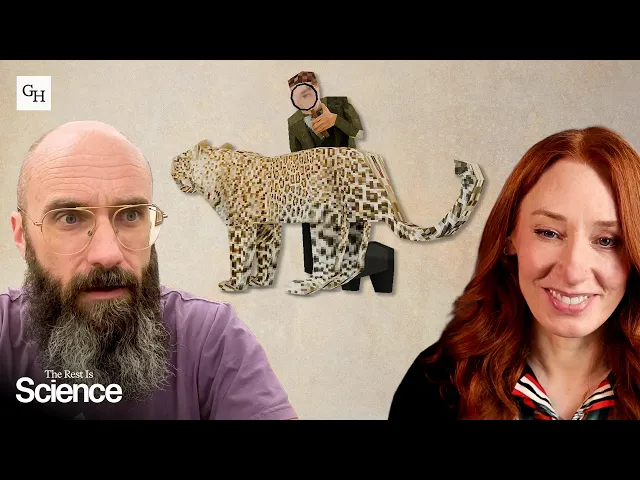
Alan Turing’s Final Theory Was About Leopards
The Rest Is Science
0:00 I've got a question for you, Michael.
0:01 Okay.
0:02 It's a bit of a It's a bit of a weird one, right?
0:05 Good.
0:05 [snorts] It's sort of a philosophical question in a way,
0:08 but maybe also maybe also deeply scientific.
0:12 [snorts] If you start out with an embryo
0:13 and it's just this perfectly symmetrical sphere of cells,
0:19 how does it ever decide where the head goes, right?
0:22 Why doesn't it just Well, how does it ever end up with any structure?
0:26 I mean, when it when there's already a little
0:28 bit of structure there, like I get it.
0:30 Maybe there's hormones that come from the head
0:32 cells that let the neck start forming,
0:35 but when you're a blastocyst, like just a ball, a symmetric ball of cells,
0:41 how does it decide, all right guys, final positions, you're the butt,
0:46 you guys are the toes, you're going to be the brain, get to work?
0:50 Ready, steady, go.
0:51 Which way's up and down?
0:52 Does it have to do with like local gravity or the parent's body?
0:56 I don't know.
0:57 How does it seed those?
0:59 How does it seed those, exactly.
1:00 But then also, I mean I mean I you
1:02 said if there's a little bit of structure there, maybe it makes sense.
1:05 But at the same time, when you look at physics, if you take I don't know,
1:09 like a glass of water for instance and you put a little drop of ink in it,
1:13 the process that happens there is diffusion
1:15 and diffusion is like the destroyer of patterns.
1:19 You don't get structure from physical processes.
1:23 So, what is it about biology that means that you end up with structure?
1:26 It's sort of It's a bit of a puzzle.
1:28 It's a bit of a puzzle.
1:29 Well, yeah.
1:30 It is It's really blowing my mind cuz I've seen a blastocyst,
1:34 a human one, through a microscope when it's like eight cells.
1:38 And you're like, wow, cool.
1:40 But how in the world does it start assigning roles to each cell?
1:46 And how do you make sure that the two cells on opposite ends
1:48 don't both decide that they're going to start forming the the brain tube?
1:51 Mhm.
1:52 Right.
1:53 Am I going to find out today?
1:54 I think you are.
1:55 I think you are.
1:56 You've got I'm going to There's going to be an answer.
1:58 There's going to be an answer.
1:59 Maybe not to your I mean, look, I'm going to go for slightly simpler animals.
2:02 I'm not going to not I don't need to get too excited.
2:05 I've only got the answer for slightly simpler animals.
2:06 But I am going to talk about how you possibly end up with structure in biology.
2:11 And the answer to this incredibly difficult question,
2:16 which I mean, was given by a really extraordinary person.
2:21 [music] This episode is brought to you by Cancer Research UK.
2:27 Here's something strange.
2:29 Your DNA contains more ancient viral fragments than genes.
2:36 The genes that build our cells make up only 2% of our DNA.
2:41 And for years, that is what scientists focused on.
2:44 They treated the rest, the ancient viruses and stuff, as junk.
2:48 But now we know that that hidden majority, sometimes called the dark genome,
2:53 influences how our biology works and how diseases like cancer behave.
2:58 It's a reminder that progress rarely comes as a single breakthrough.
3:03 It builds gradually.
3:04 Cancer Research UK plays a central role in that progress,
3:08 supporting decades of research into over 200 types of cancer,
3:13 work that's helped double survival in the UK over the past 50 years.
3:17 For more information about Cancer Research UK, their research breakthroughs,
3:21 and how you can support them, visit cancerresearchuk.org/therestisscience.
3:28 [music] There's a kind of strange hero who enters the story,
3:36 who ends up actually explaining a lot of the structure in biology.
3:39 It's not not somebody I think you would immediately expect.
3:42 It's Alan Turing, who Who's Turing?
3:45 best known for inventing the computer, for cracking Nazi cryptography.
3:51 He's the guy who came up with a lot of this stuff.
3:54 No kidding, cuz I associate him with like steampunk-y computers,
3:59 metal circuits, definitely not flesh and and and love.
4:06 [laughter] Definitely not flesh and love.
4:07 Your lucky, lucky wife, Michael.
4:10 Well, flesh flesh and and even procreation I don't associate much with.
4:14 totally.
4:15 No, totally.
4:16 Um but he was struggling with exactly this question.
4:19 This is like 1952, okay?
4:20 So, at this point in time, he is this absolute,
4:24 you know, god-like figure in the in the cryptography community,
4:28 in the sort of secret services,
4:31 but the rest of the world doesn't know who he is.
4:32 They just think he's this like crackpot old professor up in Manchester.
4:36 And he's thinking about exactly this question.
4:37 It's like, how is it possible that diffusion,
4:40 which is the process that sort of governs how liquid-y like things move,
4:45 how is it possible that when you put that in a biological being,
4:49 suddenly there's it's not following the same rules.
4:52 You get these patterns rather than being destroyed by destroyed by diffusion.
4:57 And he was looking in particular like the skin of animals.
5:01 So, leopards and spots, cows and their patches.
5:05 So, how does biology end up with these these kind of these features, right?
5:09 Not just a head and a tail,
5:10 but also front and back and left and right and these complex patterns.
5:13 You get like zebra stripes and and leopard spots.
5:16 And then he had this genius idea.
5:17 He was like, okay, well, what if it's not just one thing that's diffusing.
5:21 Okay, what if you have two things that are
5:23 diffusing simultaneously that are fighting against one another?
5:27 What what would happen then?
5:29 Okay.
5:29 So, I'm going to give you I'm going to give you a description.
5:32 Going to give you an analogy of what he was describing.
5:36 You kind of have to go with me a little bit on this analogy.
5:38 I've got I've got a couple ready for you,
5:39 but but just go with me on this analogy.
5:41 So, all right, imagine you've got this petri dish of water
5:45 and I'm going to put a drop of ink in there.
5:47 Normal diffusion, it would just spread out and it would all be gray, okay?
5:50 And it would be random.
5:51 And it would be random, exactly.
5:54 But this is special ink.
5:56 This is like a biological ink, okay?
5:58 And so, it can copy itself.
6:00 So, ink makes more ink, all right?
6:04 But the ink is like it's slow, it's thick, it's gloopy.
6:08 It diffuses, but it's really going to take its time about it.
6:11 But the key thing is that it's like it's making more ink as it goes, right?
6:14 Like a bacteria would, for instance.
6:16 Right.
6:16 Now, if it was in in there on its own, if it was just that ink making more ink,
6:20 then the whole thing would be black very quickly.
6:23 But what if instead of just making new bits of ink,
6:27 this ink also spits out some eraser?
6:31 Eraser?
6:32 Eraser, like ink eraser.
6:35 Okay, so this is like a very strange stuff ink.
6:39 As I said, you have to go with me, all right?
6:41 It's very strange stuff ink, but it can spit out All right, with me, okay?
6:44 It spits out both versions of itself and the thing that can kill itself.
6:50 So, does this mean like it like cell division?
6:52 Like it splits into more ink and eraser in the same localized point?
6:59 Yes, think of it that way.
7:00 Yes, Yes.
7:01 Same localized point,
7:02 it gets more ink so that the amount of total ink increases,
7:06 but you also get eraser, which can delete the extra ink.
7:09 Okay, this is like super theoretical.
7:12 So, if it didn't diffuse,
7:13 if it just sat there and it was spitting out ink and eraser, ink and eraser,
7:16 ink and eraser, the two would cancel each other out
7:18 and you would just have this completely clear petri dish.
7:21 Yeah.
7:22 But what Turing was thinking was, okay, well,
7:25 what if the ink is really thick and gloopy and slow,
7:29 but the eraser is thin and slippy and can diffuse really quickly.
7:34 Is there a way that this eraser could diffuse faster than the ink,
7:39 spread out across the petri dish,
7:41 and then end up creating this little moat around the ink as it forms?
7:48 Effectively like, could the ink build its own cage, essentially?
7:54 Right.
7:54 If that were the case, and he he did this all mathematically, right?
7:57 And he kind of demonstrated that you can have
7:59 this where there is a moment where there's an equilibrium where
8:02 the amount of ink being made exactly matches the rate
8:05 at which the eraser is wiping out the borders, okay?
8:08 So, it's not like a stalemate, it's not like, oh, it just stops.
8:14 If you zoomed in, the ink's still having
8:16 like still dividing into more ink and more eraser,
8:19 still kind of reacting with what's going on a Now, okay,
8:22 I I accept that is the most mathematically
8:24 accurate version of what Turing was thinking of.
8:26 But I accept it's a bit abstract.
8:28 So, I've got a slightly more human example for you, if you like.
8:32 Okay.
8:32 Well, first of all, tell me when
8:34 when in history was Turing having these thoughts?
8:37 This is '52, 1952.
8:39 1952?
8:40 So, not even that long ago.
8:42 Cuz I'm imagining these great ideas that someone can just have in an armchair.
8:47 And I'm thinking of how Einstein did that, too.
8:48 He was like, what would it be like if I was riding on light?
8:53 And he's just sitting, you know, in his chair thinking.
8:55 And here's Turing going, zebra stripes.
8:59 Let me think about this.
9:00 Let me think about eating an eraser diffusing around in a petri dish.
9:04 All right.
9:05 So, very cool.
9:06 But tell me this like more human version or this more biological one.
9:11 All right, because you you do actually get stuff quite
9:14 often that can make its own make copies of itself,
9:18 make versions of its own self, and also the thing that kills itself.
9:22 I was going to say there's got to be chemical reactions that are similar.
9:25 Well, okay.
9:26 At the time, nobody thought that there were.
9:29 Everyone thought that you don't get, you know,
9:31 it doesn't make sense with in in terms of entropy.
9:33 But there are analogies.
9:35 So, forest fires is a really good analogy of this.
9:38 Because if you think about it,
9:39 when you get a little bit of fire, actually fire makes more fire.
9:43 But [snorts] also, if it's in a forest setting, the more fire there is,
9:47 the more likely that you are to get the thing that kills the fire,
9:50 which is helicopters carrying water, okay?
9:53 Right.
9:54 So, The existence of something creates more of that same
9:58 thing and also the thing that kills it.
10:01 That's right.
10:02 So so the ink and eraser analogy,
10:04 if you imagine that you are looking at a forest
10:06 or sort of top down on a forest, okay?
10:08 You for some reason you get a little bit of fire here and there and it starts
10:12 spreading and spreading and spreading and then you
10:14 get in the helicopters who can move much faster.
10:16 The the forest fire is is spreading but it's
10:18 spreading quite slowly and the the the helicopters
10:21 can move much quicker and they can
10:23 encircle this forest fire and basically create
10:26 a moat around it so that in the end you have patches of fire that are
10:31 burning that are being controlled from the outside
10:35 by these helicopters while the fire is burning inside.
10:38 Yeah, which is which is literally what happens.
10:41 Which is literally what happens.
10:42 Fire perimeters are set up, yeah.
10:44 Exactly.
10:45 So but Turing didn't have this more
10:47 concrete analogy because there weren't helicopters.
10:49 Well, [laughter] I don't know.
10:50 When was the helicopter invented?
10:52 Well, Da Vinci came up with a version of the helicopter
10:55 if you want to go all the way back.
10:56 When were they used for fire fighting, I guess?
10:58 Yeah, good point.
10:59 Okay, there were helicopters in Turing's time.
11:02 I don't think he was I don't think
11:03 that was I don't think that was going through him.
11:05 I think he was happy to stay abstract, yeah.
11:07 One analogy that people did use around the time
11:10 around the '50s was of rabbits and foxes.
11:12 I sort of I don't I object to this analogy for other reasons but mainly
11:18 because the ink is thick and gluey and slow and rabbits are quite fast, okay?
11:22 Yeah.
11:23 But imagine for a moment the rabbits are not fast.
11:25 [laughter] Okay, I'm doing that.
11:27 I'm imagining that rabbits are slow.
11:28 Okay, and rabbits sort of stay near the burrow, okay?
11:31 Rabbits make more rabbits but they also allow foxes to exist, okay?
11:38 So the more rabbits you get,
11:39 the more rabbits you get but also the more foxes you get.
11:42 So so rabbits are effectively in a in a sense
11:45 creating both more of themselves and the thing that kills them.
11:48 Right.
11:48 Okay.
11:48 Here is the idea, if you can accept that the rabbits might be slow
11:51 and sort of stay near the burrow but that the foxes like can move around
11:55 much faster then what you end up with what you can end up with is
11:59 this dynamic equilibrium where you have the number
12:02 of rabbits that having more rabbit babies,
12:05 the rabbit babies are sort of creating this balance
12:08 with the amount of foxes that are eating them.
12:10 So you end up with these stable populations,
12:12 these little pockets of rabbits that are kind of surrounded by foxes.
12:17 So little pocket over there and a little pocket
12:19 over there and a little pocket over there, okay?
12:21 And essentially what you need
12:22 for this system is called a reaction-diffusion system.
12:25 So diffusion because you've got the foxes
12:28 or the helicopters or the eraser that's kind of diffusing through the system
12:32 and the reaction because you've got you know,
12:34 the the rabbits and the foxes are reacting together,
12:37 the fire and the water, whatever it might be.
12:39 But it relies on these two things, the activator,
12:42 something that makes itself but it's also slow
12:46 to diffuse and makes the thing that also kills itself.
12:50 So Turing was like, oh, you know what?
12:51 I reckon let's just play around with this.
12:53 Like let's just see what happens with this.
12:54 Let's just like write some equations, like see what happens.
12:58 You know, he came up with this this this mathematical system [snorts]
13:01 and it was like it's sort of like a mathematical
13:03 version of local love and long distance hate, okay?
13:07 So like the sort of the inhibitor spreads really fast and quickly
13:11 but in a in a local setting you can get a cluster where things are quite happy.
13:16 And he didn't just scribble this on a chalkboard, by the way.
13:18 He was like because he had invented the computer [laughter]
13:25 he saved a lot of many people.
13:27 He had access at Manchester University to this really really crude computer.
13:32 It's called the Ferranti Mark 1.
13:35 And so he wrote all of these computer programs
13:38 to simulate what would happen in this environment, right?
13:41 If you've got these two different chemicals or two
13:44 different processes that are fighting against each other in space.
13:47 And what he would do is he would start
13:48 off with like a soup of kind of random noise,
13:51 like little fluctuations here and there.
13:53 And then he would watch as the computer
13:57 spat out what looked like the perfect image
14:02 of the spots that you get on a leopard or on the or the stripes of a zebra.
14:08 What the computer was spitting out was I mean qualitatively
14:14 identical to what you end up seeing in animal skin, okay?
14:18 Wow.
14:19 Which is funny, right?
14:20 That it's like he's literally just having this in his brain.
14:23 So even if you start with this perfectly uniform soup,
14:28 a kind of gray embryo where nothing interesting is happening,
14:32 if you just get a tiny little variation and you've got
14:35 this process that's sitting there waiting to to kick in Turing
14:40 basically proved mathematically that you can get this order from chaos
14:44 just purely through the laws of physics and mathematics, okay?
14:47 Wow.
14:48 He also showed that the geometry makes a difference.
14:51 So he demonstrated that if you have like a big space that you've got
14:56 this process going on in a big space like the belly of a leopard,
14:59 for example then you end up with with spots and if you make it a much
15:03 narrower space then you end up with stripes like on the tail of a leopard.
15:08 And if it's too small altogether, you don't get any patterns at all, right?
15:12 So like on mice, for example,
15:14 they're usually solid colored where where whereas when
15:16 you have like larger cats, they have like much Gosh, that's true.
15:19 Yeah.
15:20 Okay, so this is all like, you know,
15:22 this is all like nice and nice and theoretical.
15:24 Would you like to know how the biologists to I would love to.
15:28 I mean poor Turing, right?
15:30 Like he's got this unbelievable glory from World
15:32 War and he can't tell anyone about it.
15:34 Poor Turing, there's a lot of reasons we could say poor Turing.
15:39 The guy died in 1954.
15:41 Mhm.
15:42 Born in 1912.
15:44 Right.
15:45 So I'm listening to this story.
15:46 This guy uses a computer to simulate the form the formation of what
15:51 turns out to look just like the spots and stripes on animals.
15:54 Mhm.
15:54 Why?
15:55 Because he invented the computer.
15:57 If he hadn't have died in the '50s, if he lived to be 100,
16:00 this guy could have been watching Chocolate Rain on YouTube.
16:04 Completely.
16:05 In his one lifetime,
16:06 he could have seen his invention become what it was by like 2012.
16:10 Yeah.
16:10 Yeah, absolutely.
16:11 He could have been like cracking codes during World War with his newfangled
16:16 computer and then lived long enough to have shared a Kony 2012 meme.
16:22 When was he born?
16:24 1912?
16:25 1912.
16:27 I mean if he'd lived to be 100,
16:29 he would have seen that really famous moment in artificial
16:34 intelligence where they started categorizing pictures of dogs and cats,
16:39 which was really I think that the beginning of the the breakthrough
16:42 of what we've seen what we've seen happen over the last 15 years.
16:45 I mean he could he could have been alive to see that.
16:48 Imagine that.
16:48 And here's the most unbelievable one.
16:50 If he lived to be 100, he could have watched Vsauce videos.
16:56 And we all know he would have.
16:58 We all know he would have.
16:59 Life is full of tragedy.
17:00 He would have been there on YouTube saying first First.
17:06 We know.
17:07 first.
17:07 And he was first.
17:08 He really well, lovely.
17:10 But he really was first.
17:12 [laughter] We will maybe do one on that another day.
17:14 Thing is, right?
17:15 So meanwhile, Turing, no one knows any of this stuff.
17:18 No one thinks he's a big deal.
17:19 He publishes this paper and the biologists are like Yeah, whatever.
17:25 [laughter] Are you joking?
17:26 Well done you with your little math parlor trick.
17:28 This is not serious science.
17:29 You're Why why did they not think it was serious science?
17:32 Because it was too mathematical?
17:34 Partly because it was too mathematical but I think also partly this is
17:37 about the same time that people are discovering the structure of DNA, you know?
17:41 This is like the point where biology is is is absolutely obsessed
17:45 with this idea that there is a genetic blueprint that, you know,
17:49 for a leopard to have spots, there must be a spot gene that's telling telling
17:53 the skin when to turn black and when to turn orange.
17:57 It's like it must be everyone was obsessed
17:59 with this very mechanical kind of top-down view of life.
18:02 And and Turing here is this mathematician,
18:03 he's got no background in but he's never dissected a frog in his life,
18:07 you know what I mean?
18:08 And he barges in and he says, oh no it's just a puddle of chemicals
18:12 and then fluid dynamics does the rest, you know?
18:14 It's just diffusion.
18:15 There's nothing going on.
18:17 So they were like, you know, this is this is not this is not proper science.
18:21 This is like looking at a cloud and saying it looks like a dog.
18:23 Yeah.
18:24 For sure.
18:25 You know what?
18:25 Like he was he was saying all of this at the time when yeah,
18:30 people the paradigm was very much about
18:33 we're actually more robotic than we think.
18:35 Not just genetically but even in the mind, right?
18:39 The behavioralists were the key psychological field that we just learn things
18:44 and then we're conditioned to behave in certain ways and that's it.
18:47 There was no room for creativity, there was no room for even free will,
18:53 let alone chaos to bring about order.
18:56 I agree.
18:57 He was way ahead of his time.
18:58 This is also in the shadow of World War right?
19:01 And I think that actually I mean we should
19:04 definitely do some episodes at some point about the kind
19:07 of the darkness of of eugenics and and and and how
19:12 people were seeing genetic differences to distinguish between us.
19:16 But in this aftermath of all of the horror
19:19 that had happened in the Second World War,
19:20 scientists were actually sort of very keen
19:23 to notice the universality of humans, right?
19:25 That that actually we're all the same.
19:27 This is sort of a really big trend at the time.
19:29 Yeah.
19:30 Top-down stuff, right?
19:31 This like this one rule that binds us all, the the rule of your genes.
19:35 This rather than there being chaos and messiness
19:38 that can cut bubble up from from the bottom.
19:41 In Turing's life as well, I mean you mentioned that he died in 1954
19:46 and this paper he released in 1952 to a third.
19:49 But what also happened in 1952 was the sequence
19:53 of events that would lead to his lead to his death.
19:56 So, in January that year he he was kind of finalizing
20:00 this exact paper this exact like ink dots um paper.
20:06 He has this little relationship with uh
20:08 a 19-year-old working-class man called Arnold Murray.
20:12 And shortly after their relationship, Turing's house gets burgled.
20:16 And Turing reports the crime to the police.
20:19 And during the investigation,
20:20 he just casually mentions that the burglar was an acquaintance of Murray.
20:26 Uh of of the guy that he'd been seeing.
20:28 And he admits to the police that he
20:30 had been having a sexual relationship with Murray.
20:32 So, he's going to the police for help.
20:35 Right.
20:35 And the police take this information and turn it against him
20:39 because homosexuality was illegal in the UK at this point in time.
20:42 Literally illegal, yeah.
20:43 Literally illegal.
20:44 So, um it's the the law was gross indecency.
20:48 And Turing didn't deny it.
20:50 He doesn't apologize.
20:51 He he's like, "I haven't done anything
20:53 wrong." But, he gets convicted in March 1952.
20:57 His paper is published in August, by the way, the one that I'm describing.
21:00 Wow.
21:01 And the state give him a choice.
21:03 They say, "Okay, well,
21:04 you can go to prison or um you can just have a year on probation,
21:09 but on the condition that you undergo
21:12 hormonal treatment to reduce your libido." But, essentially,
21:15 it's a chemical castration.
21:17 Yeah.
21:18 is injected with synthetic estrogen.
21:21 And there's this real horrible irony to um to what
21:25 happens to him considering the work that he's doing.
21:28 You know, he's thinking about biology.
21:31 He's thinking about how you get chemicals that dictate the physical
21:36 shape and boundaries and the features of a living creature.
21:39 And he's spending his evenings watching his own physical shape,
21:43 his own body be, you know,
21:45 forcibly rewritten by the chemicals that are injected by the state because
21:50 this this synthetic estrogen that he's given it it fundamentally changes him.
21:54 You know, he develops breasts.
21:56 His weight changes.
21:58 He gets loads of brain fog.
21:59 He suffers really severe depression.
22:02 By 1953, so a year later, his his you know,
22:06 it's homosexuals are considered a security
22:07 risk that are susceptible to Soviet blackmail.
22:10 So, his security clearance is revoked.
22:12 So, the thing that, you know,
22:14 he that the the world in which he is lauded as a hero has rejected him.
22:20 The the scientific community aren't interested in any of his new ideas.
22:25 He's, you know, isolated.
22:26 He's like surveilled.
22:28 He's like physically altered.
22:30 And um you know, less than 2
22:32 years after publishing this paper that I'm describing,
22:34 while he was working on a second paper on on on these biological ideas,
22:39 he um took his own life uh at the age
22:42 of 41 by eating an apple that was laced with cyanide.
22:46 It was a such a tragedy.
22:48 This like gigantic gigantic titan of computing and mathematical
22:54 history that that the state just treated so unbelievably badly.
22:57 And we lost so much because of that.
23:01 Mhm.
23:01 So much of his life and what he could
23:04 have done and what he was actively working on.
23:06 Mhm.
23:07 Completely.
23:08 Imagine what he could have done in another 40 years.
23:12 Yeah.
23:12 I mean, not least on on the computing stuff, right?
23:15 The computing stuff that he was right there
23:18 at the beginning at that people still refer back to.
23:21 Not in some passé way, but that he formed the absolute foundation, you know,
23:25 universal Turing machines are still the absolute pinnacle of of what
23:29 we are looking for and how we consider intelligence to be.
23:32 That's right.
23:32 It wasn't just the foundation,
23:33 but it was it was also like the beams that were still hanging on.
23:38 To Turing tests.
23:39 And I I mean, I knew all of that.
23:41 I didn't know he'd done work that was so relevant to biology, though.
23:44 Right.
23:45 And this is the thing because while
23:46 the the scientific community just dismissed it as absolute junk,
23:50 it turns out he wasn't just like onto something,
23:55 he was absolutely phenomenally precise.
24:01 He, in his own mind, managed to absolutely nail the precise mechanism that is
24:09 going on behind the scenes in biological systems.
24:13 So, uh it wasn't until 1995.
24:16 This is like 40 years after his death, okay?
24:19 That a biologist was looking at the stripes on an angel
24:22 fish and noticed that they they they matched Turing's equations.
24:28 Okay, but this is like a little bit of a hint.
24:30 But, only really recently, okay, in 2006,
24:34 have people found for real the ink and the eraser.
24:38 Okay, we now know that this is like genuinely genuinely legit.
24:42 So, it's called WNT and DKK.
24:45 And one of the most famous confirmations of of Turing's theory,
24:49 it's about how mammals grow hair.
24:51 Okay, so if you look really closely at skin,
24:54 hair follicles, they're not they're not randomly placed.
24:56 They're they're spaced out in this in this dotted pattern, okay?
24:59 Like imagine looking down at the forest.
25:01 You've got these little patches of fire, okay?
25:03 Imagine looking at like, you know, this landscape of foxes and rabbits.
25:07 You've got these little pockets of rabbits,
25:09 you know, and and foxes roaming in between them.
25:11 The activator is is this protein called WNT and it it tells skin cells, "Okay,
25:18 we'll start building a hair follicle here." And WNT
25:22 is this really heavy it's this really sticky protein.
25:24 It doesn't travel very far.
25:26 It stays really local and it creates this build-up of itself, right?
25:30 It's got to the more you get the more you get.
25:33 The inhibitor is this protein called DKK.
25:36 And WNT, by the way, triggers the production of DKK.
25:40 So, it's like it's making its own enemy.
25:42 And [snorts] DKK tells the skin, "Do not grow hair." Right?
25:46 It sort of says like no more hair follicles.
25:48 And DKK, exactly as Turing said, is this much smaller,
25:52 much more mobile protein that diffuses out really quickly,
25:56 rushes out into the surrounding tissue much faster than WNT can spread.
26:00 And so, thus, you end up with hair follicles
26:04 being in these little islands dotted around the landscape.
26:08 I just have to tell you, right?
26:09 To to prove that this wasn't just a coincidence,
26:13 biologists they decided to uh like tweak things.
26:16 They got some mice and they decided to like tweak
26:18 these two proteins just to see if it would make a difference.
26:21 And Turing's equations predicted that if you weaken DKK,
26:25 the inhibitor, then the hair follicles should kind of spread further.
26:29 The the um the the one that creates
26:31 the hair follicle should spread further before being stopped.
26:33 And you should get these hair spots that are much uh bigger,
26:37 much more close together, much much more kind of merged.
26:41 And so, they weakened the uh the inhibitor.
26:44 And as a result, these mice they grew these kind of huge
26:48 merged clusters of hair follicles exactly where the math said that they would.
26:53 Wow.
26:53 And then when they did the flip side,
26:55 when they engineered mice with like stronger inhibitor,
26:58 then these were like basically bald mice, right?
27:00 Their hair follicles were shrunk.
27:02 They were spread much further apart.
27:04 Like he nailed it.
27:06 We now know for a fact, okay?
27:08 And this is like studies that are going on in 2021,
27:11 that leopard spots is exactly this mechanism.
27:16 You've got the the the WNT DKK 4 in in the case of uh of um of leopards.
27:21 It happens during fetal development.
27:24 Uh you get a darker hair density and then sort of a light hair density.
27:29 It's happening as the the leopard is sort of growing in the womb.
27:33 We know that on the roof of your mouth,
27:35 the the shape of the ridges in the roof of your mouth is a Turing pattern.
27:40 Really?
27:41 I'm feeling them right now with my tongue.
27:43 You're feeling them right now.
27:44 That is Turing Turing a Turing pattern right there.
27:47 We know fingerprints, by the way,
27:49 the ridges on your fingers, um it's exactly the same thing.
27:53 It's about week 10 of pregnancy.
27:55 You get these chemical waves that that follow the Turing patterns.
27:58 Um the feather patterns of fingerprints the whole time, by the way.
28:01 Were you?
28:02 As soon as you mentioned that the geneticists were like, "No,
28:05 it's all according to the rules of DNA." I was like, "Ah, but you know what?
28:09 Not fingerprints.
28:10 Identical twins share DNA,
28:14 but they do not have the same fingerprints because those are formed
28:17 in this way that Turing discovered that's much more of an order out of chaos.
28:21 Exactly.
28:22 Exactly.
28:23 So, if you have a twin, they can bleed to cover up your crimes,
28:27 but their fingerprints will give it away.
28:29 You cannot blame them unless [clears throat] you've got their blood.
28:32 You know, even fingers and toes, right?
28:33 If you see if you think of your your hand as like it's
28:36 almost like a wave of like yes no yes no yes no yes no.
28:39 It's Turing pattern.
28:42 [laughter] No kidding.
28:42 Yes.
28:42 It's like a this wave of proteins
28:44 that oscillate across your embryonic hand that telling Yes.
28:49 They're telling you when to build bone, which is your activator,
28:52 and when to sort of die off and create the gaps between your fingers,
28:54 which is the inhibitor.
28:55 So, it's like activator finger, inhibitor gap.
28:58 It's like it's all Turing.
28:59 It's all Turing.
29:01 This he came up with this in his mind.
29:03 You know, he didn't even do biology.
29:06 What's sticking with me is that they were able to do this on mice.
29:12 It's like, "Okay, we could do math on paper
29:15 or on a computer and then the screen will output the image,
29:17 but instead of a screen,
29:19 they used a mouse's body." They do all the little like math.
29:22 They create the things and then the mouse is printed
29:25 out and it matches the equations that they have seated.
29:30 Exactly.
29:31 Exactly.
29:32 Which is it's it's wild to imagine.
29:36 And it's sort of like it's sort of which way around is it?
29:38 Is it that your body is doing these equations or is it
29:41 that the equations are just unreasonably good
29:44 at describing what your body is doing?
29:45 It's probably the latter.
29:47 But but I mean there are so few of these.
29:49 Like by the time the 1950s comes along, you know,
29:52 physics is sort of like Einstein's been along and done all of the space stuff.
29:56 You know, chemistry's got all the periodic table.
29:58 There are so few of these unbelievably beautiful
30:02 elegant descriptions of reality that are left to find.
30:05 And Turing had one.
30:07 But if he had only done this, he would have been one
30:10 of the most important scientists of the last of the last century.
30:14 Well, yeah, because after the the periodic
30:17 table is filled out and we've got relativity,
30:21 then yeah, we really moved into order,
30:24 chaos, complexity, and that's right where Turing was.
30:26 Exactly.
30:28 So this this idea then of of of how does the egg know what to do?
30:33 How does the embryo know what to do?
30:34 This is what it comes down to essentially
30:36 is that if you have a normal physical system,
30:39 then you get a tiny fluctuation, like a little ripple,
30:42 then it just diffuses, it fades away, the water goes flat again.
30:46 But when you have a Turing system, a tiny instability,
30:51 just a a random bump of the activator chemical,
30:55 ends up hitting this this positive feedback loop,
30:58 and because the activator's job is to make more of itself, you know,
31:02 you end up starting this this process
31:05 that that that ends up building these biological creatures.
31:08 And when the sperm pierces the egg, right,
31:13 it physically snaps the surface of the cell,
31:16 and that is enough of a fluctuation in some creatures
31:21 to end up dictating the main axis of the creature,
31:25 that the axis of head to butt, essentially.
31:27 Wow.
31:28 So so there is a worm.
31:31 We know this Humans are a little bit more complicated, right?
31:33 There's a bit more going on.
31:34 But there is a worm where just that fluctuation of where
31:37 the sperm enters is enough to say here's the head, here's the here's the butt.
31:42 I should tell you the sperm enters, and that's where the butt is.
31:45 Um case you're interested.
31:47 That's that's going to be the butt.
31:49 Um in the frog it's the belly where the sperm enters, it's the belly.
31:53 It's a shame it I looked this up.
31:55 I was looking this up yesterday.
31:56 It is a shame cuz I really wanted it to be that you could say in a human
32:01 that you know that the sperm from your dad
32:03 entered and it turned out to be your ear.
32:05 I really wanted that to be the case, but it isn't.
32:07 Not quite that.
32:10 [clears throat and cough]
32:10 No, cuz human eggs you can split them and then they still it's
32:13 not like this half becomes the butt and this becomes the head, you know?
32:17 Like Oh, I guess that's true.
32:19 Yeah.
32:19 have the potential.
32:21 You couldn't take a human egg, rip it in half,
32:25 reverse it, and make a butt-head person.
32:28 [laughter] I think that's the plot of human caterpillar, isn't it?
32:32 [laughter] You well Oh, no, centipede, damn it.
32:34 I've got it wrong.
32:35 Yeah.
32:35 And also it's not the plot of human centipede,
32:37 but it could be the plot of human centipede 4.
32:40 I have to confess I've never watched a single one of them, not even a trailer.
32:43 I watched the first one.
32:45 Did you?
32:45 Well, yeah, with the premise that it has, how could you not, you know?
32:50 I didn't need that mental image in my life, frankly.
32:52 Hey, there hasn't been a four.
32:54 I nailed it.
32:55 You got two and three.
32:58 Quick.
32:59 Just kidding.
32:59 I'm a huge human centipede fan and I've watched them all.
33:03 We own We own that now.
33:04 If anyone If anyone does make that plot It's got to be about
33:08 in in utero like cell changing in order to create a like a donut human.
33:15 Yeah.
33:15 centipede with one person.
33:17 Where you eat your own butt.
33:19 Like perpetual motion,
33:20 but But it sounds like you couldn't create these you couldn't
33:26 you couldn't create the human centipede four people using just genetic changes.
33:31 You would need to also alter the properties of these chemicals that create
33:36 the Turing patterns and interact with each
33:38 other in these ways that produce order.
33:40 Yeah, I mean I think that the in humans
33:42 are just so much more complicated, right?
33:44 So there's a lot going on when it comes
33:46 to the sort of complexity of a of of a human.
33:48 Not for the scientists in our movie.
33:51 They're going to figure it out.
33:52 Could you have instead of human centipede,
33:54 could you have would worm centipede be interesting or not really?
33:58 What What?
33:59 Oh, how about how about this?
34:00 How about centipede centipede?
34:03 I I would rather watch that, frankly.
34:04 [laughter] I would rather watch that.
34:07 What is what is the snake that eats itself, the ouroboros?
34:11 That's what I'm imagining.
34:12 If you do happen to be in charge of mega Hollywood budgets,
34:17 give us a call, you know?
34:18 We've got We've got many more ideas where this came from.
34:20 If you go back to that analogy of the forest, right,
34:23 and just seeing that you get these patches of of of fires,
34:28 it's a little like hot spot, as it were, of fires.
34:31 For a really long time, you know, probably since the 1970s,
34:34 people have looked at the the mathematics of Turing patterns and been like,
34:38 "I wonder if you see that in human systems, too.
34:40 I wonder if you get that in in urban
34:42 settings." And probably I think the clearest
34:44 example of this there was a there was
34:46 a paper that actually wasn't that long ago,
34:47 2019, and there was uh an urban planner called Peter Pelz,
34:53 and he was looking at slums in the global south, okay?
34:57 And his idea was, "Look, I don't think these things end up forming randomly.
35:02 They actually have this really distinctive spatial pattern." Hmm.
35:06 And so he applied Turing's equations and then found
35:09 that you get the the same kind of dynamics.
35:12 Because if you think about it, right,
35:13 you what why do you end up getting
35:16 slums in the global south where where they do?
35:19 And part of it is because of local attraction.
35:21 So you get a little bit of a demand for um low-income workers,
35:27 so they settle maybe near an industrial area or like a transit hub,
35:31 and then once they're there they create a network,
35:33 and then it means that, you know, they open food stalls, they you know,
35:36 offer informal labor, whatever it might be.
35:37 They they're sort of pulling other people in towards them.
35:39 It's local activation, like a an attraction for other people.
35:44 But as you get more people who crowd into that area,
35:47 then the land becomes really scarce,
35:49 and then the living conditions, you know, maybe get a bit worse,
35:52 because these residents don't necessarily have like mobility.
35:55 They can't, you know, pick up and move and go somewhere else.
35:58 You end up with sort of a moat,
36:00 effectively, that appears around around these these areas.
36:05 And meanwhile the the wealthy population who can commute,
36:07 they're kind of pushing back.
36:08 They're driving up land prices in surrounding rings.
36:11 So you end up with like a city that organizes
36:15 itself into a Turing pattern where you get these intense,
36:17 highly localized clusters of poverty, the sort of spots, as it were,
36:22 that are surrounded by these much wider rings of, you know,
36:25 high income or commercial areas outside of it.
36:28 That's so fascinating.
36:30 So the spots on a leopard, the rosettes on a leopard,
36:34 for those pedants out there,
36:36 they're arranged in the same way that poverty spots the earth.
36:41 So that's the theory, right?
36:43 But it's definitely more descriptive.
36:46 I mean there's no chemistry going on here.
36:48 There's no sort of like there's no But instead of instead of atoms, it's people.
36:53 Where does it possibly fall apart though, this this similarity?
36:57 Wow.
37:00 It's quite the um question that you've just asked.
37:05 Because some people think that it doesn't, or certainly thought that it didn't.
37:10 I think if you're looking for kind
37:11 of localized hot spots in an urban environment,
37:14 then uh especially some that have a dynamic equilibrium,
37:18 that sort of like stay there over time, then actually crime looks like a really
37:23 sensible place to look for Turing patterns,
37:25 because you know, let's take burglary as an example.
37:29 You've got burglars who are who are wandering around the city,
37:31 who are looking for opportunities, which is like diffusion in a way.
37:35 It's like it's like the foxes that you had before.
37:37 You've also got police who are patrolling trying to to prevent crime.
37:42 So you've got that reaction between the two groups.
37:45 The difference slightly to other systems is that you know
37:48 that burglars also communicating with each other about high-value targets.
37:53 Um we've known Criminologists have known
37:55 this for a really long time, by the way, that point at which you are most likely
37:58 to be burgled is when you've just been burgled, okay?
38:03 Um because people replace their valuables,
38:05 because burglars know the layout of your house,
38:07 maybe there's something there that they want to come back for.
38:10 But also often in a street you get
38:13 um houses that are similar structure to one another.
38:16 So burglars will repeatedly target the same
38:18 area until people people kind of notice.
38:20 So you get this like spike,
38:22 this like this moment of attractiveness of a particular
38:25 area where burglars are all drawn to that area, the hot spot, essentially.
38:30 [snorts] So in 2008 there was this group
38:31 of mathematicians who released this absolutely gorgeous paper,
38:36 and I've used this paper with my students loads,
38:38 cuz it's just like the mathematics in it is really lovely.
38:41 It's it's it's based loosely around the Turing idea of reaction and diffusion,
38:47 and it's on this idealized street network.
38:49 It's like it's a grid structure.
38:51 It's kind of this perfect mathematical model.
38:55 And uh they show that if you have this system,
38:59 this kind of reaction and diffusion between burglars and police,
39:02 you end up seeing hot spots pop up and disappear
39:05 in the same way that you do across a real city.
39:07 Right, it's like you look at it and you're like, "Oh,
39:09 well that looks a lot like what you see in the city." Kind
39:11 of in the same way that Turing looked at zebra patterns and was like,
39:14 "Well, that's sort of what you you end up seeing in real life." Yeah.
39:17 The thing is in 2008,
39:19 this was an era when people were very excited about data becoming available.
39:25 You know, we hadn't really had really,
39:26 really good data on people before this point.
39:29 And now you had mobile phones, you had like city reports, you had cameras, etc.
39:35 And so um people were wondering, well,
39:37 maybe maybe there is a way that you can do physics with people.
39:41 Maybe there is a way that there are
39:42 underlying equations that that dictate how people move in.
39:46 Sure, yeah.
39:47 Model them as a bottled gas.
39:49 Let's see what happens.
39:51 Exactly.
39:52 And the police agreed that maybe this was something that could work.
39:56 So, the Los Angeles Police Department,
39:58 they looked at this paper and they were like,
40:01 "Ooh, there might be something in this.
40:02 Maybe maybe maths can tell us where
40:07 these hotspots are going to be next, you know?
40:09 Not just where they are." Now we're predicting crime.
40:12 Now we're predicting crime.
40:14 Future crime.
40:15 Future crime.
40:17 Or at the very least, how are these hotspots moving and changing
40:21 and and how might they move in future?
40:24 So, one of the people on that original paper,
40:26 um this guy called Jeffrey Brantingham,
40:28 he took this this like what was a really beautiful theoretical
40:32 paper and turned it into a company which was called PredPol,
40:37 predictive policing.
40:38 And then in the early 2010s, what they would do is they were working with police
40:41 officers in LA and they would print out these maps
40:44 at the beginning of their shifts and the maps had
40:47 like a little 500 by 500 foot boxes on them.
40:51 Mhm.
40:51 And that box would say, "This is where there's likely to be crime this evening.
40:56 This is where we expect crime to be." Right.
40:59 The maths by this point had like I mean,
41:01 I just want to make sure that I'm really accurate.
41:02 This is like it's moved on a couple of steps from Turing's
41:05 reaction-diffusion in order to get it to work for that setting.
41:08 But that like right at the heart of it and kind of the the nugget of the idea
41:11 is the same thing that you have
41:13 these two systems that are diffusing across a space.
41:16 And I have to say, right,
41:18 they did a randomized control trial on this in Kent in the UK.
41:24 And it's the closest that anyone had been to like double-checking if it worked.
41:29 And to be honest, it actually did work.
41:31 It did work in this Kent study.
41:33 But it didn't work in Los Angeles.
41:36 Well, they didn't do a proper test of it in Los Angeles.
41:38 Or at the very least, they didn't publish a proper test of it in Los Angeles.
41:42 Okay.
41:42 But in Kent they did.
41:43 They published a proper a proper trial of it.
41:46 So, they had and it was double-blind as well.
41:48 So, they had two teams, two sets of patrol maps.
41:51 One of them was like professional crime analysts who were doing it,
41:54 humans using their intuition,
41:56 and the other was the was this this program, this software.
42:00 And what they did, the algorithm won, basically.
42:03 The the algorithm was 10 times more accurate
42:06 at predicting the exact 500 square foot box.
42:11 Where a crime would occur.
42:13 And Kent, they they reported an 8.5%
42:17 drop in street crime during this trial period.
42:19 I'm assuming what you do is you look at this grid that the software
42:24 has filled in with potential hotspots
42:27 tonight and you put officers there Exactly.
42:30 or cameras, you know, here in the states we've got these big like portable poles
42:35 with blinking blue lights covered in cameras that just tell you,
42:38 "We're watching here." I mean,
42:39 it could get really complicated because if you dissuade
42:42 the criminals from where they would have been operating that night,
42:45 they're just going to go somewhere else that same night.
42:47 You have very smartly landed on the real
42:52 vulnerability of this because when you're
42:56 observing leopard spots or retrospectively looking at where
43:01 slums have appeared in the global south,
43:04 you are not in there interfering with the system as it happens.
43:10 The real problem with PredPol was [snorts] that if you
43:15 are sending cars into a particular neighborhood and you're saying,
43:20 "This is where crime is going to occur." You've got people in those cars, right?
43:24 You've got like real police, real humans.
43:26 And if they are expecting to find crime in a particular area of the city,
43:33 they're going to find crime.
43:34 They're going to find it, yeah.
43:36 And maybe it's not the crime that the algorithm was talking about.
43:40 Maybe it's not burglary, but maybe it's I don't know,
43:43 like even someone jaywalking or whatever it might be.
43:46 But then the issue also is that the algorithm
43:50 relies on knowing where the crime was already.
43:54 Right.
43:54 And so, the more crime that you find,
43:57 the more crime you're putting into the system,
43:59 the more that the algorithm thinks that that place is already a hotspot,
44:04 the more it's going to send police back into that area,
44:07 and the more and more and more you end up finding more crimes.
44:13 [snorts] And it will not surprise you when I tell you that in LA in particular,
44:17 the neighborhoods which were disproportionately flagged as hotspots
44:20 by this algorithm were neighborhoods
44:23 that disproportionately contained African-American residents.
44:28 And so, what ended up happening essentially is that this opened
44:33 the door to what was automated harassment of particular communities.
44:38 Right.
44:39 There's a big difference between watching how spots
44:42 form or hair follicles on a mouse Mhm.
44:45 versus actually putting law enforcement officers
44:48 in a particular part of the city where
44:52 they're looking for and interacting with the very
44:55 chemical reaction you're trying to predict.
44:58 They're going to they're going to mess
44:59 up the results by being there and noticing, "Oh, I saw some jaywalking.
45:04 I saw a car without plates." Things that normally would not have been noticed,
45:08 wouldn't have been reported, are now suddenly getting fed into the algorithm.
45:12 And that's changing up not only what they think will happen,
45:15 but how they're treating everyone who lives in this whole city.
45:19 Right.
45:19 And this and and thus you come to kind of a conundrum because actually,
45:24 I have to confess that I sort of have like a bit
45:26 of a a bit of a connection to this type of work, right?
45:29 So, I have published papers on mathematics of burglary.
45:32 I have like these mathematicians who published that initial paper,
45:35 you know, I said that I've like used it for my students.
45:36 I've like met and worked with them.
45:38 And in the early days, I especially after the Kent randomized control trial,
45:43 it was like, you know, I I really didn't immediately see what the problem was.
45:48 I didn't immediately see the potential ethical concerns
45:53 of this stuff because here is the conundrum,
45:55 you can, to a certain extent, better than random chance,
45:59 predict where crime is going to happen.
46:01 You can, right?
46:02 Right.
46:02 Like the algorithms work.
46:03 The problem is, what on earth do you do with that information?
46:07 Yes.
46:08 What do you do with it?
46:10 Because a crime that might happen isn't a crime yet.
46:14 Mhm.
46:14 If you through surveillance and and presence cause it to not happen,
46:21 then what does the algorithm do for the next night?
46:24 You're dealing with probabilities here, you know?
46:26 Yeah.
46:27 I mean, in in the same in biology,
46:29 the same in forest fires, the same in all of this.
46:32 You're not saying 100% definitely this area is
46:36 going to be part of the hotspot or not.
46:38 You are handling with uncertainty front and center.
46:42 And so, it's one thing to say, "This area, this individual,
46:47 this group of people are going to be implicated
46:49 in a crime in future." It's another thing altogether to say,
46:53 "Maybe they will, maybe they won't be.
46:55 Should we or should we not intervene?" Right.
46:58 I should tell you now the way that the UK have dealt
47:01 with this, uh I imagine it sounds like it's something similar in the US,
47:05 is that if there has been a burglary
47:07 in your neighborhood and your chances of being burgled have increased,
47:11 they will put a leaflet through your door saying,
47:14 "There is a uh an increased likelihood that uh that your house may be targeted.
47:19 Make sure that you keep your security up." Yeah.
47:23 That again has had a randomized control trial and that again
47:25 has ended up with like a with a really positive impact.
47:28 But it's interesting anyway.
47:29 I just it it This is one of those areas where I feel like I was really there
47:34 as it was all going on with the academics
47:36 as people were trying to apply mathematics to areas of policing.
47:42 And really there when the backlash
47:45 and the naughty repercussions of it came through.
47:49 I mean, I should also say one of the things about PredPol,
47:51 the reason why it was dropped in particular by the LAPD
47:54 was that actually internal reports said it just didn't work.
47:57 It just didn't work very well.
47:59 Um Well, part of it could be the name, too.
48:01 PredPol.
48:02 It sounds like a dark organization in a movie.
48:07 Mhm.
48:08 You know, it's a little bit too powerful sounding.
48:12 It does a little bit.
48:13 It's a little bit Minority Report, isn't it?
48:15 Yes.
48:16 Yeah.
48:17 Not that the name was the biggest problem,
48:19 but hindsight being 20/20, you can go, "You know what?
48:22 If I was a screenplay writer,
48:24 I would call the organization that doesn't quite work right PredPol." [laughter]
48:30 I mean, absolutely.
48:31 Has anyone thought of calling it BreadBowl?
48:34 Because that [laughter] sounds delicious.
48:36 See, this is this is the kind of commentary I'm here to add, Hannah.
48:40 [snorts] [laughter] And I appreciate every moment of it.
48:43 better BreadBowl joke there than what I came up with, but you know,
48:46 you guys in the comments can give it a better setup.
48:50 This is fascinating.
48:51 It's so it's so amazing that you worked
48:53 on this mathematics and worked with the mathematicians.
48:56 So, what's the state of this field now?
48:59 I have to be honest with you.
49:00 I mean, I'm There's like There's like seven
49:02 different directions I could go in with this.
49:04 And I was thinking about this last night and I still haven't made up my mind,
49:06 which I probably should have done in advance of this conversation.
49:09 There are also lots of examples of this, right?
49:11 The one piece of work that I particularly did, actually,
49:16 um that really got me out of this whole space was
49:21 I [snorts] was working with the police in This is 2011.
49:26 And there had been these big riots across the UK.
49:28 Really really out of control, right?
49:31 Things There was There was looting,
49:33 there was arson, there was all kinds of assaults.
49:35 It was It was really the were very
49:37 shocked by how quickly things had had descended,
49:40 how out of hand things had gone over the course of 5 days.
49:45 This is when I was, you know, just finished my PhD.
49:47 This is like the first thing that I
49:48 was working on, this collaboration with the police.
49:51 And what they did was they collected all the data
49:55 of everybody who'd been arrested in connection with these riots,
49:58 and they handed it over to this group
50:00 of mathematicians and criminologists and said,
50:02 "Okay, see what patterns you can find,
50:04 what we did and didn't do and what we could have done differently
50:07 so that things didn't get quite so out of hand." In the UK,
50:11 our police are not perfect by any stretch of the imagination,
50:13 but I get the impression that we have a slightly better relationship
50:16 with them than perhaps some people do in in the States, right?
50:19 They're sort of more You get There's a more of a a kind of feeling of community.
50:23 Well, yours are called bobbies.
50:25 They're called bobbies, yeah.
50:26 They're not without flaws.
50:27 It's important for me to say that, but but on the whole they tend to be,
50:30 you know, they do a lot of really good work.
50:31 So, we did that.
50:32 We published this paper, and as part of the paper,
50:34 as well as all of the analysis that we did,
50:36 we kind of constructed this um this algorithm that I I mean,
50:42 it was very very crude, right?
50:43 Very very proof of concept,
50:45 but the idea was that you could you could look at it if something like
50:49 this happened again in future so that police
50:51 could bring about a swifter resolution to unrest.
50:54 Anyway, a few years later, we published this paper.
50:56 The academic community were like, "Great, you know,
50:58 this is like 2013, something like this." Couple of years later,
51:00 I went off to go and give a talk about this in Berlin,
51:04 and I was standing on stage at like this this audience,
51:08 which involved lots of the public,
51:10 and I was giving this really enthusiastic presentation about how great
51:14 it was that we now had all of these tools, right?
51:17 Now we were in a situation uh I think I was very naive at the time,
51:21 Michael, to be honest with you, but we were now in a situation where, you know,
51:25 we could support the police control
51:28 a city's worth of people, essentially, right?
51:30 I mean, I was very young and very naive,
51:32 and I think it just genuinely didn't occur to me that the if there's one city
51:36 in the world where people are a bit scared
51:38 about the police having too much power and control,
51:40 it's probably going to be Berlin, [laughter] Yeah.
51:44 Yeah, so what was their reaction?
51:46 I mean, they [snorts] were not happy.
51:48 They were like uh they they tore me apart in the Q&A, which I mean, actually,
51:52 it was a really important moment for me,
51:54 like a really really significant moment for me in my career.
51:57 Because the thing is, up until that point, when you are a mathematician, right?
52:01 When you are a physicist or whatever,
52:03 and you're coming up with these like mathematical ideas,
52:06 you don't have to worry about the sort of Turing wasn't
52:09 worried about the ethics of changing molecules in mice's skin, you know?
52:14 He wasn't sort of like thinking about the the moral
52:17 implications of like testing the fingerprints of twins, you know?
52:21 He was just like having fun with his equations, right?
52:25 Yeah.
52:25 And I think that that was the moment when I really realized
52:29 that a lot of the people who are designing our collective future,
52:32 a lot of the people who are working in artificial intelligence,
52:35 who are working with algorithms, who are working with data,
52:38 they've gone through with a very technical training that hasn't said to them,
52:43 "You need to be careful in what you're doing.
52:47 You need to think about the wider implications of it.
52:50 You need to not see this stuff as though it's
52:52 just like a cute little mathematical model that kind of sits
52:56 on a shelf and you can stand back and like admire
52:58 it as though it exists in isolation of the world around it.
53:01 You have to think very deeply about the way your stuff can be
53:05 used and the impact that it will have on the world." And so,
53:09 that really was the moment when I switched course.
53:11 I started writing about the ethics of of algorithms.
53:15 I've incredible amount of work ever since.
53:17 I think it really accelerated my my work in public communication of science
53:21 and talking about human issues um as well as just technical ones.
53:25 That's so cool to hear cuz it's so it's so true, isn't it?
53:29 I was thinking as we talked about Turing that he wound up
53:35 being punished by being injected with all
53:37 these chemicals because he was homosexual.
53:39 Mhm.
53:40 And yet, to prove his work right, we had to pump a bunch of rats full of changed
53:47 chemicals in order to to figure out how their hair would grow.
53:52 Not because they were homosexual, but because they were not humans.
53:55 Mhm.
53:56 That was their punishment for just being a mouse that we could test on them,
54:00 the way that in a way Turing was tested on.
54:02 But of course, what's the alternative?
54:05 That we don't test any of this at all?
54:07 Because from this research, so much good can come, too.
54:11 So, so much hinges upon the responsibility of those who
54:16 pay attention to the ethics of what they're doing.
54:19 We need the knowledge, and we shouldn't stop gaining the knowledge,
54:24 but there's a different thing called wisdom that we need even more.
54:28 And that's how you use the knowledge.
54:30 Yeah.
54:31 Because I'm also sitting here thinking, well, gosh,
54:34 now that computing power is just more and more democratized every day,
54:39 I should start doing this PredPol stuff, but in reverse.
54:42 Where should I be committing my crimes?
54:45 Where should I hide a body based on the expected
54:49 intuitions and search patterns of the authorities, right?
54:54 I could turn the tables right on them.
54:56 It's a game of cat and mouse.
54:57 Is this Is this body going to be um a head stitched stitched to a butt,
55:03 Michael, cuz I think that's going to be
55:05 a giveaway telltale that it was you, all right?
55:07 When they do finally find it.
55:09 Hannah, I'm not going to snitch on myself, but the point is [laughter]
55:13 that math and science can help us do good,
55:15 and they can also help us do anti-good.
55:17 Yeah, absolutely, it can.
55:18 It's It's still such a such a a living conversation.
55:22 Absolutely.
55:23 Absolutely.
55:23 And I don't think it's going to be one with a finish line.
55:25 I don't think this is a finish line we get to cross.
55:28 No.
55:28 No, it isn't.
55:29 It's a moving finish line.
55:30 Mhm.
55:31 Let's see, how far can we push this analogy?
55:33 Like, the muscles we're running with our knowledge,
55:36 but the the path we take is wisdom, and the finish line doesn't exist.
55:43 It's It Is it a loop?
55:44 Is it a spiral?
55:46 Wow.
55:46 See, we'll do We'll do an episode on stitched into a torus?
55:50 Is it a human stitched into a torus creating its own individual human centipede?
55:56 Why do we always come back to human centipede?
55:59 It's the ultimate circle, Michael.
56:01 It's the ultimate circle.
56:02 It's the circle of life.
56:03 The circle of [laughter] one life.
56:06 I think we should leave it there, do you?
56:09 I think we should leave it there.
56:10 Yes, thank you all for listening, Hannah, and thank you.
56:13 I I loved hearing all of this.
56:15 If you're out there and you've got some
56:17 questions you want us to answer from yourself,
56:19 we do that every Thursday on Field Notes,
56:21 and you can send your questions to therestiscience@golhanger.com.
56:25 Thank you so much for watching listening to us.
56:27 Um if you are following us on YouTube, please do write comments below.
56:33 We read all of them.
56:35 Maybe not all of them.
56:35 Sometimes it's quite a lot, but a lot of them,
56:37 especially the ones that say first.
56:41 [laughter] And likewise on Spotify.
56:43 Um if you want to leave us any comments or send us any emails,
56:45 we'd love to hear from you.
56:46 Thank you very much.
56:48 See you next time.
56:50 time.
56:53 [music]