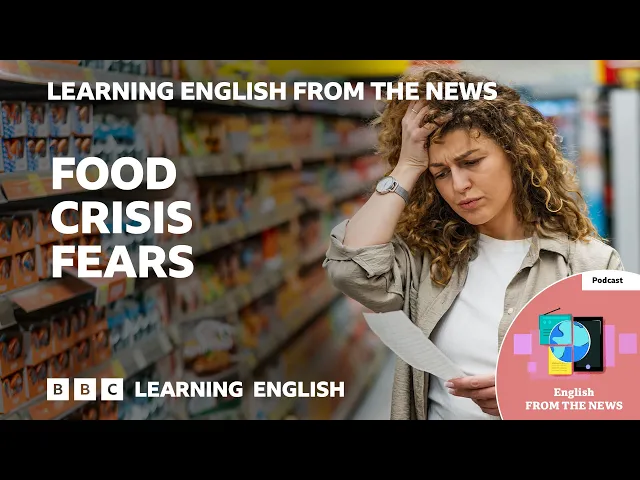
Iran war puts global food production at risk: fertiliser boss: BBC Learning English from the News
BBC Learning English
0:00 From BBC Learning English.
0:02 This is Learning English from the News, our podcast about the news headlines.
0:06 In this programme, Iran war puts global food production at risk,
0:11 according to fertiliser boss.
0:16 Hello, I'm Neil.
0:17 And I'm Georgie.
0:18 In this programme we look at one big news story
0:21 and the vocabulary in the headlines that will help you understand it.
0:25 You can find all the vocabulary and headlines from this episode,
0:28 as well as a worksheet on our website, bbclearningenglish.com.
0:33 So, let's hear more about this story.
0:42 Global food production is being threatened
0:44 by an interruption of fertiliser supply,
0:47 according to the boss of one of the world's biggest fertiliser producers.
0:51 Fertiliser is something that farmers put on fields to help plants grow.
0:56 The boss of Yara, a company which makes fertiliser,
0:59 says that this means the world will be
1:01 able to produce ten billion fewer meals a week.
1:05 And this will hit poorest countries hardest.
1:07 The UN World Food Programme estimates that the Middle East conflict
1:12 could cause 45 million additional people to experience severe hunger in 2026.
1:18 Let's have our first headline.
1:20 Trade Zone: A perfect storm rippling across the world's food supply chains.
1:25 And that headline again trade zone.
1:27 A perfect storm rippling across the world's food supply chains.
1:31 And that's from the business news section of the RBC Bank.
1:35 Now, there's a couple of interesting pieces of vocabulary in this headline.
1:38 We have a perfect storm that refers to a situation,
1:42 usually negative, which happens because of a combination of circumstances.
1:46 In this context, there's a combination
1:49 of factors affecting global food production,
1:51 for example, the war in Iran and climate change.
1:54 That's a perfect storm.
1:56 But we're looking at this word 'rippling'.
1:59 Yes, 'ripple' comes from water.
2:01 So if you drop a stone in water, it creates a ripple,
2:05 a series of small waves in a circular shape.
2:08 Now that's literal.
2:09 But metaphorically, 'ripple' is used to mean
2:11 that a problem spreads from one place to another, causing effects as it moves.
2:17 In the headline 'ripple' is a verb and is followed by 'across',
2:21 a perfect storm rippling across the world's food supply chains.
2:26 The headline is saying that the effects
2:27 of the war in Iran are felt across the world.
2:30 The effects on food supplies are rippling, or spreading, beyond the Middle East.
2:35 Yes.
2:36 Now, in the headline we see 'ripple across'.
2:39 You're also likely to hear 'ripple through'.
2:41 For example, news of their colleagues resignation rippled through the office.
2:45 It spread through the office.
2:47 And another common phrase you'll hear is 'ripple effect'.
2:51 That's a situation where an initial event causes other things to happen.
2:55 For example, her charity donation created a ripple effect.
2:59 Other people were inspired to donate as well.
3:06 We've had 'ripple', spread and affect many places.
3:13 For example, rising fuel prices are rippling through the economy.
3:23 This is Learning English from the News, our podcast about the news headlines.
3:27 Today, we're talking about threats to global
3:30 food production caused by the war in Iran.
3:33 So why is global food production under threat?
3:36 When the United States and Israel struck Iran on the 28th of February,
3:41 the Strait of Hormuz, which is a narrow waterway between Iran,
3:44 the United Arab Emirates and Oman, effectively shut down.
3:49 About one third of the world's
3:51 fertiliser trade normally passes through the strait.
3:54 The strait is also a vital channel for imports to the Middle East,
3:58 including food, medicines and technological supplies.
4:01 Let's have our next headline.
4:04 This one is from Al Jazeera, an international news organisation.
4:08 As Iran crisis drags on, fears of global food catastrophe grow.
4:12 That headline again from Al Jazeera.
4:15 As Iran crisis drags on, fears of global food catastrophe grow.
4:20 Now, this headline is from a couple of weeks ago,
4:23 and it's about fears that the war in Iran will lead to global food catastrophe.
4:27 'Catastrophe' is similar to 'disaster', something that is very bad.
4:31 We're looking at the phrasal verb 'drag on'.
4:35 The Iran crisis drags on.
4:37 But what does that mean?
4:38 It probably helps to understand the verb 'drag' in its literal sense.
4:43 'Drag' means to pull something heavy across a surface, usually the floor.
4:47 So imagine moving a heavy sofa to a new place.
4:51 You might drag it across the floor.
4:53 It's hard and slow to do, and it takes a lot of time.
4:56 The phrasal verb 'drag on' means to last for a long time,
5:00 but it has that same sense that something's slow and difficult,
5:04 it lasts longer than it should or longer than people expect.
5:07 Yeah.
5:08 So the headline says the Iran crisis drags
5:11 on, meaning perhaps it's lasting longer than people expected.
5:14 Now, war is a very serious context to use this phrasal verb,
5:18 but it has some more everyday uses as well.
5:21 For example, today's meeting really dragged on.
5:25 I couldn't wait for it to end.
5:27 Yes, or that film didn't need to be three hours long.
5:30 It really dragged on.
5:35 We had 'drag on', last for a long time, perhaps longer than expected.
5:43 For example, teacher strikes dragged
5:45 on for years because neither side could agree.
5:53 This is Learning English from the News from BBC Learning English.
5:57 We're talking about the impact of the US-Israel
6:00 war with Iran on global food production.
6:03 The price of fertiliser has increased by 80% since
6:06 the beginning of the US and Israel's war on Iran.
6:09 One of the regions that will be most affected is Asia and the Pacific,
6:13 where food insecurity is expected to rise by 24%.
6:17 'Food insecurity' means that people don't have a reliable source of food.
6:22 In the UK, food inflation, and that means the rising price of food,
6:27 could reach 10% by December, according to the Food and Drink Federation.
6:31 This is because less fertiliser means less food is grown
6:35 and if there is less food available, then prices rise.
6:38 And our next headline is about this.
6:41 This one is from Sky News.
6:43 Food price inflation still rising,
6:45 as lower income households feel the squeeze, study says.
6:49 That headline again from Sky News.
6:52 Food price inflation still rising,
6:54 as lower income households feel the squeeze, study says.
6:58 So, this headline is about the impact of the Iran war on UK food prices.
7:03 We're looking at this phrase 'feel the squeeze'.
7:07 Well, think about squeezing a lemon.
7:09 You hold it and press it firmly on all sides so that juice comes out.
7:14 You put pressure on it to make it smaller.
7:17 Yes.
7:17 Now the expression 'feel the squeeze' means you
7:20 feel financial pressure because things are becoming more expensive.
7:24 The pressure means that you have less money to spend.
7:27 So in this context, households with less
7:29 money are finding it harder to afford food.
7:32 They're feeling the squeeze.
7:34 The expression 'feel the squeeze' is about money and rising costs.
7:38 So another example, her family's been feeling
7:41 the squeeze since she lost her job.
7:43 Another useful phrase to use when someone can't afford things.
7:47 You can say that someone is struggling to make ends meet.
7:53 We've had 'feel the squeeze', experience financial pressure.
8:00 For example, they're feeling the squeeze since their rent went up last month.
8:05 That's it for this episode of Learning English from the News.
8:08 We'll be back next week with another news story.
8:10 And if you're interested in learning more English about the topic of money,
8:14 you should check out our special page with lots more programmes about money.
8:18 Find it at bbclearningenglish.com.
8:21 Bye for now.
8:23 Goodbye.