The best introduction to personal finance I have ever read
Ben Felix
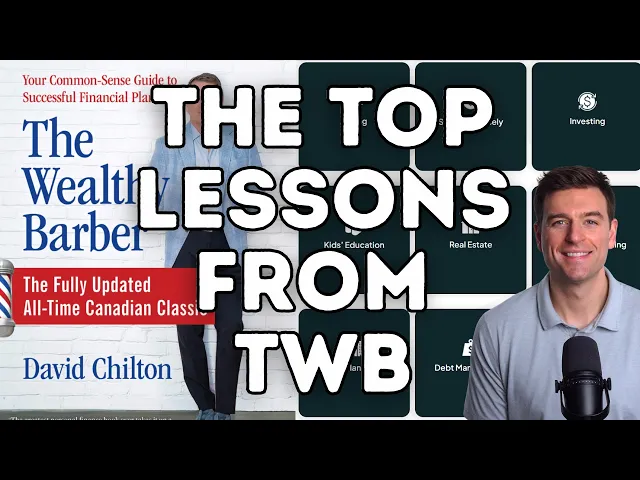
0:00 Wealthy Barber is a classic Canadian personal finance book first published
0:03 in 1989 that has sold over 2 million copies in Canada.
0:07 The author Dave Chilton has come out with a fully updated 2025
0:10 edition of the book full of top-notch personal finance advice on investing,
0:14 spending, estate planning, and insurance.
0:17 I have read the book twice now, and in this video I'm going to go through
0:20 the points that I think everyone needs to know.
0:22 I'm not affiliated with Dave or his company.
0:24 I may be a little biased because this channel is mentioned
0:27 in the book and my testimonial is on the back cover.
0:30 I know that was a bit of a humble brag, but come on, it's it's pretty cool.
0:32 I meant what I wrote there on the back of the book.
0:34 This is the best and most approachable introduction
0:36 to personal finance that I have ever read.
0:38 I think this book is a great read for anyone and an excellent
0:41 gift for someone you want to share good financial planning principles with.
0:45 Or, you know, you could just send them this video.
0:47 No, but also buy the book.
0:49 Sorry, Dave.
0:49 I'm Ben Felix, chief investment officer at PWL Capital,
0:52 and I'm going to tell you why The Wealthy Barber is a book worth reading.
0:59 The Wealthy Barber is written as a story with character development,
1:02 unique personalities, and lots of dry humor.
1:05 It starts with a Canadian couple, Matt and Maddie,
1:07 who decide they want to learn about personal finance.
1:09 They ask Matt's parents for help and they
1:11 get referred by them to their local barber, Roy,
1:14 who we find out is himself financially successful despite not
1:18 having an abnormally high income or having received a big inheritance.
1:21 He is the wealthy barber.
1:23 Roy is also an excellent personal finance teacher,
1:25 having helped many people over the years, including Matt's parents.
1:29 The book follows Matt and Mattiey's visits
1:30 with Roy as they learn about personal finance.
1:33 They're joined by Matt's overspending but successful entrepreneur sister, Jess,
1:38 his best friend Kyle Sorav,
1:40 a newcomer to Canada who lives in Royy's apartment building,
1:43 and some of Royy's regular customers who hang out in the barber shop,
1:46 and they all contribute to the discussions.
1:48 This writing style, conversational with lots of back
1:50 and forth on questions that readers likely have,
1:52 makes the information approachable for anyone.
1:54 All right, as much as I do like the writing,
1:56 I'm not just here to praise the book.
1:58 I want to give you its main lessons.
1:59 Again, I'm sorry, Dave.
2:01 I do hope people still read the book.
2:03 The first lesson imparted by Roy is you can do this.
2:06 There's absolutely nothing we're going to cover that you're
2:08 not capable of fully understanding and implementing successfully.
2:12 You can start managing your own money very well quite soon.
2:15 For many people, that is a huge lesson.
2:17 Finance and numbers more generally can be intimidating,
2:20 but becoming good at managing your finances is not a mathematical endeavor.
2:24 As Roy says in that first conversation,
2:26 none of the important financial planning concepts are complex.
2:30 This is such an important point.
2:31 Roy is absolutely correct that smart investing
2:34 and financial planning are easy to understand.
2:36 They're not always easy to execute due to human psychology,
2:40 but they should be easy to understand.
2:41 If you can't understand an investment product or financial planning strategy,
2:44 there's a good chance you should avoid it altogether.
2:47 In their next conversation, Roy introduces his golden rule.
2:50 Save and invest at least 10% of your net income for the future.
2:54 This rule is powerful due to the nature of compounding.
2:57 Saving and investing consistently over time eventually results in the returns
3:00 from your investments far exceeding your ability to save.
3:03 Compounding is both powerful and poorly understood.
3:06 Humans are just not wired to process exponential growth,
3:09 which is exactly what compounding results in.
3:11 Roy then explains that to be truly useful,
3:13 the first rule needs to be paired with the second rule.
3:16 And according to Roy,
3:17 the three most important words in personal finance, pay yourself first.
3:21 Roy explains that saving is hard.
3:23 Putting money away for your future self who feels like a bit of a stranger
3:27 is competing with spending on your present
3:29 self who's dealing with immediate needs,
3:30 a rising cost of living, the addiction-like psychology of spending money,
3:34 and our innate desire to keep up with the people around us.
3:37 Not to mention all the businesses doing everything they can
3:39 to influence you to spend your money on their products and services.
3:42 Paying yourself first, putting a portion of your money into long-term
3:45 investments or savings for some other short
3:47 or medium-term goal before you have a chance
3:50 to spend it takes away that temptation.
3:52 Roy explains that while taking 10% or more
3:54 of your income away seems difficult to do,
3:57 once you start, you realize that a lot
3:59 of your spending was on things you didn't really need.
4:01 As Roy concludes the lesson, Sorov chimes in to summarize,
4:04 save first, spend the rest good, spend first, save the rest bad.
4:09 Now, I do feel compelled to say
4:10 that many economists would disagree with this advice.
4:13 It could make sense to save less early
4:15 on in life and more later when your income is higher.
4:17 And similarly, it could make sense to save more or less
4:20 in a given year depending on your income and spending needs.
4:23 That implies spending first and saving the rest.
4:26 But as a general rule,
4:27 to get people engaged with long-term thinking, saving, and investing,
4:30 pay yourself first at a rate of around
4:32 10% of your net income is a solid foundation.
4:35 It's certainly better than not saving at all.
4:37 And as you adjust to having a little less cash in your budget,
4:40 it builds the reflex to carefully consider
4:42 the difference between spending needs and wants,
4:44 which most people probably don't do enough of.
4:47 I'll come back to that later with some useful wisdom from Roy.
4:50 The next session with Roy covers investing.
4:52 First, Roy prompts the group to consider why investing is important.
4:56 They collectively offer several correct reasons,
4:58 including to fight off inflation,
5:00 funding your future financial goals, and harnessing the power of compounding.
5:04 Roy offers up a nice catchphrase to explain
5:06 what he thinks successful investing looks like.
5:08 Be an owner, not a loner.
5:10 He's drawing the distinction here between stocks and bonds.
5:13 A stock is a piece of ownership in a business,
5:15 while a bond is a loan to a company or government.
5:18 In general, stocks are riskier and have higher expected returns than bonds.
5:23 Roy explains that stocks must have higher expected
5:25 returns than bonds because they are riskier to own.
5:28 With stocks, you're participating in the potential upside
5:30 and potential downside of the financial performance of real businesses.
5:34 Some businesses do really well while many do poorly in the long run.
5:38 Bonds are much safer because you get roughly the same
5:40 return whether the company's financial performance is good or bad.
5:44 And if it's really bad, leading the company to shut down,
5:46 bond holders often stand to recover some value while stockholders do not.
5:50 Government bonds are even safer.
5:52 Roy explains that in the long run, stocks are a bet on human ingenuity.
5:56 Being an owner, a stockholder,
5:57 lets you participate in the ongoing human innovation
6:00 that our whole economic system is based on.
6:02 It is hard to disagree with Roy here,
6:04 and I have done videos on the merits of 100% equity portfolios,
6:07 but it's also true that the volatility of 100%
6:10 equity portfolios is too much for some people to handle.
6:12 Asset allocation decisions should be made based on your ability, willingness,
6:16 and need to take on the volatility of stocks to earn higher expected returns.
6:20 The group is listening intently to Roy here,
6:22 but they voiced their concern that they don't
6:24 know anything about stocks or the stock market.
6:27 Kyle, Matt's best friend, even explains that some of his friends lost
6:30 a bunch of money picking stocks during the COVID boom,
6:33 like Pelaton is one example that he gives,
6:35 which came crashing back down to earth.
6:37 Roy explains that you need no knowledge
6:39 to invest successfully in the stock market.
6:41 He even goes as far as saying that for 99% of people,
6:44 more financial knowledge makes them worse, not better at investing.
6:47 I would qualify this a little bit.
6:49 Certain knowledge, like the idea that most people can't beat
6:51 the market and that index funds are sensible investments for most people,
6:54 is extremely useful knowledge.
6:56 Knowing how to follow the performance of individual stocks
6:58 or the direction of interest rates is probably not useful,
7:01 and I agree with Roy here, likely to do more harm than good.
7:04 People often tend to sabotage their own returns by overtrading,
7:07 timing the market, and investing in stocks that grab their attention,
7:11 all of which lead to lower returns,
7:12 and those problems are exacerbated when people who
7:14 think they have some knowledge follow the market closely.
7:18 Roy goes on to explain that successful investing
7:20 requires minimal investment knowledge because simply buying all
7:22 of the stocks or a close approximation of it
7:25 is the most consistently successful investment strategy in history.
7:28 It beats the vast majority of professional
7:30 investors and the vast majority of individual stocks.
7:33 It's next to impossible to consistently separate
7:35 winning and losing stocks before the fact.
7:37 But doing so is not necessary because all of the stocks together,
7:41 including both the winners and the losers,
7:42 have historically had more than enough return
7:45 to propel most people successfully toward their long-term goals.
7:48 This approach works because while lots of companies are losers in the long run,
7:51 the winners tend to win big.
7:53 The most you can lose in a stock is 100% of your investment,
7:56 but when you own a big winner, you can gain far more than that.
7:59 We can't identify those winners and losers before the fact,
8:02 but owning all of the stocks in the market
8:04 means that you will always hold the big winners.
8:06 This effect, which is called skewess,
8:08 is what makes owning the market so difficult to beat.
8:11 This is also part of the explanation for why
8:13 professional money managers consistently fail to deliver market beating returns.
8:17 The other reason is their high fees.
8:19 Here in Canada, we still have a huge portion of our investment
8:21 assets in high fee funds that aim to beat the market.
8:25 While as expected, very few are actually successful.
8:28 Roy admits that he too at one
8:29 time had invested in actively managed mutual funds,
8:32 but he eventually saw the light after underperforming consistently.
8:35 Between the skewess in stock returns and the high
8:37 fees charged by the managers hoping to beat the market,
8:40 trying to beat the market is a losing game.
8:42 This again leads to the simple conclusion
8:44 requiring little knowledge to simply buy the market.
8:47 The good news is that there are lowcost investment vehicles called index funds
8:51 that do aim to buy all of the stocks in a broad market index.
8:54 A broad market index is a grouping of stocks
8:56 that has been assembled to represent an entire stock market.
8:59 In Canada, we even have asset allocation ETFs which
9:02 give you a globally diversified portfolio of index funds.
9:06 Roy suggests that those asset allocation ETFs are a good
9:09 option for many people and I agree with them.
9:12 The group also raises the point that while being an owner
9:14 not a loner may have made sense in the past, the future is perilous.
9:18 We have global warming, Russia and Ukraine, and divisive politics,
9:21 all making the outlook for the global economy look weak at best,
9:25 making being an owner, being an investor in the stock market less compelling
9:28 now than it may have been in the past.
9:31 Roy does something here that I love.
9:32 He brings up history.
9:34 Roy reads a headline that he keeps laminated on his counter,
9:37 and I'm going to repeat it here.
9:38 It is a gloomy moment in history.
9:40 Not in the lifetime of any man who reads
9:42 this paper has there been such grave and deep apprehension.
9:45 The United States is beset with racial, industrial, and commercial chaos.
9:49 Drifting we know not where, and Russia hangs like a storm cloud on the horizon.
9:54 Of our troubles, no man can see an end.
9:57 The group assumes this is from a current paper,
9:59 but Roy explains that it's from Harper's magazine in 1847.
10:02 I I learned this lesson early on in my career.
10:04 When you look around at the state of the world, it always,
10:07 always, always feels like some un
10:10 unprecedented disaster is unfolding before our eyes,
10:12 making it feel like a particularly bad time to invest in the market right now.
10:16 The reality is that it always feels that way.
10:18 Wars, threats of war, discouraging economic data, natural disasters,
10:22 and a ton of uncertainty about the future are persistent realities.
10:25 That doesn't go away.
10:26 And yes, that makes investing risky.
10:28 But the very nature of that risk is why
10:31 we expect to earn positive returns in the long run.
10:33 If there were no risk, we would expect to earn the kind of returns
10:36 that you get from a guaranteed investment certificate, which are much lower.
10:40 With index funds and expected returns out of the way,
10:42 Roy goes on to explain Canadian account types, including the RRSP and TFSA.
10:47 RSPS and TFSAs are like containers that investments can be held in.
10:51 The RRSP is a pre-tax savings account,
10:53 meaning that contributions are made with pre-tax dollars.
10:56 This is implemented in practice with a dollar
10:58 for-doll tax deduction when you contribute to your RRSP,
11:02 reducing your taxable income by the same amount.
11:04 When you eventually withdraw from your RRSP,
11:06 the withdrawal is fully taxable as income.
11:09 The TFSA is an after tax savings account,
11:11 meaning that contributions are made with dollars you
11:13 have already paid income tax on, and accordingly,
11:16 there is no tax on withdrawals.
11:18 That's all pretty straightforward,
11:19 but Roy offers the crew an illustration comparing the two
11:21 account types that I think everyone needs to understand.
11:24 Say you have a 30% tax rate and contributed $5,000 to an RRSP.
11:28 3,500 of those dollars are your after tax
11:31 dollars and 1,500 are deferred income tax dollars.
11:35 The RRSP allows you to invest those future tax dollars.
11:38 It allows you to defer income tax.
11:41 Invest that at 8% for 30 years and you have just over $50,000.
11:45 Then withdraw it at the same 30% tax rate and you have just over $35,000.
11:50 Now let's look at the TFSA.
11:52 Only after tax dollars can go into the TFSA.
11:55 Following the $5,000 pre-tax RRSP contribution,
11:58 the TFSA will get a $3,500 after tax
12:01 contribution since the TFSA does not offer tax deferral.
12:04 Invest that for 30 years at 8% and you have just over $35,000,
12:09 exactly the same as the after tax outcome for the RRSP.
12:13 This shows something important and often misunderstood.
12:15 When your income tax rate is held constant,
12:18 your after tax dollars in both the RRSP and TFSA grow tax-free.
12:24 Many people see the eventual tax bill on RRSP
12:26 withdrawals and think it was a bad deal.
12:28 But the RRSP and TFSA give you an identical
12:30 after tax outcome if your tax rate stays constant.
12:34 It gets even better because it's common for people to have a higher tax rate
12:37 while they're working and contributing to the RRSP
12:40 and a lower tax rate in retirement.
12:42 In that scenario, the RRSP offers an advantage over the TFSA.
12:46 It is true, as Kyle points out in the book,
12:48 that pulling dollars out of your RRSP at a higher tax rate effectively
12:52 results in a penalty for having used the RRSP rather than the TFSA.
12:55 Now, the problem, as Roy explains,
12:57 is that we do not know with certainty what our future tax rate will be.
13:01 This does introduce some uncertainty about the optimal account choice today,
13:05 but it's still possible to make sensible decisions using
13:08 the RRSP in years where your income is high relative to what you expect it to be
13:11 in the future and using the TFSA when it's low,
13:14 or if possible, just max out both.
13:16 Next, Roy moves on to home ownership.
13:19 He first explains that it's critically important to consider
13:21 the total cost of ownership when buying a home.
13:24 Not just the mortgage payment,
13:25 but the property taxes and inevitable ongoing maintenance costs.
13:28 Not to mention the potential for the mortgage
13:30 payment to increase if interest rates increase,
13:32 an issue faced by many Canadians in recent history.
13:34 Given the currently high property prices in Canada,
13:37 Roy describes some of the levers that people can
13:39 pull to make buying a house more of a possibility.
13:42 The first one is to buy a cheaper home.
13:44 That may be obvious, but it's worth saying.
13:46 It's not necessary to buy a house that fits
13:47 the maximum amount the bank will lend you,
13:49 and smaller homes cost less and are easier to maintain.
13:52 There are terms to describe spending so much on a house
13:55 that you can't enjoy the rest of your life, including house poor and cashration,
14:00 which are both self-escriptive as states most people would want to avoid.
14:04 The next levers includes some good rationale for not
14:06 stressing too much about having a 20% down payment,
14:09 using the FHSA, the first home savings account,
14:11 and the RRSP home buyers plan to increase the amount you have
14:15 available due to the income tax deductions gained from using those tools.
14:18 taking out a mortgage with a 30-year amortization rather than
14:21 the more common 25-year amortization to lower the payments on the loan.
14:25 Finding a partner before buying a home,
14:27 living with your parents to save up for a down payment,
14:29 paying off any outstanding consumer debts to make you look
14:32 better to the bank when they assess your ability to borrow,
14:34 and earning more income.
14:36 I'm not going to go into detail on all the points here,
14:39 but each one of those does have an in-depth
14:40 discussion and a thoughtful discussion in the book.
14:43 Royy's final point on housing, and where this channel gets a shout out,
14:45 is that renting is not throwing your money away.
14:48 a renter who saves the cash flow
14:49 cost difference between renting and owning and invests
14:51 in the stock market can be reasonably
14:53 expected to match the wealth of a homeowner.
14:56 The group then shares some stories about friends who have had
14:58 large unexpected housing expenses and they
15:00 collectively start to see Royy's point.
15:02 Owning a home comes with a constant flow of unexpected costs.
15:06 So constant that they should not in fact be unexpected at all.
15:09 The basement leaks, the air conditioner stops working.
15:11 A tree has to be removed.
15:12 I just had to do that at my house.
15:14 The chimneys crumbling.
15:15 If renters are diligent about saving and investing the cost
15:18 difference between their rent and the owner's mortgage, property taxes,
15:21 and all the unexpected expected costs of owning,
15:24 they can be expected to at least match the wealth of the owner.
15:27 I have shown this in past videos using both reasonable
15:29 assumptions for the future and actual historical data for Canadian cities.
15:33 Roy does emphasize a point that I agree with.
15:35 Most people who rent will not save and invest diligently.
15:38 They will undersave and invest in shitcoins,
15:40 penny stocks, and expensive financial products.
15:43 Those are my words, not Royy's that underperform the market.
15:46 Additionally, lots of people, including some of Royy's students in the book,
15:49 have an emotional desire to own.
15:51 But Roy suggests here that Canadian society has
15:53 conditioned us to believe that home ownership is
15:55 a desirable objective and that it's worth reflecting
15:58 on whether it is really a desirable objective for you.
16:01 There are additionally lots of psychological benefits to renting,
16:04 like fewer responsibilities, more predictable costs,
16:07 and general lifestyle simplicity.
16:09 There are valid points on both sides, but Roy's point is that renting is
16:13 a viable option for housing from a financial perspective.
16:15 It is not throwing money away,
16:17 and it may be the best path for some people to follow.
16:20 Music to my ears.
16:21 Royy's next lesson on spending is incredibly important.
16:24 People spend money for the wrong reasons,
16:26 reasons not aligned with their values and goals.
16:29 Roy explains that a lot of spending is the result of faulty brain wiring.
16:33 People often spend money to impress the people around them,
16:35 even if not consciously.
16:37 And in addition to that, we are not good at delaying gratification.
16:40 The point Roy wants to hammer home is that most people would cut back
16:43 on some of their spending if they were more aware of where their money goes.
16:47 And even small changes in spending can be a big boost to your savings rate.
16:51 Royy's first tip here is a tedious
16:52 one to create an exhaustive multi-month spending summary.
16:55 The group agrees that this sounds like a miserable task,
16:57 but Roy says that over his many
16:59 years of experience teaching people about personal finance,
17:01 these spending summaries have proven vital for many
17:04 people to get on top of their personal finances.
17:06 Arguably even more importantly and interestingly,
17:09 Roy says that he is 100% sure that doing
17:11 a spending summary has positively impacted people's happiness levels.
17:15 The reason is that it makes people realize where
17:17 they are spending on things that don't bring them
17:19 value and it helps them to make sure they
17:21 are getting value from the things they are spending on.
17:23 As Roy describes it,
17:24 you want to maximize the joy units you're getting for each dollar of spending.
17:28 If you can find spending that is giving you some joy units like lunches out,
17:32 but when added up over the course of a year,
17:34 those dollars could have afforded something with a higher joy unit impact,
17:38 you might realize it makes sense to reallocate your spending.
17:41 Small numbers make a big difference.
17:42 For example, saving only $11 per day
17:45 for a year results in over $4,000 of savings.
17:48 More if you account for any return, even a small one earned on those dollars.
17:52 Roy brings up a famous quote from Ben Franklin to drive the point home.
17:56 Beware of little expenses.
17:57 A small leak will sink a great ship.
17:59 The next lesson is on wills, life insurance, and responsibility.
18:03 Nobody likes thinking about dying, but as Roy explains,
18:05 if you don't think about it,
18:06 your estate will be distributed based on your province's intestasy laws,
18:10 the laws that determine what happens when someone dies without a will.
18:13 The problem is that those laws are often at odds with what you would
18:16 have wanted to happen if you had taken the time to plan for it.
18:19 It's important to consider what exactly you want
18:21 your estate to achieve and have a will drafted accordingly.
18:24 Roy suggests going to a professional,
18:26 but acknowledges that some of the online will platforms
18:28 can also work if you have a simple situation.
18:30 Personally, I would go to a professional, especially if you have any complexity
18:34 in either your assets or your estate objectives.
18:36 Roy emphasizes the importance of choosing an executive.
18:39 The executive is the person responsible
18:41 for carrying out the will's instructions,
18:42 but it is not a small job and should not be taken lightly.
18:45 Royy's last point on wills is that they should be reviewed at least once a year.
18:49 And he also mentions that when you get your will done,
18:51 you also need to draft power of attorney documents.
18:54 Powers of attorney give legal power to someone you have chosen
18:56 to make decisions on your behalf in the event that you become incapacitated.
19:00 There are two main types.
19:01 Power of attorney for property,
19:02 which lets someone manage your money and other assets,
19:05 and power of attorney for personal care,
19:07 which lets someone make health and lifestyle decisions on your behalf.
19:10 It is worth noting that these have
19:11 different titles across the different provinces in Canada.
19:14 Similar to an executive, choosing the right person or people is important.
19:17 Finally, Roy moves on to life insurance.
19:19 He explains that while life insurance
19:21 is extremely valuable in the right circumstances, it is always a cost.
19:24 You want to make sure that you have
19:26 an insurance need before you buy life insurance.
19:29 Life insurance provides financial protection for your dependence
19:32 in the event of a premature death.
19:33 An insurance need means that other people that you care about would
19:36 be unable to maintain their lifestyle in the event of your untimely death.
19:40 The most common example would be your spouse and children,
19:42 particularly in cases where you are the primary income source for the household.
19:46 This insurance need tends to decrease over time as your assets increase.
19:49 Roy does walk through how to quantify your insurance needs in the book,
19:52 but I'll let you read that in the book.
19:54 The final point that Roy makes on insurance is one that everyone needs to hear.
19:57 Most people will only ever need renewable and convertible term life insurance.
20:02 Term life insurance pays out the face amount of the policy if the insured dies.
20:06 It has a level premium for a fixed term like 10 or 20 years,
20:09 and the insurance expires or renews at a higher premium at the end of the term.
20:14 The alternative is cash value life insurance,
20:16 which combines term insurance and a savings component,
20:20 where a portion of the premiums you pay go
20:22 toward building up a cash value inside the policy.
20:25 That's why it's often referred to as cash value life insurance.
20:28 The savings component means that you're paying higher premiums overall,
20:31 often a lot higher, for the same amount of coverage.
20:34 You do also get the savings component,
20:36 but Roy explains that buying term life insurance and investing the difference is
20:41 typically going to be a better option for most people most of the time.
20:44 I tend to agree with Roy here.
20:45 To finish off in the insurance topic, Roy discusses disability insurance.
20:49 For young people with little financial assets,
20:51 their biggest asset is their ability to earn income in the future.
20:53 Life insurance protects that future income in the event of an untimely death.
20:57 But death is not the only way that your ability to earn income can be disrupted.
21:01 In fact, disability is much more common.
21:03 When someone becomes disabled, they may lose the ability to earn income
21:06 and even become a liability to their family.
21:08 Matt mentions in the book that he's covered through a group plan at work,
21:11 but Roy correctly cautions that many group plans are insufficient.
21:14 One big point to look out for is whether the policy covers you in the event
21:18 that you can't fulfill the duties of your own occupation or of any occupation.
21:22 Own occupation disability coverage is the gold standard.
21:25 And you also want partial disability coverage, cost of living adjustments,
21:28 and for the policy to be guaranteed renewable.
21:31 Typically, that means getting additional disability coverage,
21:34 even if you do have a group plan.
21:36 This is not an area that you want to skimp on.
21:38 Okay, I left lots of good stuff out since this was already a long video,
21:41 but I hope the summary was useful.
21:43 This is a great book.
21:44 If someone asked me for an accessible book
21:46 to read as an introduction to personal finance in Canada,
21:49 this would be at the top of the list, even for me.
21:51 While most of the facts in the book were not new,
21:53 the way that they were communicated gave me a lot to think about.
21:56 I'll put a link to the book in the video description.
21:58 It's not an affiliate link.
21:59 I gain nothing from you buying it.
22:00 Thanks for watching.
22:01 I'm Ben Felix, chief investment officer at PWL Capital.