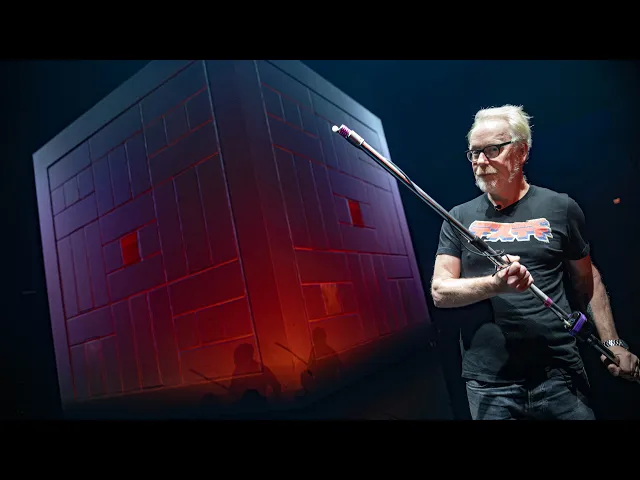
Adam Savage Learns About Real-Time Projection Mapping!
Adam Savage’s Tested
0:07 Hey everybody, Adam Savage and I'm on stage
0:09 at Circus show Echo in San Francisco with Todd.
0:12 How are you?
0:13 Really good.
0:13 Yourself?
0:14 Very good.
0:15 Um, behind us is one of your Well, this is the big piece of kit for this show.
0:20 It is the cube.
0:22 Yes.
0:22 And it not only dances and rotates and reconstructs itself,
0:26 but it also has projection mapping on it.
0:29 It does.
0:30 That is your purview for Yeah.
0:31 So, I'm the head of lighting and video on the show.
0:34 Okay.
0:34 Uh, and of all the cir shows, we've definitely got the most projection.
0:37 Oh, really?
0:38 Um, so quite a few of the shows have projection,
0:41 but uh almost all of the show we
0:43 are projecting some form of element onto the cube.
0:46 uh and with it moving, that's kind of our our biggest thing is uh allowing
0:50 it to be able to be a feature of the show,
0:52 but also stick to that surface as it moves around the stage and changes.
0:56 Now, when you say stick to that surface, is it a is it a is it dead reckoning?
1:01 Do the projectors know what marks this is going to hit
1:03 or is it dynamic and it's actively watching where the cube
1:07 it is dynamic.
1:08 So, uh we have a bunch of uh infrared dots throughout the cube.
1:11 Um and it's the same system that we use for following formers on stage.
1:15 So we have 28
1:16 following performers on stage.
1:18 So we have 28 cameras around the rooms
1:20 and uh they all have infrared trackers in their costumes.
1:23 Uh so the system at the top of a city
1:26 we calibrate and so based on uh we have four
1:30 in the stage and once the system knows where the stage
1:32 is it can start to build the environment around that.
1:35 Oh my goodness.
1:36 So all of the cameras work out where they are and then based off that they
1:39 can follow the infrared buds around the room
1:41 and know where they are at any one point.
1:43 So you can have a digital representation of everything that's
1:46 happening on stage live during the show and know where every Absolutely.
1:50 human and set piece is.
1:51 Yep.
1:52 So it's only a few of the performers, our main characters that attract,
1:55 but in theory we could scale that to everyone.
1:58 Uh and we can show you after this a bit
1:59 of a live view of what we see in the 3D space.
2:02 Um but amongst that you see the cube as an element.
2:06 So So I noticed, you know, it took me a while to find your follow
2:08 spot operators because they're well hidden in your trees.
2:11 But there are there also automated lights that follow performers from those.
2:16 Wow.
2:15 So all of the shows uh in the past have
2:17 had uh follow spot operators and we always like that.
2:20 It it provides a really nice live element.
2:22 Yeah.
2:22 But now we are starting to do a lot more with uh
2:25 tracking the performers with moving lights
2:27 as well and that's all done digitally.
2:29 Um so we have we can tweak a few elements
2:32 depending on how fast someone's moving and that sort of thing.
2:35 Uh but you would have seen like we've got a a bungee straps uh act.
2:39 So that's our hardest one to work with because as much
2:41 as we can build a bit of prediction into the system.
2:44 So if someone's moving fast, the light will keep up with them,
2:47 you've got a performer that's going to accelerate
2:49 but then very quickly decelerate and head straight
2:52 back in the other direction and the software
2:53 can't quite predict for that sort of motion.
2:56 Now when you say this is the most projection happening among the companies
2:59 of cir disle um I would assume that when a technology like that comes
3:04 in you guys experiment with it in every way that you possibly can
3:08 and you're learning things on this show that will go into future shows.
3:11 Is that really how the pipeline works?
3:12 Yeah.
3:12 So a couple of the other shows in the past
3:14 uh like Corteo had the same tracking system that we do.
3:17 Uh so they utilize that for video uh sorry for performer tracking.
3:22 Um, and actually a lot of what they experienced
3:25 was fed back to the developers of the software.
3:27 So by the time it got to us,
3:29 we actually had a lot more capability than they than they did.
3:32 They were having to build a lot of things on the fly.
3:34 Oh, amazing.
3:35 And we're doing more and more with that here.
3:36 So, uh, different acts come in, so we produce new content and, uh, yeah.
3:41 So, it's always developing, man.
3:42 I mean, my theater days were so they were over three decades ago,
3:46 but it was so analog back then, even with the digital stuff we were doing.
3:50 I can't imagine being able to have
3:52 real- time mapping of everything that's going on.
3:54 And it's funny because we we've all come from that background and we
3:56 like to do as much as we can personally and like follow spotting.
4:00 It's it's great fun, but we're we're trying to do as much of a blend.
4:03 So, as many of the cues that we can, we still want to take ourselves,
4:07 but there are some things that are are just
4:09 done better with the technology we have access to now.
4:12 Okay.
4:12 So, this cube, it moves, it rotates, it constructs, deconstructs.
4:16 What is what are some of the harder things
4:18 for you to deal with while the cube performances happen?
4:21 I mean, for us, uh, and given that we're in San Francisco right now,
4:25 we we have to do a calibration once a week.
4:27 Um, but we've already seen uh, we've experienced here, we get earthquakes.
4:32 So, we have 10 projectors around the room
4:34 and they are all very precisely focused.
4:37 The little tiny earthquakes that happen all the time here,
4:39 they throw your stuff off.
4:40 We see it.
4:41 So, because it's not just one projector at the surface,
4:43 it's multiple that are blended together.
4:46 And just a small tremor or someone grabbing onto one
4:48 of the posts is enough to give us that little shift.
4:51 Um, so there's little bits that we can do on the fly,
4:53 but sometimes we need to to do a full recalibration of everything.
4:57 So, I can imagine a situation in which a show happens and nothing went wrong,
5:01 but you can tell, you know what,
5:02 we're going to need to check the calibration on these things.
5:05 Absolutely.
5:06 So, and I mean at the same time, even if some of our tracking buds drop out,
5:10 we will start to see the projection shift slightly
5:13 um because it starts to lose that uh position.
5:16 Well, I mean, and that's like one of the reasons we
5:18 all stayed analog 30 years ago is because failure modes could be,
5:22 you know, lead to black on stage, right?
5:24 Absolutely.
5:25 So, you guys, do you build in technological like canaries
5:27 in a coal mine to help you know that things are going smoothly?
5:30 sort of like and a lot of it is
5:32 you don't know the problems there until you've hit it
5:34 and then it's and then it's looking back and going
5:36 hey what can we do to fix this next time.
5:38 Um but a lot of that is done in in our pre-show
5:40 checks and we we have a lot of contingencies built into our system.
5:45 Um as much as anything though that's for if the show ch the show version
5:49 changes on the fly uh then we need to adapt and move with something else.
5:53 Um and that is one thing that we love still having the follow spots is
5:56 actually a lot of the time they are our get out of jail free card.
5:59 uh if something is failing on stage,
6:01 you've got a person up there that can pick it up for us.
6:03 You always need that analog element.
6:05 Yeah, absolutely.
6:06 Can we watch it do something?
6:07 Absolutely.
6:07 Yeah.
6:07 So, we can do a rotation of the cube and you'll see
6:10 the the all of the faces and the projection move around with it.
6:14 Um and then we can show a couple of bits of the content where
6:17 we managed to provide a lot more depth to just this two-dimensional surface or
6:21 Absolutely.
6:21 Um yeah, let's see.
6:25 Yeah.
6:25 So you'll see as it moves, we have four of the infrared buds uh on every face.
6:30 Um and you can see where the lines line up to those.
6:34 So I'm watching I'm not just watching one projector create that image.
6:37 It's multiple projectors stitching this together.
6:40 Absolutely.
6:40 So if you actually looked at some of the projectors around the room,
6:43 you would see the color change as it moves through.
6:45 Oh, fascinating.
6:46 Because it's not delineated by lines.
6:48 It's not like two projectors are doing one phase.
6:50 No, absolutely.
6:51 So, we've got them positioned so that we can hit it essentially from every side.
6:55 Um, but I also don't see any of the projections on the gray.
6:59 No.
6:59 So, because we've got the two faces out right now,
7:02 we've basically put a mat in and blocked that.
7:04 You have?
7:04 Wow.
7:05 Okay.
7:05 So, so normally there would be something in that uh
7:08 space as soon as we put the face back in.
7:11 Yeah.
7:11 Um, but because the the cube changes throughout the show,
7:13 so sometimes that's done with content and we know
7:16 that at a at a point something is going to be missing.
7:22 That's really cool.
7:29 Absolutely.
7:29 There's there's definitely a couple of bits
7:31 of the content that do that more than others
7:33 when you're like, is that a real box or a projection of a box?
7:35 Yeah.
7:36 And I think that's an element that the audience really enjoys as well,
7:39 like see seeing what just appears to be a flat cube.
7:42 Yeah.
7:43 And it's also coupled with what the performances going on at the same time.
7:46 So, at the same time that we have performers removing physical elements from it,
7:51 right?
7:51 We've got the projection layered over top.
7:52 So, they never know quite what's real and what's not with it.
7:55 So, I I love that I'm very magic adjacent.
7:58 I have a lot of magician friends.
8:00 And one of the things I love about
8:01 magicians is they'll show you the same trick twice,
8:04 but they're not showing the same trick twice.
8:06 They're showing to you two different methods,
8:09 and those methods cancel each other out.
8:11 I noticed you guys doing stuff like that with this.
8:13 You're doing tricks with this that are impossible,
8:16 but I realize there must be dozens
8:18 of people behind the scenes making stuff happen.
8:20 There is.
8:21 And a lot of the time it is perform performers and technicians inside.
8:24 So, they might be getting cues and stuff.
8:26 So, as much as it looks simple that someone's pulled a box out of the queue,
8:30 but might actually being pushed from behind and and things like that.
8:33 You know, there's over the years on Mythbusters,
8:36 we've investigated some things that were really cool like
8:38 um uh uh uh uh like blood hounds, right?
8:41 working with police and also snipers.
8:43 And in both of these cases, what you thought was like, well,
8:46 the blood hound is the business end of this or the sniper is the business end.
8:49 In each case, those were deep partnerships, right?
8:52 Like the sniper is nothing without a spotter
8:54 and the dog is nothing without the trainer.
8:56 And you know, people come to this show
8:58 and think that it's just these performers doing amazing stuff,
9:00 but they don't realize that there's a second set of performers in black.
9:05 No.
9:04 Doing just as much work behind the scenes.
9:06 Absolutely.
9:07 And it's a funny one for our industry in that a lot
9:09 of the time people know we exist when we haven't done our job correctly.
9:13 If if we've done our job right,
9:14 people should never know that we're really there.
9:17 Um and there is a kind of magic to that in a way like
9:20 Well, and also you are there to the performers, right?
9:23 You're their partners in this show.
9:24 They're you're ever present to them.
9:26 And I I I love that sort of hidden
9:28 dynamic that the audience doesn't know is happening.
9:30 Yeah.
9:30 No, like we the audience never gets to see that reaction interaction,
9:35 but uh I mean particularly with a show
9:36 like this, we're on the road all together.
9:38 It is one big family and so we're hanging out
9:40 with them as much as we are with each other.
9:42 Can we see some of the other fun stuff that's Absolutely.
9:44 Yeah.
9:44 Let's show you some of the the content that we've got on here.
9:47 Yeah.
9:47 See, I'm completely fooled by that.
9:50 Yeah.
9:50 So, a lot of the content has been created to mimic what is underneath.
9:55 So, this one is simple in that you're seeing
9:57 the exact lines that we see on all of the containers.
9:59 But am I seeing that the light that's
10:02 moving and spilling onto that corner is actual?
10:05 No.
10:05 So that that is projection.
10:06 So there is almost like a bit of a heartbeat.
10:09 And then Yeah.
10:10 When you see this one when all of a sudden everything starts to move.
10:13 I'm completely fooled.
10:15 Yeah.
10:15 But at the same time while this is running,
10:17 a performer will come and grab a cube out
10:19 at the same time that it's projected to be removed.
10:22 I mean that's the thing is that because you have
10:23 these lighting elements here and I see these hot corners,
10:26 my brain is just telling me that's totally
10:28 Absolutely.
10:28 It adds that whole extra dimension to it.
10:31 And it's funny seeing it kind of being deconstructed right
10:34 now because this is in the first half of our show
10:37 and then the cube does actually get taken
10:38 apart later on, but the audience like they don't
10:41 see that one as much but they've kind of got to see it in in this digital world.
10:45 That's so cool.
10:48 Yeah,
10:48 dude.
10:48 This is crazy.
10:50 I want to do this on the ceiling of my house.
10:52 Yeah, right.
10:54 I mean, a lot of people are doing that now.
10:55 It's amazing what you can do with 3D projection
10:58 for a bit of decoration around the place and mapping.
11:02 Um, occasionally I would imagine you learn something that this can do
11:06 that wasn't part of its charge or some extra ability it has.
11:10 Um, I would imagine within the company you and the other
11:14 people in your position trade notes about the this technologies that you're
11:18 bringing into shows because I would imagine this is a set
11:21 of companies that always wants to push each technology to its extent.
11:25 Absolutely.
11:25 like we we do keep an eye on new and emerging technologies and what's
11:29 out there and try and integrate as much as we can where we can.
11:32 Um but
11:33 although you've got the drones and I've watched
11:35 that technology blow up in the last 15 years
11:37 and and something like that it's interesting trying to be
11:41 at the forefront but at the same time if you're if you're
11:43 the first to integrate something by the time a couple of other
11:46 people have started to do it it might be completely changed.
11:48 So it is trying to keep up with everything as it goes.
11:51 I remember calling up one of those first drone operators and asking
11:54 if I could incorporate it into a touring show and they're like,
11:56 "We need three days of setup for every performance." And I'm like, "Okay, that's
12:01 now that's nice and easy.
12:02 You have them roll out of a rack and they're ready to go."
12:05 But we we also have uh crosspollination between the shows.
12:08 So I've been with Echo now for about 6 months,
12:10 but I spent 3 years on another show.
12:12 And so I bring that knowledge from from the other show.
12:15 Any new staff members we have from outside the company,
12:17 they also bring other ideas.
12:18 And so you do get an amalgamation.
12:20 Even though it's a a fixed product right now,
12:23 there's always going to be things to change.
12:24 And but that's lovely too from a from your professional standpoint.
12:28 It sounds like uh the company engenders creativity and exploration.
12:34 So it's not just like you're showing up and pushing buttons.
12:36 You're part of this creative process.
12:38 Absolutely.
12:38 Like we a normal week we are obviously
12:41 very focused on shows but anytime we're not
12:43 we're we're doing maintenance and we've always got
12:45 projects of what can be improved and that might
12:47 be simply to make our our life easier moving from one city to the next
12:51 but a lot of it is to improve what the audience gets to experience every night.
12:55 That's really cool.
12:56 All right, dude.
12:59 This is super cool.
13:00 So this is the tracking system.
13:02 This is our our test stick.
13:04 So this is why this one looks a bit rudimentary.
13:07 Uh, but we use this every night to to check
13:09 that all of our fixtures uh are tracking.
13:11 So it'll step through individually and follow this dot.
13:14 Um, and this is one of the the little infrared buds.
13:17 So it's actively powered.
13:18 It's not just a passive device.
13:20 Correct.
13:20 And so these will uh will flicker at a slightly
13:24 different frequency and those frequencies get assigned an ID.
13:27 So we so we can assign that to our different characters and that sort of thing.
13:31 Um, and actually your your cameras probably right
13:33 now could see the ones on the cube,
13:35 but to the audience that they will never notice this.
13:38 Like if if we have a look at it closely, you can just see the faint red.
13:41 Um, but it is very faint.
13:43 Um, and so yeah,
13:45 I love this so much.
13:46 Um, because I also like I can see
13:49 why you still need a funnel spot operators, right?
13:52 They they can still do things in a dynamic way that this isn't.
13:56 But like this is so cool.
13:58 Yeah.
13:58 And like there are some limitations to the the system.
14:01 But it's also designed so that if the buds get lost at all.
14:04 If I was to cover this one up,
14:06 then none of the cameras can see it now and everything's going to fade off.
14:09 But once it gets seen by the system again, uh it's going to come back on.
14:13 Um but that's also part of why all
14:16 of our costumes and I've actually got one here.
14:20 Yeah.
14:20 So the costumes
14:21 Oh, this one in the clowns.
14:22 Yes.
14:23 Okay.
14:23 And so we can show later.
14:25 We're like seeing this moving in the 3D space,
14:27 but they've just got a couple of buds in the corners there.
14:30 And as much as anything that's that if they were say to lie down
14:34 that one of the buds is always going to be visible by all of the cameras.
14:37 Amazing.
14:37 So one's on the front, one's on the back, opposite sides.
14:40 And so anytime that the system can see more than one bud,
14:43 it's basically going to take the 3D point in space
14:46 between the two points and that's where everything will be focused.
14:49 Do you end up putting sensors on every performer or just key performers?
14:52 No, just key performers.
14:53 So we all of our characters in the show attract
14:57 um and then also a couple of the aerial acts
14:59 um we found that that's the best way to to follow
15:01 them and to get the looks that we're after.
15:02 Oh, fascinating.
15:03 So some of them have it.
15:04 Um that must have been an interesting rigging
15:07 thing putting a sensor on an aerial performer.
15:10 Yeah.
15:10 So that that then becomes a mix between rigging
15:13 and making sure they're happy with what they've got.
15:15 Uh between uh us and having the system
15:17 and obviously wardrobe and and costume and designing it all.
15:20 This is more batteries that have to be checked.
15:23 Yeah.
15:24 So, this this is just coming to a pack and it's
15:26 the exact same as what I've got on the tracking stick here.
15:29 Um, and so before every show we're
15:30 going through and swapping all of the batteries
15:32 and we have a station out the back where we check that everything's working.
15:35 Um, but we also have a camera set up so that the performers
15:38 as they're coming on stage can walk past it and see that they are working.
15:42 Incredible.
15:43 So, they're also part of the check system.
15:46 Absolutely.
15:45 Oh, okay.
15:46 So, there's your digital.
15:49 Yeah.
15:49 Chloe's just going to kind of position it for us.
15:54 So, th this one we're normally actually watching in the booth, right?
15:57 But this is purely just for us here to monitor things that it gives us a um Wow.
16:02 Uh a viewer into it.
16:06 Um and then so we have this screen here,
16:08 which is just the the camera up here in a night vision.
16:10 Right.
16:10 Right.
16:11 Uh and so Oh, look at how bright those are.
16:14 Wow.
16:14 We see clear as day.
16:15 So that's what the Wow.
16:17 Yeah.
16:17 So the system is seeing that clearly,
16:19 but as as uh well actually your camera again
16:21 will probably pick this up better than our eyes will.
16:24 Um so the performers can walk past this uh and treat it kind of like a mirror.
16:28 Just have a quick look over, make sure that they're they're okay.
16:31 Um and also we have a a person here during the show.
16:34 So we keep an eye just anytime someone passes,
16:36 quick security check, make sure that they're all good to go.
16:39 And then when they actually move out into the space,
16:42 so uh the system will start to pick it up and we have someone walking around.
16:46 You can see Alfie walking around with the stick that we had before.
16:50 Yeah.
16:49 So, right now I can see that 17 cameras are picking that up.
16:53 Um, and amongst all of the cameras,
16:55 there is about an 8 Nm uh difference that they're seeing.
16:58 So, they're they're slightly arguing with each other over that.
17:02 Um, but above a certain amount uh that the cameras will just be removed
17:07 from the equation because let's say a camera's
17:10 got bumped a good foot over or something.
17:13 Uh then it will just go, hey, there's too much of a discrepancy here.
17:16 I'm going to ignore what data you're giving me.
17:18 Fascinating.
17:19 So then the camera doesn't become part of a false feedback loop.
17:22 Correct.
17:22 Yeah.
17:23 So it will allow a certain amount of uh discrepancy.
17:26 Um but then you can see the actual dot
17:28 of uh of the pole walking around the stage right now.
17:31 So there's a bunch of other dots.
17:33 Uh for example, it's seeing all of the ones that we have on the cube.
17:36 Um but you can see Alfie walking around
17:38 and actually the lights that are following him right now.
17:40 It is all being shown in the 3D space.
17:44 I'm curious, are there like industry magazines in which
17:47 you guys do interviews about the technologies you're
17:49 using or is it mostly like as the crews
17:51 use these technologies and metriculate out into the world,
17:54 other people learn some of your
17:55 I mean there there aren't there there are a few out there.
17:58 Um but as much as anything, it's a bit of word of mouth.
18:01 Uh it is still such a small industry that we know a lot
18:04 of people in in concert work and in circus and in theater.
18:08 Uh so often we'll learn things on the likes
18:10 of Instagram and justi finding out what people are doing.
18:13 So you'll see something cool and you'll call up a mate
18:14 and you'll be like how do you know about this?
18:16 Yeah, absolutely.
18:17 Yeah.
18:17 I mean I had one of the performers come up to me one day and ask hey
18:21 am I allowed to tell my friend what
18:22 those lights are that you had around the stage
18:24 and I was like absolutely and she had
18:26 a friend that was a lighting designer and he wanted
18:28 to and we're like hey that that's something we're
18:30 absolutely happy to share that kind of knowledge around.
18:32 Um but yeah that's super awesome.
18:35 Yeah.
18:35 So, I mean, it's great having things like this because it
18:38 it does give a look into this world behind the scenes.
18:40 I would never have imagined.
18:42 That's just totally crazy.
18:43 You can literally watch a 3D representation of what's actually happening.
18:47 Yeah.
18:47 And so, the data that this system is producing is feeding back
18:50 not only into uh the projection to keep everything on the cube,
18:53 but it also provides feedback to our lighting console,
18:56 which also means I would imagine if you had a big issue during the show,
18:58 you could go back and review both of all of that data and hone in.
19:04 Yes.
19:04 No, we we do have the ability to to record this data.
19:08 Um we don't do it on a a regular basis because those files
19:11 just end up too large to deal with on a regular basis.
19:14 Um but at times if we are trying to really hone in a particular queue,
19:18 we can actually record a scene and play back the data
19:21 and is you wouldn't see Alfie up here walking around the stage,
19:25 but you would see the dot of where he had been uh moving in that 3D space.
19:29 All right, I feel like we're done talking.
19:30 We should tell Alfie he can stop wandering around.
19:34 Hey Alfie, you're good.
19:37 Um, so when you have a a technology like this, you're
19:40 also watching how their competitors are doing what they do,
19:43 looking for the most amount of I would imagine the most amount of flexibility.
19:47 Absolutely.
19:47 There there are multiple different providers out
19:50 there starting to do this sort of technology
19:51 and and each bring their own uh kind of systems to the uh to the market.
19:56 Um, and sometimes ours does have a lot of flexibility
20:00 in that we can program and build things ourselves in the background.
20:03 So sometimes there are elements that we see
20:06 exist in other systems that don't in ours,
20:08 but we might be able to kind of get a workaround that gets us close to that.
20:11 So you would might you guys do
20:13 your own like Arduino circuitry for sensing technology
20:16 or do you really try and leave that to other vendors who are making it robust?
20:20 For the most part, other vendors.
20:21 Um, but there are things that we can do with various algorithms and stuff.
20:24 So I was mentioning before about the prediction of the performers
20:27 um to try and get different motions and we can also
20:30 set boundaries at the edge of the stage so
20:32 that as a performer walks over a boundary they'll begin to fade out.
20:35 So it's not just that you're programming if then you're programming
20:39 when this happens you can do this or you can do that.
20:43 And we're also looking at things like velocity.
20:45 So like follow spotting we it's circus we have a lot of dynamic elements
20:49 right they're happening too fast to sense but it could
20:51 happen fast enough that it knows it's happening and accommodate.
20:54 Correct.
20:54 So it might be that we can make things uh increase their diameter so
20:57 that we we have a bit more leeway if a performer is moving quickly.
21:01 Um, yeah.
21:02 And there's a lot that we can do with it, but it's all time.
21:07 Do you guys run into frequency?
21:09 What do you call it?
21:10 Like my sound guys over the years have had to change their microphones a bunch
21:14 of times as the FCC changes its codes and you guys perform all over the world.
21:19 There must be interesting interference issues that show up.
21:21 There is.
21:22 So, at least not with this.
21:23 For the infrared stuff, we're okay,
21:24 but we do use a bit of wireless uh wireless data
21:28 for some of our uh we have lights in some of the costumes,
21:30 couple of the small set elements.
21:32 Um thankfully here in North America, not too bad,
21:34 but as we've traveled around, we do sometimes have issues with that.
21:38 Yeah.
21:38 Um, and it's often we find if there's a cell tower on the corner of the site,
21:44 yeah, and the annoying thing is that we
21:46 might check everything at preset and it's perfectly fine,
21:48 but then you put two and a half thousand cell phones in the room
21:51 and all of a sudden you have a lot of issues come showtime.
21:54 I had a gag in one of my touring shows in which we had to ask
21:57 the audience to put their phones on airplane mode in order for the gag to work.
22:02 Yeah, we I also had a site where
22:04 we were right next door to the rescue helicopter.
22:07 Anytime that they flew out, they actually sent out a jamming signal.
22:10 So, all of a sudden, everything was gone.
22:12 Yeah.
22:13 And I mean, there's no predicting for that one.
22:15 That's amazing.
22:16 So, in in a sense, like the CIRC is this compendium
22:20 of knowledge of the different laws all over the world, how to deal with them.
22:24 Anytime we go to a site, we we do a city report afterwards.
22:27 And that can be everything from the wireless
22:29 issues to how different uh permitting departments work, right?
22:34 Ground conditions, everything.
22:35 So, uh for future shows,
22:37 we have that information so that we can look back and go
22:40 in with a little bit of preparedness uh to know what we're going into.
22:44 Amazing.
22:44 Todd, thank you so much.
22:46 Really thrilling.
22:49 Yeah.
22:47 So cool.
22:48 This This is amazing.