Finding Kentucky's Lost Cherry | The Savers of Flavor | Full Episode
PBS Food
0:05 David: Join us as we delve into forgotten
0:08 flavors of southern orchards and discover the Dyehouse cherry.
0:16 To know what's lost, you have to know what was.
0:21 A final request of Kentuckian George Dyehouse was to grow a southern cherry,
0:27 a tasty tart cherry, a cherry to dye for...
0:31 But over time, this flavorful sour cherry was lost.
0:36 What happened?
0:38 A mystery.
0:40 [opening music]♪ In every heirloom seed lies a story of survival,
0:46 of resilience, a flavor forgotten by the modern world.
0:50 Join Charleston chef Kevin Mitchell and me,
0:53 food historian David Shields on our mission
0:55 to preserve the long lost flavors of the South.
0:59 We are "The Savers of Flavor."♪ music plays:♪ Can
1:12 she make a cherry pie,♪♪ Billy Boy, Billy Boy?
1:17 Can she make a cherry pie?
1:20 Charming Billy♪ David> There it is.
1:24 Dyehouse.
1:25 The one classic southern cherry.
1:28 Glossy.
1:29 Orange red.
1:31 Best very early cherry.
1:35 [phone rings] Kevin.
1:38 Hey, I got it.
1:41 Yeah, I found it in a Stark Brothers catalog.
1:44 The Dyehouse.
1:47 That's right.
1:49 We're on.
1:51 [sound of car engine]♪ David> Here's some curvy, country roads here.
2:08 It's like squiggles on the map.
2:11 Kevin> This car is handling it pretty good.
2:14 Pretty good.
2:15 David> Well, it's a ton and a half of American steel.
2:18 Hey, Kevin, what would you say are the classic southern pies?
2:25 Kevin> The top of my head, we have pecan,
2:28 sweet potato, David> You got to agree with that.
2:31 Kevin> buttermilk, blueberry, cherry.
2:34 David> You know, when you go over that list,
2:37 and I think that's a really good list,
2:41 you presume that all the ingredients used to make the pies come from the south.
2:45 Kevin> Yes.
2:46 You know, sugar cane grows in the south,
2:49 so you would have to expect that the rest
2:51 of those ingredients grow right here in the South as well.
2:55 David> I thought so, too, until I learned about the cherries.
2:59 Kevin> What are you saying?
3:00 No one grows cherries in the south.
3:02 David> Cherries are gone with the wind.
3:06 Kevin> It's got to be B.S.
3:07 I mean, the many historic southern kitchens I've traveled through
3:12 and cooked in, the cherry pitting machine was standard equipment.
3:16 David> Cherries were grown in the south.
3:19 There was this one cherry that was cultivated
3:25 from the 1870s to the 1950s that was a southern cherry.
3:33 The name of that cherries.
3:34 The Dyehouse.
3:35 It hails from Kentucky.
3:37 Kevin> Where does cherry fall in the spectrum of deliciousness?
3:41 David> Well, you know, it's definitely on the tart cherry side.
3:44 It's a classic pie and, preserves.
3:51 I guess they call it jam up in this part of the woods.
3:54 Kevin> You gotta call it jam.
3:56 David> And you're probably wondering, you know, how did the cherry get lost?
4:01 Kevin> Yeah.
4:01 Where did it go?
4:02 Why is it lost?
4:03 David> Can't really say.
4:04 It's something of a mystery.
4:06 Particularly since it was sold by Stark Brothers, a major national nursery.
4:12 The Second World War,
4:13 it was sold by so many people and planted by so many people.
4:17 I figure it still has to be out here somewhere.
4:20 Kevin> How'd you track this one down?
4:22 David> I got a friend here in Kentucky, and he has a show,
4:27 radio show, and he heard that I was interested in tracking down this cherry.
4:31 So, he did a most wanted poster type of, show with descriptions
4:36 and, photographs and got broadcast and wouldn't you know, it got a hit.
4:42 Somerset, Kentucky.
4:44 That's not too far from Lincoln County,
4:47 where the, cherry began, and that's where we're heading.
4:52 <Okay> So, to the old family land of, Dan Dutton, an artist.
4:58 Kevin> An artist.
4:59 Hey, that's fascinating.
5:01 David> Here it is.
5:02 Campground Road.
5:04 We're getting close.
5:13 We'll have to see what an artist bailiwick looks like.
5:17 Kevin> Yeah, I'm very, very fascinated by that.
5:24 Dan> David.
5:26 Welcome.
5:28 So good to see you.
5:29 David> Hey, it's great to be here.
5:31 Dan> Kevin.
5:32 Nice to meet you.
5:34 Welcome to Dandyland.
5:35 <Thank you> David> I couldn't help notice, but these wonderful,
5:38 huge trees on the way and how long as your family owned this farm?
5:42 Dan> The first deed is in 1810,
5:45 and the farm kind of expanded a little bit after that.
5:48 So, these trees have been growing here quite a while.
5:51 Kevin> All right, well, speaking of trees, let's go see this cherry tree.
5:54 Dan> All right.
5:55 Well, it's just over the edge of the garden.
5:56 Let's take a step over here.
5:57 David> Show us the way.
6:00 This is a great old beech tree here to the left.
6:03 Dan> Oh, thanks.
6:04 Yeah.
6:05 There's really some wonderful plants growing here.
6:09 Look, here's a wild black raspberry that I let those grow here.
6:13 The wild phlox.
6:16 And here is the Dyehouse sapling.
6:19 David> This is it.
6:19 <Yes> There's an entire grove of these things.
6:21 Dan> Yes.
6:22 They've come up from the roots, wherever, I don't mow, they come up.
6:26 But, if you just step back here,
6:28 I'll show you the mother tree that they originate from.
6:31 <Oh> So here it is.
6:33 The modest thing now.
6:36 Couple of years ago, we had a winter storm that took the mother tree down.
6:40 And I have seen that happen three times now in my lifetime.
6:45 And, new tree has come back up out of the roots.
6:48 And that's what you see here.
6:49 It's probably two years old.
6:52 David> What was the circumference of this?
6:56 Dan> I want to say probably about 16 inches.
6:59 It makes a tree about 30 foot tall, if you let it go.
7:04 And I fully expect that I'll see it get that large,
7:07 because as you can see, it's a fast growing tree.
7:10 David> Well, looks like the roots are still alive.
7:12 Dan> Yes.
7:13 Yeah.
7:14 And they're headed out here under the yard.
7:16 If I didn't mow this, that would be Dyehouse,
7:19 There would be Dyehouse saplings just like this, growing everywhere.
7:23 David> So how far out do they grow?
7:25 Dan> Well, they grow all the way out across
7:28 the yard to the other side of the garden.
7:30 And where I stop mowing and stop plowing, they come back up again.
7:34 So, there's actually a whole row headed out through there.
7:38 Yeah, it's a lovely tree in the spring.
7:40 It has, pretty flowers.
7:43 And then the fruit is a lovely thing to on.
7:46 David> It looks like there's, something chewing on it.
7:50 So, you know, it must be good.
7:51 Dan> Yes.
7:53 Well, I'll tell you, the birds certainly love the cherries.
7:56 You have to, you have to be, early to rise to beat the birds to them.
8:01 <Right> All right, if you'll follow me, I'll show you my painting studio.
8:06 And I'll show you a painting of the cherry tree.
8:09 David> Great.
8:10 So, Dan, I can't tell how old this building is.
8:14 Dan> Well, I built it,
8:16 but the wood came from a carriage barn built in, around 1810, 1820.
8:22 soft music♪ David> There was a moment
8:26 when you realized that this was this famous
8:31 lost cherry that people had been combing the South for decades trying to find.
8:38 What changes took place?
8:41 Did people start approaching you about the cherries or...
8:45 Dan> I saw the image and thought, okay, well that looks like the same cherry.
8:49 And then I started reading a little bit about that.
8:54 And whenever I landed on the sentence that it was last known,
8:58 growing along Crab Orchard Road, I was like, well, that's here.
9:03 And then it all begins to sort of fall in place.
9:06 I knew that my dad's home place here, which dated back to 1810,
9:11 that there were a lot of different fruit trees there.
9:14 And my parents loved, fruit trees and move trees from there to this farm.
9:20 Once the botanist came here and examined the tree, you know,
9:23 in more detail and the determination was made that it was the Dyehouse.
9:28 I know for me, that was that deal of reading,
9:30 of how that it came up from root, root suckers coming up to form new trees.
9:35 I thought, that's it.
9:36 That's got to be it.
9:38 All these things, it fell into place, the color of it.
9:41 I had not yet done any taste comparison.
9:44 I literally hadn't tasted any other sour pod cherries except this one,
9:48 so I had no idea how unique the flavor
9:51 is <Right> until the this all came to pass.
9:55 And then as various orchardist throughout the South began to, you know,
10:02 to email me and message me.
10:04 You know, I started digging the saplings up,
10:07 wrapping them in wet newspapers and packing them in a way
10:11 I thought they would survive and sending them off.
10:13 And as more and more of them beginning to go outward,
10:16 it began to strike me more the importance of the situation.
10:20 David> Give us some sort of geographic,
10:23 range of where these trees have been gone.
10:26 Dan> I think the farther south is probably Louisiana,
10:29 North Carolina, Alabama, South Carolina, Tennessee, Ohio, Arkansas.
10:37 I've sent trees to all of those states, now.
10:39 It could just as easily have happened that I would have
10:43 lived and died without ever knowing that the Dyehouse was here,
10:47 and someone could have just bulldozed it over,
10:50 and that would have been the end of the tree and the end of that story.
10:53 But instead the story blossomed again.
10:56 I think that's beautiful.
10:58 David> I noticed this painting here, <Right,
11:01 aflutter with birds> where the birds are, dancing in between the branches,
11:09 brandishing their newly plucked cherries from this tree.
11:14 Well, it looks like your cherry picker is slumbering down there.
11:18 David> Yes.
11:20 You know, the cherry picker has picked a bucket of cherries.
11:21 And there they are, the wonderful things.
11:23 But now has started to dream about perhaps the pods to come or whatever,
11:28 and dozes off, and the birds come
11:30 and steal all the cherries while you're doing it.
11:33 So, the idea of keeping these heirlooms alive and so that they can
11:38 travel onward through time and nourish people
11:41 and amaze people with these beautiful flavors, that's what I think is important.
11:49 David> You know, my conversation with Dan put me in mind
11:52 of a poem I read in the old Saint Nicholas Magazine.
11:55 This was published back in the 1870s.
11:58 It was called, "Cherries." Under the tree, the farmer said,
12:08 smiling and shaking his wise old head, Cherries are ripe.
12:14 But then you know there's grass to cut and corn to hoe.
12:20 We can gather the cherries any day,
12:23 but when the sun shines we must make our hay.
12:27 Tonight, when the chores have all been done,
12:31 we'll muster the boys for fruit and fun.
12:36 Up in the tree, a robin said,
12:39 perking and cocking his saucy head, "Cherries are ripe.
12:45 And so today we'll gather them while you make the hay.
12:50 We are the boys with no corn to hoe, no cows to milk,
12:55 and no grass to mow." At night, the farmer said,
13:01 "Here's a trick, those roguish robins have had their pick."♪
13:13 Kevin> I've got a beautiful array of cherries here for you.
13:16 Dan> I don't think I've ever seen so many kinds of cherries.
13:19 What do we have here?
13:20 Kevin> When you go to the grocery store,
13:22 fresh cherries you see during cherry season are either these <okay>
13:26 or these <right> and both of these are sweet cherries.
13:29 You don't get fresh sour cherries in American grocery stores.
13:32 <Why is that?> American grocery stores
13:35 want to sell immediate gratification cherries.
13:37 Fruit you can buy, pop in your mouth and pay off in a really big way.
13:42 Dan> Ahh, I get it.
13:43 So just wash it and eat it.
13:45 Kevin> Yes.
13:45 Here you have the classic Bing.
13:47 <Okay> And this was created by a Chinese immigrant named
13:50 Ah Bing at the Seth Lewelling Orchard in Milwaukee, Oregon.
13:54 This one arose in the mid 1870s as a cross
13:59 between the Black Republican cherry and the Royal Ann.
14:03 Here's its parent, the Royal Ann, now considered a specialty cherry.
14:07 It was originally a French sweet cherry sold
14:10 in the early 19th century called the Napoleon Bigarreau.
14:14 It is softer than the Bing, which makes it harder to ship, but it is sweet.
14:19 Now we use it for chocolate covered cherries or for home canning.
14:23 The Royal Ann looks closer to the Rainier cherry than the Bing cherry,
14:28 yet the Bing was one of its parents.
14:31 Variety called the Van is the other.
14:34 Down in the South, we don't see this cherry much.
14:38 This is called the Lapins, which was another offspring of the Van Cherry.
14:42 It was bred in British Columbia in Canada and released in 1983 by Karlis Lapins,
14:48 and is well-loved by growers since it doesn't split when growing.
14:53 Sweetheart cherry is another Canadian bred sweet cherry.
14:57 Its great claim to fame is that it grows on a self fertilizing tree,
15:02 so you don't have to have pairings of a male and a female trees in the orchard.
15:07 Dan> Ahh, so a home grown could grow a single tree and grow this cherry.
15:11 Kevin> Finally, here is a sour cherry that dominates the American market.
15:15 It is an old French heirloom called the Montmorency,
15:18 and orchards of the tree cover entire counties in Michigan.
15:22 Dan> Okay.
15:23 Well, let me try this.
15:29 Okay, it's tart, but it is not as tart as the Dyehouse cherry.
15:34 And it doesn't have its intense of cherry flavor, either.
15:37 Kevin> So we've got sweet cherries from Oregon,
15:41 Washington, Canada, and Northern California.
15:44 We've got sour cherries from Michigan.
15:46 What is the geographic common denominator here?
15:50 Dan> All those of northern states or northern parts of states.
15:54 So why is that?
15:55 Kevin> All cherries need to be cold for a portion
15:57 of the year in order for the trees to set fruit.
16:00 So that's something of a problem in parts of the South.
16:03 The Dyehouse is a variety that doesn't require
16:06 as many chill hours as other sour cherries to flourish.
16:10 That's the one reason why it became the southern cherry.
16:15 Dan> That and the fact that it tastes fantastic and I
16:18 think that it's going to be much better for making pies.
16:22 Kevin> Let's go make a pie.
16:23 Dan> I'm ready.
16:24 Let's do it.
16:24 Kevin> All right.
16:25 Let's do it.
16:32 Dan> Do you want to try making this pie the way my mom made it?
16:35 Kevin> I would love to do that.
16:36 Dan> I'll show you how old fashioned Kentucky pies were made, okay?
16:39 Kevin> Perfect.
16:40 That's what I'm waiting for.
16:42 Fantastic.
16:42 We want to make the crust first.
16:43 Sure.
16:43 Okay.
16:44 Go right ahead.
16:44 Dan> All right, well, let me get in here.
16:46 So we've got about three cups here.
16:49 That's perfect.
16:50 Kevin> Now, why is this pie so special to you?
16:52 Dan> My mom was a wonderful cook, and we grew up eating her cherry pies,
16:57 all of her fruit pies, blackberry, raspberry, apple,
17:01 peach, all the different kinds of fruit pies.
17:04 I learned how to cook in the kitchen with her.
17:07 One thing that she told me actually, about making, pie crust.
17:11 She said, go by, feel, not by sight.
17:16 She meant quite a bit <Yes> by that.
17:19 Kevin> My grandmother would say the same thing.
17:20 She make pies, her pies that she would make the most would be sweet potato.
17:25 I try to get her in the kitchen to make me a sweet potato pie.
17:27 Dan> get a taste of home.
17:28 All right, I'm gonna put a pinch of salt in with this.
17:31 We're going to do a mixture, probably about 50-50 of butter and lard.
17:34 And I'm going to say we're going to put in maybe about six tablespoons.
17:40 <Okay> When I first begin learning to bake things in the kitchen, you know,
17:45 watching my mom, it seem that there must be some kind of magic involved in it.
17:49 You know, I would ask her, I would say,
17:51 stop and let me measure that, you know, and she would say, okay, watch this.
17:56 She's like, pour some salt into her, palm of her hand.
18:00 She said, give me that spoon.
18:01 Pour it out, exactly one teaspoon.
18:04 Kevin> That's how my grandmother did it.
18:06 She wouldn't give me recipes, per se.
18:09 She would just make me sit and watch.
18:11 <Watch> That's the beauty of food for me,
18:14 you know, just learning from, you know, the matriarch, the woman,
18:17 the woman of the family Dan> passing that love on down.
18:20 <Yes> That's true.
18:21 So when you get this about the texture,
18:23 of course meal, you know, you could have lumps.
18:25 My mom would say that's big as a pea.
18:27 You don't need to fuss over it a whole bunch.
18:29 And now you just need enough water to get
18:32 this to come together in a crumbly mass.
18:35 Kevin> Starting to look good.
18:36 Dan> Typically, I'll chill this for about a half hour,
18:39 15 minutes to a half hour.
18:41 How about I go take this and put it
18:43 in the fridge and I'll be right back with the dough.
18:45 Kevin> And I'll start working on the filling.
18:47 <All right> So of course we have our beautiful Dyehouse cherries here.
18:52 We have about five cups or so in here.
18:54 We're just going to add that.
18:56 We got about a cup of sugar here.
18:58 You try to get as much as the sugar
19:01 granules melted into this beautiful cherry liquid here.
19:04 Then from there you're going to need a little bit of, cornstarch.
19:08 Of course, that's going to bring the pie together.
19:10 About a third of a cup of cornstarch.
19:13 Just kind of sprinkle it over.
19:17 Now, I like to add just a little bit of, vanilla.
19:22 So I'm going to do just about a teaspoon of vanilla extract here.
19:26 And then I like to use a little bit of lemon.
19:28 Just scrape once or twice.
19:31 Now I'm gonna do just a pinch of salt.
19:33 Got the, the filling made?
19:35 Dan> Well I took the dough and I divided
19:37 it into two discs and chilled it a little bit.
19:39 So we're ready now to roll this out.
19:42 Flour this up here.
19:45 Kevin> That's why I try to instill with my students at the culinary school.
19:50 You gotta have the heart.
19:51 You gotta have passion for what you want to do.
19:54 I can show them all the rest.
19:56 Dan> I'll move this over,
19:57 and I'm going to pop this on, and you can you may have to do a little,
20:02 a little adjusting there to get that in place.
20:05 Kevin> So we're going to put the, just go ahead and put the filling in, yes?
20:07 Dan> Okay.
20:09 Mmm.
20:09 Look at that.
20:10 It's going to be good.
20:12 Kevin> This is going to be really good.
20:13 We want to use up all these beautiful Dyehouse cherries in here.
20:16 Dan> Yeah, they're a precious thing.
20:18 Kevin> You like me to trim this off a little bit?
20:20 Dan> Yeah.
20:20 Just go ahead and, if you want to, and trim that.
20:23 I think of it as my own innovation.
20:25 But, I'm sure plenty of other people have done it,
20:27 but it's great for doing a lattice, a pizza cutter.
20:30 <Yeah> So I'm just going to try to make, some strips.
20:34 Kevin> Yeah.
20:35 So you're all about a thinner lattice.
20:37 Dan> This is about the size that I really like in terms of having
20:41 a certain amount of crust with the amount of filling that you have.
20:44 So I'm going to take every other strip, you know,
20:47 so that I'll have enough to go the other way.
20:50 And I'm just going to place these about the same width of what my cut was.
20:55 Kevin> Okay.
20:56 Beautiful already.
20:57 Dan> I hear a catbird up there that's fussing about us,
21:01 like, yeah, you all the ones that got my cherries.
21:04 [laughs] True labor of love right here.
21:08 All right, so what we're going to do is,
21:10 I'm just going to fold back every other one across here,
21:15 really carefully lay it over on top of itself.
21:17 Yeah, just fold it back a little bit and we're going
21:20 to put the first one on and then just bring them back.
21:23 And when you do give it a little press
21:26 and we're going to do every other one again.
21:28 The ones that have gone over now are going to need to go the other way.
21:33 And like I say this is kind of delicate.
21:35 And this one here is our broken one.
21:36 So this is where we're going to do this hard.
21:39 See, you know, in the kitchen you have a little mistake.
21:43 Nobody is going to I know.
21:46 Yeah.
21:46 You make a pie like this and you're intersecting
21:50 with history and community and a really wonderful way.
21:56 Kevin> And that's what, for me, food is all about,
21:59 is learning and understanding where things come from and for me specifically,
22:04 you know, the people.
22:06 Dan> Making something like this in the kitchen together,
22:09 it's a way of making friendships, too.
22:11 All right.
22:12 Now that we got those all on there,
22:13 just go around and sort of give them a little bit of a press with your fingers.
22:18 Now, if you trim that off all the way around with the knife again.
22:24 Kevin> So what do you have there?
22:25 Dan> Well, this is one of my little personal touches.
22:27 I've mixed some, milk and some maple sirup together.
22:32 It's to help the sugar we're going to put on, stick to it.
22:36 But the little bit of brownness that it has to it, you know,
22:41 helps this lattice to have it come out with a nice golden color.
22:44 You just going to do regular white sugar?
22:46 Let's, let's use the, the raw sugar on it
22:48 and we'll have even a little bit more brown.
22:51 You see if you can get a little bit everywhere on there.
22:53 Kevin> I think we're good to go.
22:54 Dan> All right I'm going to pop this in the oven.
22:56 <All right> And, about 45 minutes to an hour we're going to have a pie.
23:00 Kevin> Oh, fantastic.
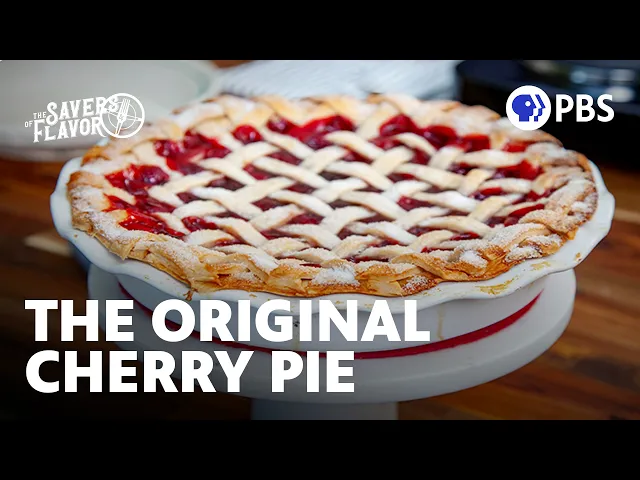
23:09 Dan> We have pies.
23:10 Kevin> Beautiful.
23:12 David> Oh, look at that.
23:13 Well, deserves to be on a pedestal.
23:14 Dan, come on over here.
23:15 Down with me.
23:15 I'm eager to have a taste of this.
23:18 And don't be stingy here.
23:20 [laughs] No, I don't think that Chef Mitchell's going to do that.
23:24 Serious slice of pie.
23:27 David> Oh, no.
23:28 You're not getting this, Dan.
23:30 [laughs] Dan> I should have known.
23:33 David> I've been the person that's been looking for the Dyehouse for years.
23:37 Look at that.
23:38 Dan> That's everything you'd want a cherry pie to be.
23:39 Yeah, look at that color, the crystal.
23:43 To George W.
23:45 Dyehouse, wherever you are.
23:57 Yeah, that's a lip smacker.
24:00 Dan> This to me, is the taste of home.
24:02 Kevin> Sugar on the lattice.
24:04 Really nice texture.
24:06 David> Dan, we need to serenade.
24:09 <A serenade?> That's right.
24:11 Dan> Pies ain't enough for you, David.
24:13 You need music, too?
24:15 The old mountain dulcimer.
24:18 Kentucky dulcimer.
24:19 David> Go ahead, Dan.
24:20 You know the one.
24:21 Dan>♪ Can she bake a♪♪ cherry pie, Billy boy, Billy boy?
24:26 Can she bake a♪♪ Cheery pie, Charming Billy?
24:33 She can bake a cherry pie,♪♪ quick as a cat can wink its eye.
24:38 She's a young thing and cannot leave her mother.
24:42 David> Well, that's the one question.
24:44 Can she bake that pie?
24:46 [laughs] Dan> Well, we know we can.
24:48 Kevin> That's right.
24:49 David> As long as you got the Dyehouse cherry,
24:51 and when you taste that, you know the Dyehouse will live on.