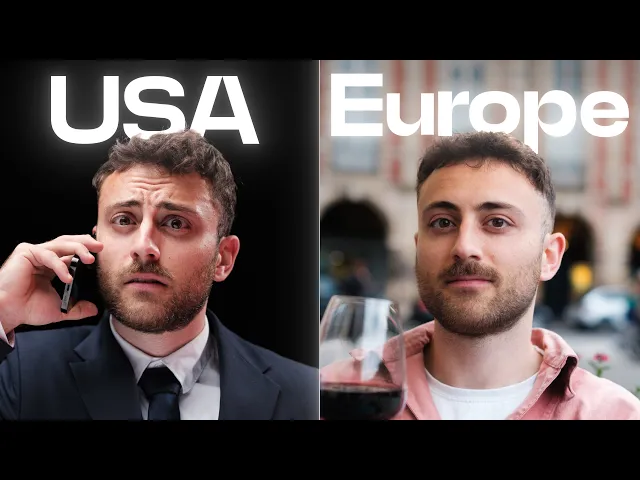
Making Money in the USA vs. Making Money in Europe
Nathaniel Drew
0:00 One of my favorite things about the
0:02 world that we live in and about humans
0:04 as a species is that we are insanely
0:07 adaptable and that we figured out many
0:09 different ways to live.
0:11 This is what I've loved so much about travel and of
0:14 living in different countries throughout
0:16 my life.
0:17 It's the fact that you get very
0:18 different answers to the same basic
0:21 human questions of how to live depending
0:24 on where you are.
0:25 roughly one-third of your life will be
0:27 spent working when all is said and done.
0:29 And so what is that one/ird of your life
0:31 going to look like?
0:32 What is your relationship going to be to that work?
0:34 Depending on what society you've grown
0:35 up in, you probably have a different
0:37 answer to that question.
0:38 I am a product
0:39 of the United States.
0:40 I was born there.
0:41 I grew up there.
0:42 And I'm still coming to
0:44 terms with just how much that country
0:46 has impacted me and how I see the world.
0:51 years ago.
0:52 I left the United States for
0:54 many reasons, but one of them being that
0:55 I felt that the relationship to work and
0:58 and just the lifestyle felt unhealthy,
1:00 imbalanced, unhealthy and imbalanced.
1:03 All of the hustling all the time is just
1:05 suffocating and it's exhausting.
1:07 Always keeping up with the Joneses.
1:08 And this work hard, play hard attitude is one of
1:11 the things that I think contributes to
1:13 the excesses that you see in American
1:15 society.
1:15 And if you don't figure it out,
1:16 if you don't play the game, you get left
1:18 behind.
1:19 So that's where I grew up.
1:21 And then I left and I've spent the
1:23 majority of the last decade living in
1:25 Europe and traveling like a pingpong
1:27 ball around this continent.
1:29 And when I left, I could only see the bad in the US
1:32 and the good in Europe.
1:33 There's less of that rising grind mentality where you
1:36 take work wherever you go.
1:39 But over time, I realized a few
1:42 things.
1:43 Whether I like it or not, the US
1:44 has left a lasting mark on me.
1:47 And not all of it is bad.
1:48 And I feel like some
1:49 of the American mentality has been hard
1:52 encoded into me.
1:53 And I fundamentally see
1:55 some things differently than a lot of
1:57 Europeans my age.
1:59 There are some things
2:00 that you will see in Europe that you
2:02 will never see in the United States and
2:04 vice versa.
2:05 For example, when I was
2:06 living in Paris, I had a doorman in my
2:08 building.
2:09 He was a pretty young guy,
2:10 like in his 30s.
2:11 He was working there
2:12 for, I don't know, 4 or 5 months and
2:14 then disappeared.
2:15 I later discovered that I guess he had some kind of medical
2:18 issue or problem with his elbows.
2:20 He got a slip from the doctor saying that he
2:22 had this issue.
2:23 He just stopped showing
2:24 up for an entire year before returning
2:25 and for that entire year he was paid.
2:27 That kind of thing just does not happen
2:29 in the US.
2:30 In the US it's very common to
2:32 be reachable and available on work
2:34 rellated matters pretty much any time of
2:36 day.
2:36 Whereas in Europe there are
2:37 actually laws in place that make it so
2:40 that you do not have to answer
2:42 management outside of work hours.
2:44 And yet, for all of the wonderful things
2:46 that make Europe such an amazing place
2:47 to live, there are trade-offs.
2:49 And so, in this video, I'm going to explore how
2:50 we're different and [Applause]
3:01 why.
3:02 Okay, two things I have to clear
3:04 up.
3:04 I know how annoying it is for
3:06 Canadians and Latin Americans to hear me
3:08 refer to the United States as America.
3:11 Okay, trust me, I know because my
3:13 family's from Argentina.
3:14 I just say America out of simplicity.
3:16 I've tried a different approach in the past using the
3:19 word Eonian or Eonia, but I just don't
3:22 see how that's ever going to become a
3:23 thing.
3:23 That is so fetch.
3:25 Gretchen, stop trying to make fetch happen.
3:28 It's not going to happen.
3:29 The other thing is that
3:30 I'm highly aware that Europeans don't
3:33 like it at all when I put them all in
3:34 one bucket.
3:35 And this is the beauty of
3:36 Europe, right?
3:37 It's such a diverse
3:38 continent with so many different
3:40 cultures and histories and governments.
3:42 I get it.
3:42 You're French or you're
3:44 Portuguese or you're Danish or you're
3:46 Polish first.
3:48 And if you even feel
3:49 European, that comes second.
3:51 The thing is, I'm going to talk
3:52 about how systems shape us.
3:54 You know, the big trends.
3:55 There are a variety of
3:56 systems that are knitting it together
3:58 and intentionally so, right?
3:59 This was done by design.
4:00 You have the Euro zone,
4:01 you have the Shenen zone, you have the
4:04 EA, EFTA.
4:06 And a lot of this has been
4:07 done so that Europeans can all be a
4:10 little bit more on the same page and
4:11 stop killing each other.
4:12 And in the end,
4:12 if you look specifically at every single
4:14 one of these agreements, somebody's
4:15 always left out.
4:16 But on the whole,
4:17 you've got a group of countries that are
4:19 at least in theory trying to work
4:21 together as a team.
4:22 And there's another reason for this.
4:23 Even though the US has
4:24 pulled ahead in recent years, about 10
4:27 years ago, the GDP or gross domestic
4:29 product, which is a common economic
4:31 metric, was roughly the same between the
4:33 US and the EU.
4:34 And so that makes
4:35 comparisons easier.
4:40 So let me begin by saying that
4:41 when I first moved over to Europe, it
4:43 felt like such a relief to come over
4:46 here and to discover a whole variety of
4:48 societies that are organized in
4:50 different ways.
4:50 But collectively, education is way more affordable and
4:54 healthcare is way more affordable and
4:55 doesn't run the risk of bankrupting you
4:57 and there's better paid sick leave and
4:59 there's paid maternity and paternity
5:01 leave.
5:01 Like what is not to like?
5:03 Sure.
5:03 Okay.
5:03 So GDP is growing faster in the US
5:07 and there's lower unemployment.
5:08 So what what happened to enjoying life, right?
5:11 Yeah.
5:12 Okay.
5:12 So there's lots of work in
5:13 the US and the salaries are higher, but
5:16 more is asked of you and you can be
5:18 fired at any time almost.
5:20 And also cost of living is higher and you got to not
5:22 forget that.
5:22 And especially if you want
5:23 to eat healthy, right?
5:24 You know, like what's the point of making a lot of
5:26 money if you're stressed all the time.
5:28 Here I was, this American dude who just
5:30 arrived on the continent and people my
5:33 age were getting up to two years of
5:35 unemployment benefits which covered like
5:37 60 or 70% of their former salary.
5:40 These are unheard of amounts in the United
5:43 States.
5:43 It just sounded insane to me.
5:45 Such a generous system.
5:46 And then you combine that with these beautiful
5:51 walkable cities and excellent public
5:54 transit and all the other awesome stuff
5:56 that comes with being in Europe.
5:57 It just kind of sounded too good to be true.
6:00 I'm anticipating some people saying that a
6:02 lot of what I'm saying doesn't apply as
6:03 much to Eastern Europe as the rest of
6:05 Europe, which fine, fair enough.
6:07 But even in countries like Poland, there's
6:10 more affordable education and social
6:12 services than in the United States.
6:14 So even there, I think a lot of what I'm
6:17 saying here applies.
6:18 You know, I'm in
6:19 Austria right now in Saltsburg, but it
6:21 doesn't matter where you are, you know,
6:22 whether you're in Bucharest or Madrid or
6:25 Ljubljana.
6:26 Like, so much cool oldw world
6:28 charm.
6:29 I guess a part of me did sort of
6:30 resent the Protestant workaholic thing
6:35 going on in the US.
6:36 And I'm going to
6:36 come back to this point, but the thing
6:37 is I actually really do like working.
6:40 I really love what I do.
6:41 And I feel like
6:42 in Europe often times I feel like I'm
6:44 coming up against a headwind.
6:46 And little by little, I came to realize that for
6:48 all the amazing things that this
6:49 continent has to offer, there are
6:51 trade-offs.
6:52 There are sacrifices that
6:53 are being made, you you can't have
6:54 everything.
6:55 Nobody has it all.
6:56 Let's talk about efficiency.
7:00 You see, I didn't realize
7:02 this at first, but a lot of Europe has a
7:07 crippling Kafka-esque level problem, and
7:10 it's called bureaucracy.
7:13 There has been a lot of noise and
7:14 complaining about bureaucracy in the
7:16 United States recently with Elon Musk
7:18 and the Trump administration, but it is
7:21 nothing compared to Europe.
7:24 And I can't generalize here.
7:25 This isn't the case for
7:26 all European countries, but a lot of
7:28 them have it really bad.
7:30 It is just on a
7:31 whole other level.
7:32 In the Nordic countries, they've got their systems
7:35 more in place.
7:36 Things are more digitized.
7:37 Things are more efficient.
7:38 So, your mileage may vary with regards
7:40 to this point on bureaucracy.
7:42 But if you're not dealing with bureaucracy,
7:43 then you're definitely dealing with
7:45 regulations.
7:45 And often times you have to
7:47 like mail in your paperwork instead of
7:50 digitally submit it and do all these
7:52 kinds of like ass backwards things.
7:55 Okay, before I go any further, I want to
7:57 speak briefly about BetterHelp, whose
7:59 support in this paid partnership makes
8:01 all of the research and writing and
8:03 shooting and editing of these videos
8:04 possible.
8:05 I think there is a huge amount
8:06 of anxiety that comes with change.
8:08 I mean, I have felt that myself and it's
8:10 one of the reasons why I'm making this
8:12 video series and especially in a time
8:13 where there is so much change happening
8:15 in politics and around the world.
8:17 I have found that therapy is a really powerful
8:19 tool in a world that moves this fast.
8:21 I speak to my therapist every week and
8:23 that has allowed me to better navigate
8:25 and adjust to life out here in the
8:28 countryside.
8:28 It also helped me when I
8:30 moved to Europe from the United States
8:32 which was a big shift, a big transition.
8:35 BetterHelp has a large network of
8:37 credentialed therapists that can help
8:39 you navigate and make sense of what
8:41 you're feeling, especially if you're
8:42 feeling anxious.
8:43 Also, it's designed to
8:44 be flexible and adapt to your schedule.
8:46 And another big plus is that you can try
8:48 different therapists out and change for
8:50 free if you're not clicking with who
8:51 you're talking to.
8:52 And I also like that
8:52 you can communicate to your therapist
8:54 however you prefer, whether that's via
8:56 text, call, or video call.
8:58 It's easy to sign up and give it a shot for yourself.
9:00 You can just go to the link in the
9:02 description or go to
9:04 betterhelp.com/nathaniel Drew.
9:05 Clicking that link actually supports this
9:07 channel, but it also gives you 10% off
9:08 your first month when signing up.
9:10 Okay, let's dive back in.
9:13 I really feel like I
9:14 did not realize just how good I had it
9:17 with regards to convenience and
9:19 efficiency while I was living in the US.
9:21 It's just so straightforward.
9:22 opening a bank account, getting your driver's
9:24 license, starting a new business because
9:26 everybody's taking vacations on in
9:29 August or different parts of the year.
9:32 There are times of the year that it's
9:34 bad to start stuff, so you have to sort
9:36 of plan your year around that.
9:37 That was never the case in the US.
9:39 Things are always available.
9:40 Nathan from the future
9:41 here.
9:42 Uh, I spent a lot of time writing
9:44 and shooting and editing this video in
9:46 February and March.
9:46 And now we're in
9:47 April and an unbelievable amount of new
9:50 developments have been taking place.
9:52 Trump with his tariff policy and the
9:54 mass uncertainty economically speaking
9:57 around the world is calling into
9:58 question some of the things that I said
10:00 in this video.
10:01 Things that were true for
10:02 the entirety of my life until I guess
10:05 the last month or two.
10:06 I don't know where all this is taking us, right?
10:09 We're all figuring this out in real
10:10 time.
10:10 I just want to acknowledge this
10:12 just so it doesn't seem like I'm not
10:14 addressing everything that's happening
10:15 in the world right now.
10:16 As this series progresses, I want to move more and more
10:18 towards current events and then looking
10:20 towards the future.
10:21 So definitely more to come.
10:23 Just wanted to mention that.
10:24 All right, let's dive back in.
10:25 It's hard to beat in terms of efficiency one main
10:28 language being spoken across the whole
10:30 country.
10:33 Now, I moved to Europe because I love
10:36 the multilingual, multicultural aspect.
10:39 I really appreciate that.
10:41 School.
10:43 That's one of the biggest, one of my
10:45 favorite things.
10:45 I can jump on a train
10:46 and be in a different country with a
10:48 different history and a different
10:49 language over here.
10:52 And I think it's exactly this uniformity
10:55 that I've spoken about in the past that
10:56 I find kind of disturbing.
10:58 You know, the same looking strip mall, whether you're
11:00 on the west coast, in the south, on the
11:02 east coast, it all looks the same.
11:04 It's that uniformity that makes things
11:06 efficient and easier to build out and do
11:08 quickly.
11:09 So, I guess you're making a
11:10 trade, right?
11:11 And, you know, honestly,
11:12 on that point, it's like I love the old
11:14 world charm.
11:15 That's why I'm filming all
11:17 of this stuff in this beautiful city in
11:20 Europe, but there's constantly
11:23 renovation work that has to be done
11:25 because, you know, it's nice stuff
11:28 that's old that needs repairing.
11:30 I have yet to step foot in another country
11:32 that's as businessfriendly as the United
11:34 States.
11:35 I'm not saying it's the most
11:36 affordable place to do business, but it
11:38 definitely feels like it's the easiest
11:40 place to do business.
11:41 There's a real beauty to having an idea and being able
11:44 to execute it quickly, you know, and not
11:46 constantly having to work through
11:48 roadblocks, you know.
11:49 I'm somebody who will get excited about something and
11:51 will want to bring it to life quickly.
11:53 It's just nice to not feel bogged down.
11:55 And that is genuinely something that I
11:57 feel sometimes in Europe.
11:58 It feels like I am not encouraged to take big risks
12:02 here.
12:03 I do feel like my individualism is
12:05 sometimes seen as a problem here.
12:06 That again is something that I feel like was
12:08 learned in childhood.
12:09 Here you got to
12:10 move a little bit slower and you can't
12:12 deviate so far outside of the system
12:14 otherwise you get your ass kicked.
12:15 If I had to draw it
12:18 out, this is the spectrum and on one
12:20 side you have gas and on the other you
12:22 have brakes.
12:22 The US has built way more
12:24 towards convenience and efficiency and
12:26 you know same day shipping in your car
12:28 if you want.
12:29 A two-hour lunch break is
12:30 an absolute eternity.
12:32 So more on the gas
12:33 side of things, right?
12:34 And then in Europe it's a lot more about regulations
12:36 and consumer protections.
12:38 So there's more breaks built into the system.
12:41 Look at the data privacy laws or food
12:43 regulations.
12:44 Thank God for some of the
12:46 protections Europeans have in place for
12:48 this because it's frankly quite scary to
12:50 see what's happening in the US.
12:52 I don't even know what the FDA even does.
12:54 It feels like everything is genetically
12:55 modified now.
12:56 Kids are allowed to eat
12:58 sludge at school.
13:00 I was shocked when I
13:01 ate in a cafeteria in a French school.
13:04 It was beyond gourmet in comparison.
13:07 So, you know, people eat whatever in the US
13:10 unless you're a health nut, in which
13:12 case you're going to be very health
13:14 consscious.
13:15 Uh, and once again, an
13:16 example of the extremes of the country.
13:22 I think this also goes beyond
13:23 bureaucracy and regulations.
13:27 I think it's like a cultural attitude sort of
13:29 thing.
13:29 The idea of consumer being king
13:31 reigns supreme in the United States and
13:34 that just does not exist in Europe.
13:36 Living in France, another place that's
13:38 very invested in the idea of freedom.
13:41 You know, I realized that freedom
13:44 actually means very different things to
13:45 different people.
13:46 In the US, the idea of
13:47 freedom is tied to being able to do
13:49 stuff, to be able to own a gun or
13:53 getting an appointment very quickly to
13:55 something, right?
13:55 It's okay to work a
13:57 lot because that's your ticket to the
13:59 possibility of a better life.
14:01 That's kind of the premise of the American
14:02 dream, whether that still exists or not.
14:04 The French idea of freedom is way more
14:07 built around the idea of not having to
14:09 do something.
14:10 As in not having to work
14:12 one extra minute than is necessary
14:14 because that is your ticket to a worse
14:16 life, a life spent working more than you
14:19 have to.
14:19 You can see this happening
14:20 because all of the employees in a French
14:23 store like 30 minutes before it closes
14:25 start getting nervous and skittish
14:26 trying to get everybody out so that they
14:28 don't have to stay late.
14:30 And I mean, this is the country that adopted the 35h
14:32 hour work week all the way back in the
14:35 year 2000.
14:36 I saw this in the Netherlands
14:38 as well.
14:38 I was 3 minutes, and really I'm
14:40 not exaggerating here.
14:40 I was 3 minutes
14:41 late to returning a bike that I had
14:43 rented.
14:44 I called to see if I could still
14:45 return it.
14:46 And the shop owner answered
14:47 me telling me the shop was not only
14:49 closed, but he was already back home
14:52 with his kids.
14:52 Priorities, right?
14:53 And I mean, how can you fault them?
14:55 There is so much more to life than work.
14:59 Being a part of a community and getting
15:01 something from that community but also
15:03 contributing something to the community
15:05 give you more freedom in the end than
15:09 the individualistic approach.
15:13 Europeans have this kind of work life
15:15 separation thing mastered.
15:17 You talked before about not the
15:19 opportunity for like huge money, just
15:21 like opportunity just for Yeah.
15:23 more quiet life, which is is really cool
15:25 because it's just a whole different kind
15:27 of freedom, right?
15:29 From Sweden to Greece, Europeans know how to take their
15:31 vacation time often in July and August.
15:34 And what this means is that you just
15:36 never know when things are going to be
15:37 open.
15:37 So maybe this is just what it
15:39 costs to be part of a awesome system
15:43 that takes better care of its people.
15:45 He just has to deal with more bureaucracy
15:47 and more regulation.
15:48 I don't know if
15:48 there's a way to have it all.
15:49 Doesn't seem like it.
15:54 I have a different issue, a
15:56 different challenge, which is that I
15:59 have an entrepreneurial brain.
16:01 Like I don't have a normal relationship with
16:04 work.
16:04 I love what I do.
16:06 I'm very passionate.
16:07 And so all these employee
16:09 benefits, paid unemployment and
16:13 severance packages, like that doesn't
16:15 apply to me.
16:16 I'm on the other side of
16:17 things, which is that I have to think
16:18 very carefully before hiring somebody
16:20 because if that goes badly, it's really
16:22 bad.
16:22 I have to foot the bill.
16:24 And that can actually be ruinous for a business
16:27 owner in Europe.
16:28 The thing is like I
16:30 learned very early on in my career that
16:32 I just I don't want to be an employee.
16:33 I don't want to work for somebody else.
16:34 And even though that comes with all
16:36 kinds of its own stresses, I still way
16:38 prefer it.
16:38 So, let me explain a little
16:39 bit more what I mean by having to be
16:41 very careful about who you hire.
16:43 I spoke with someone who used to be the head of
16:45 HR, human resources, at a Fortune 500
16:48 company that operates globally.
16:50 She explained to me companies are legally
16:53 mandated to give some kind of reasonable
16:55 accommodations to find another job if
16:57 they let you go, like a wait period.
17:00 And that wait period can be as much as 3 to
17:02 6 months.
17:05 And you cannot terminate things
17:07 immediately unless things get really
17:10 bad.
17:10 As in like if the employee commits
17:12 a crime against the employer.
17:14 This makes the cost of failure of running a
17:17 business orders of magnitude greater in
17:20 Europe versus the United States because
17:21 in some cases businesses still have to
17:23 pay employee contracts for years even if
17:27 the business fails.
17:28 This in turn stifles
17:30 the appetite and the possibility to take
17:33 big business risks.
17:35 And then this goes
17:36 both ways, right?
17:37 So businesses can't lay off people right away.
17:39 There's that wait period.
17:41 But employees often can't
17:42 just quit right away.
17:43 Sometimes they have to give notice and if they've been
17:46 working at the company for a long time,
17:47 sometimes they have to still work for
17:49 several months before they can leave.
17:50 Some of these concepts are very
17:51 difficult for Americans to understand
17:53 because for us still having to work at a
17:56 company that you don't want to work at
17:58 anymore sounds kind of like indentured
18:02 servitude.
18:03 This stands in stark contrast
18:05 to the legal idea that applies in the
18:07 United States known as at will
18:09 employment where an employer is allowed
18:12 to dismiss an employee for any legal
18:15 reason at any time.
18:17 This is why Americans are known for you're fired.
18:19 You're fired.
18:20 You're fired.
18:20 You're fired.
18:21 So, in the United States, you can
18:22 go from one day having a job and a home
18:24 to not having a job.
18:26 And if things go
18:27 really badly, not having a home.
18:29 As a US employer, there are just so many less
18:32 hoops that you have to jump through.
18:33 2 weeks, which is nothing by European
18:37 standards, is traditional in terms of
18:39 giving notice, but not even a legal
18:40 requirement.
18:41 And so I know that this
18:42 horrifies a lot of Europeans, but it
18:45 goes both ways.
18:46 You know, as an
18:47 employee, you can step away at any time.
18:50 And the beauty of the system in the
18:52 United States, according to a lot of the
18:53 people, is that there's always going to
18:55 be work.
18:56 There's always going to be
18:57 opportunities out there.
18:58 You know, the US is used to seeing a way lower
19:00 unemployment rate than in Europe.
19:02 Is this freedom or is this the illusion of
19:05 freedom?
19:05 It's hard to say.
19:06 What I can say is that a lot of Americans live
19:08 paycheck to paycheck, which means that
19:10 these are razor thin margins.
19:12 That's a lot of stress to live with constantly.
19:14 Depending on who you are and what you
19:16 gravitate towards, there's probably one
19:19 system that better matches your
19:20 preferences than the other.
19:22 Without a doubt, I think we're seeing some of the
19:24 worst of it right now in the US with
19:26 Elon Musk and the Dogeled mass layoffs
19:29 that are taking place in the government.
19:32 Many people are just receiving an email
19:35 just like that.
19:35 Boom, you're done after
19:37 sometimes many years working for the
19:39 government.
19:39 It does feel like it borders
19:41 on cruelty, but this is also common in
19:44 the US.
19:45 I mean, you see this in the tech
19:46 sector all the time.
19:48 This is going to
19:48 depend on the person, the circumstances,
19:51 the location, right?
19:53 But generally speaking, it feels like Europeans are
19:55 okay with dedicating a smaller
19:57 percentage of their lives to work.
20:01 I'm the American nut job that loves what
20:03 I do, that is willing to put in many,
20:05 many hours.
20:06 This is again where I feel a
20:07 little bit different.
20:08 And there's downsides to that as well.
20:09 Uh where I have difficulty disconnecting and
20:12 separating work and life.
20:14 But in general, this is a huge source of
20:16 meaning for me and gives my life a lot
20:18 of direction.
20:19 I don't know.
20:19 I guess the concept of taking vacation time to just
20:22 do nothing isn't that appealing to me.
20:25 Which again probably makes me sound like
20:27 the obsessive workaholic American.
20:29 I don't know if it was my upbringing that
20:30 shaped me to be like this, but I feel in
20:33 this specific respect more at home in
20:35 the United States.
20:36 People don't look at
20:37 me like I'm weird over there.
20:39 So, if we build on this spectrum that I've laid
20:40 out already, considering the many
20:42 protections workers have in Europe, we
20:43 have security, an offshoot of the
20:45 regulations and work protections, so
20:47 that with the regulations, sick leave or
20:49 unemployment benefits.
20:50 When life hits you with surprises, you don't fall so
20:53 far.
20:54 You won't be bankrupted by
20:55 healthcare costs or student loan debt.
20:57 Well, actually, even if you declare
20:59 bankruptcy in the US, you can't get rid
21:01 of student loan debt.
21:01 So, I guess I
21:02 can't make that point.
21:03 But over here, we
21:04 have risk.
21:05 And what comes with risk is
21:06 also sometimes possibility.
21:08 More work opportunities, more heights that you can
21:11 climb.
21:12 Are these heights that you
21:13 necessarily want to climb?
21:14 Not me.
21:14 I didn't want to.
21:15 I'm not interested in
21:17 creating a startup that becomes a
21:18 unicorn and makes me a millionaire,
21:21 billionaire, or whatever.
21:22 I'm not interested in climbing the corporate
21:25 ladder.
21:26 And who benefits from these
21:27 possibilities, right?
21:28 Not everybody.
21:29 It's usually the rich that become a lot
21:31 richer.
21:31 This is why once again you end
21:33 up with a country of extremes, very
21:35 rich, very poor.
21:37 And I think you see this
21:39 everywhere in the world, but because
21:41 there's so much wealth in the United
21:42 States, it's even more upsetting that
21:45 there are people living in deplorable
21:47 conditions.
21:48 The very act of living in
21:49 the United States is a risk.
21:52 And I think you just as an American, you grow up in
21:54 that system and you get used to it.
21:55 You just adapt.
21:56 You you develop a mentality
21:58 around that.
21:58 I'm not entirely sure if I
22:00 can unlearn that.
22:01 You know, my parents
22:01 taught me to fend for myself, to not
22:04 rely on the government.
22:05 I guess it's just one way of operating.
22:07 It's kind of sad when you say it that way, honestly.
22:09 But instead of counting on social
22:11 security, you're much more focused on
22:13 saving up money and investing it and
22:15 building up a nest egg.
22:16 And this is why
22:17 there are so many people with side
22:18 hustles.
22:19 Depending on how you look at
22:20 it, it's either a testament of the
22:23 entrepreneurial spirit of the American
22:25 people or a disturbing commercialization
22:28 of every nook and cranny of our lives,
22:31 every hobby and fun activity and every
22:35 little thing.
22:36 And so, while individual
22:38 people have way more to lose in the
22:40 United States, companies and startups
22:42 have less to lose.
22:43 The system is better
22:44 set up for that.
22:45 And so I think that's
22:46 one of the reasons why the tech sector
22:48 is so much further along, so much more
22:50 developed in the US versus Europe.
22:51 Restructuring is easier.
22:53 And so this leads to the counterintuitive dynamic
22:55 that I wanted to talk about here, which
22:56 is that this riskier system that the US
23:00 has, it's like a more conservative
23:02 system, right?
23:03 There's less of the
23:04 left-leaning progressive social security, welfare safety nets in place.
23:10 It creates a dynamic where Americans are
23:12 more prone to take risks and that leads
23:14 to more innovation, more change.
23:16 Whereas in Europe, you have so many more of
23:18 these policies and that results in a
23:21 culture of business conservatism.
23:23 You don't want to take as big of risks.
23:25 What do I mean by that?
23:26 I mean like if we
23:26 look at the definition of the word
23:28 conservative, it's an aversion to
23:30 change.
23:30 It's more oriented towards
23:32 preservation of things.
23:36 And so with regards to innovation, I
23:39 mean, the US is so much further ahead.
23:42 I mean, you're watching this on an
23:44 American platform, and you may or may
23:46 not be watching it on a device that's
23:48 made by an American company.
23:49 I mean, you're definitely not watching it on a
23:51 Nokia.
23:52 And hat tip to Russell Max Simon,
23:54 who wrote an excellent essay about this,
23:58 all these employee protections make it
24:00 easier for employees to quietly quit,
24:02 right?
24:02 You can't be fired unless things
24:03 get really bad.
24:04 That can result in a
24:06 degraded work experience on one level
24:08 out of morale because the rest of the
24:10 team has to pick up the work that isn't
24:13 being done by people that are doing the
24:14 bare minimum.
24:15 Now, Europeans will go,
24:16 "Well, yeah, but in the US, you actually
24:20 do have burntout workers who don't have
24:23 any of the protections and therefore the
24:25 rest of the team still has to pick up
24:27 the workload, right?
24:28 Except people can't take breaks." It's really hard to
24:30 imagine the Amazon workers having to pee
24:32 in bottles because they don't have
24:34 enough time to take breaks situation
24:37 happening in Europe.
24:38 It looks like a dog
24:39 eat dog system where everybody's just
24:40 trying to become rich.
24:42 And this may go
24:42 some ways to explain why Americans don't
24:45 even take all of the little holiday, you
24:48 know, paid vacation time that they get.
24:49 So, we have this dynamic where you're it
24:52 feels like you're punished for taking
24:53 too many risks in Europe and it feels
24:55 like you're punished for not taking
24:56 enough risks in the United States.
24:58 So, is either system better?
25:00 I mean, it's not that simple of a question.
25:02 I will say I definitely know where I prefer to
25:04 live.
25:04 I do feel like I left the US with
25:06 skills that give me an advantage
25:09 elsewhere in the world.
25:10 I think some hustle is really not a bad thing.
25:12 A manageable dose.
25:13 And I always like that
25:14 Americans see and recognize hustle and
25:17 they will cheer you on.
25:18 They will not get in your way.
25:20 Whatever it is that you
25:22 do, wherever it is that you live, what
25:24 seems to matter the most is that you
25:26 find work that is meaningful to you.
25:28 And I think this is something that's
25:30 challenging no matter where you are.
25:31 The way I was able to do that was by
25:33 starting my own business.
25:34 And so therefore, I think I'm grateful to have
25:37 grown up in a system in a country where
25:40 starting up that business is easier to
25:45 do.
25:46 There's a lot more I want to say
25:48 about this, but I'm going to pause here
25:49 for now.
25:50 This is the first episode of an
25:52 entire series I'm doing comparing the
25:54 United States and Europe in a variety of
25:56 different facets of life.
25:58 And if you're interested in knowing when those videos
26:00 come out, please consider subscribing.
26:03 And please consider liking this video,
26:04 too, if you enjoyed it.
26:05 It helps me out
26:06 a lot.
26:06 It helps make this video show up
26:09 for more people.
26:10 You know, got to work
26:11 with the algorithms.
26:12 I have done a few
26:13 Europe versus US videos already, and
26:15 I'll link to those down below.
26:17 And I also write very regularly on Substack.
26:20 So if you enjoy my reflections on life
26:22 and navigating culture and the world
26:24 that we live in, that might be of
26:26 interest to you as well.
26:27 Again, I'll leave a link to that in the description.
26:29 Thanks for watching and I'll see you
26:31 soon.