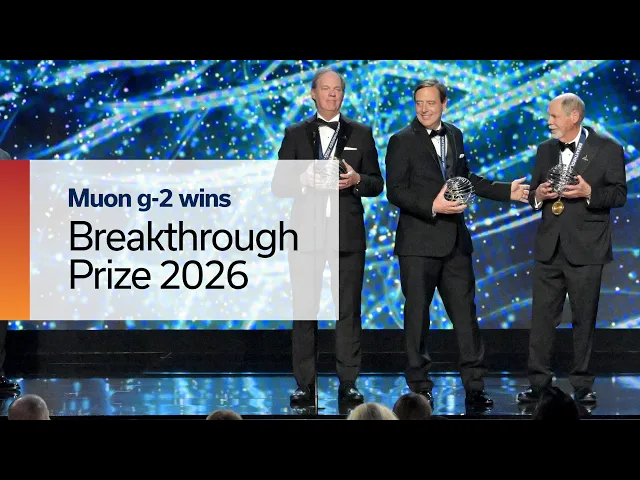
Muon g-2 wins Breakthrough Prize in Fundamental Physics
Fermilab
0:00 What Muon g-2 is trying to understand is if we understand particle physics.
0:05 Are there new particles, new forces we haven't yet discovered in the universe?
0:09 It's looking for interactions of the muon with some unknown particle.
0:13 That would be new physics that goes beyond
0:15 the Standard Model that we know and love.
0:17 The muon was sort of the first
0:19 particle we discovered that really broke the mold.
0:20 Because the muons are 200 times heavier,
0:23 you're 40,000 times more likely to make this quantum foam,
0:25 when you use a muon than an electron.
0:27 So it's kind of in a sweet spot.
0:29 We can make tons of muons, and we can do ultra precise measurements of muons,
0:35 more than you'd really be able to do with much heavier particles.
0:38 When we make a measurement and compare it to the prediction,
0:41 it's kind of like a go no go for all the knowledge we have.
0:45 It’s do we understand particle physics, yes or no?
0:49 So with Muon g-2, what we're actually doing
0:51 is measuring the magnetic moment of the muon,
0:54 because the sea of particles that's constantly fluctuating in and out
0:58 of existence effectively changes the magnetic moment of the underlying muon.
1:02 You can think of the magnetic moment as being sort of the dipole moment...
1:06 If you ever had a bar magnet with a north and south pole,
1:09 every individual muon is like that with a sort of its own internal bar magnet.
1:13 We're looking at what happens to this little bar
1:16 magnet when we put it in a magnetic field.
1:20 The first measurement of the magnetic moment
1:22 of the muon took place way back in the 1950s.
1:24 Leon Lederman, who was a former director of Fermilab,
1:27 was part of that experiment.
1:28 That continued through a series of experiments at CERN in the 1970s,
1:32 culminating in 1979 with the CERN 3 [third] experiment,
1:36 where they pushed the precision, their ability to measure this quantity,
1:39 this magnetic moment of the muon, to a precision of seven parts per million.
1:44 After the experiment ended at CERN in the 1970s,
1:47 the next generation took place at Brookhaven National Lab,
1:51 and the goal there was to push the precision even further.
1:54 So it was 14 times better than the CERN experiment.
1:57 And furthermore, it left the field with a bit of a mystery,
2:00 it was enough to make everybody in the field wonder,
2:03 are we creeping up on the discovery of a new set
2:06 of particles through this precision measurement of the muons magnetic moment?
2:10 the experiment was moved from from Brookhaven to Fermilab.
2:13 the cryostat is big...on a highway it would take four lanes of highway,
2:17 and we're not allowed to take it apart.
2:19 We're supposed to leave it as intact as possible.
2:21 It entailed shutting down two different interstates
2:24 in the Chicago area on two different nights.
2:26 People came out to watch and, we were overjoyed by all of the interest in it.
2:30 It was so special because we, you know, the, the people working on it,
2:34 all the planning that went into it and all of the attention we got from it,
2:39 that was totally a surprise to me.
2:41 We were a young team.
2:41 We used to joke that we needed a grown up
2:43 on the team because none of us had ever done project management before,
2:46 and we were kind of making it up as we went along.
2:48 It was perfect to bring it here and reuse it.
2:50 It would have been significantly more expensive and difficult
2:52 to to try to recreate a similar device here.
2:55 The Fermilab campus had previously been focused on the Tevatron collider,
2:59 where we collided protons and antiprotons, and so for the g-2 experiment,
3:03 we took what used to be the antiproton source and converted it to a muon source.
3:08 It was a challenge to see if we can do better.
3:10 Once we put the beam into the ring,
3:12 we figured out how to stabilize the beam a lot better.
3:15 The powerful accelerator complex at Fermilab was capable of making
3:19 20 times the muons compared to what was done at Brookhaven.
3:21 It felt like a firehose- we just start filling up with muons like gangbusters.
3:26 At the same time, I think we did recognize,
3:28 that this was very important experiment,
3:30 that could potentially find physics beyond the Standard Model.
3:32 So when you get to the final result, to us, as experimentalists,
3:38 a really important part of that is we met
3:42 our initial goals that we started writing down in 2007,
3:47 when we were almost making best guesses of how good
3:52 do we think we can really do on this experiment?
3:55 And for me, it's still the only project that I've
3:58 been involved with, sort of from beginning to end.
4:00 It's really been maybe the best experience of my career.
4:02 Being part of Muon g-2 almost undoubtedly will be the highlight of my career.
4:08 It's been an honor.
4:09 Definitely a highlight of my career.
4:10 Muon g-2 is a huge part of who I am today,
4:13 and it’s just extremely gratifying to know that the Breakthrough Prize
4:17 committee selected this beautiful little experiment for the award this year.
4:20 What I remember most are the people and the friendships I made.
4:24 It's been a pleasure and a privilege to be a part of it.
4:26 I'm just so happy for everybody on the collaboration.
4:29 The grad students and the postdocs and the engineers and technicians.
4:33 I think this award is really nice recognition of all
4:35 the work over the years that has gone into this measurement,
4:38 and I'm proud to be a piece of that.
4:40 I would say by far one of our most
4:42 important byproducts is our ability to inspire future scientists.
4:46 It all sounds like science fiction until you realize it's reality.
4:50 You know, there's different levels
4:52 of recognition for accomplishments in the field.
4:55 There's peer recognition, which is actually, to us, the most important.
5:01 And then there's being recognized, you know,
5:04 outside of your immediate peers and it's a very nice feeling.
5:09 We're all very touched by the award.