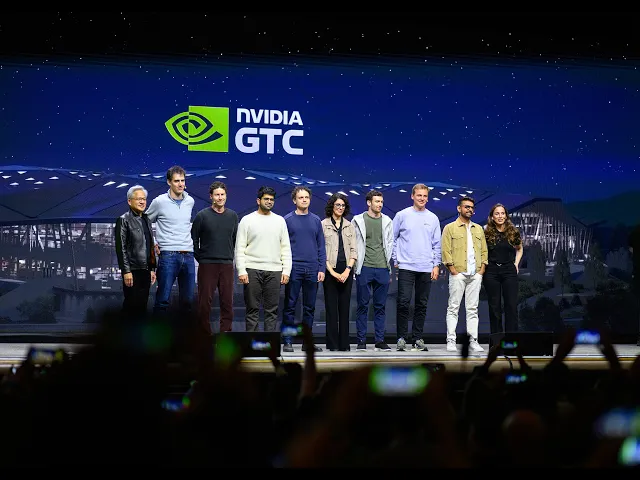
NVIDIA GTC 2026 Open Models Panel Highlights with Jensen Huang
NVIDIA
0:12 Everybody, welcome!
0:14 Great to see all of you.
0:15 I have a special treat for you.
0:18 We have two sessions.
0:19 We have so many great speakers for you.
0:21 We broke it up into two sessions.
0:26 Let's get right to it.
0:28 I think we love a world where there's proprietary products,
0:32 but we also we also need a world where,
0:36 a whole bunch of companies and different industries
0:40 in different domains need models as a technology,
0:45 that we could then transform into products.
0:47 So today, really what I wanted to celebrate is not the proprietary versus open,
0:56 because I don't think that that's a thing.
0:58 Proprietary versus open is not a thing.
1:00 It's proprietary and open.
1:02 And we we love the fact that there
1:04 are these terrific models that are really products.
1:09 Folks think that there are only two types
1:12 of companies up at the software level of AI.
1:16 I think that they think that there are
1:18 foundation model companies that build very large general models,
1:22 sell access to those models through APIs,
1:25 do lots of products in different verticals and then there
1:27 are application companies that don't really do much AI work themselves,
1:31 but they build great products on top of the models.
1:33 And I think that we are really seeing the birth and flourishing
1:37 of a third type of company that sits in between the two.
1:42 A company that uses the best the market has to offer at an API level,
1:46 but then also does great work on the modeling front too,
1:50 and takes both the best the market has to offer on an API level,
1:55 their own models, and wraps them all into one,
1:58 into the best product for a certain vertical.
2:01 And in particular, I think we're seeing the rise of a new
2:05 type of agent happening over the course of the next year or two,
2:08 where the way you used AI models, it started as you're just calling a model.
2:15 And then it got a little bit more complicated.
2:16 It became calling a model, and that model has a bunch of tools that it can use.
2:21 And I think we're soon going to see agents really be coworkers that can
2:25 take on tasks that take many hours
2:28 or many days and do incredibly complex workloads.
2:31 We've experimented with things in this domain,
2:34 in software, where we've experimented with building,
2:36 for instance, prototype browsers from scratch over the course of many weeks,
2:40 entirely intent with agents.
2:42 And when you start to get
2:43 to these much more complicated workloads, under the hood,
2:46 you want to be farming out that workload to different models,
2:49 because different models have different strengths.
2:51 And they're going to be times when you want to use the computer,
2:53 use abilities of a foundation model from one of the APIs.
2:57 And there's going to be other times
2:58 where you want to use the industry-specific intelligence
3:01 you have as a company that's focusing on one domain to format your own models.
3:06 And so I think we're going to see the rise of these compound agents
3:08 that can be smarter than any one model on their own and mix them all together.
3:12 As Jensen said, AI is not the model—it's the system.
3:17 It's the computer.
3:20 Perplexity computer is the idea that you should
3:24 build the orchestration system of everything AI can do.
3:27 Every single capability—coding, writing, generating multimodal content.
3:34 So what you want is a multimodal,
3:39 multimodel and obviously multi-cloud orchestra of every
3:43 single two-model file system connectors put together.
3:49 So that all you got to do is delegate your task.
3:52 You don't have to worry about which model is good at what.
3:54 It's for the orchestration system to figure it out.
3:57 These sub-agents are like musicians, and the models are just instruments,
4:02 and the work that AI gets done for you
4:05 is the symphony or the music that they play.
4:07 And that makes it all pretty simple.
4:12 And, you know, you get to basically think of any task that AI can do today,
4:17 any different model.
4:18 You don't have to feel any vendor lock-ins.
4:20 And as Jensen was saying at the beginning— It doesn't
4:23 have to be a dichotomy between open models and closed.
4:27 We have open models in computer.
4:31 We have closed models in computer too.
4:33 And there are different needs for each of them.
4:36 Open models tend to excel at being very token efficient, cost efficient.
4:43 Closed models are very good at orchestration, reasoning, two calls,
4:47 and basically what's happening is models are essentially
4:51 becoming just tools like file systems and connectors.
4:54 And we're able to operate at an abstraction about models.
4:59 Finally.
5:00 The first one is that model companies are not actually model companies.
5:04 Like, they don't just build a model.
5:06 They build a whole stack, end-to-end.
5:08 So when you're buying a model from a proprietary or otherwise,
5:13 you're actually buying the chips, this orchestration software,
5:17 the inference and product—and all of that has been optimized end-to-end.
5:22 Now that yields great products.
5:25 And what openness allows is for other
5:28 people to basically optimize the whole thing end-to-end.
5:30 So you're not just buying a model— you're buying a whole system.
5:34 I think the other big misconception is on open models,
5:38 that somehow open models are fundamentally going
5:42 to be behind the frontier, that, you know,
5:44 the hit that you take when you adopt an open model is you get control,
5:49 but you get something that’s a few months behind.
5:51 I think that's just an artifact of the time where we are today.
5:55 There's nothing fundamentally different between an open and a closed model.
6:00 And, you know, models in general in this system,
6:05 these are it's fundamental knowledge infrastructure.
6:09 And fundamental knowledge Infrastructure yearns for openness.
6:13 You know, like a like an animal, you know,
6:15 it yearns for the hills or for the forest, like it wants to be open.
6:19 Like books used to be closed, and the printing press made them open.
6:22 Science used to be you know, the real alchemists,
6:26 and then the scientific journal made it open.
6:28 And strong encryption, there was a debate between closed and openness.
6:32 And actually, it ended up being both that started out closed,
6:36 and then there's a whole flourishing
6:38 ecosystem of strong encryption that became open.
6:40 And I think the same thing is about to happen in AI,
6:42 where there's a flourishing ecosystem of powerful,
6:45 closed models but equally capable open models that are
6:48 going to be coming over the next couple of years.
6:50 I think that's really exciting.
6:52 One last thing I did is that, progress is extremely fast.
6:56 We are on an exponential and everything is very compressed,
7:00 and there is a lot to learn.
7:01 There's a lot of study to be done,
7:04 and it cannot be done completely in the large labs.
7:09 Because there are tons of smart people out there.
7:11 But they're lacking access to knowledge, access to tools.
7:15 And this is where openness can be very helpful.
7:19 And it doesn't have to be just models— also infrastructure data,
7:23 general research insights.
7:25 And this can enable a ton of people
7:27 out there that can study various aspects of research.
7:32 And it advances the science of AI, science of intelligence.
7:36 I see this as a very positive sum.
7:39 Pretraining is memorization and generalization and some basic knowledge.
7:44 That basic knowledge gives you the foundation to go learn skills.
7:48 If you didn't have that basic knowledge, you wouldn't even be able to teach.
7:51 I mean, you know, you can't teach someone how to be an engineer
7:56 if they don't have any basic skills in math and science and, you know,
8:00 some basic understanding of technology.
8:01 And so the pretraining part was just the beginning.
8:04 Most people misunderstand that, in fact,
8:07 all of your labs do enormous amounts of model development,
8:12 particularly in post-training and the post-training area.
8:16 If you were to think about the amount of computing scope in the future,
8:19 the amount of computing use in pretraining was like 90% of training two,
8:23 three, or five years ago.
8:25 But in the future, the amount of training
8:27 percentage in pretraining is probably going to be tiny.
8:30 It's going to be mostly post-training.
8:33 It is also probably the case that these proprietary
8:38 models are going to be the best generalists.
8:43 But it's very unlikely they're the best specialists.
8:46 And most value is derived from specialists.
8:50 We need generalist capability all the time.
8:53 And they're going to get better and better.
8:55 And as you say, when we integrate them into a system,
8:58 you get the benefit of an insane generalist as well as an incredible specialist.
9:03 The first inflection point that I believe
9:06 at least I saw that basically made me switch
9:08 from theoretical physics to AI was a system
9:11 that my co-founder Ioannis has helped build called AlphaGo,
9:15 which was the first super- intelligent agent at scale,
9:20 and it was a 60 million parameter network.
9:23 It was tiny, relative to what it is now.
9:26 And it beat the best kind of player in the world at Go.
9:30 And the thing is, that system never stop learning.
9:33 It was just an economics problem.
9:35 How much compute are you willing to put in to get it,
9:37 you know, to be 10 times better?
9:39 And at some point, they cut it off because, you know,
9:41 would you put 10 billion more dollars
9:43 to make AlphaGo beat Lee Sedol even harder?
9:46 Probably not.
9:48 But you know, now that RL has started working on language models,
9:52 those are the kinds of questions we'll be asking now,
9:55 and a year from now, of am I willing to put in $10 billion,
10:00 $100 billion to solve, to cure a particular disease, right?
10:04 When you have RL working at scale, the things that you can solve,
10:08 because these are mechanical brains with endless capacity to learn,
10:12 become just a matter of economics.
10:14 And we're seeing the first generation of that in coding,
10:17 in agentic kind of enterprise applications.
10:19 But we will be coming to a point
10:22 where there's kind of fundamental scientific problems,
10:24 and we're just making economic decisions of whether we
10:27 want to allocate those resources to have a breakthrough.
10:30 And now we're at a point where models are extremely capable.
10:33 And in order to unlock usefulness,
10:35 you need to work on this orthogonal capabilities—connecting the context,
10:40 being able to operate within your data, within,
10:44 you know, what you're trying to do in your domain.
10:47 And this is an example of that, having an agent
10:50 that sort of can operate in your domain within your data,
10:54 connecting everything together, building this system that's more of an operator.
10:59 And we have a long way to go to actually make this very
11:02 reliable and take actions that you want to do with intent that you have.
11:09 But it sort of like shows that capability and where we need to go,
11:15 in terms of unlocking more usefulness.
11:17 The models and the systems orchestrating the models
11:21 are going to get much more capable.
11:22 And so you'll be able to have personal productivity agents
11:25 that can take on more complex tasks that run for longer.
11:28 And I think that also these compound agents
11:31 they will get much better at using tools.
11:34 Open models is how we got known, with Mistral 7B in 2023.
11:39 And effectively, we started Mistral to create an enterprise
11:43 business on top of an open model foundation.
11:46 And we've been lucky to work with you on Mistral Nemo, which was a 2024 release.
11:52 Which is quite good.
11:53 And the reason why we believe that open wide models should actually be
11:57 the basis for building all the AI software in the world is really two things.
12:02 The first is control, because the AI agent sits at the execution layer.
12:06 You want to have control over where this gets deployed.
12:10 You want to make sure that you have the turn-on
12:12 button to all agents that you're deploying in your company.
12:14 And so if you actually own the systems entirely,
12:17 so from the models to the orchestration layer,
12:19 and you know what code is actually running and you can actually modify it,
12:23 suddenly, you're much more confident than if you're depending on only APIs
12:27 that can be turned off or it can fall into certain problems.
12:30 So that resilience is actually very important.
12:33 The second reason is really customization.
12:36 Agents are great when they're operating in the virtual world,
12:38 where they're operating on knowledge.
12:40 They are great on health care because they see a lot of documents.
12:43 But whenever you have something where you
12:45 have a physical footprint, you have a machine,
12:48 you want to model a physical system,
12:50 you have an engineering team that is actually to build things,
12:53 in the physical world.
12:54 Well, suddenly you have a lot of IP
12:57 that you want to put into the models themselves.
12:59 And it's never going to go back to the general
13:01 purpose models that are trained fully on the virtual world.
13:04 And so you suddenly you have access to models
13:06 that you can modify to whom you can plug, time series, stream, etc.
13:11 You can actually build agents that understand
13:13 the physical world and actually make them useful
13:16 for teams like engineering teams that currently
13:19 do not benefit a lot from generative AI.
13:21 So I think that customization aspect, we've released the product called Forged
13:25 that is precisely meant to connect models
13:27 to various sources of data that may come from the physical world is,
13:31 the second reason why open models are very important.
13:35 And I would say, like, finally, open models are great because it allows
13:38 us to make cheaper versions of everything,
13:41 by working together, by sharing R&D cost.
13:44 That's the new neutron and coalition that we're
13:46 happy to be part of, by having an open
13:49 ecosystem of people that have aligned incentives to create
13:52 assets that are going to be great for humanity.
13:55 We can actually accelerate progress and make sure
13:58 that everybody gets access in a fair way,
14:00 across the world, to artificial intelligence.
14:02 And so that's why I think it matters a lot.
14:05 Open models are strictly better than closed models.
14:08 Because I actually think in some contexts, closed models are great.
14:11 But there is one context in which open models are extraordinary.
14:15 If you think about all the applications that you guys just mentioned,
14:19 they're increasingly mission critical.
14:21 You know, 3 or 4 years ago, I think the questions we often used to get is,
14:25 will AI be useful for anything more than chat bots?
14:28 And now because of RL and agentic infrastructure,
14:33 these are getting useful at mission-critical applications.
14:36 And the thing about mission critical applications is you’ve got to trust
14:40 that they will perform the way you do in a high-stakes situation,
14:43 where the margin of error is very low.
14:46 And the reality is, if it's not an open model,
14:49 and you don't control where, you don't know where,
14:51 you can't introspect it, you can't host it,
14:54 and you're dependent on third parties for that.
14:56 Hey, they're good at some things,
14:58 but at the end of the day, you're delegating trust.
15:01 And I think that will become more and more a topic of conversation.
15:04 As those of you who are deploying agents in critical industries,
15:08 I think we will come back to trust.
15:10 And it's much easier to trust an open
15:13 system that you can introspect and you can say,
15:15 look, this parts of this system are closed and they're good.
15:17 It's good at that.
15:18 I'm going to deploy it.
15:19 and I'm gonna have some guardrails.
15:21 I'm going to manage the risk.
15:22 But at the end of the day, especially in healthcare, defense, you know,
15:28 places that if we want to welcome these agents
15:30 into the most mission-critical parts of our lives,
15:32 I think we're going to have to find a way to trust them.
15:35 And as far as I know, open models are one of the fastest ways to trust a system.
15:42 Now, the flip side is, I think the infrastructure also has to be open.
15:46 And that's not happening as quickly as it should.
15:49 We are heading into a phase
15:50 of the industry where infrastructure is consolidating very fast.
15:53 If you study the history of the industrial revolution—you asked us to consider
15:56 the industrial applications— and I think we are in a new era.
15:59 But there's some clues that the the 1800s gave us,
16:02 where if you looked at factories that had a steam
16:05 engine and knew that you could make interesting products,
16:08 they were starting to realize that, hey,
16:10 the inputs to production are pretty critical.
16:13 And they started hoarding them.
16:14 And if you just do a flyby of 1800 Victorian England,
16:18 you'll see factories with generators running at half capacity,
16:21 because everyone's hoarding generators and trying to run their own generator,
16:24 and you have piles of coal just stockpiling, not being used.
16:28 And I think what we need to go to is open models and open infrastructure.
16:33 We need to develop a mechanism that allows us to share,
16:37 not to overprovision per peak,
16:40 but have enough secure infrastructure that we get our baseload,
16:44 but then they can spike up and down.
16:46 And that's called a grid.
16:47 And that's what we're working at AMP.
16:48 As you know, we're building an AI grid.
16:50 But I really do think for open models to be developed at the frontier,
16:54 we're going to need open infrastructure too.
16:56 When we have a language model or an AI system these days,
17:00 we just look at the final snapshot of this whole very long,
17:05 curated process, of how these models are developed.
17:08 However, we argue that or I argue that there
17:12 is a long process and releasing different parts of it,
17:16 enabling researchers and developers to use different parts of it,
17:20 it enables infinite customization,
17:22 not just the final way, but also on top of different checkpoints of the model.
17:27 So my team built Olmo, and through that, we developed model flow,
17:31 which we call it the full development
17:33 cycle of the whole process, including the data,
17:36 all the model weights, all the infrastructure, and everything,
17:39 so that researchers on hard-core developers could actually play with it,
17:44 integrate their finding, and even build on top of that.
17:47 So why is this important?
17:49 So this is particularly really important to make
17:52 advances in the next generation of AI.
17:55 Because these days, you might argue that the progress
17:58 in AI is getting limited into a few close labs,
18:02 but it's actually very important to the vast
18:05 majority of academia and researchers or kind
18:08 of nonprofit and other places who want to also be part of this progress.
18:13 And we've seen that these all this progress
18:16 already has happened by everything being open.
18:19 So for example, you've probably all seen that hybrid
18:23 models are being used in many of these open models,
18:26 and even closed model like Nemotron, a very good example of that.
18:30 So most recently, we—actually our team— has started releasing and studying
18:34 why hybrid models are probably only better than only transformers.
18:39 And based on analysis and more theoretical findings,
18:42 we actually found that okay,
18:44 there are theoretical reasons why hybrid models are better.
18:48 And then empirically we show that yes— it actually is much more efficient,
18:52 much more token efficient in training.
18:53 So having access to this infrastructure, training,
18:56 and being able to kind of publicly talk about it, and also,
19:01 kind of study these models,
19:03 enable the next generation of even model architecture,
19:06 better AI systems, and so on.
19:08 So enabling research is also a very important topic.
19:11 Open models are strictly better than closed models.
19:14 I think they enable diffusion of innovation, research, and competition.
19:19 I guess like competition in the end is good for like for you.
19:22 Right?
19:22 And, in addition to that, it's really also,
19:26 I don't know, l’m here in Silicon Valley,
19:29 every two months, then I'm based in Germany for my usual day-to-day work.
19:34 And I come here now and just like this weird
19:36 AI psychosis going on, where people even like AI researchers,
19:40 think that they cannot really contribute anymore because
19:43 of the advances in coding agents, stuff like that.
19:47 But I think even if you're, like,
19:50 really convinced of that, then like the way that you can have impact should be
19:55 thinking about how can I make an open
19:57 model that actually can replicate these capabilities.
19:59 So I think, it's actually one of the most exciting times to work on, you know,
20:04 like the frontier models,
20:05 the big models, or more specialized open models that then get deployed,
20:09 like on device and all that.
20:10 And there's like so many different frontiers,
20:13 and all of them should have some open component.
20:16 Even in a company that is a closed model company,
20:20 I really believe that open models will be used as part of the agentic system,
20:26 where the closed model is your crown jewels.
20:30 And I'm fairly certain that even in visual
20:33 intelligence that used to be text-to-image in the future.
20:37 well, you're already there now— increasingly,
20:41 it's in robotic visual intelligence system.
20:45 and so it's reasoning, it’s trying, it’s taking inputs,
20:49 and the prompts could be text and many other conditionings.
20:52 It's solving problems and ultimately generating an image or a stream
20:59 of images that you can even interact with in a very robotic way.
21:02 And so I think the future of visual
21:05 intelligence that you're working on is just so exciting.
21:08 And even though it's a proprietary crown jewels today,
21:11 you're going to surround it with a whole bunch of open models.
21:13 It's my prediction.
21:15 And so all of these different industries are starting
21:18 to get solutions that are very impactful and very capable.
21:21 And so I think that this year we're going to see,
21:24 really instead of the question, “What is the ROI of, you know,
21:29 the last three years?” All of the questions are,
21:31 “What are the ROIs’ of AI?” I think now,
21:34 this year, starting with with coding, of course.
21:37 And coding is not just software engineering.
21:39 Coding is the description, the codifying of business processes,
21:43 codifying basically the rules of all businesses
21:47 and all engineering and almost all work.
21:50 And so coding is a very big deal.
21:52 But nonetheless, we're going to see an inflection
21:54 this year of real business economics taking off.
21:58 And you guys are all experiencing that.
22:00 Ladies and gentlemen, hey, let's get the last crew back up here.
22:07 That’s it.
22:08 The future!
22:11 Thank you, guys.
22:12 Good job!