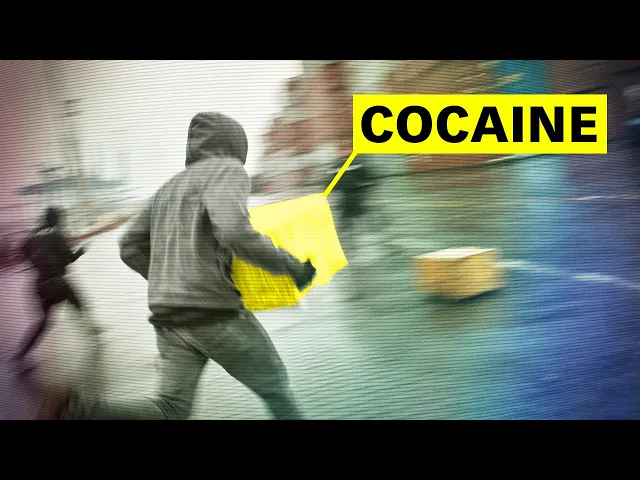
The Most Dangerous Job in Crime
fern
0:08 Five teenagers are dropped off just outside the port of Antwerp.
0:12 The port is as big as an entire city.
0:15 And it never sleeps.
0:19 Throughout the night,
0:20 there are trucks rolling in and containers being shifted around.
0:24 But the boys are here for a very different kind of job.
0:27 Their mission is to get their hands on bags full
0:29 of cocaine hidden somewhere in this maze of countless containers.
0:34 And inside the maze, Belgian police are always on alert.
0:38 One wrong move and it's game over.
0:43 This is the insane brutal world of Europe's coke runners.
0:50 [music] [music] [music] [music] [singing] [music]
1:20 Hey, Jonas here with a brief interruption.
1:22 I got some exciting news.
1:23 Our documentary on China's secret highway is
1:25 a finalist at the 18th annual Shorty Awards.
1:28 Now, with your vote, we have a chance to win the audience honor.
1:31 You can support us by leaving your vote here before April 8th.
1:34 A link is in the description.
1:36 We are grateful for the nomination and for every vote.
1:40 Europeans love cocaine.
1:43 We already made a video about how the continent is hooked on coke,
1:47 how the market for it keeps growing,
1:49 how the substance works, and what it does to the people who use it.
1:52 But what we didn't specifically talk about is how it gets here.
1:56 How a product that's made thousands of kilometers away in the jungles
2:00 of Latin America ends up in a nightclub bathroom in Berlin.
2:04 Almost all of the world's cocaine is
2:06 produced here in Colombia, Bolivia, or Peru.
2:10 Often, it's brought from the jungle to other Latin American countries first.
2:15 Powerful cartels control this part of trafficking.
2:18 Mexican organizations like the Sinaloa Cartel
2:21 and Cartel de Jalisco Nueva Generación,
2:24 known as the CJNG, or Colombia's most powerful cartel, Clan del Golfo.
2:29 In Brazil, the Primeiro Comando da Capital, or PCC, is a major player.
2:35 Balkan traffickers are active here as well.
2:37 And in Ecuador, the Albanian mafia has become extremely powerful.
2:42 They all organize the cocaine's journey to Europe,
2:44 but they don't operate on their own.
2:47 Various criminal groups cooperate across production,
2:50 logistics, and distribution.
2:52 By the time the cocaine ends up in a container at a Brazilian port,
2:56 it's already passed through four or five different hands.
3:01 Cocaine routes are constantly shifting, but the most popular ones are by sea,
3:06 usually hidden on container ships or sometimes under them
3:10 or in the sophisticated narco subs we covered in this video.
3:14 Mexican cartels smuggle cocaine from here to Mexico.
3:18 From there, they ship it east, often to Spain.
3:21 The Colombian Clan del Golfo either sends it directly from Colombia
3:25 or to other transit countries in South America via speedboat.
3:29 From there, it heads to Europe.
3:31 The Albanian mafia sends the cocaine from here and here to Ecuador.
3:36 From there, it travels on a container
3:37 ship through the Panama Canal toward Europe.
3:40 Sometimes, the drugs also take a detour through Africa.
3:44 The Montenegrin Kavač and Škaljari crime groups
3:47 both maintain a strong presence in Brazil,
3:49 often collaborating with the PCC.
3:52 From here, they send cocaine on container ships to West Africa,
3:55 often to Senegal or Gambia.
3:58 There, they collaborate with the Italian 'Ndrangheta mafia.
4:02 To hide their trail, the drugs are redistributed.
4:04 Then they move on to Europe, usually via the Iberian Peninsula.
4:09 But when you look at all the routes cocaine takes into Europe,
4:12 two places stand out.
4:14 First, the port of Rotterdam.
4:16 But Europe's biggest gateway for cocaine is the port of Antwerp-Bruges.
4:25 This is Johnny from Antwerp.
4:26 [music] He's 15 years old.
4:29 Behind the wheel is a guy he doesn't really know.
4:32 Actually, except for his friend sitting next to him,
4:35 he doesn't know anyone in this van.
4:37 But that doesn't matter because Johnny stands to make a lot of money tonight.
4:43 [music] A few days ago, he and his buddy were approached by an older guy.
4:46 He asked if they wanted to become uithalers, coke runners.
4:50 The job sounds simple.
4:51 Break into the port, get drugs out of a container, [music]
4:54 bring them out of the port, and earn a ton of money for it.
4:58 Thousands of euros.
5:01 [music] It sounds awesome, even fun.
5:03 But now it's dark and cold,
5:05 and Johnny has no real idea what he's supposed to do.
5:09 Too late to back out though.
5:11 Two guys in the group lead the way.
5:12 They've done all this before.
5:15 So after a moment of hesitation, Johnny follows them and climbs over the fence.
5:22 The port of Antwerp is gigantic.
5:24 It stretches across an area of over 11,000 hectares.
5:28 That's bigger than the center of Paris.
5:31 In 2024, over 13 million containers were handled here.
5:35 It's a simple calculation.
5:37 A huge port with lots of cargo also means lots of cocaine.
5:42 We have a lot of ships entering the port of Antwerp, but also Rotterdam,
5:45 Hamburg, Le Havre, which import legal goods from South America,
5:50 from Africa, from far overseas.
5:52 We sat down with Ann Berger,
5:54 a spokesperson for Belgium's federal police, for an exclusive interview.
5:58 And those are criminal organizations, they abuse the legal ways of transporting
6:02 goods to transport their illegal drugs as well.
6:05 They always choose the path of the the least resistance.
6:08 In 2024, Belgian customs seized 44 tons of cocaine in the port of Antwerp.
6:14 But that's probably only a fraction of what moves through here.
6:17 There's estimations that about 10% of the cocaine that enters
6:21 the ports in Europe is seized, but nobody's sure.
6:24 There is a dark number, of course.
6:27 Have you ever wondered how we make these animations?
6:30 Well, ask this guy.
6:31 Oh, hi.
6:32 I'm Matthias, emotion designer at Fern.
6:35 While I show you a bit of my workflow,
6:37 let me quickly tell you about this video's sponsor, Odoo.
6:40 Before I started working at Fern, I ran a small clothing brand in Austria,
6:45 and getting people to notice you online is the really hard.
6:48 What you need is exposure, and honestly, a good website is still king.
6:52 Odoo is an all-in-one management platform with more than 45 applications.
6:56 One of its apps is an easy-to-use website builder
7:00 that lets you create and customize your own site in minutes.
7:04 You pick the type of site you want, choose a color palette, or add your logo.
7:07 Add the pages and features you need, and select a theme.
7:10 That's it.
7:11 Definitely faster than animating this thing.
7:14 All you need to do is add content
7:16 using an intuitive drag-and-drop function and personalize it.
7:20 And here's the finished animation.
7:22 Check out Odoo's website builder with the link in the description.
7:25 The first app is free for life with unlimited hosting and support.
7:29 With the website app, you also get a free personalized domain name for 1 year.
7:34 It's a great way to support our work,
7:36 and I really wish I would have found Odoo a little sooner.
7:41 Criminal groups go to extreme lengths
7:43 to ensure their illegal cargo avoids detection.
7:45 They've reportedly smuggled cocaine in sugar bags,
7:48 with oranges and bananas, and in backpacks hidden among frozen vegetables.
7:53 Or they smuggle a liquid form of the drug inside clothing, coal, or plastic.
7:58 They hide it in cans of joint compound,
8:00 inside fresh pineapples, even inside individual coffee beans.
8:05 They might hide it under the floor, behind a wall,
8:07 or in the engine compartments of refrigerated containers.
8:11 But even if most cocaine likely slips through,
8:14 it still sits here in a container inside the vast port.
8:19 And getting it out of there to sell it
8:20 on the streets is a completely different challenge for organized crime.
8:24 They're always playing a high-stakes cat-and-mouse game with the authorities.
8:28 They have to stay inventive, constantly finding new approaches.
8:33 And a few years ago, a new method emerged that completely changed the game.
8:38 Criminal organizations, they recruit people.
8:40 We call them coke runners.
8:43 They're in.
8:44 Johnny has never seen so many containers in his life.
8:48 A sea of giant metal boxes stretches out in every direction.
8:52 Hundreds, if not thousands,
8:54 of containers stacked so high it feels almost unreal.
8:57 Row after row, wherever he looks.
9:00 It's overwhelming.
9:01 How can they find the exact container they're looking for?
9:05 Luckily, one of the older guys has a phone and is in contact with the client.
9:09 He sends over a photo that roughly shows the spot, plus the coordinates.
9:13 Time to go.
9:15 Right turn here.
9:16 They try to stay quiet,
9:17 ducking into the shadows, listening for any unusual sounds.
9:21 Johnny's pulse is racing.
9:23 He can hear the heartbeat in his ears.
9:25 After this, it's to the left.
9:27 Then there should be a red container between
9:29 blue and yellow ones on the bottom row.
9:32 And bingo.
9:35 Johnny and the others probably don't realize just how dangerous this all is.
9:43 The port's authorities have implemented an array of security
9:45 measures to combat the surge of coke runners.
9:48 About exact technologies, I'm not going to give you any information,
9:51 but we work hard together with everybody.
9:53 We have a lot of exchange of information.
9:56 The port is packed with security cameras, police officers, customs agents,
10:00 and thousands of workers are in the area every day.
10:03 The port also relies on smart technology, smart cameras,
10:07 sensors, and a network of six automated drones.
10:10 They take off from these docking stations and do 18 flights a day.
10:15 The drones are managed from here, the port's command and control center.
10:19 It's unclear to what degree these drones aid in catching potential coke runners.
10:23 Using the cameras inside the drones,
10:25 port staff can zoom in and out of different areas in the port's infrastructure.
10:29 Soon, they say, they'll also have autonomous drones
10:32 sending back images and data in real time.
10:35 These drones would feed information straight into Apica,
10:38 an AI assistant with a 3D interface.
10:41 Hello, I'm Apica, your virtual assistant monitoring
10:44 all activities in the Port of Antwerp-Bruges.
10:47 Thanks to a digital network of drones, cameras,
10:50 and sensors inspired by the five human senses,
10:53 I can tell what is happening in the port 24/7.
10:56 It can analyze the port's activities and acts as its digital nervous system.
11:01 But first and foremost, the police are doing old-fashioned patrols.
11:05 The most effective method in catching coke runners is be present in port.
11:10 That's [music] what our maritime and river police does.
11:12 They're present all the time.
11:14 They check up on a lot of people.
11:15 If there's any suspicious behavior, they know it most of the time.
11:19 Last year, they checked more than 10,000 people.
11:22 In 2024, they caught almost 100 alleged coke runners.
11:27 In 2025, it was nearly double that.
11:30 Of course, it's unclear how many they didn't catch.
11:35 And then there's another huge challenge, corruption.
11:38 It's very difficult to get drugs out
11:40 of the port without having someone inside the port.
11:43 So, somebody needs to put container in a certain location.
11:47 Somebody needs to communicate the location
11:49 to other members of the criminal organization.
11:52 These insiders move containers so coke runners can access them quickly.
11:56 For that kind of assistance, port workers can make over 100,000 euros.
12:01 Preventing corruption is absolutely crucial for port security.
12:05 If nobody was telling Johnny and the crew where to go,
12:08 they'd never find their target container.
12:13 They made it.
12:14 Now they need to get in.
12:16 They pull open the doors and see bananas.
12:19 But right there, among the crates,
12:21 exactly where they should be, bags full of cocaine.
12:26 Johnny throws a bag over his shoulder.
12:28 It's heavy.
12:29 As the shoulder strap bites into his neck,
12:31 he's already picturing a new phone, maybe even a car.
12:35 Time to sneak back out.
12:36 Police!
12:38 __] The port police have spotted them.
12:40 Two take off in this direction.
12:42 The third runs this way.
12:44 Not a smart decision.
12:45 Doesn't he realize that he's running straight toward the water?
12:51 Johnny and his friend just stand there, panicked, frozen.
12:58 These boys are the bottom of the food chain.
13:00 Catching them won't get you anywhere near the higher-ups or the cartel bosses.
13:04 They don't usually reside in Belgium.
13:06 But Ann Borge tells us she
13:08 and her colleagues are hunting these individuals as well.
13:11 And we really try to trace up to the instigators of the criminal organization,
13:15 the principals of the criminal organization,
13:18 and there's a lot of them being brought to court.
13:20 Who's the biggest [music] fish that you caught?
13:22 I won't give you any names, but if you Google it, you'll find them.
13:26 Well, okay.
13:27 Let's find out.
13:30 There's Othman El Ballouti,
13:32 a cocaine kingpin linked to the so-called Mocro Mafia.
13:36 In 2021, he ordered the transport of 11
13:39 tons of cocaine that were intercepted in Antwerp.
13:42 In 2024, he received a 20-year prison sentence for it.
13:47 In 2021, international law enforcement agencies
13:50 cracked the encrypted messaging platform Sky ECC.
13:53 They were able to read hundreds of millions of messages sent by criminals.
13:58 As a result, a court in Belgium sentenced more than
14:00 100 criminals in a mass drug trafficking trial in 2024.
14:05 And at the time of our reporting,
14:06 the trial of alleged drug boss Flor Bressers is still ongoing.
14:10 He's accused of co-running a network that shipped
14:12 huge amounts of cocaine from South America to Europe.
14:16 He allegedly made around 230 million euros from just 10 shipments.
14:22 When Johnny and his friend were first approached,
14:24 they might have thought it would be
14:25 a quick and easy job without any consequences.
14:28 Well, they're taken to the police station.
14:31 Johnny is brought to an interrogation room.
14:34 He's scared and completely overwhelmed.
14:36 And the first person they see is not
14:38 their mother or their father or nobody they know,
14:41 but it's just me because I'm going to be there
14:43 with them in order to help them because as a minor,
14:46 they can't be interrogated by the police without
14:48 being in the presence of a of a lawyer.
14:50 My name is Chantal Van den Bosch.
14:52 Uh I'm a lawyer and I often defend minors or adults concerning coke deals.
14:57 So, I think I've represented for more than 100 cases.
15:02 Just like our fictional Johnny, coke runners are often very young.
15:05 Youngest I saw was 13.
15:08 We see a lot of young guys, mostly between 15 and 17, 17 and a half.
15:13 Just when they're still minor cuz it's an advantage.
15:17 Because when you're a minor, you can't go to jail.
15:19 So, teenagers like Johnny might think they won't face any a lot of money.
15:26 For north of 10,000 euros, Johnny won't see any of the pay he was promised.
15:34 Instead, he spends the night with a lawyer and the police.
15:37 The officers start questioning him,
15:39 but Johnny doesn't really know who he was working for.
15:42 And even if he did know, telling the cops wouldn't be a smart idea.
15:46 Because if Johnny were to give up the person who recruited him,
15:49 he'd be in serious danger.
15:50 They don't realize it, but once you're in that world,
15:54 it's not that easy to get out of it.
15:56 Of course, the organization wants to know whether they talked,
15:59 whether what they said, and what they were doing.
16:02 Chantal Van den Bosch always suggests her clients not tell officers anything.
16:07 That way, they avoid being seen as snitches.
16:10 Cuz it's into the file.
16:12 Everyone can read it and it's much too dangerous.
16:15 So, I suggest him to keep silent.
16:18 I can't put my youngster in danger.
16:21 I can't do that.
16:22 But whether they talk or stay quiet during questioning,
16:25 underage coke runners face serious legal consequences.
16:28 So, when you're a minor, you are arrested and then you have
16:32 to appear the next day before the juvenile court.
16:35 The juvenile judge can send you to the juvenile prison or to a detention.
16:40 They might have to stay there for weeks or even months,
16:42 but it's different if you're over 18.
16:45 If you're an adult, you come into the prison.
16:48 Afterwards, you get a sentence and that's between [music]
16:51 40 months and you will have to pay a fine
16:54 of about 8,000 euros if you're a first offender, of course.
16:59 In February 2025, three Dutch men were arrested
17:02 in the Port of Antwerp for allegedly attempting to retrieve cocaine.
17:06 The authorities didn't catch them in action.
17:08 There was no cocaine on them,
17:10 but they did have the typical tools of the trade with them.
17:13 Now, they face over 3 years in prison.
17:16 Belgian authorities are taking a tough approach, hoping it will make an impact.
17:20 They also want to crack down on the recruiters behind these operations.
17:24 There's new litigation now [music]
17:26 telling that whoever uses minors in order to do something for them,
17:31 the sentence they get is much higher because of the use of the minors.
17:35 The Netherlands has seemingly taken a page from the Belgian approach.
17:39 In the past, first-time offenders usually just
17:41 got community service or a suspended sentence.
17:44 Coke runners had to pay a small fine of 90
17:47 to 100 euros for trespassing if they weren't caught red-handed.
17:51 If they're caught inside the port without a valid reason today,
17:53 they can also end up in prison.
17:56 Even if coke runners managed to pull off a few jobs, there's often no way out.
18:00 You don't just tell a criminal group, "Nah,
18:02 I'm good." once you're done risking your freedom.
18:05 Once you do something for a criminal organization and you get money,
18:08 it's very difficult to say no next time.
18:10 Because this isn't an exciting heist movie.
18:13 It's work for a cartel,
18:15 some of the most brutal, ruthless criminals on the planet.
18:21 Over the past few years, violence in Antwerp has exploded.
18:25 Drug gangs are fighting each other in the streets.
18:30 We have seen that there are a lot of bombs in Antwerp.
18:32 Drug-related violence is huge here in Antwerp and it's uh it's very dangerous.
18:37 In an anonymous letter, a Belgian judge even expresses concern
18:41 that the country is turning into a narco-state.
18:43 But it's not just Belgium.
18:45 In Europe's port cities, there are shootings,
18:47 car bombings, kidnappings, torture chambers.
18:52 [music] So, if these guys want you to do another coke
18:53 runner job or move another container to the bottom row,
18:57 they won't take no for an answer.
18:59 If you don't do what they want, the criminal organizations,
19:01 they can also touch your family and a lot of people don't know that.
19:04 They they don't realize it until it's too late.
19:07 Many times I have the assumption that they really don't
19:09 realize what's going on and what they have to expect,
19:13 what is going to to happen to them.
19:15 For me, that's like you didn't realize it, you didn't think about it in advance.
19:19 You're just thinking you're recruited,
19:21 you think about the money you're going to get.
19:23 You don't think about the danger.
19:24 Afterwards, you're not thinking about the troubles you're going
19:27 to be in or what risks you are taking.
19:31 And the cartels couldn't care less if
19:32 kids like Johnny end up in serious trouble.
19:35 The criminal organizations just send other people into the port.
19:39 Other young people will be recruited on the street and brought to the port.
19:44 Business as usual.
19:47 The cat-and-mouse game between cartels and the authorities
19:50 shows no sign of slowing down.
19:52 The cartels keep adapting.
19:54 They're always finding new and creative ways to smuggle cocaine.
19:58 One new method is the so-called Trojan container.
20:02 Coke runners hide inside a container and are
20:03 brought into the port from the mainland.
20:06 Those people have to stay inside of that container
20:08 for sometimes a few days until they get a message from the criminal organization
20:14 that a container with drugs has arrived from overseas.
20:17 Then they have to get out of the container,
20:18 try to find a container with the drugs,
20:21 remove the drugs to another container, or take it out themselves.
20:25 The port police are constantly trying to keep up,
20:27 but they know this is a fight they can't fully win.
20:30 So we try to manage it.
20:31 We try to be able to seize as much as possible,
20:35 not only by coincidence, by scanning goods, but also by information that comes
20:39 from inside the organizations and from uh yeah,
20:42 intelligence all over the world, from abroad, from Belgium, and so on.
20:46 We also know we won't be able to eliminate drug trafficking to Europe.
20:50 As long as there's a lot of money to earn with drug trafficking,
20:54 criminal organizations will try to do it and try to bring the drugs into Europe.
21:00 Experts stress there's no single solution to drug trafficking.
21:04 It requires multiple approaches at once.
21:06 Reducing demand, prevention, health initiatives, research, and law enforcement.
21:12 For the time being, all parents and teachers can
21:14 do is try to discourage teenagers from getting involved.
21:18 We have uh people who come afterwards and they say,
21:21 "I'm very happy I was caught at that time.
21:23 It changed my life.
21:24 I get another view now and I go back to school.
21:28 I get an education, a a degree,
21:30 and I'm very happy that I'm not living that life as I used to be." Others,
21:36 they come again and they say,
21:37 "I we made another mistake and we're trying to make the best out
21:40 of it." Every youngster we try to help or every youngster we can help,
21:45 it's one life or an environment that we're going to save.
21:50 So it's very important.
21:51 If I can change a little bit of their life,
21:53 if I can just put one domino stone to change,
21:57 [music] it can make a huge difference.
21:59 And even if it doesn't work, it's it's never-ending story,
22:02 but we have to invest in it.
22:04 It's They're our youngsters, they're our future, so we have to invest in them.
22:08 It's very important.