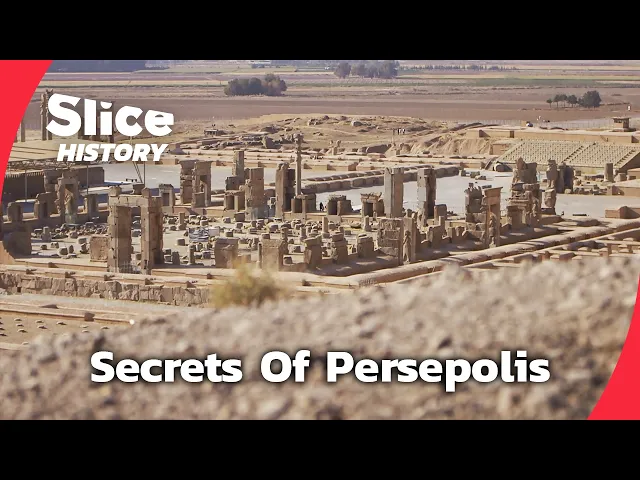
Persepolis: The Lost City of the Persian Empire I SLICE HISTORY | FULL DOCUMENTARY
SLICE History
0:07 On top of Iran's plateaus is the cradle of one
0:09 of the greatest civilization of builders of ancient history.
0:13 The Persians.
0:16 They built here an architectural masterpiece.
0:19 Persepolis.
0:23 Until now, it was thought that this site was limited to its impressive
0:26 terrace used by the Persian kings only a few months of the year.
0:33 But recent findings reveal a different face of Persepolis.
0:38 That of one of the most opulent cities of the ancient world.
0:43 A paradise in the heart of the Persian mountains.
1:01 When you think of Persepolis, you think especially of this huge
1:05 artificial terrace on which stood sumptuous palaces.
1:09 And upon which we still see the impressive proportions.
1:17 The royal terrace demonstrates the excess of the Persian sovereigns.
1:21 Over 1,500 ft long and 1,000 ft wide.
1:25 Before reaching the palace,
1:27 the visitor had to use that entry flanked by two gigantic statues of bulls.
1:32 The entrance had a very symbolic name.
1:35 The door of all nations.
1:38 Between the 6th and 4th centuries BC,
1:41 the Persian empire of Achaemenid dominates 23
1:44 nations represented on the reliefs of the terrace.
1:49 Here two different peoples from Anatolia.
1:53 The Ionians and the Lydians with their specific hairstyles.
2:00 There are the Nubians who came from today's Ethiopia.
2:10 When in 522 BC, Darius the Great, the most famous king of the Achaemenid Empire,
2:16 took power, his empire stretches from today's
2:18 Libya to the banks of the Indus River.
2:23 A vast territory which makes him one
2:25 of the most powerful kings in the ancient world.
2:32 Texts relate that to manifest the grandeur of his reign,
2:36 he built Persepolis in the heart of these arid plateaus.
2:45 He came here with his itinerant court during major seasonal ceremonies.
2:55 Delegations from all the peoples of the empire come here
2:58 to proclaim their allegiance to him in a procession loaded with gifts.
3:10 Until now, archaeologists thought that Persepolis was
3:14 therefore limited to a place of ceremony
3:17 installed on the terrace and occupied only a few months in the year.
3:24 Yet, Diodorus Siculus, a Greek author,
3:26 describes Persepolis as a veritable city, the richest of all Persia.
3:30 Today, from the terrace, we see absolutely nothing of it.
3:34 So, where is it?
3:37 Below, there are no elevations.
3:39 No remaining vestiges of the Persian city are visible.
3:47 Pierre Francesco Callieri has been digging at Persepolis for 8 years.
3:51 He and his Iranian colleagues have identified the shortcomings in the models
3:55 established by archaeologists who have studied this site since the 19th century.
4:03 The royal terrace dominates its surroundings by several meters.
4:06 What did they think existed below?
4:10 The first archaeologists who came here did not
4:13 give much importance to places around the terrace.
4:19 They showed no interest.
4:21 I think that was because there was so much to excavate here.
4:25 This area is enormous.
4:27 The terrace measures 12 hectares.
4:30 But it interested you.
4:33 Yes, because it's like a big ship on the ocean.
4:37 It's impossible for a ship to survive without supplies like food.
4:44 So we must change the perspective.
4:48 We must think that such a monumental terrace could only exist
4:52 with a great support structure in the plane below the terrace.
5:00 If archaeologists can now support this hypothesis,
5:03 it's thanks to a fundamental discovery.
5:09 It was made in the 1930s in the terrace's fortifications.
5:16 Ernst Herzfeld, a scientist from the University of Chicago,
5:20 uncovers thousands of clay tablets dated from the reign of Darius.
5:26 For the archaeologists,
5:28 these tablets are carrying key information for understanding Persepolis.
5:32 But there are so many that decades later, they are still not all decrypted.
5:41 Today, some of them are being studied in Tehran at the National Museum of Iran.
5:51 Wouter Henkelman are among the few researchers deciphering this treasure.
5:59 What they were able to read on these tablets
6:02 completely changes the vision we had of Persepolis.
6:08 I see it's a wedge, but it's written in what language?
6:12 These are written in Elamite.
6:15 Elamite was one of the administrative
6:17 and official languages of the Persian Empire.
6:20 So when it was discovered,
6:21 originally people were very fascinated and they thought maybe they have
6:25 found some political text from Persepolis from the time of Darius.
6:30 But when they studied them, they realized that these are very important
6:34 texts which are actually from behind scenes.
6:37 They say something which usually are not
6:40 told by the royal inscriptions and the kings.
6:42 So they contain very important information.
6:46 Wouter, what is written on these tablets?
6:50 For example, this tablet talks about a priest who
6:53 receives quantities of flour and it's a significant amount, 360 liters of flour.
7:02 The tablets are usually acts of a vast bureaucracy that distributes food.
7:09 Flour for example.
7:11 To teams of workers.
7:13 Priests.
7:16 Men with official duties in Persepolis' economy.
7:21 This archive talks about 10,000 workers and that means that Persepolis
7:25 is not just a ceremonial center used occasionally by the kings.
7:30 It's a real city.
7:31 Yes, absolutely.
7:34 Thanks to the translations of these tablets,
7:37 Pierre Francesco and his Iranian colleague Alireza
7:40 Sajjadi began their quest to discover the city
7:42 of Persepolis and its tens of thousands
7:45 of residents in the valley below the terrace.
7:52 The city we see over there is
7:53 certainly stretched across the plane all around us.
7:58 We know that there was an administration.
8:01 There were laborers, artisans, all these people lived permanently in the city.
8:12 Persepolis was a royal city.
8:14 The king received delegations from throughout the empire.
8:17 He had to impress them with opulence.
8:20 We must look for a city that's like no other city.
8:31 But where to start searching?
8:34 Around the terrace, there are only fields and arid lands.
8:39 The dwellings, the more modest workshops were built of mud.
8:43 They disappeared with time.
8:50 To find this ghost town in such a landscape,
8:53 Alireza and Pierre Francesco called in geophysicists.
8:58 The Iranian Kurosh Muammar Irani and the Frenchman Sebastian Gondet.
9:04 Seb, we've got something.
9:07 Thanks to this portable instrument, they measured the soil's magnetism.
9:11 Geophysical survey is a method particularly suitable for a field such as this.
9:16 Yes, first of all, human activities have
9:18 the property to increase the magnetism of the soil.
9:21 Magnetism which we measure with geophysical exploration.
9:25 With this method, we managed to do about 1 hectare per day,
9:28 allowing us to map large areas.
9:30 It's perfectly suited to a case like Persepolis.
9:33 We know the city was probably spread out over several hundred hectares.
9:39 Kourosh and Sebastian completed this work by direct observation of the ground.
9:46 Look, concentrations of pottery.
9:49 Here, too.
9:49 Here's an example, a piece of a big jar.
9:53 And there.
9:55 And here, too.
9:56 These fragments have been dated to the Achaemenid period.
10:00 Decades of plowing have brought them up to the surface.
10:08 Yes.
10:08 But, they've been moved by farming, so they're out of context.
10:12 In fact, on geophysical maps, we don't find a detailed plan of the buildings.
10:17 That's why we also map concentrations of ceramics on the surface.
10:21 And if we have a superposition
10:23 of concentrations of ceramics and magnetic soil zones,
10:27 that's when we can start to say, "Yes,
10:30 there really was a permanent occupation here." The two
10:36 scientists were able to identify zones of occupation,
10:39 certainly the old quarters of the city.
10:45 Archaeologists then began excavating these areas.
10:52 And soon, the first signs were brought up.
10:57 Here, an oven.
11:01 There, a neighborhood of artisans.
11:06 Or even large buildings, perhaps aristocratic residences.
11:17 Around the royal terrace,
11:18 researchers began to see emerging the city desired by Darius,
11:23 organized in specialized areas.
11:26 Some occupied by workers and craftsmen,
11:29 others by officials and aristocrats who administered the region.
11:35 But the excavations have also led to an unexpected conclusion.
11:39 Persepolis was not a very dense city.
11:42 Its different neighborhoods are widely spaced from each other.
11:45 Between them, vast areas appear to have been deliberately left empty.
11:55 Mapping it with their sensing device,
11:57 geophysicists have identified traces of ancient furrows in the soil.
12:04 What do they represent?
12:17 To answer this question,
12:19 Sebastian gave me an appointment 30 miles from Persepolis.
12:27 At Pasargad, another royal city of the Achaemenid Empire.
12:36 Hamid Fadaei is the curator here.
12:41 These canals are well preserved, like everywhere in Pasargad?
12:45 Yes.
12:46 Yes, the part where we are covers 12 hectares and its peculiarity
12:51 is that it's covered with over a half mile of stone canals.
12:56 The engineering of these canal systems is incredible.
12:59 Their shape, their slope, their magnificent architecture with stone
13:04 basins and sections without any joints.
13:06 This is very well planned.
13:12 Archaeologists have therefore understood that at Pasargad,
13:15 this arid area, normally uncultivable,
13:18 was equipped with an ingenious irrigation system on a large scale.
13:25 So, if I understand well, the arid landscape around us was green at the time?
13:29 Toutà fait.
13:30 Absolutely.
13:31 Imagine gardens in which many species were planted.
13:35 The kings were very fond of showing they could
13:37 dominate the landscape by building and landscaping lush gardens.
13:41 This is what Greek authors called a paradise, paradeisos in Greek,
13:45 and this term probably dates back to the Persian period.
13:49 A paradise?
13:50 A paradise.
13:51 At Persepolis we find this type of landscaping
13:53 of parks to the west of the terrace.
13:56 And in Persepolis it might be even larger.
13:59 Persepolis is based on the model of Pasargadae.
14:02 They reproduce the model of Pasargadae but on a much larger scale.
14:05 And so these paradises, these parks incorporated not only the palace,
14:09 fields, and orchards, but also the common dwellings, the town.
14:16 The power of these Achaemenid kings is measured
14:18 by their ability to create these earthly paradises in the desert.
14:23 Open gardens to be viewed by all to affirm their prestige.
14:27 To achieve such a feat, it was still necessary to find water.
14:34 Using satellite images,
14:36 archaeologists have found traces of an amazing canal at Persepolis.
14:41 In the valley, Sebastia has followed the route
14:44 over several miles into the mountain of Seydan, which we go to visit.
15:02 We have good reason to believe that this source you
15:04 see here was exploited by the Achaemenid kings to supply Persepolis.
15:09 It's a real technological feat.
15:10 How many miles away are we?
15:13 We're 9 miles from the terrace of Persepolis,
15:15 meaning they had to build a canal from these sources to the terrace.
15:21 A channel that crossed the reached the mountain of Persepolis,
15:25 and continued to the terrace.
15:28 And this explains the water used to irrigate the gardens?
15:33 Exactly.
15:34 To irrigate the parks, gardens, fields, and orchards,
15:37 they needed a lot of water, so they came here.
15:40 Why?
15:41 Because this is good quality water.
15:44 Other sources of the plain are often very salty.
15:47 But here was great water for agriculture
15:50 and also for human consumption of Persepolis' population.
15:59 So, it's thanks to this pure water that King
16:01 Darius was able to make Persepolis a Persian paradise.
16:06 But what could this Eden have looked like?
16:12 A few months ago, a team of Iranian and French
16:15 scientists embarked on the track of the essences of the past.
16:20 By diving deep into the earth.
16:24 These cores had imprisoned the memory of Persepolis' gardens.
16:39 Morteza Jamali is able to interpret these time capsules.
16:43 He's a palynologist specialized in pollen.
16:49 What we're observing is a section of a carrot from Lake Maharlu,
16:52 not far from the palace of Persepolis.
16:56 This period between 78 and 86 inches corresponds to the Achaemenid period,
17:01 the period between 550 to 330 BC.
17:07 The Achaemenid period represents only a small part
17:10 of this core sample that includes sediment accumulated over 4,000 years.
17:17 These sedimentary layers can trap pollen grains among other things,
17:21 and pollen grains can reveal vegetation changes.
17:30 By observing these samples under the microscope,
17:33 Mortaza discovered that new pollens appeared
17:35 in the region when the Achaemenids came to power.
17:43 Here is a Platanus pollen.
17:47 What's most remarkable is the appearance of cultivated trees.
17:53 One can find five species of planted trees,
17:56 walnut trees planted for their fruit,
17:59 olive trees obviously planted for their oil,
18:04 sycamore and cypress trees often planted for shade in Persian gardens,
18:09 but also pine trees.
18:15 Walnut, olive, pine, cypress, and sycamore.
18:23 These species did not exist on Iran's high plateaus before the Achaemenids.
18:29 They seem to have been imported from the four corners of their empire,
18:32 and they managed to grow them on these arid lands,
18:35 another way to express their power.
18:42 Observing a leap in pollen quantities from these trees,
18:46 especially from items planted in the Persian gardens like cypress and walnut,
18:50 shows the Achaemenids significantly landscape the area.
18:56 Here was something new.
18:58 It may be the invention of garden cities
19:01 or the large-scale development of gardens throughout the area.
19:08 Thanks to the work of archaeologists around the terrace and its palace,
19:12 Persepolis, the Persian Eden, is revealed.
19:17 A city with islands of housing spaced from each
19:20 other and embedded in lush vegetation with fruit trees, shade trees, and ponds,
19:30 Persepolis must have been the most opulent city of the empire,
19:35 the Persian paradise.
19:39 This marvelous city was the work of Darius the Great.
19:43 In any case, that's what history retained until now.
19:49 But around the site, Pierre Francesco's team has made an unexpected
19:54 discovery that could change the history of Persepolis.
20:08 What exactly made you search here?
20:10 It was by chance.
20:13 Because our palace in the city project led us to conduct surveys over the plain.
20:22 When we started digging, we found a surprise.
20:28 This is a monumental gate which has a rectangular plane.
20:32 It's very solid.
20:36 Brick walls 32 ft thick encircle a corridor with an inner chamber.
20:42 What was this building's purpose?
20:45 Finding the answer perplexed archaeologists.
20:54 Until in searching, they discover these decorative elements.
20:59 Some are decorated in reliefs, others are varnished.
21:05 Alireza Schedi, the co-director of the excavation, studies them as they emerge.
21:12 Look.
21:13 That's an eye.
21:14 A beautiful eye.
21:17 We can see that it was painted with two different colors.
21:20 And look.
21:22 Here's another engraved brick associated with it.
21:25 And to which we attach great importance.
21:28 This one.
21:30 We believe this is part of a Babylonian dragon called Mushhushshu.
21:34 Here is Mushhushshu's horn.
21:37 And when we place this brick next to the other one,
21:39 they become a part of Mushhushshu's head.
21:46 From these brick fragments, the researchers have reconstructed the animal.
21:52 The Mushhushshu is a dragon with the front paws of a lion,
21:55 the hind paws of a raptor, and a snake's head.
22:02 A mythological animal originating in Babylon
22:05 that archaeologists had never before found in Persia.
22:14 Thus, in reconstituting this puzzle,
22:16 they made the connection with Babylon's Ishtar Gate,
22:20 which was one of the main entrances to the powerful
22:23 Mesopotamian city located more than 600 miles away.
22:28 Why reproduce this door at Persepolis?
22:32 When does it date from?
22:34 An inscription put them on the track.
22:46 This inscription in cuneiform is very important.
22:51 It means king.
22:55 But it's written in an ancient language that was
22:58 no longer used at the time of Darius.
23:02 This allows us to affirm that this Babylonian style
23:05 door was built before the arrival of Darius to power.
23:12 Thanks to the discovery of this gate,
23:14 archaeologists have deduced that a city certainly
23:17 existed here before the reign of Darius.
23:22 Maybe founded by one of his predecessors, Cyrus,
23:25 who 20 years earlier, in 539 BC, conquered Babylon.
23:32 It was he who would have built this door to celebrate his victory.
23:39 He would have founded Persepolis before Darius moved here
23:42 with his palace and transformed the city into a Persian paradise.
23:50 With these new findings, a completely new story of Persepolis is revealed,
23:55 thanks to the work of these Iranian, Italian, and French archaeologists.
24:03 How has your recent work changed the vision we had of Persepolis?
24:07 Now we've changed our perspective.
24:10 The aim of the study was transferred to the outer city.
24:16 We realized that we cannot understand the true Persepolis without
24:21 a perspective of a city whose terrace is only one part.
24:29 So we increased the limits of Persepolis much further in both space and in time.
24:40 This is an important part of Iranian culture
24:45 that was born here during the reign of the Achaemenids.
24:51 That is why for us Iranians it is so important to understand
24:55 the civilization that was built and thrived
24:59 in this beautiful city of Persepolis.