Talk about Puberty and Body Changes in English
Adam’s English Lessons · engVid
0:00 Hi, everybody.
0:00 Welcome to www.engvid.com.
0:02 I'm Adam.
0:03 Today's lesson is for mature students.
0:06 And the reason I say that is because I'm
0:09 going to talk about very natural things that happen
0:12 to everybody.
0:13 It happened to me, it happened to you,
0:15 it happened to your parents, it happened to your
0:17 children.
0:18 And if you don't have children,
0:19 it will happen to your children, brothers, sisters, friends.
0:22 It happens to everybody.
0:23 It's a very natural thing,
0:25 but some people might not be very comfortable discussing this.
0:30 We're talking about puberty.
0:32 Puberty is that age and stage of your life
0:36 where you change from being a child into beginning
0:41 the process of becoming an adult.
0:43 And the first process of becoming an adult,
0:46 physically, is being able to reproduce.
0:49 So I'm going to give you some vocabulary that you need to know about puberty,
0:54 what happens to girls, what happens to boys as their bodies mature.
0:58 Again, mental side of adulthood, that's a whole other issue.
1:02 The physical side we're going to talk about.
1:05 And again, all of these words are natural words.
1:08 If you're not comfortable hearing them or seeing them,
1:11 keep that in mind and make your
1:14 choices, but that's what we're going to look at today.
1:17 Anyway.
1:18 So, again, puberty is usually in most kids,
1:23 they'll start around 12, 13 to start seeing
1:27 changes in their bodies, but the actual process begins much earlier.
1:32 For girls, it starts from anywhere from 8 to 11 years old,
1:35 and for boys, from anywhere
1:37 to 9 to 11 years old.
1:39 Now, you're thinking 8 and 9 is too young.
1:42 This is just the beginning process.
1:44 You don't actually see anything.
1:46 You don't really feel any difference.
1:47 The body is starting to change, and it starts in the brain.
1:52 There's a gland in the brain called the pituitary gland,
1:55 I hope I'm pronouncing it correct,
1:57 and it starts sending signals to the rest of
2:00 the body to prepare for the changes that
2:02 are coming.
2:03 And then puberty itself could be anywhere from 2
2:06 to 5 years in length until the process
2:09 is finished.
2:10 So, it starts young, and then slowly after that,
2:14 you'll start seeing physical changes
2:16 in the body.
2:17 So, for girls...
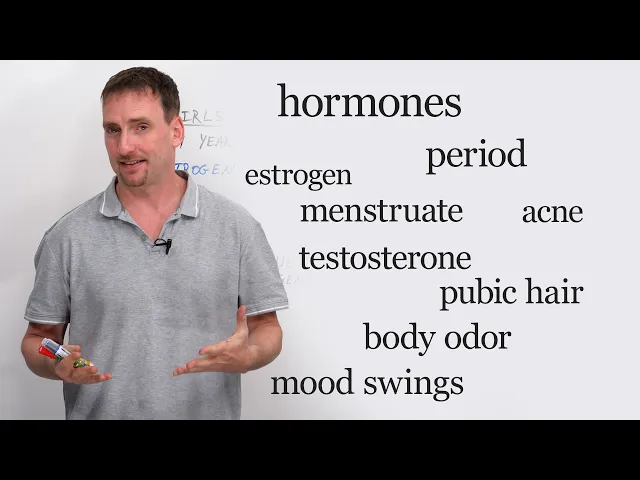
2:18 Actually, for both boys and girls, the main thing that changes is the hormones.
2:25 You start developing the hormones that make you
2:27 an adult male or an adult female.
2:31 For girls, this hormone is called estrogen, you start developing this hormone.
2:35 Boys start developing testosterone, so estrogen, testosterone.
2:42 They're big-looking words, but they're pretty common words.
2:46 People use these words even in everyday situation,
2:49 like you'll often hear somebody walk into
2:52 a room...
2:52 Like, a woman will walk into a room full of men,
2:55 and she'll say, "Oh, there's just too
2:56 much testosterone here." It means too much male attitude,
3:00 but again, that's a whole other story.
3:03 Okay, let's get back to puberty.
3:05 Now, as far as actual physical changes that will
3:08 be noticeable to the young boys and girls,
3:12 girls start developing breasts, okay?
3:16 Their breasts start to grow.
3:18 They also...
3:18 Obviously, they don't see this,
3:19 but they also start developing their ovaries, which is where
3:22 the...
3:23 Basically, where they will have the baby,
3:25 where the baby will start to grow once conception
3:28 is made.
3:29 Now, if you want to learn about conception a little bit more,
3:32 I actually made a video
3:33 about having a baby.
3:35 You can look for the link in the description to this video,
3:37 and it talks a little bit about
3:39 the actual process and what happens before, during, and after.
3:44 Boys, on the other hand, start developing their testicles.
3:47 This is where they're going to produce the sperm
3:49 that they will be able to use to make
3:52 babies, and that's what makes them adults as well.
3:55 Now, both boys and girls start to develop pubic hair.
4:00 Be very careful, this is not public pubic hair;
4:04 that's a little hair around the genitals.
4:07 The genitals are the actual sex organs of humans.
4:11 For boys, it's a penis; for girls, it's a vagina.
4:14 These are the correct words; don't be shy about using them.
4:18 And the more...
4:19 The most noticeable difference for the boys and girls.
4:22 Girls will start to menstruate.
4:27 They begin their menstruation cycle.
4:30 The more common word for this is their period.
4:33 So, every month, they will have a period;
4:35 again, depending on a regular cycle or not.
4:38 Menstruate is the verb; menstruation is the noun, the process.
4:42 Boys will start having erections;
4:44 that's when the penis starts to get hard because all the
4:48 blood is flowing to it.
4:49 Both...
4:50 The girls obviously release blood;
4:52 the boys start to release other types of fluids as
4:56 they get more and more excited as they grow up.
4:59 Okay, so now there are some other things that
5:02 you're going to see physically or even emotionally
5:05 during puberty.
5:06 Okay?
5:06 And we're going to look at some of the other signs that appear during this time.
5:12 Again, both boys and girls will start growing armpit hair;
5:15 armpit is under your arm.
5:17 Maybe some leg hair and some facial hair; mostly for boys, not all boys.
5:22 Some girls...
5:23 Again, that depends on the hormones inside your body.
5:28 This especially for boys, it does happen to some girls,
5:31 but mostly for boys, their voice
5:33 breaks.
5:34 Now, boys, when they're young, have a very high voice.
5:38 And then suddenly, during puberty, it starts to crack,
5:41 and they're in a very uneven tone
5:44 of voice,
5:45 and then it starts getting deeper and deeper until it's finally set, and they
5:49 have their deeper male voices.
5:52 That's called a voice breaking, or sometimes their voices crack, we say.
5:58 A lot of young people have acne;
6:00 acne are like the little red dots on your face that
6:04 happen during this time of your life.
6:06 Again, that's all based on hormones.
6:08 You could get treatment for it, but it's a natural part of it.
6:12 Some kids have it much worse than others.
6:15 If it's a source of embarrassment, or shame,
6:17 or whatever, it shouldn't be, but kids are
6:20 kids.
6:21 Oh, a very common expression, a very common proverb,
6:26 we say, "Children can be cruel."
6:33 So, children can be very cruel to each other,
6:35 but this is also part of their growing up
6:38 and becoming adults.
6:39 Unfortunately, puberty is a very hard time of life to go through,
6:43 I think, for everybody.
6:44 So, anyways, there's muscle growth.
6:47 Again, both boys and girls will start developing muscles.
6:50 Boys generally are a bit faster than the girls.
6:53 There's something called "growth spurts".
6:55 So, if you think back about your school time,
6:58 where maybe you were the tallest child in
7:01 the class, and then you went on summer vacation,
7:04 and then you came back, and then, like, three
7:06 of the boys are, like, a lot taller than you, because they grew over the summer.
7:11 So, this is called a "spurt",
7:12 where there's a very fast and sudden growth, and then it
7:15 slows down again, and then maybe another one.
7:18 A lot of kids will have two or three of these spurts over their...
7:22 during their puberty.
7:24 And everybody starts developing body odor, right?
7:28 Your hormones are changed, your mechanisms are changed,
7:31 your systems have changed, now
7:33 you're starting to sweat and you're starting to have a smell.
7:37 And again, it's a natural smell,
7:40 but a lot of kids start using antiperspirants, deodorants,
7:44 maybe some cologne and perfume, although not recommended.
7:49 Just by the way, I just have to make sure everybody understands,
7:52 I'm not a doctor, I'm
7:53 not a biology teacher, I'm an English teacher.
7:55 I'm giving you all the vocabulary.
7:57 It's very important that if you want to know more about all of this,
8:01 and if you want more
8:02 specific details, you should do your own research,
8:05 you should go ask your doctor what
8:08 is happening with your child, etc.
8:10 I'm just giving you the basics so that
8:12 you can have that conversation in English,
8:14 so I hope it helps a little bit.
8:17 Now, a few other things to keep in mind about puberty.
8:21 We have an idiom or an expression that's
8:23 called "talking about the birds and the bees".
8:26 Now, this is a very old-fashioned expression,
8:29 but people still use it now just for fun,
8:32 I think, more than anything else.
8:34 The birds and the bees,
8:36 when it's time to talk to your child about how babies are made.
8:40 About sex, basically.
8:42 What they should do, what they shouldn't do,
8:44 you have to be careful, you have to do this,
8:46 you have to do that, how to treat a woman, how to treat a man, etc.
8:49 But basically, it's sex education.
8:52 Now, sex education is part of many schools' curriculum, curricula.
8:58 Some schools are against it, some schools are for it,
9:01 some parents are against it, some
9:03 parents are for it.
9:05 It all depends on the school and the area you're in.
9:09 But if the school doesn't do it,
9:12 it's very important that parents talk to their children
9:15 about sex before there's a problem, right?
9:18 Teenage pregnancy is a big problem in many countries,
9:22 so that comes from lack of education.
9:27 Puberty is also a time of discovery,
9:30 a time of self-discovery, where a child learns about
9:33 his or her body, about what he or she likes,
9:36 the type of people he or she is attracted
9:39 to, the type that they've developed for themselves,
9:42 also a very important part of this life.
9:47 Mood swings, this is a very common thing that happens during puberty.
9:52 Kids will come to school in the morning, they're all happy and cheerful.
9:56 By the end of the day,
9:57 they want to kill everybody, they're very angry and violent.
10:00 And then they go home, they're happy again,
10:02 and then they're angry again, they go all
10:04 over the place.
10:05 The hormones are not balanced yet.
10:09 So, as the hormones get more balanced, the mood will settle.
10:13 But during the heat of puberty,
10:15 you can have a child go through many different moods in
10:19 any given amount of time.
10:21 It takes a lot of patience for parents,
10:24 for teachers, for classmates and friends, etc.
10:27 And in some cultures, this is when social interactions start happening.
10:33 Girls start to like boys, boys like to...
10:36 Girls start to like boys,
10:37 boys start to like girls, or whatever other combination, and
10:41 they start dating, and there's more parties,
10:43 and there's more outings, and this is basically
10:46 when their interactions begin more seriously,
10:48 and again, all of this comes down...
10:51 It's very important to have sex education to help them, anyway, protect them.
10:57 So, this is in a nutshell, puberty.
11:01 Of course, there's a lot more to know.
11:03 You should do some research if you have kids or
11:05 if you want to have kids in the future.
11:08 If you're teachers and you're dealing with kids,
11:10 if you're young teachers and you're
11:11 dealing with kids,
11:13 and you're not sure what's going on with your 12-year-olds, find out
11:17 more about this stage of their life.
11:19 Very important, especially for teachers and young parents.
11:23 Okay?
11:23 So, if you have any questions about this stuff, I hope I can help.
11:27 Please ask me at the www.engvid.com comment section.
11:30 There's also a quiz to practice your understanding of the English we discussed,
11:34 and I hope you
11:36 liked this video.
11:36 I hope it was informative.
11:38 If you liked it, please give me a like.
11:39 Don't forget to subscribe to my channel and ring
11:42 the bell if you want to get notifications
11:44 for future videos of mine.
11:47 And come back soon, and we'll do this again,
11:49 and hopefully have informative lessons again.
11:52 See you then.
11:53 Bye-bye.