International Trade Explained
CFR Education
0:02 Every day, a network of ships,
0:03 trucks and planes move massive quantities of goods around the world.
0:08 Your car might come from South Korea, and your T-shirt from Bangladesh.
0:12 All countries export, sell products and services abroad and import
0:16 buy goods and services from foreign trading partners.
0:20 These goods are manufactured items or agricultural commodities.
0:25 Services, a dynamic and growing part of trade,
0:28 refer to all intangible goods such as advertising and telecommunication.
0:33 But the trade network is more complex than sellers and buyers.
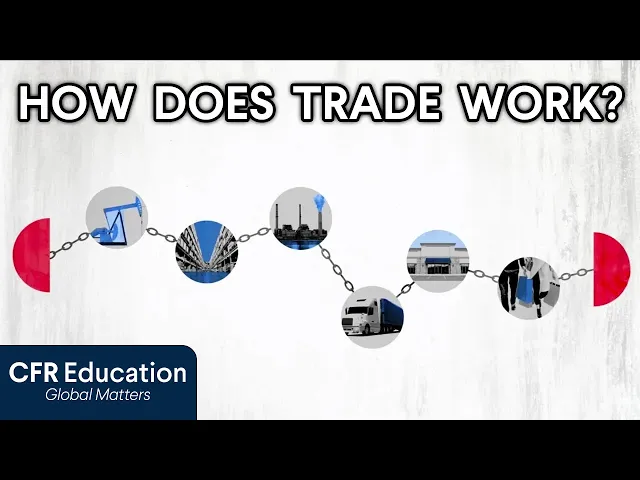
0:37 The system of worldwide trade is an intricate web
0:40 in which lengthy supply chains allow products to be sourced,
0:43 assembled, packaged and sold in different parts of the world.
0:48 The materials for your phone or shoes or the tuna fish
0:51 you had for lunch might have been produced in one country,
0:54 processed in another country,
0:55 assembled in a third country and packaged somewhere else.
0:59 All before getting to your local store, how does this make sense?
1:04 Why can't countries just make their own phones,
1:06 shoes or tuna fish and provide more jobs in business domestically?
1:11 Before the 19th century, most European countries tried to do just
1:15 that prioritizing self-sufficiency in a system called mercantilism.
1:19 Mercantilism aimed to maximize exports, minimize imports,
1:23 and increase the country's supply of gold.
1:27 This system led to strict tariffs, or taxes on imports,
1:30 as a way to not only discourage bringing
1:33 in goods from abroad, but profit off it.
1:37 Mercantilism created barriers to international trade.
1:40 Countries aim to produce as much as possible on their own,
1:43 including things they weren't able to make efficiently.
1:47 In the late 18th century,
1:49 so-called classical economists refuted these long held beliefs,
1:52 championing the idea that societies should trade with one
1:55 another to be more successful because of comparative advantage.
1:59 The idea that when countries focus on making things,
2:01 they're comparatively good at an import, the rest everyone benefits.
2:06 This is known as specialization, and when countries don't have to spend
2:10 time and resources producing textiles or wine,
2:13 for example, there's more room for them
2:15 to innovate and create entirely new products.
2:19 These classical economists argued that it was counterproductive to judge
2:22 a country's power on how much gold it could amass.
2:25 Today, we measure countries in economies on productivity
2:29 their ability to utilize their limited resources for maximum value.
2:33 This metric is known as Gross Domestic Product,
2:36 which totals the sum of all the final
2:38 goods and services a country produces in a year.
2:42 Each country's human, physical,
2:44 technological and financial resources determine what
2:46 that country can produce efficiently and successfully.
2:50 Costa Rica excels at exporting pineapples and coffee,
2:53 while Germany exports millions of cars and computers.
2:56 With the acceptance of these new ideas.
2:59 International trade took off.
3:02 Measuring GDP instead of just gold helped boost trade and grow economies.
3:06 At the same time, advances in technology
3:09 and travel made remote markets much more accessible.
3:12 Massive container ships, cargo planes and cheap,
3:16 instantaneous communication connected the world's
3:18 producers with millions of new customers.
3:21 And after World War Two, the newly formed United Nations created
3:25 the General Agreement on Tariffs and trade, or get this agreement,
3:29 substantially lowered trade barriers like tariffs and created
3:32 rules to dictate how countries should trade freely.
3:36 The GATT became the World Trade Organization in 1995 and tried
3:40 to eliminate even more obstacles to keep up with the changing world.
3:45 The WTO expanded the definition of trade to include not just goods but services,
3:50 and to create rules governing intellectual
3:52 property such as copyright or a patent.
3:56 The WTO is also an arena for countries to hammer out the rules
4:00 and regulations of international trade and lodge
4:02 complaints if they believe those rules aren't followed.
4:06 According to the principle of comparative advantage,
4:09 if one country can't sell a high quality
4:11 product at a reasonable price point or new technology,
4:14 make the business uncompetitive, It will not succeed.
4:18 Its stores or factories might be forced to close and jobs will be lost.
4:23 That country must then adjust its economy
4:25 around something it can be comparatively good at.
4:28 This is the nature of international trade.
4:30 However, some countries and industries are accused
4:33 of skirting the rules of international trade,
4:35 and that's where the WTO tries to come in.
4:39 For example, in the United States,
4:41 labor unions argue the WTO doesn't adequately protect U.S.
4:44 wages from being undercut by unfair trade practices in China.
4:48 And some developing countries say the WTO
4:51 rules don't take into consideration their unique circumstances.
4:54 For example, agricultural subsidies provided by wealthy
4:58 governments make it hard for sellers
5:00 from smaller or poorer countries to reasonably
5:02 export their crops to those countries.
5:05 The WTO has failed to solve these problems.
5:07 They are especially hard to address because changes
5:10 to the rules require consensus among the WTO's 164 member countries.
5:16 Some countries forge bilateral and regional trade agreements
5:19 to address their particular needs and trade strategies.
5:22 In 1994, the North American Free Trade Agreement, known as NAFTA,
5:26 was designed to facilitate more trade
5:28 among the United States, Mexico and Canada.
5:31 NAFTA provided a blueprint for similar
5:33 types of agreements between other countries.
5:36 From just 1990 to 2015, world trade volume increased more than
5:42 fivefold from 3.5 trillion to 19 trillion.
5:46 International trade has created a tightly
5:49 interconnected world economy that's given
5:51 more people than ever access to cheaper and better goods and services.
5:55 It's created millions of jobs and strengthened
5:58 international connections leading to global stability.
6:01 At the same time, trade can hurt those individuals,
6:04 companies and communities where imports make it impossible for local
6:08 firms to compete against better or cheaper goods from somewhere else.
6:12 Trade will inevitably create winners and losers,
6:15 but it is inseparable from modern life.
6:18 The challenge, then,
6:19 for policymakers is to assist those who have been disadvantaged
6:22 with support and the training for new jobs so everyone can continue
6:26 to benefit from the system that is given more choices to consumers
6:30 and more work for producers in every corner of the world.