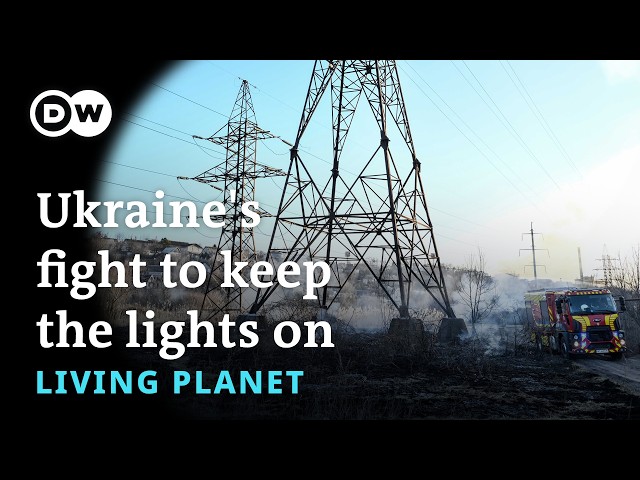
How the war is boosting Ukraine's demand for renewables | Living Planet Podcast
DW Podcasts
0:00 Just a note before we start,
0:01 we're working on an upcoming episode about rivers and dams and how
0:06 they shape the environment around us in often profound and unseen ways.
0:11 And we want to hear from you.
0:13 Do you live near a river or a dam?
0:16 What does it do for you?
0:17 And what does it mean to you?
0:19 Let us know.
0:20 Send us a voice message by going
0:21 to dw.com/livingplanet and pressing the record button.
0:26 That's the easiest way.
0:28 or you can go the old school route and write us an email to livingplanetw.com.
0:34 We'd love to hear from you.
0:35 And now, let's get this week's episode started.
0:39 I wouldn't say it was that we were scared.
0:42 Uh, it was that we were terrified of the prospects of that happening.
0:47 It takes a lot to scare Sha Bernie.
0:50 After 35 years as a nuclear specialist with Greenpeace,
0:54 the Burley Scotsman has worked in some of the most radioactive places on Earth.
1:00 The scariest point in terms of nuclear was in 2024, autumn 2024.
1:07 Sha is talking about Ukraine where he now spends most of the year.
1:11 On August 26th, Russia starts firing more than 200 missiles
1:15 and drones in one of the largest aerial attacks of the war.
1:19 It systematically pounds energy infrastructure,
1:22 hitting gas and coal fired plants, the grid, and transformers.
1:27 Around 8 million homes lose power.
1:33 For the second time in 2 weeks,
1:34 Russia launched a nationwide strike against Ukraine's energy grid, seen here.
1:39 Authorities say emergency power outages are
1:42 in place nationwide, leaving hundreds of
1:45 residents in Ukraine's capital, Keefe, are woken up by air raid sirens.
1:49 Russia has been trying to Ukraine's energy system
1:52 since it invaded the neighboring country in February 2022.
1:56 But this is different, says Sha,
1:58 because the Russians started targeting electrical substations.
2:02 A nuclear plant that's connected to the grid
2:05 requires uh what's called grid stability.
2:09 And it's the substations that keep power flowing in and out.
2:13 Uh there's about 10 of them that are critical to nuclear plant safety.
2:18 But during the Russian attack, the grid begins to buckle.
2:21 Four reactors disconnect.
2:23 Plant operators power one down completely.
2:27 you were looking at a scenario that really had
2:30 never been seen in the world before where multiple reactors
2:34 would be forced to shut down because that instability
2:38 the the safest option is to shut down the nuclear reactor.
2:42 And why is that?
2:43 If you lose electrical power from the grid,
2:46 it's called a loss of off-site power, a loop.
2:50 You need to go to your own electricity supply on the plant itself.
2:55 And in the first instance, that's emergency diesel generators.
2:59 That needs to happen within minutes.
3:01 So, electricity is delivered to the water pumps,
3:04 keeping the extremely hot reactor and spent fuel cool.
3:08 But those enormous generators have maybe 7 to 10 days of fuel.
3:13 Restarting a reactor takes far more power than they can provide.
3:17 It has to come from the grid.
3:18 If that power isn't restored and fuel runs out or a generator breaks down,
3:24 cooling systems fail.
3:25 Within hours, water boils away, exposing the core.
3:30 Temperatures climb to around 2,700° C.
3:34 That's the boiling point of steel.
3:36 The fuel melts, otherwise known as a core meltdown.
3:42 I don't really get scared, but that was the really serious moment when you go,
3:47 okay, Ukraine, Russia knows that Ukraine is faced with this horrendous dilemma.
3:55 Shut down the reactors before it's too late or keep operating
4:00 and risk not just one reactor uh not even one nuclear power plant,
4:06 but multiple reactor failures across Ukraine.
4:10 So multiple Fukushima radologically speaking potentially multiple Chernobyl.
4:20 That was the worst case scenario.
4:23 But the plants regained offsite power.
4:26 The grid stabilized and plant operators were able to restart the reactors.
4:31 But the risk hasn't gone away.
4:33 Ukraine says Russia is still trying to knock their nuclear plants offline.
4:38 plants that now provide more than half of the country's electricity.
4:42 And the UN's nuclear watchdog,
4:44 the International Atomic Energy Agency, has called the situation
4:48 the world's biggest threat to nuclear safety.
4:53 This has left some Ukrainians questioning
4:56 the vulnerability of a highly centralized energy system
4:59 and whether nuclear power can ever be truly safe in a time of war.
5:04 Ukraine knows better than most what a nuclear disaster means.
5:08 It's now clear that the Soviet Union has suffered one
5:11 of the worst disasters in the history of nuclear power.
5:14 Massive quantities of radiation have apparently been released
5:18 in an accident at the Chernobbile power station.
5:21 On the 26th of April 1986,
5:23 a reactor at the Chernobyl nuclear power plant exploded,
5:27 sending radioactive material across Europe.
5:30 Hundreds of thousands of people were forced to leave their homes.
5:33 many never to return.
5:35 It remains the world's worst nuclear disaster.
5:38 And we have to ask ourselves whether it is reasonable to rely
5:43 so heavily on technologies where the consequences of failure are so high,
5:49 especially in such unstable condition as war.
5:53 I'm Neil King and this is Living Planet.
5:55 Russia's attacks on Ukraine's power grid have pushed the country's energy system
5:59 to the edge and its nuclear plants to the brink of disaster.
6:03 We'll hear how Ukraine is fighting
6:05 back with an unexpected weapon, renewable energy.
6:09 Could building out solar and wind essentially make Ukraine and Europe safer?
6:14 Stay with us.
6:18 There's no shortage of conversations about climate change in our planet,
6:21 but some questions take a little bit more time to sit with.
6:24 Green Frequency is a new Earth radio show,
6:27 a space to follow the ideas shaping how we understand this planet.
6:30 From oceansing carbon to what it actually takes to build environmental policy,
6:34 we explore the science and the systems around it
6:37 with the people working at the center of it all.
6:39 Thoughtful conversations with entry-level nuance and a clearer pathway forward.
6:44 Tune in to Green Frequency Earth Radio wherever you're listening to this now.
6:55 One of the reasons that worstc case scenario Shaun Bernie described hasn't
6:59 happened is the rapid response of nuclear plant workers under immense pressure.
7:04 Another is the people keeping the grid alive.
7:07 the unbelievable work of the Ukraine uh grid operators,
7:11 Ukraine Argo uh personnel from uh
7:16 companies like DTEK maintaining the electricity
7:19 system despite being under assault uh constantly every night and you
7:25 know engineers have died as a direct result of working at these electrical
7:30 stations trying to get them repaired and then being hit again.
7:33 The most obvious way to reduce the danger
7:36 would be for Russia to stop targeting the grid.
7:38 But as long as those attacks continue, Ukraine is being forced to adapt.
7:43 More than half of the country's electricity
7:45 generation capacity has been damaged or destroyed.
7:49 And the Saparicha nuclear power plant,
7:51 once supplying a quarter of Ukraine's electricity,
7:54 remains under Russian control.
7:57 The targeting of big thermal power plants and the centralized grid
8:01 has been a kind of quite stark um
8:05 revelation of the vulnerability of concentrated um energy infrastructure.
8:12 So Russia has fairly brutally targeted um
8:16 Ukraine's um energy infrastructure across the board.
8:19 And what they found is that targeting um thermal power plants,
8:24 what we'd sort of say is conventional power plants.
8:26 So these could be um nuclear, coal,
8:29 gas and so on where there's they generate a large quantity of electricity.
8:34 That is uh relatively effective way to cause
8:39 a lot of damage with relatively few missiles.
8:43 That's Chris Elliot.
8:45 I'm a research fellow in the environment society center at Cham House.
8:48 Um, I work on geopolitics, trade, climate change, and the energy transition.
8:54 Chris says Ukraine isn't just rebuilding,
8:56 it's rethinking how its energy system works.
8:59 And what they found is that um, solar, wind,
9:03 and batteries has tended to be the most effective,
9:07 the fastest, and the most kind of secure way of doing that.
9:11 Ukraine's largest private energy company, DTEK,
9:14 ran um whole fleet of mainly coali power plants.
9:18 um prior to the invasion.
9:19 But as they've been systematically attacked
9:21 and DTEK has been trying to repair them,
9:24 what they've also found themselves doing is bringing in everinccreasing
9:27 quantities of wind and solar and batteries um because they
9:32 have found that they tend to be harder to attack
9:36 uh and less likely to be targeted by the Russians.
9:40 It's not just harder, but also less economical to target smaller
9:44 and more spread out renewable sources, says Chris.
9:47 I think one statistic that they've cited is that it takes one
9:51 particular missile to take out really a 250 megawatt um say coal cap
9:58 coal fired power station but it would take 40 times that amount
10:02 of missiles to take out um the equivalent capacity of wind power generation.
10:09 And wind and solar are cheap and quicker to install
10:12 and quicker to repair than a badly damaged coal plant.
10:17 And unlike a coal plant, if a drone takes out a solar panel,
10:21 the lights don't all go out.
10:23 So, for example, if there is a solar park,
10:26 if there is damage to that, it doesn't necessarily need
10:29 to take everything out because you could swap new panels in.
10:32 Big energy companies and Ukrainian NOS's have all
10:36 been working to bring more green power online.
10:39 In 2025, about 56% of the country's electricity generation came from nuclear.
10:45 Coal made up 14% and renewables including hydro power,
10:49 solar and wind came in at around 21%.
10:52 Jumping from 12% before the invasion.
10:55 Ukraine has been rolling out smallcale decentralized power
10:59 particularly in frontline and high-risk regions to make
11:02 the grid harder to knock out and ensure
11:05 a stable electricity supply to people and businesses.
11:08 Some of that is smaller gas plants, but a lot of solar is going up on rooftops.
11:14 municipal buildings, hospitals, and schools.
11:17 In 2025 alone, Ukraine installed enough to power over a million homes.
11:23 The goal now is to nearly double that within 4 years.
11:27 And the people rolling all that out are doing it under fire.
11:36 Fortunately, everything was quiet.
11:37 We only see the military aircraft monitoring the sky.
11:42 It's March 2026.
11:45 25-year-old Lena Kondrauk is standing in the cold
11:49 in total darkness in the middle of a field
11:52 somewhere between Ukraine's capital Kev and a town
11:55 called Mikolai about 60 km from the front line.
12:00 She looks up.
12:02 I hadn't seen such sty skyh for the long time.
12:06 Of course, uh I thought that probably I would
12:09 see such sky in the mountain at my vacation, but it still was really beautiful.
12:15 Lena is standing in this field appreciating the stars because an air
12:19 raid alarm sounded as the train she was on raced through the darkness.
12:24 All the passengers have to disembark.
12:26 It's a Russian attack.
12:27 Passenger trains are now a target.
12:30 We know about that.
12:31 we know about these risks and our conversation
12:35 and dark humor made it lighter because for example every
12:39 uh each evocation I asked myself um it would
12:43 be better uh to burn alive or freeze to death.
12:48 Uh because that carriage train carriage burns down completely in 9 minutes only.
12:54 And if you outside in 0° weather for over uh an hour,
12:59 no matter how warmly you dressed, you start to freeze.
13:03 And we spent about 2 hours outside uh to talk about this.
13:09 And fortunately, we didn't have answer for this question.
13:12 Still, it's the kind of dark humor Lena says
13:15 helps Ukrainians deal with the reality of war.
13:18 When the air raid is over, they board the train again and arrive safely
13:22 at Mikollay for the opening of a solar power plant.
13:29 Lena makes this journey about once a month.
13:32 She works for the Ukrainian NGO Eco Club,
13:35 helping bring solar power and battery storage to communities across the country.
13:40 The trip takes around 13 hours if it isn't interrupted by air raids.
13:47 Lena is the youngest in her family.
13:50 Yes.
13:50 On 30 minutes.
13:52 She's got a twin brother who she says doesn't really understand her job.
13:57 And they still think that I am just
13:59 uh sitting with my laptops and doing something.
14:03 Lena joined Eco Club at 18 after her older sister encouraged her to volunteer.
14:08 I didn't have like any expectation on it uh because
14:13 uh I um have started to study at the university.
14:18 She thought she would become an engineer, steady work, well paid.
14:22 But when she started volunteering, she saw
14:24 how these people love this work and what the impact of this work.
14:30 I uh understood that uh I want uh to have
14:35 a job with real social impact at the world.
14:39 Just before the pandemic, she takes on a role as an analyst.
14:43 At that point, Eco Club is focused on advocacy pushing for renewable energy.
14:48 Then February 24th, 2022, reports of explosions across Ukraine.
14:58 We are beginning this morning with the breaking news of a fullscale
15:01 invasion of Ukraine that began overnight after Russian President Vladimir.
15:06 I was also scared and shocked because I
15:08 didn't believe that it can happen uh in 2022.
15:13 I didn't believe the news that all said that it will happen.
15:17 The invasion changes everything.
15:19 The team pivots first to humanitarian aid then
15:23 as blackouts spread across the country to energy.
15:26 We have started this campaign called Solar Aid for Ukraine because
15:30 we see that Russia started to shell the energy infrastructure for Ukrainians.
15:37 The constant loud were of diesel generators are now a familiar sound.
15:42 They're not only noisy but polluting and the fuel
15:45 needed to run them keeps getting more expensive.
15:48 Eco Club and its largely European donors want
15:51 to replace those with solar and batteries and Lena
15:54 is asked to step up as project manager
15:57 getting those renewable energy projects off the ground.
16:00 She's just 21.
16:02 Actually, uh I was really scared to take
16:05 this responsibility because I wasn't sure that I can.
16:09 I agreed for this offer because of the war because
16:12 I understand that uh for example I can die tomorrow.
16:21 It's a stark realization for someone so young.
16:25 But like so many Ukrainians, she has learned to live with the knowledge
16:28 that everything can change in a moment.
16:31 She's built routines to hold on to morning
16:34 runs followed by long breakfasts with coffee.
16:37 because uh if I did if I doing that I
16:41 feel this stability because I don't have stability at anyone
16:46 in my life and even if I have like um
16:50 plan for a year for all my projects at work
16:54 I see that in the end of the year all
16:56 my plans was not as I planned I need to create
17:01 new way for example to do other activities or there
17:05 is a shale or some damage I need to replace.
17:10 And uh it's really uh it's really hard,
17:12 but it's lessons learned for everyone in Ukraine is you should to adapt.
17:22 Since then, Lena has helped bring nearly
17:24 90 solar power systems online across Ukraine.
17:27 Traveling through a country at war wasn't easy at first.
17:31 She lives in Rivet in the west, far from the front.
17:34 Her first trip to Mikolif just 60 kilometers from the fighting was daunting.
17:40 I've never been in Mikolai before the war.
17:43 I was uh checked like the all information
17:47 how far away Mollay from the front line,
17:49 how often air alarms happened,
17:52 how often shing in it and uh actually it's only 60
17:57 km from front line and I was really scared to go there.
18:04 While Lena was there, the city was shelled by the Russians.
18:08 There is no electricity and I thought that I didn't
18:13 want to come back to the city because I am scary.
18:15 I have the anxiety about it.
18:17 But Lena did go back.
18:19 I met a lot of kind people in my life and I
18:23 see how the people even near the front lines can live.
18:28 They uh they continue to work.
18:31 They continue to have the normal weekend.
18:33 They continue to have the dreams and plan their life in the future.
18:37 And they teach that it's even during such uh war time,
18:43 it's still possible to find a happy moments in your life and continue it.
18:54 In Mikollay, Lena says solar and batteries are
18:57 helping utilities to keep water flowing during blackouts
19:00 and ensure hospitals can keep caring for patients
19:03 and doing surgeries even when the grid goes down.
19:07 Sometimes blackouts can last up to 16 hours and locals will turn up
19:11 at the facilities that have solar to charge their phones and in winter get warm.
19:17 The important point that renewable energy in Ukraine
19:20 is not about the climate and sustainability.
19:23 It's about surviving now because we see uh
19:27 how the water utilities and hospitals need this electricity
19:31 during the power outages and uh for each
19:34 Ukrainians it's about the access to the basic needs.
19:39 One project particularly close to her heart brought solar power
19:42 to a longstay care home for women with mental health and neurological issues.
19:47 Before the solar panels, staff were waking up at 4:00 a.m.
19:51 to get breakfast ready before the power cuts.
19:54 Blackouts shaped the entire day.
19:56 Often no hot meals, no TV, sometimes no electricity at all.
20:01 And after that, they was happy because they have like access to everything.
20:06 They can watch TV in every hours of day when when they want to do it.
20:12 and it was really grateful and happy to see uh the smiles of their faces.
20:19 Lena says the solar plant has also helped the home save money to put
20:22 into improving conditions for the people living there
20:25 who are often overlooked by the Ukrainian government.
20:28 Personally uh this project discovered for me
20:31 that I thought that I didn't uh and I am not empathetic person but I am because
20:39 every time when I visit this facility I
20:42 was uh I wanted to give everything that I want and help them as my best
20:49 because I see how these people are vulnerable and how they need our help of it.
21:02 In January 2026 alone,
21:04 Russia fired more than 6,000 attack drones, 5,500 aerial bombs,
21:10 and 158 missiles at Ukrainian infrastructure,
21:14 repeatedly targeting thermal power plants,
21:17 electricity substations, and district heating facilities.
21:21 Ukrainians are already dreading the next winter.
21:24 The last one was the harshest in 16
21:26 years with temperatures dropping to minus21° C.
21:31 Things were particularly bad on the front lines where
21:34 families live in damaged homes with unreliable heating and electricity.
21:38 Even in Rivener in her office, Lena felt it.
21:42 Usually we spent a day at the office with winter coat on ourselves with hats,
21:48 with hat, and even uh with gloves because it was really cold.
21:53 and not only outside but also inside.
21:56 Lena also lives with blackouts,
21:58 though not as frequently as in other parts of the country.
22:01 Often outages are scheduled and she plans her day accordingly,
22:05 having important meetings and doing work around those.
22:09 Last winter, some colleagues in other parts of Ukraine had to work
22:13 in the evening or even in the night because it's
22:16 only the time when they have the electricity to do it.
22:19 Aside from changes to her workday,
22:22 Lena says her reading habits have significantly improved.
22:25 And talking about the Netflix,
22:27 I download series over movies for my phone and watching later.
22:33 And I buy additional power banks for home.
22:38 I try to cook uh food in a few days, not only for one day.
22:43 I also started to often visit for example my family,
22:47 my parents at the home because they have electricity and like
22:50 hi mom I will visit you today for the dinner.
22:54 For Ukrainians the priority is simple.
22:57 Keep the lights and heat on.
22:59 That has meant keeping nuclear plants
23:01 running throughout the war despite the risks.
23:04 So far they've operated without major incident.
23:07 Without them, experts say Ukraine would be in a far worse position
23:11 considering how much of its fossil fuel plants have been knocked offline.
23:15 But we see that, for example,
23:17 solar power can't cover uh electricity demand in the winter.
23:23 They can help uh in the summertime a lot, but in the winter,
23:26 we should find another way to help to survive uh communal facilities in Ukraine.
23:33 Alongside expanding renewables,
23:35 Ukraine is also planning at least nine new nuclear reactors.
23:40 Some being built in the country's west and others in the south,
23:43 partly to compensate for the loss of the Saparicha plant occupied by Russia.
23:48 That would bring around 11.25 gawatt online.
23:52 The cost of one reactor would be at least 5 billion.
23:57 In a recent survey, 80% of Ukrainians supported
24:00 the nuclear plans and 95% backed renewables expansion.
24:10 So, is the lesson no nuclear in the future energy mix?
24:14 It depends on who you ask.
24:15 Lena and Greenpeace's Shaun Bernie say
24:18 countries including Ukraine should concentrate on expanding
24:21 solar and wind with industrial and smallcale
24:24 battery storage as much as they can.
24:27 And for me it's not of course saying that nuclear
24:30 energy is bad because even now a part of energy system
24:34 depends on the nuclear power in Ukraine but it clearly shows
24:39 uh the importance of diversification and decentralization of energy in Ukraine.
24:45 But at the same time, pretty much all the G7,
24:48 that's Germany, France, Canada, the US, Japan, Italy,
24:51 and the UK are saying, "We need to build nuclear plants." Um,
24:56 but they also made a statement, I guess,
24:59 cuz they're not called out by people saying, "Hang on a second.
25:02 You're saying let's build lots of nuclear." But on the other hand,
25:04 you're saying because of the lessons of Ukraine, we need to decentralize.
25:08 Okay.
25:09 What one do you really believe?
25:12 My own sense is that the energy transition it's
25:17 you know that that train has already left the station.
25:20 We're moving towards a massive roll out even greater roll
25:24 out of renewable energy economics basically that wins on this.
25:31 In the short term they also want tougher sanctions on Russia's
25:34 nuclear industry similar to ones for oil, gas and coal.
25:38 Countries like Hungary and Slovakia still buy uranium from Rosatom,
25:43 the state company that occupies nuclear power plant Saparichia.
25:47 They say banning it would threaten their energy security.
25:50 The EU is looking for alternatives, but has no firm timeline.
26:01 Chris has been looking at what others can
26:03 learn from Ukraine when it comes to energy resilience.
26:07 For him, the main lessons from Russia's war in Ukraine when it comes to energy,
26:11 lessons that the European Union is also paying
26:13 attention to is a better geographical spread of infrastructure.
26:18 And yeah, that is basically um agnostic of the the power generation source.
26:22 While nuclear and fossil fuel plants are still
26:25 doing a lot of heavy lifting in Ukraine, diversifying energy supply with a lot
26:29 of renewables and storage is another big lesson.
26:33 the sort of initial impetus between um behind um rolling out renewable
26:37 energy and electrification was you know
26:40 tackling climate change by reducing greenhouse
26:42 gas emissions which is really important still but at the same time
26:45 sort of post the Russian invasion of Ukraine there was a you know
26:48 a hu in response to that a huge deployment of renewables as Europe
26:52 realized we need to be less reliant on gas uh you know
26:56 it's a very it's a really fossil fuel poor continent and it
27:00 was never going to have anywhere near enough to meet its your needs.
27:08 Global instability, including oil price hikes linked
27:11 to conflict in the Strait of Hormuz,
27:13 could only sharpen Europe's desire to move away from fossil
27:16 fuel imports and gain more energy independence through decarbonizing.
27:22 Another lesson is making sure you've got the right components.
27:25 You've got stockpiles of these components.
27:27 That's not things like I wouldn't say
27:28 that's things like stockpiling or critical minerals.
27:32 It's more like the the, you know,
27:33 the the vital parts of your system that keep everything turned on.
27:37 And those components should all be standardized for easy and quick replacement,
27:42 meaning restoration takes days instead of weeks.
27:45 But back to the question, do we need nuclear?
27:49 Chris is very optimistic about where renewables are headed and how fast.
27:53 Batteries are getting cheaper and advances are
27:56 being made in the duration of long-term storage.
27:59 grids just need building out and adapting.
28:02 That's the big bottleneck.
28:04 His view is there's this narrative of scarcity with um renewables.
28:08 At the moment, there's not going to be enough.
28:10 Actually, we're not too far away from there being too much on some levels.
28:15 For its part, Ukraine wants to phase out coal by 2035
28:19 and to reach 27% renewables in final energy consumption by 2030.
28:24 On nuclear, Chris is pragmatic rather than prescriptive.
28:28 Ukraine is dependent on it as is France which
28:31 has over 50 reactors and that's not changing soon.
28:35 I'm not sure I would necessarily say we should
28:37 you know that you know one or the other
28:38 government should invest tens of billions in a new
28:41 nuclear plant rather than renewables and batteries.
28:45 I think you'd have to think very carefully about that.
28:48 Um but I don't I do think that it's part of the European
28:53 energy mix at the moment and I don't see why that wouldn't continue.
28:57 You just need to be quite careful
28:58 about thinking it can deliver all these benefits.
29:01 And I think there is potentially an argument that you
29:05 and this has been sort of shown with the Ukraine experience.
29:07 You do want to have some diversity.
29:09 Chris says there's still debate in energy systems modeling.
29:13 Some scenarios get to 100% renewables, others closer to 90%.
29:19 But he thinks the real point is often missed.
29:22 There's no silver bullet.
29:24 I mean, it's it's it's actually a really interesting exercise,
29:26 but ultimately you just want to build out as much low carbon as you can
29:30 and you want to make it as secure as you can while you're doing it.
29:34 So, basically trying to derisk the dangers of running nuclear power in a war,
29:38 moving away from buying nuclear fuel from Rosatom
29:41 and also bolstering your renewables against cyber attacks, for example.
29:45 It's awful, but it's been it's almost been a laboratory of what can happen.
29:50 And I think it's really important that Europe and and other countries
29:56 as well do draw the right lessons because otherwise it's it's almost an insult.
30:01 It's it's like they've gone through this terrible experience.
30:05 They're continuing to go through it.
30:06 They've shown amazing sort of ingenuity at rebuilding
30:10 fast and it's taught us a lot about what's vulnerable and what you need
30:13 to consider and what could be targeted.
30:15 It's actually really really important that Europe
30:18 does take these lessons on board.
30:24 Lena says she's glad she was born long after Chernobyl,
30:28 even as she lives through a different kind of disaster in Ukraine.
30:32 One she doesn't expect to end soon.
30:36 Unfortunately, in this question, I am a pessimist.
30:40 But Lena and others in Ukraine are looking to what happens after the war.
30:44 I still uh want to live there.
30:46 I still want to help uh my country.
30:49 I still want to continue my work at the Eco Club.
30:52 And I still think that even after the war and after our victory,
30:58 there would be even more work uh compared to now because we
31:03 have to rebuild country and rebuild it in greener and uh better way.
31:16 This episode of Living Planet was researched and produced by Jennifer Collins.
31:21 It was edited and soundscaped by me, Neil King.
31:24 Our sound engineer was Zeed Slayman.
31:27 What did you think of this episode?
31:29 Send us a voice message.
31:30 Just go to dw.com/livplanet and hit the record button.
31:34 Of course, you're also free to write us an email, living.com.
31:40 That's it for this week.
31:41 Thanks for listening and sharing living planet.