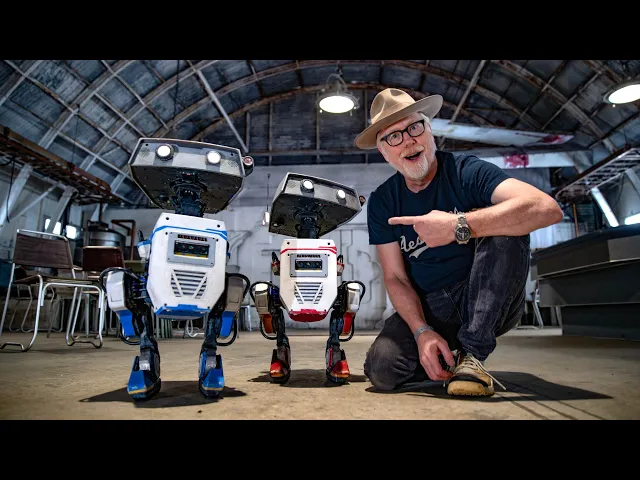
Adam Savage Meets Imagineering's Star Wars BDX Droids!
Adam Savage’s Tested
0:01 Have you seen these before?
0:02 I have not.
0:03 Oh, these are pretty cool.
0:04 Holy cow.
0:05 So, these are the BD droids that the Imagineers built for the parks.
0:08 Yes.
0:08 Yeah.
0:09 New adventures in the Star Wars universe not only
0:11 enrich the world building that we see on screen,
0:14 but they also inspire future generations of storytellers,
0:18 effects artists, and droid builders.
0:20 The latest example of this virtuous
0:22 cycle are Walt Disney Imagineering's BDX Troids,
0:25 made possible by the latest advancements in robotics
0:28 married with Star Wars pedigree of character-driven design.
0:32 I got my first chance to meet a pair of BDXs
0:35 on the set of Star Wars the Mandalorian and Grou,
0:38 where director John Favro introduced me
0:40 to their breathtaking technology and even bigger personalities.
0:45 Can I push one?
0:46 I don't know.
0:46 Let's talk to Can I push one of OUR EXPERTS HERE?
0:52 THESE GUYS LOOK so expressive.
0:55 And now I could walk up to you.
0:56 We have them in the film uh in the background.
0:59 And they walk too.
1:00 Could you walk them around a little bit, too?
1:01 They're they're very stable, but they have so much personality.
1:05 And what I like about it, too,
1:06 is it captures the whole um the way George was able and and all
1:11 of you in Star Wars are able to get personality into the tech,
1:14 but it still doesn't look overly anthropomorphic.
1:17 No, but yet there's still like a chicken form in there.
1:20 And uh I want one of these in my house.
1:24 I know some people make some calls.
1:27 They're crowds.
1:29 I love how stable they are.
1:30 You guys are gorgeous.
1:35 It's awesome.
1:36 It's such a great It's such a great time, right?
1:40 Like this is incredible that this is practical.
1:42 It It is.
1:42 And but but it's also consumerf facing like
1:44 you could have people it could interact with people.
1:47 It's not just for a film set.
1:48 It's not just for a demo.
1:49 So the park is becoming more immersive
1:52 through these innovations that Imagineering are doing.
1:54 And
1:55 if you think about what Walt did with um
1:58 Abe Lincoln with animatronics for the first time,
2:01 all of that and and even stuff that he built
2:04 for the World's Fair that he then brought in like the dinosaurs uh uh tiki room.
2:10 This is really building on that tradition and and when
2:12 you see people actually interacting with the the suits,
2:15 the Baby Yoda animatron and these are stupendous.
2:19 It just creates a more immersive communal experience
2:23 that I think we're only seeing the beginning of
2:26 this tremendous potential there and they're and I know
2:30 at Disney they're really trying to lean into that.
2:32 Well, you create these imaginary worlds and bring us into them.
2:35 And this is part of making that actually real to us on a on a direct level.
2:40 It's amazing.
2:41 It's all very vertical.
2:43 Now,
2:44 you'll tell a story and then they'll see something that inspires them
2:47 or you'll or I saw them and put them in the movie.
2:50 Right.
2:50 Right.
2:51 There's it's a conversation that goes back and forth.
2:52 The servos in here, they're just they're so responsive.
2:55 It's crazy.
2:56 And these have to go all day.
2:58 I This isn't just for a few takes and Let's go send in people to adjust it.
3:04 This has to go all day long.
3:06 Oh, thank you.
3:09 Let's see here.
3:09 What you got going on?
3:11 I really I want to start I want to put a tape cassette in and have them play.
3:14 Right.
3:14 You can give them a dust plan.
3:17 Exactly.
3:16 They fit in good here, though.
3:17 See, that's how I know we're all doing
3:19 our cuz they look they look like they fit in
3:22 and all of it looks like it fits into the
3:25 what Howard Hughes built here.
3:27 I know.
3:27 What a continuum.
3:30 Yeah.
3:30 It's all part It's all drawing upon the stuff George drew on.
3:34 That's the trick.
3:34 Isn't
3:35 that amazing?
3:35 Yeah.
3:36 Is you look at the stuff that got that got him his gears turning.
3:40 And if you go back to what
3:42 you know, whether it's Corousawa, uh Leone,
3:45 uh Ford, World War II movies, Damn Busters, Battle of Britain,
3:50 or Hot Rodding, you know,
3:51 all of that is part of what went into George's imagination
3:55 and created this unique thing that we all fell in love with.
3:59 And so you can get back to the it's like looking at a chef's ingredients, right,
4:04 from their menu that you love and then you look at, oh,
4:06 where did they where did they source these things?
4:08 What did they, you know, what cuisines are they leaning into?
4:11 You know, I think we think about it more than he does.
4:14 Fair.
4:14 Which totally makes sense, right?
4:16 If you ask him about it, it's not something
4:18 it's super intuitive and internal.
4:19 He'll he'll he'll share, but yeah, he doesn't know as as we don't probably,
4:24 right?
4:24 Right.
4:24 What what's what what
4:26 what brings it together.
4:27 But I I love that this feels like this could have been in one of his.
4:30 No.
4:31 And and you could drop this into any one
4:32 of the films and you'd feel totally in place.
4:35 The color breakdown, you know, borrowing from the X- Wings and stuff.
4:40 It's just really cool.
4:42 So, this was not on camera,
4:44 but it's always good to have uh a a standin for framing and for lighting
4:49 and for color and
4:50 but of course, Legacy does one that you you know looks Oh my god, he's soft.
4:56 So we we had this for framing and you know, God bless him on the set.
5:00 It looks like
5:02 HR Puff and stuff.
5:03 It's not it's not as impressive,
5:05 right?
5:05 But once the animation,
5:06 we have Jeremy Allen's voice in there and we have the animators
5:09 and it's uh Hal Hickle uh uh running the uh as lead animator,
5:14 bringing these digital characters to life wasn't something I we
5:17 really had opportunity to do that much on the show.
5:19 Sure.
5:19 Sure.
5:20 But here you have Zeb, you have Rada.
5:23 From time to time we have uh Grou will
5:25 be digital if there are certain things he can't do.
5:27 Right.
5:27 Right.
5:28 Or we'll do a little augmentation.
5:30 Uh but so much of it is puppets and suits.
5:35 So I think you know I think we got the b the balance right.
5:39 Yeah.
5:39 But but this character is all digital.
5:40 But we figured we'd show it all.
5:41 And these are all uh practical masks that were used and costumes that were used
5:47 either in this or most of them are from the show.
5:49 Yeah.
5:49 This is the egg the uh
5:51 Yeah, the frog lady and the husband.
5:53 That's right, Misty.
5:55 And then we had that was John Leguisama was the cyclops.
5:57 We had our
5:59 Tuskan Tuskkins.
6:00 Yeah.
6:01 And some of them are actually quite involved.
6:03 You can't tell, but there's a lot of animatronics built into a lot of them.
6:06 I mean, every one of these is weeks and weeks and weeks for a team of people.
6:10 I know.
6:10 And then the performances, too.
6:11 Learning how to do it.
6:12 The people who had to Yeah.
6:14 to to wear
6:15 to emote out of That's the thing that amazes me about your costume performers.
6:18 They've got to get a whole character out of being
6:21 strapped into a whole bunch of plaster and rubber.
6:23 It's usually it's it's the ones who are the best at are the ones who build it.
6:28 Ah, and they love being in it.
6:30 Interesting.
6:29 As opposed to imagine you do an audition, you're going to be a fraud
6:34 and they're getting ready and they go to set and they're
6:36 in this thing and whereas somebody who built it knows what it does.
6:40 They know the team and they know how to get the most performance out of it.
6:44 So, a lot of our a lot of our uh
6:46 performers are people that are also either puppeteers or or designers.
6:50 So, it's but it's something you learn you learn that over time, right?
6:54 That's part of the collaboration.
6:55 Yeah.
6:56 So, it's so so so we've become more
6:58 collaborative with all of our vendors and departments.
7:01 Oh, that's right.
7:01 This is not a one-way street.
7:02 This is like we're thinking of doing this.
7:04 Show us what you're thinking.
7:04 And they know me well enough now that they'll pitch me back things, you know,
7:09 or you know, visual effects might make some
7:12 editing requests or change might change the cut, right?
7:16 Or somebody from editorial might request another shot.
7:18 It's very nonlinear.
7:20 We could pick things up and do things.
7:21 And so having best idea wins and everybody
7:24 pulling together and trying to plus the ideas
7:27 and that's why having a long schedule helps
7:30 you because you could keep refining and keep refining.
7:33 Dude, it's so thrilling to be in here and see the business end of all this.
7:35 It's just completely inspiring.
7:38 I knew you had to come.
7:39 That was it.
7:40 I was like, can we get out?
7:45 I really appreciate you watching all of that.
7:47 And if you are pondering right now what to get for the maker,
7:51 tinkerer, or general obsessive in your life, or what to get yourself,
7:54 I'd like to humbly suggest our brand new Savage Industries Shop Apron.
7:59 Its predecessor is one of the most popular things we have ever manufactured,
8:03 and we are still selling them, but now we've added to it.
8:06 We've simplified it.
8:07 We've lowered the cost and we've made an entry-level apron.
8:11 Uh, still manufactured in the United States, still made of upcycled materials.
8:14 And I swear this might become my new daily wear.
8:17 Get yours today at adamsavage.com.
8:20 Yeah, there we