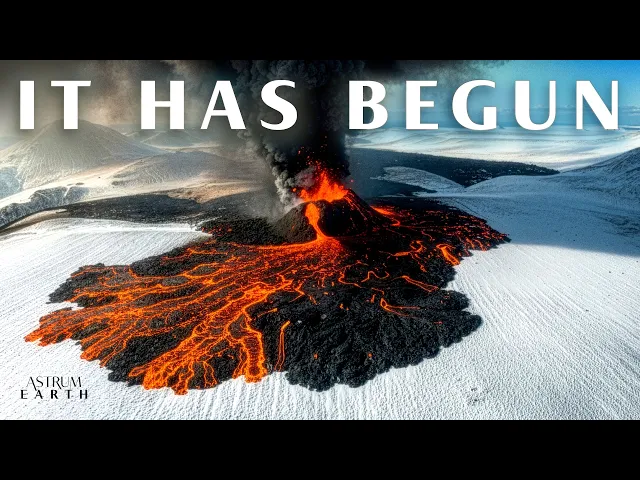
Iceland Is On Fire
Astrum Earth
0:01 Iceland is on fire with earthquake swarms, volcanic eruptions,
0:07 and lava fountains spewing hundreds of meters into the air.
0:11 This tiny country is experiencing volcanic activity on a staggering scale.
0:17 It isn't the first time, and it certainly won't be the last.
0:22 This is the awakening of a thousandear cycle.
0:26 A rhythm that last transformed the landscape when Vikings walked these shores.
0:31 And this is no blip on the radar.
0:34 It's a geological marathon.
0:37 The activity we're seeing today could last for 2 to 400 years.
0:43 But this time will be different.
0:45 This isn't the Viking era.
0:48 Today, Iceland is a modern nation of geologists and engineers
0:52 who aren't going to take this lava invasion lying down.
0:56 As the ground tears apart beneath their feet,
0:59 they're attempting the impossible to outenineer
1:02 a continent pulling itself in two.
1:06 So, can a modern society survive four centuries of fiery chaos?
1:13 We're going to find out.
1:15 I'm James Stewart, and you're watching Astram Earth.
1:18 Join me as we explore the youngest land on the planet,
1:21 delving into the ancient cycles responsible for carving
1:24 out this mythical anomaly of fire and ice.
1:28 Geological patterns that have left Iceland facing the ultimate test, survival.
1:38 Iceland is unique.
1:40 Not only is fermented shark considered a delicacy,
1:44 but geologically there's nowhere quite like it.
1:48 It sits a stride the midatlantic ridge,
1:51 a divergent boundary where the North American and Eurasian plates
1:55 pull apart at a rate of around 2 cm a year.
1:59 That's roughly, by the way, the same speed [music] your fingernails grow.
2:03 As the plates separate, magma rises to fill the gaps,
2:07 cools into bassalt, and forms new crust.
2:11 And I know what you're thinking.
2:12 There's nothing particularly unusual about that.
2:15 But over millions of years,
2:17 this process has built the longest mountain range on Earth,
2:21 running down the center of the Atlantic Ocean.
2:24 Almost all 16,000 km lies 2 to 3 km beneath the waves.
2:30 That is until you reach Iceland.
2:33 Here, land pokes its head above the surface.
2:37 Why?
2:38 Well, Iceland isn't just on a tectonic plate boundary.
2:42 Here, the Mid-Atlantic Ridge intersects another
2:45 geological phenomenon, a mantle hot spot.
2:48 These are best known for creating island chains such as Hawaii,
2:52 the Galapagus, and the Canary Islands, all of which, I might add,
2:55 lie in the middle of tectonic plates, not at the edge.
3:00 The hot spot under Iceland instead creates the geological equivalent
3:04 of a pressure cooker left on high for millions of years,
3:08 turning an already active boundary into something far more volatile,
3:13 producing a third of all the lava that's
3:15 erupted onto Earth's surface in the last 500 years,
3:20 which is not bad for a country smaller than England.
3:24 Now, mantle hotspots are somewhat of an enigma,
3:27 which is sort of a nice way of saying
3:28 that scientists don't exactly know what causes them.
3:31 Actually, let me know in the comments below if
3:32 you'd like to see a video on that another time.
3:35 But for now, what we need to know is
3:36 that they are driven by columns of unusually hot,
3:39 buoyant rock rising from deep within
3:41 the Earth and pushing up through the mantle,
3:44 and that they can last for tens of millions of years.
3:47 Now, the important thing to note here is that these hot
3:49 spots can raise mantle temperatures by as much as 200° C.
3:55 And in doing so, the drop in pressure causes hot solid rock to melt into magma.
4:01 The result is an unusually thick crust up to 40 km compared to typically
4:06 7 km and enough buoyancy to lift the ridge out of the ocean.
4:11 And voila, an island or in this case an Iceland.
4:16 This is the only inhabited mid ocean ridge on Earth.
4:20 In fact, visit ThinkF Vit Lea National Park [music] and you
4:23 can literally stand in the separation zone between two continents.
4:27 But it's what's inside that ridge that's problematic.
4:31 We often talk about tectonics in the past tense.
4:34 But in this case, the problem is present.
4:37 Very present.
4:41 Iceland is a mere teenager in geological terms.
4:44 The oldest rocks found in the west fjords and the eastern
4:47 fjords are just 16 to 18 million years old,
4:50 which is basically yesterday compared
4:52 to continental Europe's half billiony old crusts.
4:55 [music] And if you thought that was impressive, well, wait for this.
4:59 When you move south, the land gets even younger still.
5:02 It is only 3 to 7 million years old in places like the Grecian Peninsula.
5:07 And remember that name.
5:09 It's somewhere we're going to come back to.
5:12 Now, just off the south coast is the youngest land on the planet.
5:15 [music] In the 1960s,
5:17 the island of Certzi erupted into existence from beneath the sea.
5:23 The island is a pristine natural laboratory,
5:25 allowing scientists a rare chance to study an island from birth.
5:30 really because it began as sterile lava with a known birthday if
5:34 you like and has remained free
5:36 of human interference thanks to strict protections.
5:39 Researchers can trace exactly how life builds an ecosystem step [music] by step,
5:45 giving us an insight into processes analoges
5:48 to the spreading of life on early Earth.
5:51 But Iceland's youth isn't only interesting
5:53 for the sake of scientific research and this video.
5:57 It's dangerous because young land means fresh lava and lots of it.
6:04 There are around 30 volcanic systems active across the island and over
6:08 a 100 volcanoes have erupted in the last 10,000 [music] years.
6:12 I say around 30 because nature doesn't draw neat boundaries.
6:16 It would be very helpful if it did.
6:18 Some systems here have obvious central volcanoes.
6:21 Others are long networks of underground fishes.
6:24 and many are a combination of both
6:27 slipping in and out of activity over centuries.
6:30 So depending on the geological criteria used to define active,
6:34 the number sits somewhere between 28 and 33.
6:38 And thanks to lying on such a rare tectonic sweet spot,
6:42 Iceland produces almost every major style of volcanic behavior on the planet.
6:48 From flood bassults that spread lava in vast sheets,
6:52 gently built shield volcanoes,
6:54 groundsplitting fisher eruptions, explosive composite volcanoes,
7:00 sticky rioly domes, and even huge ashflow calderas.
7:05 Nowhere else puts this entire volcanic toolkit on display quite like Iceland.
7:11 In fact, the country's image as a land of fire
7:14 has become central to its identity and its economy.
7:18 But it also hides a hard geographic reality.
7:22 For all its beauty, the interior of the country is a vast, high freezing desert.
7:28 Often compared to the surface of the moon,
7:31 its harsh conditions leave it largely uninhabited.
7:35 Instead, nearly everyone lives around the coast,
7:37 especially the southwest corner.
7:40 The Gulf Stream keeps this part of the country relatively barmy.
7:43 Winter temperatures rarely drop below -5° C,
7:47 leaving harbors ice free year round.
7:50 Combine that with rich codtock seas, and why wouldn't you want to stay here?
7:56 Over time, small settlements grew into towns and cities,
7:59 pulling in even more people.
8:02 I really can't state enough that this area is the nerve center of the nation.
8:07 80% of the population lives within an hour's drive of Recuik.
8:12 Icelanders have cleverly leveraged the country's
8:14 geological activity here to their advantage, too.
8:17 Over 85% of homes are heated by geothermal water,
8:21 underpinning Iceland's position as a green energy leader.
8:25 High temperature geothermal fields where hot water and steam
8:29 circulate above shallow magma bodies are tapped by bore holes.
8:34 Housing, swimming pools, and even pavements are warmed by the earth itself.
8:40 [snorts] Imagine that.
8:40 Underfloor heating while you walk to the shops.
8:43 That's my kind of luxury.
8:46 But with this growth comes new vulnerabilities.
8:49 More people means more infrastructure now sits
8:52 in places that will be affected by future eruptions.
8:56 And by future, I don't mean in hundreds of years.
8:59 I mean as soon as tomorrow.
9:01 because something even more sinister is brewing below the surface.
9:08 In late 2019, something changed.
9:11 Earthquakes shook the ground beneath Farraha,
9:14 an area less than an hour's drive from Recuik.
9:18 And I'm sorry for my pronunciation here, Icelanders.
9:20 Let me know how I get on.
9:22 They started small, but soon multiplied and strengthened.
9:26 By early 2021, more than 40,000 earthquakes shook the region
9:31 in a matter of weeks in what's known as seismic swarms.
9:36 Terrifying, absolutely, but also a geological warning.
9:41 Something was going on just a few kilometers below the surface.
9:46 Seismic swarms can be caused by magma forcing its way up
9:49 through cracks in Earth's crust in what's known as an intrusion.
9:54 Rock fractures, magma floods in, pressure builds,
9:57 and it's often only a matter of time until it reaches the surface.
10:02 In March 2021, the ground finally gave way,
10:05 and a fisher ripped open in Floroshi.
10:09 A surreal glowing curtain of lava, 180 m long,
10:15 fountained into the air before flowing into a sheltered valley.
10:20 It was the first eruption on the Rekiness Peninsula in 8 centuries.
10:24 I said I'd come back to this place and it
10:27 went on for nearly six months before suddenly stopping.
10:31 But that was not a return to dormcancy.
10:34 That was just the start.
10:37 Further eruptions followed in 2022 and again in 2023.
10:42 Then the activity began to migrate,
10:45 shifting a few kilometers southwest to Sparteni along the Suns Nuke crater row.
10:51 It was closing in fast.
10:55 On the 10th of November 2023,
10:57 the decision was taken to evacuate the town of Grintovvic, home to 3,700 people.
11:04 The telltale seismic swarm showed that a major
11:07 magma intrusion was propagating beneath the town.
11:11 Days after the evacuation, fissures opened,
11:14 destroying homes and damaging infrastructure.
11:18 It was described as Iceland's most severe natural disaster in 51 years,
11:24 and Grintovvic remains largely uninhabited today.
11:28 For geologists, this was the final confirmation needed that a long,
11:32 quiet volcanic system had awoken,
11:36 the starting pistol for a centuries long eruptive cycle.
11:40 But how do they know this is only the beginning?
11:43 By bringing Viking sagas into the satellite age.
11:48 This, my friends, has happened before.
11:53 When you think of what Icelanders have to deal with on a daily basis, i.e.
11:57 actual lava, it makes me realize I've got it pretty
12:00 easy here in my very boring village in the UK.
12:03 And I've got a bit complacent over the years, truth be told.
12:05 I mean, there's literally a pub and a pond here.
12:08 That's it.
12:09 My biggest worry right now is why did I throw my Pokemon cards away in 1998?
12:13 And all that nonchalantness has given strangers
12:16 a free ticket into my house without me realizing.
12:20 It's kind of crazy when you think about it.
12:21 We do everything we can to protect our families physically, don't we?
12:24 We buy life insurance.
12:25 We lock the doors at night.
12:26 We install security cameras.
12:28 I mean, I've got about seven of the things here.
12:30 I'm an Alfred away from a Bruce Wayne style surveillance operation.
12:34 But the biggest vulnerability might be the digital map
12:37 leading to the mother lode inside the house, my data.
12:41 That's why I'm using delete me.
12:43 It proactively removes my home address,
12:46 phone number, and family details from the internet.
12:49 So don't wait for a scare to [music] happen.
12:51 Be proactive.
12:52 Remove the digital breadcrumbs that lead the bad guys to your front door.
12:57 Why not treat yourself to a digital detox this year and join Delete Me?
13:01 You can get 20% off with my link.
13:03 Join deleteme.com/astramear and use code astrome earth at checkout.
13:10 Thanks to delete me for sponsoring this video.
13:12 The link is in the description if you want your digital life a bit more private.
13:16 As we head back to the video,
13:20 the Norse Vikings first settled in Iceland in 874 AD
13:24 and lucky for us in this instance were impeccable record keepers.
13:29 Their annals and sagas describe fire coming out of the sea
13:33 and darkness during daytime in Urekunez area between 1210 and 1240.
13:40 During this period, now often referred to as the Rekines fires,
13:44 the peninsula was gripped by repeated fisher eruptions.
13:48 Widespread environmental destruction led to devastating
13:50 effects on livestock and farming,
13:52 pushing the medieval communities here to the very edge of survival.
13:57 Eight centuries later, what was once recorded as folklore have become
14:01 a critical guide for modern science and potentially survival.
14:08 Beneath soil and lake sediment in volcanic regions are layers of volcanic ash.
14:13 When analyzed, these tiny shards of essentially glass carry
14:17 a chemical fingerprint with a precise mix of silica,
14:20 iron, magnesium, calcium, and sodium.
14:23 Now, crucially, these fingerprints vary from one volcanic system to the next.
14:29 When paired with radiocarbon dating of the sediments
14:31 above and below the ash layers, as well as observations from old lava flows,
14:36 the timing and sequence of historical eruptions can be pieced back together.
14:42 In March 2020, Christian Simutson from the Icelandic
14:46 Geo Survey and his colleagues published evidence of at least three major rifting
14:51 and eruptive episodes over the last 4,000 years,
14:55 each lasting a few hundred years and spaced roughly 800 to a,000 years apart.
15:01 Now, to be honest, this would have been quite good
15:02 to know before Iceland set up the majority of its economy,
15:05 infrastructure, and housing in this area.
15:08 But even so, what on earth was causing them?
15:12 The timing of all these cycles comes back to that uniquely
15:15 Icelandic geological boiling pot that we talked about at the start.
15:19 Yes, Iceland as a nation sits on the mid-Atlantic ridge,
15:22 but the Rekineses Peninsula in particular sits directly astride.
15:27 There is no single centralized volcano here.
15:30 [music] The plate boundary itself is the volcano.
15:34 As the North American Anurasian plates slowly pull apart,
15:38 lateral strain builds within the crust, it stretches and over time fractures.
15:44 This creates underground networks of fishes
15:46 that are invisible to us at the surface.
15:49 As magma rises from below, it intrudes into any nook and cranny it can find.
15:55 At first, it stalls at depth, not erupting, but building pressure.
16:00 For centuries, this process unfolds quietly, steadily, relentlessly.
16:07 The apparent calm above ground is deceptive.
16:10 Eventually, the combined force of plate motion
16:13 and magma pressure just becomes too much, and the crust gives way.
16:17 Existing fractures are forced open.
16:19 New ones tear through rock and magma surges sideways
16:23 for kilometers at a time through networks of thin underground dikes,
16:28 triggering these seismic swarms that signal what comes next.
16:32 When those intrusions finally break the surface,
16:35 long fishes open and eruptions ignite along the rift.
16:40 Each eruption releases some of the accumulated stress,
16:44 and the rift switches on and off
16:47 over decades until centuries of tension are relieved.
16:52 Then the system quietens, and the cycle simply resets.
16:56 And terrifyingly, the most recent seismic swarms
16:59 and eruptions fit the expected cycles uncannily well.
17:03 This activity is right on schedule.
17:07 But when this cycle last played out,
17:09 it was medieval communities who were pushed to the brink.
17:13 What can modern Icelanders really do in the face
17:16 of a cycle that cannot be stopped?
17:19 Well, they're going head-to-head with the lava.
17:22 Obviously, modern GPS and intererometric synthetic aperture radar
17:27 or INSAR from satellites show that before eruptions,
17:31 the land inflates as magma accumulates.
17:34 [music] In 2021, some areas rose by tens of centimeters before subsiding again.
17:42 Taken together with thousands of small earthquakes,
17:45 magma pathways can be mapped in real time.
17:49 This allows geoysicists to estimate the volume of magma involved
17:53 as well as the depth and shape of the reservoirs.
17:56 And all of this gave Iceland time to plan.
17:59 Well, as much planning as you can do when it comes to huge impending lava flows.
18:04 When seismic activity first returned to the Rekineses Peninsula,
18:08 Iceland's Department of Civil Protection
18:10 and Emergency Management recognized its [music] significance.
18:13 To prepare for the looming period of increased vulcanism,
18:16 they established the Infrastructure Protection Group,
18:19 which feels like it sort of needs
18:20 its own Avengers style superhero fanfare, doesn't it?
18:23 The IPG does pretty much what it says on the tin.
18:26 This crack team of engineers, scientists,
18:29 and emergency planners worked to protect
18:32 people and critical infrastructure from lava.
18:36 As the 2021 eruptions near Farraha unfolded,
18:40 lava eventually spilled beyond shelter valleys and began creeping towards roads.
18:45 [music] The Department of Civil Protection made a pivotal decision.
18:49 They would try and hold it back.
18:51 [music] With no recent president to draw from, this response
18:55 became a realtime field experiment in lava flow engineering.
18:59 And the first challenge was deceptively simple.
19:02 Where to put a barrier?
19:05 And that's where engineers like Horn come in.
19:07 And thank you so much to her.
19:08 She helped us massively in researching this video.
19:11 With a background in hydrarology and hydrodnamics,
19:14 Horn's expertise was in modeling floods and river ice,
19:18 both slow and fastm moving destructive flows shaped by gravity and terrain.
19:24 Yeah, those fundamental principles, it turned out could be applied to lava.
19:30 By using flood simulation software originally designed by the US Navy,
19:34 she was able to quickly predict with remarkable accuracy
19:38 where molten rock was most likely to go next.
19:42 Teams rushed to build the first experimental
19:45 barriers using whatever they could find in situ.
19:48 Literally anything, mud, gravel, soil from past eruptions.
19:52 Crews worked around the clock and they were close
19:54 enough to feel the burn from the encroaching lava.
19:57 This is serious stuff.
20:00 Now, the aim here was not to stop the lava outright,
20:03 but to delay it, restrict it, and essentially [music] buy time.
20:07 These early tests show that this approach could actually work.
20:11 But they also revealed some critical lessons.
20:15 Firstly, lava type matters, and it matters a lot.
20:20 R lava is chunky and rough.
20:22 When this hit a barrier,
20:24 it thickened and piled up like a sort of geological porridge.
20:27 So, if you want to stop it,
20:29 your walls need to be built like a medieval fortress.
20:33 PHO hoy lava, on the other hand, is smooth and much runnier,
20:37 behaving more like honey, if we're doing the breakfast metaphor thing.
20:41 Interestingly, drone surveys showed that it flowed over dams,
20:44 but could be redirected using angled BMS.
20:48 And it was this piece of information that immediately
20:50 suggested that a barrier doesn't have to stop lava flow.
20:53 It just needs to guide it.
20:56 These initial field trials made up as they were going
20:58 along led to the most ambitious lava defense project ever attempted.
21:02 [music] And as volcanic activity shifted further west,
21:06 closer to towns, the lessons became more critical.
21:10 Multicometer barriers up [music] to 24 m high
21:14 have now been built across the Rekineses Peninsula.
21:17 Such is the scale of them that two
21:19 new quaries have been opened to provide enough material.
21:23 The new barriers are built with compacted
21:25 bassalt gravel to resist heat and [music] pressure.
21:28 And they're armored with boulders
21:29 and stabilized to prevent erosion and collapse.
21:33 They're carefully shaped, too,
21:35 based on lava modeling to steer lava away from towns,
21:38 key roads, and crucially, the Sparteni geothermal power station.
21:44 Of course, there are gaps in these barriers, too.
21:46 Strategic openings for roads,
21:48 pre-cast concrete bridges for pipelines, and emergency access.
21:53 But each one also comes with pre-positioned earthworks in place
21:57 so they can be sealed within hours if necessary.
22:01 And trust me, [music] it's been necessary.
22:04 Behind the scenes, the IPG works in constant coordination
22:07 with the Department of Civil
22:08 Protection and Emergency Management and Universities.
22:12 For engineers like Horn, being on call is the new normal.
22:16 As seismic swarms propagate,
22:18 she can have as little as 15 minutes warning before lava reaches the surface.
22:23 In that time, she has to rush to her office, be there to receive the first data,
22:27 which she uses to model the flow,
22:29 and then she has to tell the team on the ground which gaps to close off.
22:33 After the immediate threat is over, so follows more modeling, more barriers,
22:38 and more refinement, and so on and so on, again, and again, again.
22:43 But the good news is, so far, these models have been incredibly accurate.
22:48 Each time Horn and her team have built
22:50 new barriers or increased the height of current ones,
22:53 they very quickly be needed.
22:56 But that job does come with tough decisions.
22:59 They can't save everything.
23:00 In late 2024, lava overran the car park of the famous Blue Lagoon Spa.
23:06 This wasn't a failure of defenses, but a reminder of priorities.
23:11 Newly installed barriers were designed to protect
23:13 the [music] power station and the spa buildings.
23:15 And the car parks, well, those were sacrificed.
23:19 RIP cars for Grintovvic.
23:22 However, the limits are laid bare.
23:24 No barrier on Earth can protect a town
23:26 from fishes that open directly beneath the streets.
23:31 Beyond this system of physical defenses,
23:33 scientists and authorities are looking at how else
23:36 they can prepare for a circa 200-year eruptive period.
23:40 Plans include everything from relocating electricity
23:42 mass and burying pipelines deeper within bedrock.
23:46 Major road networks are being redesigned to allow for rapid
23:50 rrooting and AI is being drafted in to further improve forecasting.
23:56 Civil protection agencies around the world are closely watching this all unfold.
24:00 This is the first time a modern nation has
24:03 tried to engineer its way through an ongoing volcanic crisis.
24:07 If it works, this will become the blueprint
24:09 for a new form of geological urban defense.
24:12 One that fights against the slow, relentless forces of Earth itself.
24:21 Iceland truly is the ultimate land of fire,
24:25 and it's as captivating as it is deadly.
24:28 And that really isn't likely to change anytime soon.
24:31 As the latest cycle of the Rekin fires takes hold,
24:35 Iceland will once again brace itself and the world
24:38 will watch the latest round of humans versus nature.
24:42 Whatever the outcome this time around,
24:44 the feeling is that at some point something will have [music] to give.
24:48 And for the sake of the people of Iceland and beyond,
24:51 all we can do is hope it's not them.
24:55 Just before I leave you, I'd love your feedback on the pronunciation
24:58 of some of these words because oh wow, were these ones tricky.
25:02 I committed.
25:03 I tried really hard.
25:04 I think it went okay.
25:05 If you got this far in the video and we did a good job,
25:08 leave us an Iceland flag in the comment to let us know.
25:10 And if you're from Iceland, wouldn't that be amazing?
25:13 I'd love to know your feedback.
25:15 Thanks, and I'll see you in the next one.