Speak English: How to Ask for Directions and Understand the Answer
Learn English with Gill · engVid
0:00 Hello.
0:00 I'm Gill at engVid, and today's lesson
0:05 is about giving directions and asking for directions.
0:10 Okay?
0:10 If you're in a new place you haven't visited before, if you don't have a map,
0:18 if you don't have a smartphone to find your way,
0:23 if you want to just ask somebody or if you feel like talking to somebody anyway,
0:30 just for human contact,
0:32 or if you're wanting to practice your English in an English city or town,
0:40 and you want to practice asking directions, this is a good way of doing that.
0:49 So, okay, first of all,
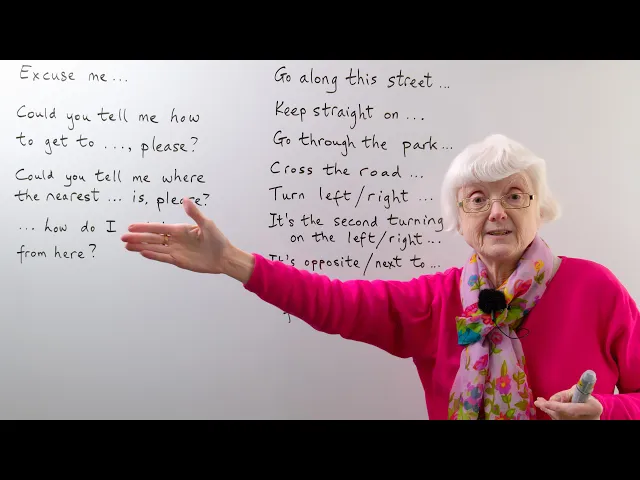
0:51 on the left here we have different ways of asking for directions.
0:58 So, it's a good idea to start...
1:00 If you're approaching someone in the street,
1:03 you have to be a bit careful, and you might from a distance say,
1:09 "Excuse me", a polite way of getting their attention
1:14 without making them feel threatened in any way.
1:19 "Excuse me, could you tell me how to get
1:24 to maybe the nearest bank?" Something like that.
1:28 Or, "to get to the station, could you tell me how to get to...?" And "please",
1:36 "please" is always a good word to include.
1:41 Right?
1:41 Or, "could you tell me where the nearest bank is or the nearest station,
1:49 the nearest post office is, please?" Again, "please" is always good.
1:59 Or you could just say, "How do I get to the park from here?
2:07 How do I get to a bank from here?"
2:12 Or if it's a particular place like an art gallery,
2:17 "How do I get to the National Gallery from here?" That sort of thing.
2:22 Okay?
2:23 So, in...
2:24 Where the dots are, you just put in the specific place that you're looking for.
2:30 So, moving on to giving directions,
2:34 this is probably going to be where you have asked for directions in English,
2:42 and then a native...
2:44 Possibly a native English speaker will be giving you an answer,
2:50 telling you how to get somewhere.
2:53 So, you need to be able to understand what they're saying,
2:58 and unless they happen to be someone like
3:02 me who teaches English as a foreign language,
3:05 they will just speak in their normal way.
3:09 They may speak quite quickly,
3:11 they may have an accent of some kind that makes it a little bit difficult to...
3:19 To follow what they're saying.
3:21 So, you have to be ready to understand the kinds of phrases that they might use.
3:28 So, they might say, "Go along this street." So,
3:31 that means, you know, "Keep walking along here.
3:35 Don't cross the road or anything.
3:37 Just stay on this side of the street.
3:40 Stay on this pavement and keep walking.
3:45 Keep straight on.
3:47 Keep straight.
3:48 Go ahead in this direction." Okay?
3:54 They might say, "To go through somewhere." So, that's through a park, possibly.
4:00 "Go through the park." So, if you go through the park,
4:05 you enter the park maybe through a gate,
4:08 and just go straight through the middle of the park and out of the...
4:13 At the other side.
4:15 Okay?
4:15 So, "to go through somewhere", "through the park", or "to go across".
4:22 Maybe there's a square,
4:25 like maybe Trafalgar Square or something, a big public space.
4:30 "Go across the square", so you go in a straight line from one side to the other.
4:37 And usually the person will be pointing, indicating,
4:40 so you kind of follow the direction that they're showing you in a straight line,
4:47 if you can, through the park, through the square.
4:53 If they say "cross the road", that means you have to actually find a place
5:00 where you can safely go across the road.
5:04 Usually you will find some sort of crossing with lights
5:09 where the traffic will stop every now and then.
5:13 The lights will go red and the traffic will stop,
5:18 and there may be a little green figure, a little lit in a green light,
5:26 a little sort of walking figure to show that you can cross, it's safe to cross.
5:32 But it's also important to look at the traffic
5:36 to make sure that it has actually stopped,
5:40 because people could make a mistake and go through the red lights,
5:44 so you have to look out.
5:47 So, "cross the road" means get across the road,
5:51 you know, when the traffic has stopped, do it safely.
5:55 So, you're going from one side of the street to the other,
6:00 from one pavement across the road to the other pavement, okay?
6:07 And then "turn left" or "turn right",
6:09 so if they're showing you somewhere in the distance
6:13 and say "turn right around that corner" or "turn...
6:17 Cross the road and turn left at the next corner", something like that.
6:23 So, you have to go around a corner to turn left or right.
6:30 They might say it's the second turning
6:33 on the left or the second turning on the right,
6:38 so you have to count, you're going along straight, and there's the first corner,
6:43 that's the first turning, so you go past that, and then to the next corner,
6:49 and then that will be the second turning,
6:53 the second corner on the right or the left.
6:58 Okay.
7:00 They might say it's opposite somewhere, so it might be opposite a station,
7:09 so there may be a railway station on one side of the road,
7:14 and then directly opposite on the other side of the road,
7:19 it may be the post office that you're looking for.
7:23 Okay.
7:24 So, it's opposite or it's next to, so "next
7:28 to" means on the same side of the road,
7:33 side by side, so the station and the post office are together side by side.
7:40 It's next to the station, it's next to the post office.
7:44 Okay.
7:45 And then they might very helpfully give you an idea
7:49 of how long it will take to walk there.
7:53 They might say it's a 10-minute walk
7:56 from here or it's a 20-minute walk from here,
8:00 something like that, so it gives you a good idea, then,
8:05 of how long it will take you to get there, and so that you know, you know,
8:11 when you're nearly there and you can start
8:14 looking out for the place you're going to.
8:18 Okay, so I hope that's helpful and will help you to find
8:25 your way around if you're visiting an English-speaking place, town or city.
8:33 So, if you'd like to do a quiz on this topic,
8:38 just go to the website, www.engvid.com, and have a go at the quiz.
8:45 I hope you've enjoyed the lesson.
8:48 Thanks for watching, and see you again soon.
8:51 Bye for now.