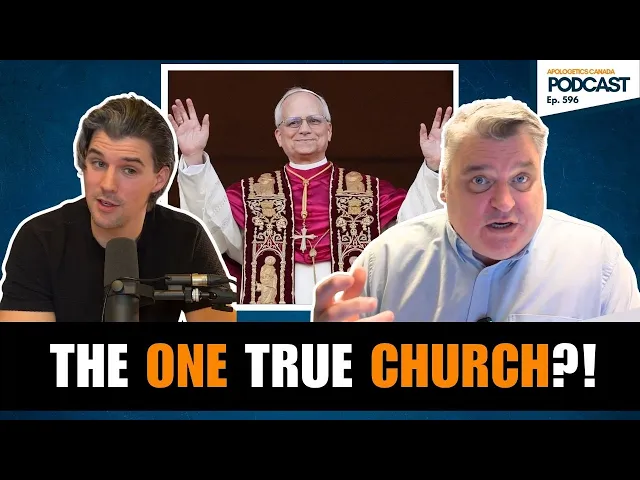
Denominations Series: Roman Catholicism with Dr. David Deane
Apologetics Canada
0:09 It's the AC
0:11 for THE LOVE OF GOD.
0:12 LOVEACE.
0:16 WELL, hello everybody.
0:17 Welcome back to the AC podcast.
0:20 My name is Ben McDonald and we are carrying on in our series on denominations.
0:25 This is a podcast series that we're going to be releasing throughout
0:29 the year where I am going to be sitting down with theologians,
0:33 thought leaders, pastors, uh,
0:35 from various faith backgrounds within the Christian tradition
0:38 to just talk about what is the church,
0:40 you know, what is what is the faith and how can we come together and find unity.
0:45 And with that, I am very happy to introduce uh my guest for today.
0:50 Uh a friend of mine from over here
0:52 on the east coast who is no longer uh with us.
0:55 Actually, Dr.
0:56 David Dean is a Roman Catholic theologian who has now moved to uh
1:02 Newman Theological College in Edmonton where
1:05 he is a professor of systematic theology.
1:07 I suppose that's a real Irish exit that you did because you were here
1:10 at the Atlantic School of Theology and I
1:13 didn't get to say goodbye, but there you go.
1:15 Dr.
1:16 David Dean is the author of numerous publications including his last book,
1:20 The Tyranny of the Banal on the Renewal of Catholic Moral Theology,
1:24 and you can check him out online on a number of podcasts.
1:27 David, it's great to see you.
1:28 Great to have you on the pod.
1:30 It is great to see you too, Ben.
1:32 and and apologies for that Kaiser so style Irish goodbye,
1:37 you know.
1:37 Yeah, I should probably expect that.
1:38 That that's totally fine.
1:40 David, just for our audience, Dave and I have known each other for a while.
1:44 You can actually go search on the internet.
1:45 You could probably find we did a podcast a couple
1:48 years ago when I was at Deepwater Church on on Nichze,
1:52 which was fantastic.
1:54 We have a we have a colleague with us at AC
1:56 who's doing his dissertation right now on GK Chesterton and Nietze.
2:00 So, he'd be Oh, wow.
2:01 I'm sure he'd love to chat with you
2:02 at some point about all of that, but that's great.
2:05 I'm always keen.
2:06 Always keen.
2:07 Well, uh, David, um, I would love to start with a a really simple question,
2:12 and it's sort of a question I I ask everybody, um,
2:15 that I'm interviewing, and it is simply, what is the church?
2:19 Uh, from the Roman Catholic perspective, um,
2:23 what does it mean to be the body of Christ?
2:26 What is the ecclesia?
2:27 And, and I want to just frame this first.
2:30 I'm asking it specifically because I think there's
2:33 a lot of people um who when when you go on the online world and you see
2:38 the sort of debates between Catholics and Protestants or Eastern
2:42 Orthodox there's a lot of talk of the one
2:44 true church and there's this idea that you
2:49 know there's a lot of variation there's a lot
2:52 of diversity across both Roman Catholicism and Protestantism.
2:57 How do we define the church?
2:58 How do we think about what does it mean to be
3:00 the one true church and and how do you see that?
3:04 Yeah, the language certainly since Vatican 2 is uh focuses on a concept called
3:10 subsistence and therefore that rests uneasily with references
3:14 to the one the one true church.
3:17 um to I think to frame it is is is is best
3:22 to start with the question you asked first in terms of what is
3:25 the church from the Roman Catholic perspective and it's it's fairly simple
3:30 there's a wonderful little line in the catechism of the Catholic Church which
3:34 notes that the church is Marian before she is Petrine and what
3:38 this really refers to is a is a tradition that you have
3:41 in the fathers um which notes that at the enunciation there we have
3:47 the the church bubbling up into being in a very very distinctive way.
3:52 And therefore I tell all my students
3:54 that when they want to think about the church
3:56 particularly the church is an onlogical reality
3:59 that they need to think about the enunciation.
4:01 Why?
4:02 Because you have a creature just like you and me
4:04 the blessed mother um who says yes to the holy
4:08 spirit and the and the result is the real
4:10 presence of Christ in her body and in the world.
4:13 And this is what the church is.
4:14 The church is what happens when women and men say yes
4:17 to the Holy Spirit leading to the presence of Christ in the world.
4:22 Um therefore the church is prefigured in the in the history of Israel
4:27 and in the Old Testament when people say yes to the Holy Spirit and the real
4:31 presence of the word bubbles up into being
4:34 even prior to the the full incarnation and then of course in a very
4:38 very distinctive way fleshified after the incarnation itself.
4:43 So the church in Nuche is a yes to the Holy
4:46 Spirit which leads to the presence of Christ in the world.
4:49 Everything flows out from that.
4:50 And so the Petrine church which is
4:53 the Roman Catholic uh uh church understands that.
4:57 So in a sense this onlogical reality yes the Holy Spirit
5:00 lead to the presence of Christ within this is the sap
5:03 and then that leads to branches um which which which might be
5:07 visible in the world more distinctly visible which we call the church.
5:10 But that's but that's it.
5:11 That's what it amounts to.
5:12 It's an ontological reality.
5:14 Um, and and this is what the church is.
5:17 And the body of Christ happens.
5:19 And I tell my students that Romans 7:8-12 really summarizes the the distinct
5:26 emphasis that you that you have in the gospels on the church.
5:30 But in Romans 7, um, Paul says, "Who will save me from this body of death,
5:34 wretched man that I am?" And in Romans 8, Romans 8:11,
5:37 we have the wonderful um when the spirit of he who
5:41 raised Christ Jesus from the dead dwells in your mortal body,
5:44 then you shall have eternal life.
5:46 And so this yes to the Holy Spirit permeates his mortal body.
5:50 And Romans 12 notes that this yes is a yes that we say,
5:55 but that doesn't mean that we entrap the Holy
5:58 Spirit in our bodies because God is one.
6:00 God is God is God is bigger than us.
6:03 And therefore really what it does is it knits people
6:05 together in the ecclesia as cells in this body of Christ.
6:09 And so this is what the church is.
6:10 The church is the body of Christ.
6:12 It's a it's a real ontological reality that comes
6:15 from the real ontological presence of Christ in the world
6:18 through the yes from women and men to the holy
6:21 spirit who proceeds from the father and the son.
6:24 Um speak the filioquay in there.
6:28 Yes.
6:30 That's really quite interesting.
6:31 So because it's it's you're understanding the church
6:34 as an ontological reality through these figures, right?
6:38 You're mentioning Mary and you're mentioning Peter, Marian,
6:41 Petrine and and to understand the church through that.
6:45 You also at one point there said that the body
6:47 of Christ happens which I I think this is interesting.
6:50 I was speaking with David Goa not too long ago, Eastern Orthodox theologian,
6:55 and he had a very similar way of speaking
6:56 about the church as an event in a sense.
6:59 But this idea of the the figures of the church,
7:02 seeing the church as Marian and also Petrine,
7:06 is this is this a distinctive Roman Catholic thing?
7:10 Is this something that we we've talked
7:11 on the podcast before about the role of Mary, for instance, the figure of Mary?
7:16 But how help Protestants understand how how do you use
7:22 these figures to to understand exactly what the church is?
7:28 Well, your introduction flagged the kind of apologetics this is
7:35 and the and and the kind of apologetic energy that this um podcast has.
7:41 And therefore I would I would be loathed to flag
7:48 the fact that this approach that I'm mentioning with reference
7:54 to the blessed mother um is properly Protestant um although
7:59 it uh and so therefore it's there in Luther it's there
8:02 in Sauron Kirkagard it's less there in 20th century US
8:06 evangelicalism um and so one of the things that happens is
8:14 and you can see this very very clearly in the 19th
8:17 century is that the reformation leads to an increasing polarization.
8:22 There's a Roman Catholic theologian who I don't like called Carl Roner and Carl
8:26 Roner wrote a little book at one stage called the shape of the church
8:28 to come and this little book was one of the few things from that actually
8:32 really enjoyed and so he's writing at a time and at the time it's
8:36 after the second Vatican council and there's
8:38 two little camps developing in the Roman
8:39 Catholic Church and one focused on a on a journal called Communio and the other
8:44 focused on a journal called Conchilium and he he said look be careful guys
8:48 um your your habitation of these two
8:52 different camps isn't itself the the worst thing.
8:57 But what is the worst thing is that because you will read the same things
9:00 and because you will define yourselves over and against
9:02 the other this polarization is a propulsive thing.
9:06 It will drive you further and further and further
9:08 apart and we see that after the reformation.
9:11 So we see that Luther and and and Kugard
9:14 will also use the blessed mother as an example.
9:17 you know, kgar will talk about our parents
9:19 in faith and he's talking about Abraham and he's
9:21 talking about the blessed mother and of course
9:23 Luther's Marian theology is is like is exceptionally rich.
9:27 Um but what happens in the 19th century um is
9:30 that we start to vilify each other in order to define ourselves.
9:35 And so the Catholic Church doubles down
9:38 on certain things which are in yourrface against Protestantism.
9:43 And so
9:44 what I would say there and I'm a I'm a big supporter
9:46 of the Marian dogma and if I'm going to talk about the
9:49 the ecclesiology for Mary I'll I'll I'll I'll bring in the enunciation
9:54 or the assumption and the immaculate conception and things like that.
9:57 Um but the the 19th century um Roman Catholic Church
10:02 identifies that they are these dogma are necessary for salvation.
10:06 That's a that's an explicitly anti-protestant move which is designed
10:11 to to force Catholics in Germany for example during the culture
10:17 camp funer Bismar um to remember that they belong first
10:21 to the church and then only second to you know
10:24 to Germany and so too the the the Protestant church
10:29 is moving in a a less Marian and and many other
10:34 things as well but a sort of a less Roman
10:36 direction as each becomes uh defined over and against the other.
10:41 So when you say you know what is
10:42 there for like for for Protestants like the reformers
10:46 um and and and Protestantism could not imagine
10:52 um uh not using examples such as the blessed
10:57 mother as an example of of what it
11:00 means to be church because all through and again
11:03 it's it's scant in the gospels but she says
11:07 listen to him do what he says you know,
11:10 she constantly learns.
11:12 She starts out, she's just like us.
11:15 She says, you know, "Come in, son.
11:17 You'll be you, you'll be killed.
11:18 Stop, you know, stop stop attracting all this attention
11:21 and getting yourself in trouble." And he says,"Woman, get back." And she does.
11:27 and she's the one who's there at the foot of the cross
11:30 because she like us and again like Peter learns um and and learns
11:36 to say yes more to the Holy Spirit and therefore to grow
11:39 with in Christoformmity and so this is the model but the but the key thing
11:44 for the cath for the for like for Catholicism and again I I'm
11:47 not saying this is not there in in reformed traditions is that the church
11:51 is an ontological reality um that it is that it is not people living
11:58 in harmony with a set of beliefs or ideas although it is that too.
12:03 It is a a real presence of Christ in the bodies of women and men.
12:09 And this is not to say that therefore we conflate these bodies with Christ.
12:14 That would be absurd um by virtue
12:16 of the fact that we will still despite our yeses
12:19 to the Holy Spirit sin and and and and often deny um you know Jesus Christ.
12:25 And this happens in bishops and popes um uh too
12:28 like a sort of the bishops and popes will will billow
12:34 with the presence of Christ and therefore and therefore be
12:37 the church very very fully at various times and in various moments.
12:43 And then at other times they may reject and say
12:45 no to the Holy Spirit and therefore this presence
12:48 of the church and the presence of the Holy Spirit
12:50 and and their participation in the trying in life will will desist.
12:54 The great example that all the fathers use and and and Luther
12:58 himself uses is of the iron and the fire.
13:00 That is sort of the, you know, that we're the iron and we're cold by nature.
13:05 We're absolutely cold, but you place us into the into into the furnace and we
13:09 absorb the heat and the and the and and and and the fire
13:13 and the oreness from the coals and the furnace and then
13:16 we will too will glow glow orange and become part of it.
13:19 And if you touch it, you'll you'll burn yourself.
13:22 but you take us out of there and we will go back cold again.
13:25 And this is the case for every single human being.
13:28 Um, and as human beings comprise the church,
13:31 this is the case for the for the church too.
13:34 And so that there's a lot to say there.
13:36 The the the poker and the fire as a as an example.
13:40 The early fathers using that often to speak about the incarnation itself, right?
13:44 I mean, it's the property of the flesh
13:46 and then it has the properties of the fire.
13:49 But you and you transfer that to the church as well.
13:51 So there's an incarnational reality to the church.
13:55 But here's where I wanted to talk about is that you had
13:57 mentioned this is what I see is this idea of the reactions
14:01 and that we are defining things in reaction to each other
14:04 and that things end up getting very puffed up after the reformation
14:08 and it seems like I wanted you to go back to Vatican 2.
14:11 You mentioned Vatican 2.
14:13 It seems that there there was a move to be made ecumenically to sort
14:20 of widen the scope of how the Catholic Church sees the body of Christ,
14:25 sees the church itself.
14:26 Am I right in in saying that?
14:28 Is that sort of tell me a little bit more about that move?
14:31 I mean, because you go from extra ecclesium nullos, right?
14:36 No salvation outside of the church,
14:37 but then that is sort of modified with Vatican 2 or changed in some way.
14:42 I mean how how are we to understand that and that progression
14:45 well there there's a sense in which it
14:47 can't be changed um because so many fathers particularly
14:51 Augustine use that exact phrase um Augustine says
14:55 explicitly outside the Catholic Church there is no salvation.
14:59 Um Cyprien says the same thing.
15:01 Um even says the says the same thing.
15:04 So when the the second Vatican council um affirms
15:08 the the reality of salvation in for example Protestant denominations,
15:13 what is what what it must be saying and is saying is
15:17 that the church Catholic is not is
15:20 not exclusively identical to the church of Rome.
15:24 Um which is which is quite a dramatic thing to say.
15:27 Now why is it saying that and why is it insisting on that?
15:31 Um well the the fact is and so one of my favorite
15:35 books on marology is um is she's um classic text and this is
15:40 an amazing book on the blessed mother
15:43 which is beautiful and mystical and delightful
15:48 and he's reasoning out from scripture and from tradition in just beautiful ways.
15:54 And every now and again he gets really hot under
15:57 the collar at people having a go at his mom,
16:01 you know, and that's and that's and that's that's what
16:05 happens in in in certain sections of 19th century Catholicism.
16:09 And don't forget that the church at the time is is is facing existential threat.
16:15 So what what do I mean by that?
16:16 Well, Napoleon places the the pope under house arrest.
16:21 um Italian unification risk the annihilation
16:23 of the of of the Vatican and the Papal States.
16:26 Um the new modern nation states particularly Protestant
16:30 nation states we think of Germany after its
16:32 pushification under Bismar um is really is really
16:36 pushing back against that and this leads to something
16:39 of a siege mentality where the church becomes
16:43 very very feisty and this and and I don't want to suggest because I know there's
16:48 probably going to be Roman Catholics listening as well.
16:51 I don't want to suggest that this leads the church into error.
16:54 Um, but it definitely leads the church
16:56 into what I believe to be an unnecessary feistiness,
17:01 um, an unnecessary palemicism.
17:03 And by virtue of that, it is pushing back
17:07 strongly against the satiriological claims of bodies outside the church.
17:13 And um, and and emphasizing Cri and Ignatius of Antioch, Augustine, etc.
17:19 to do so.
17:20 Now a far more temperate mood prevails in the second Vatican council.
17:28 It it it can't does not want to say all the church fathers who say there is
17:33 no salvation outside the Catholic Church are wrong because
17:35 that would be that would be really really problematic.
17:38 If they're wrong on that then let's let's let's let's cast out the doctrine
17:42 of the trinity and all the other stuff that they that they get up to.
17:45 Um and so what it then moves to is a notion a focus
17:52 on on subsistence and a move to subsistence over and against EST.
17:57 So so what what is that there?
17:59 So the church is a yes to holy spirit
18:00 which leads to the real presence of Christ within.
18:02 Therefore the church is the body of Christ.
18:05 Now est is the body of Christ.
18:08 This can lead to the idea which we have in 19th
18:11 century um Roman Catholicism that the church is the body of Christ.
18:17 And what the church is is all the stuff that's visible.
18:21 And so you see a building, you see a bishop, you see a pope,
18:25 therefore you see the church, therefore you see the body of Christ.
18:28 Institutional.
18:29 So it conflates the institution with the onlogical reality.
18:32 When the fact is that within Ben Macdonald there
18:37 is this yes to the Holy Spirit which leads
18:39 to the presence of Christ within which will shape
18:41 him in certain ways and there will be faith,
18:43 hope and love and this is the truth.
18:46 This is the this is the the real presence of God.
18:49 This is something which is beautiful and if
18:51 this directs him it is it is it is glorious.
18:54 But then there's also a radical peripheration of concupisence and sinful desires
18:59 and countless nos to the Holy Spirit where Ben McDonald will say,
19:03 "Not today, Holy Spirit." And will act in in accordance with the flesh.
19:09 Like this is this is solid Paul stuff.
19:11 Are you going to act in accordance with the spirit?
19:12 Are you going to act in accordance with the flesh?
19:14 And when you act in accordance with the flesh,
19:16 you are not the church ontologically.
19:19 And this is this is the same for the church of Rome.
19:21 So what the church says.
19:22 So so therefore what the church faces is
19:26 the spectre of saying there is no church which is
19:30 um going to be any way better than any
19:32 other church by virtue of the fact that church is
19:34 yes to the Holy Spirit which leads to the presence
19:36 of Christ within and therefore if you're practicing Christian
19:39 or not you could say yes to the Holy
19:41 Spirit in creation leading to the presence of Christ within.
19:45 But the church doesn't go that far and instead says
19:49 that the yeses that are possible through the church of Rome
19:54 by virtue of its feely to the aids that Christ
19:58 gave it and gives us in in in the gospels for example do this in memory of me
20:04 and a certain eucharistic theology and the sacraments and so
20:06 on and so forth means that the onlogical participation
20:11 of the church in the body of Christ has a higher ceiling.
20:15 then rationally.
20:18 So, here's an example of this.
20:20 Let's say you've got two people and um person A eats right
20:27 and goes to the gym and does all those good things and um
20:32 is extremely healthy and person B sits on their ass and eats whatever
20:38 they want and never goes to the gym and is just as healthy.
20:42 Well, this is this is bizarre.
20:43 Is it is it is it possible?
20:45 Yeah, it's possible.
20:47 And this is how Roman Catholics, I think,
20:50 you know, see um salvation outside the church.
20:53 It is definitely possible and it can happen.
20:56 And so I've got I see my Protestant brothers and sisters who know Christ
21:01 and relate to Christ and participate in Christ
21:04 and billow with the presence of Christ.
21:06 And I am in awe of them because for me that I don't think I could do that unless
21:11 I had assets like the rosary for example where
21:15 in in union with the blessed mother through the holy spirit
21:19 I can begin to glimpse the son almost through
21:23 a mother's eyes and therefore feel that love and feel
21:26 that overwhelming sorrow and joy and and and and other
21:31 and other mysterion sacrament things which bind me to Christ.
21:36 So, I need the gym and and diet in order to get healthy,
21:40 but I'm aware that others don't have don't go
21:43 to the gym and don't and don't have diet, but but they can do it, too.
21:48 Um, how doesn't make sense to me, but but they do, and that's fantastic.
21:52 And so, that's really what um what the you what lumencium,
21:56 the second Vatican Council, um, you know, is is suggesting.
22:01 So, the church Catholic is an ontological reality.
22:04 It's an ontological reality which is made
22:06 possible um and certainly made easier by feely
22:09 the tools and the guidance established
22:12 in Jesus Christ testified to in sacred scripture
22:16 um and yet there are many people who don't share in all of those things
22:21 who can still know the fullness of salvation and that's and God bless them.
22:25 That's fantastic.
22:29 Jenna.
22:31 Troy,
22:31 guess what?
22:34 What?
22:33 I'll meet you down there.
22:38 What is it?
22:40 Oh, the Western Youth Summit is back.
22:43 Round two.
22:44 Same place, same time, but this year even bigger.
22:49 Because last year we sold out before the early bird deal was even done.
22:52 So, for that reason, this year we're increasing capacity.
22:55 But like last year, I'm expecting tickets to sell quickly and honestly
23:00 to move faster than a pizza on a Friday night at youth group.
23:05 So, we're excited to officially announce the return
23:07 of the Western Youth Summit May 23rd at Trinity Western University.
23:11 I'm Troy, creative director, and I'm Jenna, the AC intern.
23:15 Jenna, what exactly is the Western Youth Summit?
23:17 Well, the Western Youth Summit is about identifying
23:20 where students are at, equipping them with truth
23:23 and tools and connecting them with trusted ministries
23:25 to help them walk through life beyond high school.
23:28 AC and Trinity Western are partnering to make this as impactful as possible.
23:32 That's why we're going to have amazing speakers for main sessions
23:34 and breakout and they're covering topics
23:36 that are actually relevant to students today.
23:39 If I'm being completely honest, when I was in high school,
23:41 I thought the whole adulting thing was going to be pretty easy.
23:45 graduation happened and I realized I was not prepared.
23:48 Yeah.
23:48 And looking back on my own experience,
23:50 I realized just how important it is to get connected early.
23:53 And that is why the Western Youth Summit exists
23:55 cuz universities aren't waiting till students get on campus.
23:58 They're trying to recruit and they're trying to get them connected now.
24:01 It's true.
24:01 They're scouting ahead, training ahead, preparing ahead.
24:04 Our faith deserves the same intentional preparation.
24:07 And there in lies the heart of the Western Youth Summit.
24:09 It's a one-day event intended to identify, equip,
24:12 and connect students for life in high school and beyond.
24:15 Graduation isn't the time to start scrambling for answers.
24:18 Intentional formation starts now.
24:20 Research shows the transition from high school to life
24:22 beyond is a crucial time for faith development.
24:25 Those that have it, they share it.
24:27 So, we're building bridges.
24:28 You're going to have the opportunity to meet with trusted Christian
24:30 ministries that are ready to walk with you through high school,
24:33 through a gap year, or even university.
24:36 You're not going to want to miss this event.
24:37 And there's also going to be some award opportunities for you.
24:40 Go to our website and sign up now.
24:43 We'll see you guys real soon.
24:48 I So I want to talk then about
24:50 tradition then in this sense because it's, you know,
24:54 you're making the analogy to it's like going
24:56 to the gym being a part of, you know, it it's the proper regimen, right?
25:00 It's the it's the exercise, the progressive overload.
25:03 this is this is the place where you train
25:05 and it's and it's where we get healthy so to speak.
25:08 And yet, so it sounds to me though
25:10 like Protestants will will typically argue that that there's
25:15 a restrictive sense in which the Roman
25:18 Catholic Church has maintained this tradition over against
25:21 I think the way Roman Catholics tend
25:23 to see that they are preserving something and so
25:26 there's a utility in a certain but do you see what I there there happens to it
25:32 it seems I think to many of us like there's a an anathema you know I
25:37 mean I want let's talk about for instance
25:39 Marian dogmas you had mentioned these earlier right
25:41 something like uh the immaculate conception which which
25:44 comes into existence in the 1800s and I
25:49 you might want to change semantically what I'm
25:52 saying there but I mean it's it's made
25:53 the promulgation of the dogma definitely
25:56 promulgation of the dogma now if I am somebody who who
25:59 is sitting there in 18 you know whatever 53 or something like
26:02 that and I say I don't quite agree with those dogmas And I
26:08 I'm not you know do I I need to submit to the magisterium.
26:13 I don't have a place or I am anathema.
26:15 Is there how is there like help me understand the utility then
26:20 that Roman Catholics see in the restrictive sense of preserving the tradition?
26:25 Because I think that's sometimes where Protestants see themselves as being more
26:28 Catholic than the Catholic Church because
26:31 they're able to expand their definition.
26:34 But obviously that's problematic for Rome.
26:37 Yeah.
26:37 So, you know, at the two extremes,
26:41 one might see tradition as a weight that that that that pulls us under
26:46 and drowns us as a life boy that that that that keeps us above water.
26:51 Um, tradition is democ as as Chesterton said is a democracy of the dead.
26:56 That it that it reminds us that we are part of a of a of an ecclesia
27:01 of a of a church community of a body of Christ
27:04 that is not reduced to those who are alive now.
27:08 And therefore the presence and the voices of those outside it are
27:12 a ballast which stops us being conflated
27:16 with any um prevailing and passing ideology.
27:21 And without tradition this happens.
27:23 Um, and so I am I'm very convicted of the fact
27:28 that um that we definitely need to be more
27:32 attentive to to tradition than less by virtue of the fact
27:36 that without it we will simply mirror our social order,
27:39 the epistemological and onlogical presuppositions of our social
27:42 order and so on and so forth.
27:44 um the my opinion which which is perhaps
27:51 a little distinctive in relation to the Marian dogma.
27:55 And so um Marian dogma are um a good
27:58 example of the of the development of doctrine.
28:01 And so the development of doctrine position is that you have
28:04 a tree and then you have branches which organically proceed from this.
28:09 Now if I was the the magisterium, if I David Dean was the magisterium,
28:18 then I would have a softness to this.
28:23 Um, which is perhaps distinct from the approach
28:25 the church takes in the 19th century.
28:28 And what I mean by that is that that while I
28:32 am convicted rationally of the Marian dogma and why they make perfect
28:38 sense to me and why I think that they logically flow
28:42 from um from the from the truths of the of the Christian faith.
28:47 Um I certainly don't think I certainly would not
28:51 hold that requiring belief in them is necessary for salvation.
28:56 Um I also believe that the that the siological
29:02 significance of of for example faith
29:04 in the assumption is qualitatively very very different
29:10 from the siological significance of faith in the trinity.
29:15 Um so you know so like like so let's let's let's get into the logic of it
29:21 and and try and try and show us some things um of of how they work.
29:26 So without belief in the trinity, without faith in the trinity,
29:29 without understanding that we um that we encounter the Holy Spirit,
29:35 within the created order within the word of God, within sacred scripture,
29:40 and this unites us and conforms us to Jesus the Christ in whom
29:44 we are God the whom we could become one with God the father.
29:47 without understanding that um really the chances of me
29:52 getting to health are very very very slim.
29:56 Without understanding that God is trying,
29:58 I'm going to I'm going to really be limited in my capacity to get to health.
30:03 Now, what does the doctrine of the assumption add to that?
30:06 The doctrine of the assumption adds something which I think
30:09 is quite small but is a balance against something else.
30:12 So what we have with the assumption and again it's necessitated earlier
30:15 by the doctrine of the immaculate conception
30:17 but the doctrine of the assumption um
30:20 holds that the blessed mother who is you know in terms of ontology
30:26 in terms of nature is fully fully human just like David or Ben.
30:32 Mhm.
30:31 And she constantly says yes to the Holy Spirit
30:34 um out of love and in love with her son.
30:37 And through these yeses without any no there's no no
30:41 because of the dogma of the immaculate conception um she
30:45 she is she becomes saturated by the presence of the Holy
30:49 Spirit and therefore she she has no push back.
30:53 She becomes like eucharistic bread.
30:56 Um whereas David will say yes to the Holy Spirit,
30:58 yes to the Holy Spirit, no to the Holy Spirit, no to the Holy Spirit.
31:01 And therefore the degree of saturation is very very limited.
31:04 the blessed mother not having that no, not having that push back.
31:08 It's all yes.
31:09 And so therefore, she the the space between
31:12 heaven and earth becomes blurred in her being.
31:17 Now this tells me that my participation in the triune life
31:24 is not simply an esqueological reality but begins here and now.
31:28 This tells me that my that my yes to the Holy Spirit leads
31:32 to the real presence of Christ within
31:35 and it has it has um onlogically significant.
31:39 It has ontological significance from my mode of being
31:42 in the world and it is and refuses any quaiic um juxiposition of salvation
31:50 as a as a as an ephemeral decision by a distant deity.
31:57 and what salvation really is the healing of a self
32:01 by Jesus Christ in relation to the Holy Spirit.
32:04 So it adds a sort of a lens that can help me imagine
32:07 it and it also adds a lens which can provide a ballast which
32:11 can avoid me um from you know fluttering off into the distance and assuming
32:16 that salvation is a is a is a decree by a distant deity.
32:21 Um is this necessary for salvation?
32:24 I don't believe so.
32:26 I don't believe so.
32:27 Now, now when the church at the time says it is
32:31 and this is definitely in tension with with with what
32:35 we get in the second Vatican council.
32:38 Um something interesting is happening.
32:41 But this brings us to the question of tradition and we can get into why
32:44 the assumption is predicated upon the document
32:46 the immaculate conception later on if you want.
32:49 But but the point is that I, David Dean,
32:56 realize that I am hardwired by evolution to soak up the ideas from my time
33:01 and place that will cause me to to advance within my social order.
33:05 I therefore distrust myself significantly.
33:09 And if I think X and the church in fieldalty to to tradition thinks Y,
33:17 then even if I'm right and the church is wrong, for me to say here I stand,
33:22 I can do no other is establishing myself as tradition,
33:26 establishing myself as the as the as the pope,
33:29 establishing myself as the Lord, as the Lord of all.
33:33 And therefore, even if I was epistemologically right,
33:36 I would be ethically wrong.
33:39 and um and that's and that's a problem.
33:41 So I'm docile to tradition but that doility
33:45 that dility requires distinction between what is the sacred
33:51 deposit of faith and what is um silia
33:55 accretions that are just stuff we've done before.
33:59 And so when Luther is is is taking a a side
34:05 to aspects of the late medieval church um he's
34:10 taking aside I would suggest to ugly accretions which are
34:15 not articles of faith but are um but are sin.
34:19 He's taking aside the sin and that's reformation.
34:22 That's that's that's what that's what the reformation should be.
34:26 That's what the reformation is in itself.
34:28 That's what that's what the reformers are.
34:30 Take aside the sin and confront the church
34:33 with the gospel and slap the church around with the gospel.
34:36 And that's necessary.
34:38 But but it's a it's a risky thing because that side is a blunt instrument.
34:42 And um and the babies of really helpful uh proper dogma can
34:48 be um can be cast out with the bathwater of of ugly accretions.
34:52 And I think as Luther watches watches
34:55 what's happening in Eucharistic theology from Switzerland, he um he says, "Whoa,
35:00 I can see some babies getting thrown out with bad water here."
35:04 Well, help me help me understand that then because
35:06 if and that is it seems what it is, right?
35:09 I mean, the reformers were trying to uh rid the church of accretions, right?
35:14 They didn't think they were doing something novel, right?
35:16 They thought they were returning to something.
35:17 And it sounds like to a degree uh you might even
35:20 agree with some of that given what was going on in 1517.
35:24 I mean it sounds like some of it was at the same time.
35:28 Help me understand from your perspective how you perceive then the reformation.
35:33 I mean I isn't there a sense and I I want to move even to I would love
35:37 to talk a little bit about the council of Trent
35:39 because we've been spending some time particularly apologetics Canada.
35:43 We've been spending some time looking at the Council of Trent
35:46 and looking at the cannon of scripture and looking at these things
35:49 and this idea of how how can we talk about
35:52 from the Roman Catholic perspective the tradition as being infallible, right?
35:57 I mean that would be the language or on this no
36:01 I mean on the same scripture and tradition having equal weight.
36:06 Undoubtedly scripture and tradition have equal weight by virtue of the fact
36:09 virtue of the hermeneutical reality of what happens when someone engages a text.
36:14 And so um one one seeks to read a text from the perspective
36:21 of the body of Christ of the church of the men
36:24 and women whose bodies have been pollinated by the presence of the Holy
36:28 Spirit and not by virtue of the of the mores of 21st century.
36:34 um you know uh epistemology and and and desire for you know for for social
36:41 progress or whatever you know and so this is why tradition is um
36:45 is important but ultimately what one is seeking is the word Jesus the Christ
36:52 through the words of of scripture and tradition
36:55 helps us in that in that process.
36:58 Um but it is not an infallible authority.
37:02 Of course it is like no more than we
37:04 could talk about the gym as as an infallible authority.
37:08 It is a it is a it is a machine
37:10 for you know for shaping our bodies and shaping our minds.
37:14 Um and so there is no we simply can't say where tradition begins and ends.
37:21 It's not a distinctive thing that we can have certainty about
37:25 and that this is a text and this is all of tradition,
37:27 you know, um that doesn't exist.
37:29 And one of the problems with the modern mindset of which the of which
37:33 the Reformation and the Renaissance are are
37:36 are parts is this desire for certainty
37:40 which is wholly out of keeping with the with the reality of the theological
37:46 enterprise for the first 1400 years of the of of the Christian tradition.
37:50 We simply can't have that.
37:52 Um, infallibility is um is an ontological
37:56 reality that's predicated upon upon thistic epistemology.
38:01 So what's happening there is um most
38:02 modern epistemology comes from you know Kant
38:05 and so we have a we have a subject and an object and I
38:07 am a subject and I'm thinking and here we have my AirPods case this is
38:11 an object and so I will come to a position about this and I
38:15 will come to think about it and I will come to assess it
38:17 and the subject is active and the and the object is is passive the object
38:21 is just inert standing there and so my capacity to know this and the veracity
38:27 of my knowledge of this is predicated upon upon me the subject.
38:32 Now the important thing theologically is that it works the opposite way
38:36 around in a sense that that I am not the active one.
38:40 Um God as the as the objective knowledge is the active one
38:44 in giving himself to me as the son through the Holy Spirit.
38:49 And so if I am completely docile
38:51 to that um then the knowledge is certain ontologically
38:55 by virtue of the of the reality of God by virtue of the certainty of of of God.
39:01 This is a distinct form of certainty than
39:03 the certainty I might have that this is
39:05 white or that this is you know an inch or two tall or whatever.
39:09 It's it's a different kind of thing.
39:11 Um so yeah so again nobody can say with absolute certainty that this is
39:19 accretion and this is and this is capital T tradition as part of the deposit
39:24 of faith and um and therefore it becomes a a an ongoing process in the live
39:30 declassia the right thing I think for all reformers um and here and again
39:36 I don't want to get pmical here um But with Francis and Dominic and Peter
39:44 Damian and Hildigard of Bingan um the right thing is to is to is
39:50 to kick up a fuss and assail the church with the gospel and um
39:54 and to do so in ways which which
39:58 retain which which which don't break into schism.
40:03 Um because what happens when we break into schism is I think what's happened
40:06 to the church in the last 500 years which is truly tragic in my opinion.
40:12 Um and this is that within Roman Catholicism.
40:16 So the so the church if you look through time the church
40:20 exists in a constant state of of of reform that that because
40:24 we're sinners and so we sin and we mess up
40:26 and we and we get sloppy and we get lazy and we
40:29 get sinful and horrible stuff emerges and develops and then reformers
40:34 come and assail us with the gospel and this is good
40:36 and and then we and we often kill them and then learn
40:40 from them and and a sort of and and progress this way,
40:44 you know, and and that this is this is this is the way of reform in the church.
40:50 And I think there's a sense in which that process ends
40:53 with the the so-called reformation by virtue
40:55 of the fact that within Roman Catholicism,
40:58 the trauma of reformation and it is trauma.
41:01 It's not just schism.
41:02 It's not just a breaking open of our of our entire
41:05 understanding of the world and the Holy Spirit's love for God's people.
41:09 Um it also leads to hundreds of thousands of deaths in wars of religion.
41:13 And so this trauma means that the word
41:16 reform becomes taboo within the Roman church afterwards.
41:21 And so constant not constant but many reformers are are are
41:28 assumed to be heretics and many reformers are assumed to be schismatics.
41:32 And so there is a a stifling of this lifeblood of reform in the church.
41:37 there is a stifling of this of this energy
41:40 which Luther participates in and which many others
41:43 participated in and that's a that's a tragedy
41:46 and so therefore the Roman Catholic Church I don't
41:48 even like the expression and I know we're
41:50 getting the trend I don't even like the expression
41:52 counterreformation because I don't think it's it's it's
41:55 really much of a much of a reformation um interesting
41:59 and then in the on on the other side in the Protestant
42:01 denominations um the the genetic code of schism becomes is
42:07 established to such an extent that um that schism rather than
42:12 reform becomes I don't want to say reflexive but it becomes
42:18 too common and therefore you have two
42:21 branches of Christianity which are which are
42:24 cut off from the lifeblood of reform because of the trauma of the reformation.
42:29 Um, so you know, I I I find this um I find it
42:34 tragic and lamentable and I find our our brokenness and our fragmentation um
42:40 I certainly do too.
42:42 grotesque.
42:42 You know, where do you where do you see where was
42:45 the fundamental misstep do you think that led to that?
42:48 I mean, why couldn't it be why didn't it stay together?
42:52 Why couldn't Luther reform the church?
42:55 Why didn't that work?
42:57 Sin.
42:58 Sin.
42:58 absolutely sin.
43:00 So, we had a little peace process in Ireland.
43:01 I'm originally from Ireland.
43:02 And if someone told me when I was growing up or even into my teens that we
43:09 would have an island on which there was
43:11 not bombs being planted to to blow up civilians,
43:15 I I could I I I said, "Yeah, absolutely." You know,
43:18 and Ireland will, you know, will win the World Cup.
43:21 Like, it's just it's it's just unimaginable.
43:23 It just couldn't happen.
43:25 And it did happen.
43:27 It did happen.
43:27 And and one of the reasons it
43:29 happened was because incredibly through either God's
43:34 grace or pure ridiculous look a huge
43:37 amount of extremely affable people came together.
43:41 And so if you look at all the people
43:43 for all their sinfulness like you know Tony Blair
43:46 took us into you know war in Iraq and so
43:48 so he's he's no angel but affable really affable.
43:52 Bill Clinton, you know, had his own problems.
43:56 More and more were finding out, but affable, really good people person.
44:00 We had in Ireland, we had, you know, Bertie Hearn,
44:04 we had good leaders, we had affable people, mole them,
44:06 good people, and so they were affable and they're able
44:09 to get on and and and and do their business.
44:11 Um, the pope at the time of the Reformation was an Um,
44:17 Luther for all his theological genius was an And part
44:22 of the problem was because the the worse angels of human sinfulness,
44:28 the the the aspects of Luther and the Pope which were
44:32 not the church but which were their sinful desire for self assertions
44:37 came into absolute for and then there were other people
44:42 um in Spain and in France and in Germany um
44:46 with their own agendas who wanted schism or at least wanted
44:53 um wanted to to use what was happening for political ends.
44:57 And so the the body of Christ became dismembered um through through sinfulness.
45:06 Sinfulness which has not destroyed the body of Christ
45:10 in that the church is alive in Protestant denominations.
45:14 It's alive within Roman Catholicism,
45:16 but it's alive in a it's it's alive in a in a in in a butchered state.
45:22 Um, and a and sin is the is, you know, is the reason.
45:28 Do you remember the first time you heard the gospel?
45:30 That moment when someone spoke the good news of Jesus Christ into your life.
45:33 Maybe it was a friend, maybe a stranger, maybe your mom.
45:37 Whoever it was and whenever it happened, that moment shaped who you are today.
45:41 It's how you came to love Jesus.
45:43 And it's why you love people the way you do.
45:45 Because the God who created everything sent his son to die in your place.
45:49 And then he sent someone else to share that good news with you.
45:52 And now it's your turn.
45:54 Your turn to be that someone for someone else.
45:57 And we're here to help you step into that calling.
45:59 Visit sherwordglobal.com/ac to find out.
46:04 Do do you think unification is possible without
46:08 watering down the differences between these two things?
46:11 because it seems to me we have more of an ecumenical spirit these days.
46:16 It seems I think I think by and large when you go back and look at the the blood
46:21 that was shed during the the just after the middle
46:24 ages and you know you think about all of that.
46:27 I mean we're not experiencing that to the same degree but there is still a lot
46:31 of you know Protestants who treat Catholics
46:33 as though it's an other religion or vice versa.
46:36 to Catholics who, you know, just I mean,
46:38 I'm sure I'll receive multiple comments in the YouTube
46:41 comment section just saying submit to Rome,
46:43 thinking that that will somehow convert us all.
46:46 Um, you know, is it possible,
46:49 how do we find a common ground while still holding to these distinctives?
46:57 Yeah.
46:57 So I think that um I I tell
47:01 the seminarians here um that I believe in their lifetime
47:06 the 11th century schism will be overturned that east
47:10 and west will be um reunited in their lifetime.
47:13 So I think that's going to happen in the in the 21st century.
47:19 Interesting.
47:18 I think that the I think this will be a significant
47:22 step towards the reunification of the of the church of Christ,
47:29 the small Catholic Church by virtue of the fact
47:33 that um that the church of Rome will in so
47:38 in in unifying with the Eastern Church will acknowledge the rightful
47:46 diversity diversity which is possible and positive within the Catholic Church.
47:55 Now this diversity has hard boundaries.
47:59 Um there is an awful lot in Christianity
48:02 today which is outside the Catholic Church.
48:06 Um and and it ain't coming back.
48:09 it it you know um but there is a diversity
48:12 you know Aquinas and Augustine are very very different figures Augustine
48:17 in many ways is as reformed as you're going to find
48:21 in terms of the in terms of many of the core issues
48:24 um Aquinus um has edges that that I'd want to chip off on on the on the other
48:31 end in terms of the affirmation of of of of time and space and matter.
48:38 Um but within that I think there is scope for a generous orthodoxy.
48:41 The people who were saying return to Rome,
48:44 I think their instinct needs to be curtailed by their affirmation
48:53 that the Rome that people may return to that is
48:58 the right relationship with the bishop of Rome or ontological union
49:03 with the bishop of Rome um will be a doubtless different Rome.
49:08 um will be will be a Rome which has worked to remove accretions
49:14 which um perhaps have um have have been spawned by the by the vice
49:21 and the sinfulness which is inherent in the in the human condition
49:25 and I think the second Vatican council was a step on that way.
49:29 Now believe me if anybody knows me I am not wishy-washy.
49:33 I am I am myself quite a quite a hardliner.
49:37 And so I'm not talking about pluralism.
49:40 I'm not talking about not having a clear sense.
49:42 What I'm talking about is that there are pathologies in in conflating the church
49:52 with the the visible church in all its operations with the body of Christ
49:57 and not seeing that the body of Christ is within the church within
50:02 the within the the yeses which pollinate the life of of the church at times.
50:08 But there's also a huge amount of accretions beyond
50:11 that which need to be which need to be paired away.
50:14 And so that's um what I would like to what I would like to push for.
50:19 I can assure the people saying come back
50:22 to Rome that there are countless people maybe
50:28 even a majority of baptized Roman Catholics who
50:32 are more alien to them than many reformed Christians.
50:38 and to realize that if the church is an ontological reality,
50:43 that their ven diagram with many reformed Christians is more filled
50:48 in than their um ven diagram with many within the Roman Catholic Church.
50:54 And once they realize that, then they've got the basis
50:57 to build then they've got the basis to build
50:59 um I think a more coherent ecclesiology which is more
51:02 open to to the restoration of the body of Christ.
51:06 um we're failing Christ.
51:08 We're failing the world.
51:09 We're failing um we're failing what we promised to do
51:13 in Peter and others in the in the Gospels.
51:16 Um because we've been torn apart and and we've torn ourselves apart by sin
51:22 and and sorry and just and and just
51:23 and just to amplify that and apologize for this.
51:26 No.
51:26 Yeah.
51:27 Here's here's something we need to remember in 2026.
51:31 The church was the Christian faith was in its
51:36 was strongest in North Africa and around the eastern Mediterranean.
51:41 Um this was where the church was.
51:43 This was the intellectual stronghold of the church.
51:46 This was the doctrinal stronghold of the church.
51:48 This was New York, Paris, Toronto, Berlin.
51:52 This was where it was at up into into northern
51:56 Europe and Germany and France and and even the British Isles.
51:59 that was um that was a a swampy
52:03 forest which which didn't matter and the church was
52:07 completely erased and annihilated in um around the Mediterranean
52:12 in North Africa by the rise of Islam.
52:14 Um it was decimated.
52:16 It was destroyed.
52:17 It was over overthrown.
52:18 And one of the reasons that happened was because the church
52:22 was not united because the church was fractious in these areas.
52:26 And therefore a an heretical form of Christianity.
52:29 This is how John of Damascus is imagining Islam.
52:32 An heretical form of Christianity could emerge
52:34 and basically subsume all the rest of it.
52:38 In the modern west in the last hundred years,
52:40 we have been confronted with what I believe
52:42 to be a heretical form of Christianity, secular liberalism.
52:45 Um, which has which has emerged as a new
52:48 world religion like Islam emerged in its time.
52:51 and it will do to the church in the west what Islam did
52:54 to the church around the Mediterranean unless
52:57 we can unify and offer a coherent alternative.
53:01 So we are faced with an existential threat um
53:05 that we need to get our asses in gear in relation
53:08 to and um and and and that involves saying okay
53:12 this is what the like this is what Christianity is.
53:15 This is this is the core element.
53:17 this is what the church is to do
53:18 real serious theology within Protestants and Catholics
53:23 and to and to say okay here is
53:25 this understanding that we can work together within
53:28 and um and in so doing we can be the kind of body of Christ
53:33 that can ensure the growth of faith
53:35 in the third millennium or or or else we'll die.
53:38 Before we bring this to a close, David, I want to ask you,
53:42 what do you think the biggest misconception
53:45 of the Roman Catholic Church is for non-atholics?
53:49 All the usual things.
53:50 Um, so one of the problems that we have, so apologetics, um,
53:56 which is what you're about is perhaps
54:00 the most important thing that we Christians, um, can do in the 21st century.
54:07 And thanks be to God,
54:09 we have through YouTube and Twitter and social media a plethora of platforms
54:16 to do apologetics and to proclaim the the truth of Jesus Christ to the world.
54:22 And that's absolutely vital.
54:24 The flip side of it is that if we get involved
54:28 in our own debates and attempt to win arguments with each other,
54:35 we will um further tear the body
54:39 of Christ apart and we will caricature each other.
54:43 I grew up with caricaturures of Protestants.
54:47 That it was it was water to me.
54:49 It was it was it was the air I breathe.
54:52 this is who Protestants are.
54:53 And it was it was brutal.
54:55 And I'm someone whose Christian faith would not be
54:59 where it is were it not for Protestants, Carl Bart.
55:03 And so I'm reading nothing but BS
55:05 Post Vatican 2 Roman Catholic wishy-washy Theology, which is which was junk.
55:10 And then all of a sudden in my third year of undergrad,
55:13 I had the good fortune to read Bart's um epistle to the Romans.
55:19 And it was like it was just oh my goodness this is
55:23 this is the real food of faith you know.
55:26 So so there's things there that we that we need to learn
55:28 from each other and um and pmics can drive us apart.
55:32 And so what happens in pmics is that we
55:36 um say things which are unnuanced and untrue.
55:40 And you know you said why did why did we schism um at the reformation?
55:45 Why did the why did the church of Rome act the way it did?
55:48 Why did Luther act the way it did?
55:50 Because it straight away went into a pmical mode of trying
55:54 to win arguments and therefore seeking to demonize the other, you know,
55:58 and and and it be through the use of the of of the printing
56:02 press and other things and cartoons and pornographic images.
56:06 It became the Twitter of its time and it tore us apart.
56:09 And this is and this is the thing.
56:11 So, you know, I would talk about the, you know,
56:14 the idea that the that the blessed mother is considered some kind of deity,
56:18 that we pray to saints, that we believe that if um Pope Leo says
56:23 that the White Socks are the best team in baseball,
56:25 that that's somehow infallible.
56:27 Um that um can't be true.
56:30 So, yeah, you know, certainly can't be true, you know.
56:32 So, all those kinds of things that um that we
56:36 that we that we believe in a church rather than Jesus Christ.
56:40 um that we believe in a man-made reality
56:44 rather than rather than the like the triune god.
56:49 All these things are are false but require nuance.
56:54 And what we're what we see in online spaces is is that we actually
57:00 become car we become the caricature the other is trying to present us as.
57:05 So because we want to go screw you
57:08 and a and that brings the absolute worst out of us.
57:12 And so the come back to Rome, you heretic, those folks,
57:16 they're becoming they're becoming the ugly Catholic that the others
57:21 are are are saying we want to watch out for just
57:23 to try and because they want because they because they felt
57:26 hurt by something and then they want to hurt you back,
57:28 you know, and we see that in the leftright debates in in US politics.
57:32 And if that becomes the church, then we're sinning.
57:35 Sin is there's all there's only ever one problem, sin.
57:38 There's only ever been one solution, Jesus Christ.
57:41 and and and and that's that's the truth of it.
57:44 And so we've got to reduce the sin and amplify Jesus Christ.
57:50 Yeah.
57:50 Well, I couldn't have put it better myself.
57:52 I don't think there's any better way to end
57:53 than that because I think you're absolutely right.
57:56 One problem, sin, one solution, Jesus Christ.
57:59 And I just want to thank you so much for coming on here.
58:01 I embrace you as a brother in Christ.
58:03 And uh I I really benefited from this conversation.
58:06 I hope others did as well.
58:07 So until next time, me too.
58:09 Thank you so much, Ben.
58:10 Yeah, thanks very much, David.
58:12 And and we always say at the end of this podcast, love God, love people.
58:16 So, carry on with that.
58:18 We'll see you next time.
58:19 Amen to that.