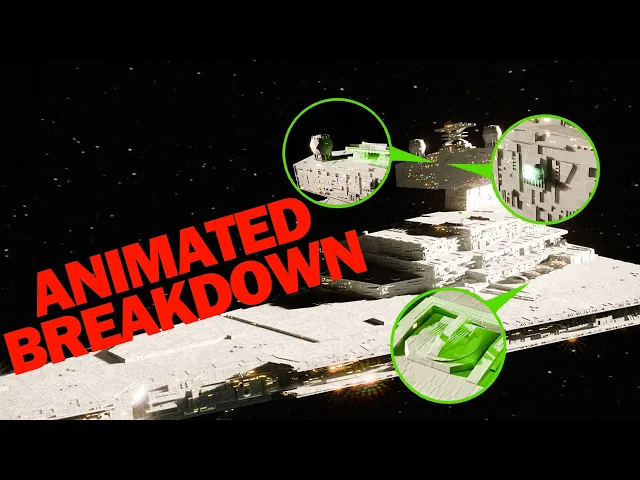
The Star Destroyer's Evolution - Animated Breakdown and History
Wizards and Warriors
0:00 Few things symbolized the might of the Galactic
0:07 Empire during its reign and struck fear into the hearts of the Star Wars
0:18 Galaxy’s inhabitants quite like the Imperial Star Destroyer.
0:21 This versatile and imposing vessel represented the peak of galactic engineering,
0:26 and a return to a style of massive capital
0:29 ship typically not seen for over a thousand years.
0:32 In today’s video, we’ll discuss the historical forces which
0:35 influenced the development of the Star Destroyer, its predecessors,
0:39 the way it fit into Imperial doctrine, and finally,
0:42 the way it fell out of favour- especially in the Star Wars Legends timeline.
2:02 While records of the earliest service dates of the Imperial-class
2:05 Star Destroyer are sometimes conflicting- no doubt because
2:08 of misinformation spread throughout the historical record by Imperial
2:12 agents- it was certainly a product of the Clone Wars.
2:16 This massive conflict saw rapid innovation in all forms of technology,
2:20 but especially in capital ships.
2:23 A millennium before the war’s outbreak in 22BBY,
2:26 the final war between the Sith and Republic,
2:29 called the New Sith Wars, concluded at Ruusan.
2:32 This was followed by the Ruusan Reformation,
2:35 presided over by Supreme Chancellor Tarsus Valorum,
2:38 an ancestor of Palpatine’s predecessor Finis Valorum in that same position.
2:43 These reforms effectively stripped the Republic of any active military,
2:47 leaving only a token Judicial force.
2:50 Planets were allowed to maintain their own defensive fleets,
2:53 but there were significant restrictions on size and power.
2:57 While ships hundreds of meters or even
2:59 a kilometre long were not even particularly rare before,
3:02 they were now generally outlawed.
3:04 Shipbuilders in some systems sometimes skirted these restrictions,
3:09 constructing massive battlecruisers,
3:11 but these were legally limited in both hyperdrive grade and armament,
3:16 and existed more as vanity projects and large
3:19 hunks of flying durasteel waiting for the opportunity
3:22 to be refit into something more practical
3:25 if a conflict arose than as true warships.
3:28 So, when the Clone Wars broke out,
3:30 both sides approached the challenge of building the first military
3:33 the galaxy had seen in a millennium in different ways.
3:37 The Separatists relied at first on refitting ships formerly used
3:41 as either cargo haulers or to protect their merchant fleets.
3:44 The Republic pulled together whatever Judicial
3:47 and planetary defense fleets they could,
3:49 but they also relied on a new fleet of larger,
3:53 more powerful capital ships built in secret.
3:55 At the outbreak of the war,
3:57 the Acclamator-class Assault Ship was the main new vessel of this type,
4:01 measuring 752 meters long and serving
4:04 in various configurations as troop transports,
4:06 fighter carriers, or direct combat ships.
4:09 As the war progressed, various other vessels in a similar,
4:13 now quite familiar wedge shape would follow the Acclamator,
4:16 and the Republic’s shipbuilding efforts came
4:19 largely from two competing shipbuilding concerns-
4:21 the ancient and well-respected Rendili StarDrive
4:24 and the younger but ambitious Kuat Drive Yards.
4:28 The competition between these two shipwrights was made all the more personal
4:32 by the identities of their star designers-
4:34 a father-daughter pair named Walex and Lira Blissex.
4:38 Walex was already an established ship designer by the time of the Clone Wars,
4:43 having designed the Delta-7 Aetherspite for the Jedi Order.
4:46 Lira had grown up under her father’s tutelage,
4:49 assisting him because he was unable to use a computer.
4:53 Each contributed their own personal design to the Republic’s war effort,
4:57 meeting the need for larger,
4:58 more powerful ships of the line within the Republic in their own way.
5:03 Lira, who moved out from her father’s shadow by working for Kuat Drive Yards,
5:07 designed the Venator-class Star Destroyer,
5:09 an 1137 meter ship which mixed significant fighter carrying capacity- having
5:15 a fighter complement numbering in the hundreds- with a powerful armament.
5:20 This included 8 powerful DBY-827 Dual Turbolaser turrets as the keystone,
5:25 along with dozens of smaller laser cannons,
5:28 four proton torpedo tubes, and a pair of lower-grade turbolasers.
5:32 Walex’s design, made under the rapidly-fading banner of Rendili StarDrives,
5:37 resembled the future Imperial-class far more closely.
5:40 This was the Victory-class Star Destroyer,
5:42 made as part of the Victor Initiative Project, a name which more closely matched
5:47 the convention used for the Venator and Acclamator.
5:50 The Victory, which measured in at 900 meters in length,
5:54 typically carried only two starfighter squadrons compared
5:56 to the Venator’s much more sizable complement,
5:59 and instead focused on anti-ship weaponry.
6:02 The Victory was introduced with a loadout consisting
6:05 of 10 Quad and 40 Double turbolaser batteries,
6:09 along with twenty assault concussion missile tubes.
6:12 A later model, the Victory Mk II,
6:14 would swap the concussion missiles for ion cannons
6:17 and upgrade the turbolasers to a higher calibre.
6:20 Walex’s design would see much more limited use during the Clone Wars,
6:25 although it became far more popular under the Empire.
6:28 We can posit a few reasons for this.
6:31 Militarily, the Clone Wars were a conflict which
6:33 relied heavily on snubfighters and bombers for both sides.
6:37 While the Victory was effective at battling other capital ships,
6:40 it had limited defenses against fightercraft,
6:42 on top of its own lack of a significant fighter complement.
6:46 The Venator, conversely, had ample fighters of its own,
6:50 along with point defence lasers able
6:52 to protect it from incoming bombers and munitions,
6:55 even if it was otherwise less capable in ship-to-ship combat, ton for ton.
7:00 Politically, Kuat Drive Yards was also generally becoming more favoured,
7:04 which gave yet another edge to the Venator.
7:07 Towards the end of the Clone Wars, Lira wanted to build on her father’s design
7:12 and produce a new ship for the Republic,
7:14 and thus was born the Imperator-class Star Destroyer,
7:17 which would come to be known
7:19 as the Imperial-class after the declaration of the Empire.
7:22 This design removed the maneuvering wings of the Victory-class
7:25 and scaled it up to 1600 meters.
7:28 Its hangar space exceeded that of the Venator, although, as we’ll discuss later,
7:33 under the Empire, this was traditionally
7:35 used to carry assets beyond just fighters.
7:37 Like the Venator and the Victory,
7:39 the heaviest cannons aboard the ship were in two rows of four,
7:44 lining the ship’s superstructure.
7:45 In initial runs, this included 6 double-barreled heavy turbolaser turrets,
7:50 with the aftmost turret on each side being a heavy dual ion cannon.
7:55 The ship additionally boasted 60 Borstel NK-7 ion cannons,
7:59 60 Taim& Bak XX-9 turbolaser cannons and 40 laser cannons.
8:04 Although it was introduced late into the conflict,
8:06 it had already begun to supplant the Venator by the war’s end,
8:10 at least on production lines if not on the battlefield quite yet.
8:14 The first ship of the class to enter service was the Executrix,
8:18 which participated in the Imperial subjugation of Kashyyyk.
8:21 The second was the Exactor, which would go on to serve as Sith Lord Darth
8:26 Vader’s personal flagship in the early days of the Empire.
8:30 Over its service history,
8:31 the Imperial-class would see multiple different configurations emerge.
8:35 The earliest of these was the Tector-class,
8:38 which was designed and built alongside the earliest
8:41 models of the Imperators during the clone wars.
8:44 This configuration removed hangar space in favour of additional armour plating,
8:48 allowing the prominent reactor bulb on the ventral side of the ship to be
8:52 more safely tucked away than the attractive
8:55 target it typically presented on the Imperial.
8:57 This typically came along with a different weapon configuration, as well.
9:01 As the Clone Wars ended, and the Republic turned into the Empire,
9:05 the Imperial Star Destroyer became an ever
9:08 more common sight within the Imperial Navy.
9:10 Lira continued to loyally serve the Empire
9:13 in the creation and improvement of warship designs,
9:16 while Walex Blissex opposed the New Order, and would go on to join the Rebellion
9:21 in trying to destroy his daughter’s- and his own- creations.
9:25 But Lira had long since divorced her fate from her father’s
9:28 and had become a rising star within the Empire in her own right.
9:32 Before the end of the Clone Wars, she had married Denn Wessex,
9:36 commander of the Venator Star Destroyer Redoubt,
9:39 who then became the Grand Moff of the Relgim Oversector.
9:42 The Imperial-class became the perfect tool
9:45 to carry out Imperial oppression throughout the galaxy.
9:48 While it technically could out-carry the Venator in raw numbers of fighters,
9:52 even during the height of the Rebellion,
9:54 there was not the same emphasis on regular,
9:57 pitched battles which were seen during the Clone Wars.
9:59 Instead, much of the hangar and cargo
10:02 space was dedicated to increased supplies for longer,
10:05 solo deployments, along with troops and materials to establish
10:08 and supply Imperial bases on a planet’s surface.
10:12 Most Star Destroyers carried an IM-455 modular garrison base for this purpose,
10:17 along with nearly 10,000 soldiers and dozens of walkers.
10:21 This typically left only 6 squadrons of starfighters,
10:24 along with a wide array of troop transports and shuttles.
10:28 All of this was on top of the nearly-37,000
10:31 crew required to fully staff the Star Destroyer itself.
10:35 A fully-loaded Star Destroyer could, depending on the mission profile,
10:39 operate completely independently for up to 6 years.
10:42 As the Empire worked to expand its reach throughout the galaxy,
10:46 both in systems which had been members of the Old Republic and in new frontiers,
10:50 a single Star Destroyer was often enough to keep the local systems in line.
10:55 It’s estimated that at the Empire’s peak,
10:59 over 25,000 Star Destroyers were in service.
11:02 As important as its direct combat capabilities were
11:05 the Star Destroyer’s ability to prevent combat from arising,
11:09 as part of what was called the Tarkin Doctrine,
11:12 also known by its detractors as the Doctrine of Fear.
11:16 This doctrine relied on the “widespread deployment
11:18 of a heavily armed military” to dissuade invasion,
11:21 enslavement, or, most tellingly, the fomenting of political dissent.
11:25 The purpose of this wide deployment of Star Destroyers, then,
11:29 was to give each system a symbol of the Emperor’s
11:32 power and to prevent a rebellion before it could even start,
11:36 while holding enough firepower to bring down most
11:39 local armed resistance if or when it arose.
11:42 The Star Destroyer was incredibly effective in this context,
11:45 but it was also not without its own weaknesses.
11:48 A special operations commando once quipped
11:51 to smuggler kingpin Talon Karrde that the Imperial
11:55 Star Destroyers were nothing more than
11:57 174,000 design flaws waiting to be exploited.
12:00 One commonly cited example of this was
12:03 the exposed command bridge atop the ship’s main superstructure.
12:07 Additionally, while the wedge shape theoretically allowed
12:10 more weapons to focus on a single target,
12:12 it required the ship to pitch forward somewhat to accomplish this in practice.
12:16 Luckily for the Empire, for much of the conflict,
12:20 these weaknesses were purely academic,
12:22 as it was rare that a Star Destroyer would need to go
12:25 toe-to-toe with a similarly powered ship during most of the Galactic Civil War.
12:30 Lira’s conversion of her father’s Victory-class design
12:33 into the larger Star Destroyer also omitted crucial information,
12:36 leading to design flaws that made the ships more expensive than
12:40 necessary and that Lira feared might one day doom the entire project.
12:44 At the height of the Rebellion,
12:46 Lira and her husband even attempted to lure Walex into an Imperial
12:50 trap to force him to work alongside her and rectify these issues.
12:54 Unfortunately for her, this attempt failed.
12:57 Certain flaws in the ship were addressed in subsequent iterations.
13:01 The original Imperial-class started to be replaced shortly
13:04 before the Battle of Yavin by the Mark II.
13:08 The first of these was called
13:10 Empire and focused primarily on improved shielding.
13:12 The biggest hallmarks of the standard Imperial-II, however,
13:16 involved the vertical conning tower of the Imperial-I being laid on its side,
13:20 and the replacement of the main guns alongside the superstructure.
13:24 The heavy dual cannons were replaced
13:27 by two batteries of four octuple barbette turbolasers,
13:30 and much of the ship’s ion cannon
13:32 loadout was typically replaced with additional turbolasers.
13:35 One early example of this updated class, Avenger,
13:38 was even used by Moff Kalast in support of Rebel forces,
13:43 before Darth Vader successfully trapped
13:44 the traitorous Moff with an Interdictor Cruiser.
13:47 He returned the ship to Imperial service under Captain Lorth Needa,
13:51 within Vader’s own notorious Death Squadron.
13:54 Point defence laser cannons were also typically removed from this iteration,
13:59 leaving the ship more vulnerable to starfighter attacks.
14:02 This proved to be a growing issue for the Empire after Yavin.
14:06 The Death Star was notoriously destroyed
14:08 by snubfighters approaching critical systems by taking
14:11 refuge in one of the many trenches running along the station’s surface,
14:15 but similar trenches could also be found on Star Destroyers,
14:19 allowing for similar tactics to succeed
14:22 in damaging these fearsome capital ships.
14:24 This gave rise to a pandemic known as Trench Run Disease.
14:28 One Rebel fighter commander, Horton Salm,
14:31 noted that “ImpStar Deuces” as the mark two became colloquially known,
14:35 were particularly vulnerable to this disease without
14:38 their own fighters to cover vulnerable areas.
14:41 Another Rebel commander, Edge Antilles,
14:43 noted that the actual success rate was relatively low,
14:46 but damaging a Star Destroyer at all was a rare thing in general,
14:50 and the tactic was successfully deployed at least a few times,
14:53 not just against smaller Imperial Star Destroyers,
14:56 but against much larger Super Star Destroyers.
14:59 The Empire tried to introduce other means to combat this weakness-
15:03 the Lancer-class Frigate was developed
15:05 as an anti-fighter escort for Star Destroyers,
15:08 but it was never able to be produced
15:11 and deployed in significant numbers before the Battle of Endor.
15:14 Other attempts to introduce higher-quality fighters,
15:16 like the TIE Defender, saw similarly limited deployment.
15:20 Ultimately though, the fall of the Empire was not because
15:23 the Empire’s fleet of Star Destroyers was defeated in direct combat,
15:27 so it’s inaccurate to pin their defeat on any
15:30 single failure in military design or fleet deployment.
15:34 Once Emperor Palpatine was killed at Endor, the majority of Star Destroyers,
15:38 spread out as they were throughout the galaxy,
15:41 began falling prey not to the Rebellion,
15:43 on its way to forming the New Republic, but to each other.
15:47 Initially, the Rebellion and New Republic relied on their own smaller
15:51 capital ships and Mon Calamari Cruisers to fill out their fleets,
15:54 but over time, they managed to capture many of the Star
15:58 Destroyers which had formerly been in the Empire’s service.
16:01 Ships like Accuser and Adjudicator were captured and integrated
16:04 into the New Republic Defense Fleet and rechristened Emancipator and Liberator,
16:09 participating in the destruction of their former masters.
16:12 Many other ships joined not through capture but through willing defection.
16:18 While these ships remained in service for decades within the flagging Empire,
16:22 desperate to retain any symbol of their former glory,
16:25 the days of these all-in-one vessels built
16:27 for long deployments were coming to an end.
16:30 As the New Republic began to design
16:32 their own purpose-built fleet for the galaxy’s defense,
16:35 it found itself in need of a very different type of ship.
16:39 System defense was certainly important,
16:40 but where the Empire had needed a constant reminder of its power
16:44 to keep systems in line which could
16:47 operate without the support of allied facilities,
16:49 the New Republic was held together by mutual agreement,
16:52 and so a permanent, independent deployment was rarely necessary.
16:56 The development of these new ships was repeatedly
16:59 delayed by crises caused by re-emerging Imperial leaders,
17:02 such as Thrawn and the Clone of Emperor Palpatine,
17:06 but the result was the New Class Modernization Program.
17:09 The crown jewel in this program, which introduced several new classes of ships
17:14 designed by the Republic Engineering Corporation,
17:17 was the Nebula-class Star Destroyer.
17:19 This so-called “pocket” Star Destroyer was
17:22 significantly shorter than the Imperial class,
17:25 at 1040 meters compared to the ISD’s 1600,
17:30 with a proportionally smaller beam length,
17:32 and a far less prominent superstructure.
17:34 This made it even somewhat smaller than the Venator-class of the Clone Wars.
17:39 Despite its smaller size,
17:40 it was able to bring nearly as much individual power to bear.
17:44 It was equipped with 80 heavy turbolaser batteries, 20 Ion Cannons,
17:48 8 concussion missile launchers, and still managed to carry 60 starfighters,
17:53 only one squadron short of the Imperial-class’s
17:56 standard complement under the Empire,
17:58 given that the Empire had dedicated so much
18:00 carrying capacity to supplies needed for long deployments.
18:03 These fighters were typically the new E and K wings,
18:07 and were individually higher quality than Imperial fighters.
18:11 This also allowed for a significantly reduced crew, closer to 7000,
18:16 a far cry from the 37,000-plus
18:18 ground support typically carried under the Empire.
18:22 The New Class saw limited deployment, given its introduction shortly before
18:26 the Empire and New Republic declared peace,
18:28 and there were certainly weaknesses within its own design philosophy.
18:32 The Imperial-class would remain in service for both
18:35 the New Republic and Empire for several decades,
18:38 but that was more out of convenience, given the sheer amount of them,
18:42 than a belief that they were the optimal design for the day.
18:46 Some new variations would still emerge, like the Anakin Solo in 40 ABY,
18:50 which equipped a classic Star Destroyer hull with new,
18:53 long-range turbo laser technology.
18:55 But the era of the Imperial Star Destroyer’s supremacy was at an end.
19:00 Thank you for joining us on Wizards and Warriors
19:03 for this exploration of the Imperial Star Destroyer.
19:05 Please consider liking, subscribing,
19:07 and clicking the bell to be notified for future video releases.
19:11 These videos would also be impossible without the support
19:14 of our patrons and channel members here on Youtube.
19:17 You can follow the links in the description
19:19 to join them and get early access to videos,
19:22 our Discord, a release schedule and other benefits.