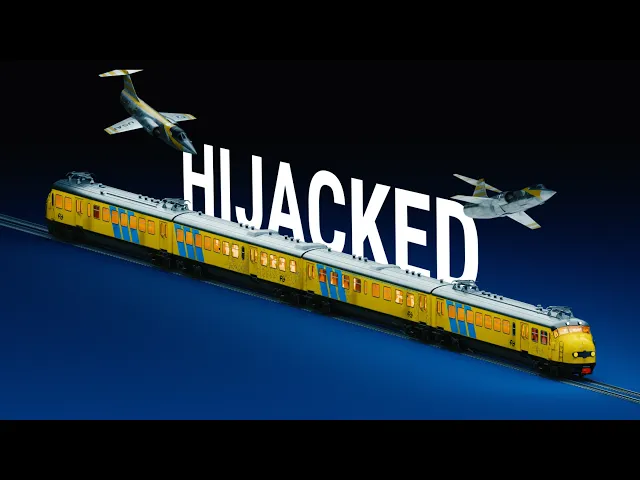
When Dutch Marines Made a Massacre
The Present Past
0:02 It's the 23rd of May 1977 at seven past nine in the morning.
0:07 Max Papilaya pulls on the emergency break of the train from Assen to Groningen.
0:12 The train screeches to a halt.
0:15 Max and eight friends tell the passengers, 'This is a hijacking.' At the same
0:20 time four youths walk into an elementary school.
0:23 They take 105 children and their teachers hostage.
0:27 The longest hijacking in history has begun.
0:31 482 hours later Dutch Marines set out to free the hostages.
0:37 Four tanks rush towards the school and six
0:41 fighter jets roar through the skies towards the train.
0:45 The attempt to end the hijacking turns into the bloodiest
0:49 action in the Netherlands since the second world war.
0:52 'Is this one dead?' 'Yes, now he is!' And it leads to one
0:57 of the biggest government cover-ups in Dutch history.
1:01 'It remains in execution.' How did we get here?
1:08 The train has stopped on a bend in the tracks close to the village De Punt.
1:15 The hijackers are of South Moluccan descent, a minority in the Netherlands.
1:20 They quickly release a few hostages,
1:22 mainly older people and those that are not ethnically Dutch.
1:25 In their eyes the remaining hostages are guilty
1:28 of supporting the Dutch government in a big injustice.
1:31 But the train is less important now.
1:33 The eyes of the nation are on the school hijacking.
1:37 The Dutch Secretary of Justice reflects this sentiment.
1:40 'It's horrible that they went so far as to involve a school with children
1:44 in it.' Two hostage situations on the same day is not a coincidence.
1:48 These attacks have been months in the planning.
1:50 The leader of the group is 25 year old Max Papilaya.
1:53 In his daily life he is not in the business of taking hostages.
1:57 He works as a civil servant.
1:59 He is active in a Moluccan Christian youth club.
2:02 And he is frustrated with the government of the Netherlands.
2:05 There is also a girl in the group, Hansina Uktolseja.
2:08 This morning she left a letter to her parents.
2:12 'Daddy and mommy, if you find this letter I
2:15 am no longer at home but with my friends.
2:18 I am a South Moluccan and a Christian and I am not afraid to die.
2:22 If I get shot that's okay because it will not have been in vain.
2:26 It will be for a purpose that is not
2:29 meaningless.' Hansina has no history of political extremism either.
2:32 She is a dental assistant.
2:34 But she has a secret relationship with Marcus Rudi Lumalessil, another hijacker.
2:38 In this way she can be close to him.
2:41 The hijackers share a list of demands.
2:44 They want the release of 21 Moluccan prisoners,
2:46 a bus to the airport and a flight to a destination of their choice.
2:50 If the government does not accept within 48 hours
2:53 they will throw a hand grenade in between the children.
2:57 The deadline is set for Wednesday, 2 pm.
3:02 Growing up I didn't know much about
3:06 the South Moluccan minority in the Netherlands.
3:09 But in the 1970s the papers were filled with reports of attacks,
3:14 hijacking and hostage situations by people from this community.
3:18 I wanted to understand this story, so I spent months researching,
3:22 I visited locations and I animated how this hijacking happened.
3:30 430 years ago, four Dutch ships set sail in search of spice, their destination?
3:43 Indonesia.
3:44 They came to trade but soon wanted control.
3:47 The main post turned into a thirst for territory.
3:50 To conquer all the islands of Indonesia the Dutch needed clerks,
3:54 nurses and soldiers.
3:55 They found many of them in this area, the Moluccas.
3:59 In a sea of Muslim subjects, here the Dutch found islands of Christianity.
4:03 Many joined the Royal Dutch Indies Army.
4:06 Other groups don't always like that, they
4:09 are sometimes called Belanda Hitam, Black Dutch.
4:13 The relationship between the Dutch and the Moluccas would not be good forever.
4:23 The Dutch government establishes a crisis center to manage the situation.
4:28 Specialized police and military units,
4:30 including the newly founded anti-terror unit
4:33 ‘Bijzondere Bijstandseenheid’’ are deployed to the scene.
4:35 By now there is a phone line to the train,
4:37 so negotiators can talk to the hijackers.
4:39 They demand food and supplies, a trolley is brought to the train,
4:43 a journey that will be made 51 more times.
4:46 The hijackers want to show they are serious.
4:49 To put pressure on the government they place
4:51 two hostages outside of the train at gunpoint.
4:54 One of them is 23 year old Rosemarie Oostveen.
4:57 I fought back fiercely saying that I didn't want to die
5:00 because they didn't stand for something I was willing to die for.
5:04 In response they told me it wasn't their intention to kill me.
5:08 But this is information the outside world does not have.
5:11 And the Moluccas try to put the government under pressure in other ways.
5:14 At the school they ask the kids to recite some words.
5:17 Words aimed at the secretary of justice.
5:20 The children hang out of the windows and chant.
5:31 This almost makes worried parents break
5:33 the barricades to free their kids themselves.
5:35 Then there is a mismatch between communication
5:39 to the outside and what actually happens inside.
5:44 One hundred nine days after the death of Germany's
5:53 famous failed art student Indonesia declared independence from the Netherlands.
5:59 The Dutch went to war to defeat
6:01 the rebels and many Moluccans fought on their side.
6:06 After four years the Dutch finally let go of their colony.
6:15 The peace treaty, Indonesia's leader agreed to a united state
6:19 of Indonesia with relative freedom for places like the Moluccas.
6:23 But within a year the Indonesian leader betrayed
6:26 the agreement and proclaims a nation state instead.
6:30 The South Moluccas declare independence but Indonesia invades them.
6:35 Many Moluccan soldiers of the Royal Dutch Army are in barracks across Indonesia.
6:39 They want to go home and fight.
6:42 But Indonesia doesn't want trained soldiers joining the resistance.
6:46 So where should the soldiers go?
6:48 The Dutch want to stay friendly with the new Indonesian state.
6:51 So they pressure the Moluccas and take
6:55 them and their families to the Netherlands.
7:06 But temporary will not be the reality of their stay.
7:12 It's the day of the ultimatum.
7:15 The situation is tense.
7:17 The government has decided that if two hostages are
7:20 executed the BBE will storm the train in the school,
7:23 without proper planning it is a big risk.
7:25 The main strategy of the government is to wear the hostage takers out.
7:29 To stop the ultimatum they say they are willing
7:32 to talk about the demands of giving a free passage.
7:35 The children always had absolute priority so
7:38 we said we are willing to discuss granting
7:40 safe passage which is at least for a lawyer
7:43 something different from actually offering safe passage.
7:46 To keep it to talking about free passage
7:49 instead of granting it the government complicates every step.
7:52 They say they can give the hijackers a plane
7:55 but they just need to know the destination.
7:57 And if the hijackers share a destination they will
8:00 contact the country to make sure it's not possible.
8:03 On the side of the hijackers Max is in charge.
8:06 He refuses to share where they want to go.
8:10 He has reasons not to trust the Dutch government.
8:15 Max Papilay was born in a camp in the Netherlands.
8:20 I'm at Schattenberg.
8:21 This is one of the places where the Moluccans
8:23 were housed after they were sent to the Netherlands.
8:26 But it wasn't always called that.
8:28 In the second world war it was called Westerbork.
8:31 And this was the place where all the Dutch Jews
8:34 were allocated before they were sent to their final destination.
8:46 My mother told me that there were many fairy tales
8:55 about what was not in the barracks in terms of spirits.
8:56 Vita Pical is of Moluccan descent.
8:58 She remembers where her grandmother lived.
9:02 Now they know what happened.
9:04 It's not strange.
9:05 Moluccans are settled here and in barracks all over the Netherlands.
9:08 They are cut off from the society.
9:10 They are not allowed to work.
9:12 They receive food stamps.
9:13 All because their stay was supposed to be temporary.
9:16 But for Max's generation the worst thing is what happened to their fathers.
9:20 The moment they set foot on Dutch soil they are fired from the army.
9:26 They fought for the Dutch flag.
9:31 And then they came here.
9:36 They had no soldiers left.
9:40 Nothing at all.
9:40 And they had to wait.
9:40 And that took years.
9:41 The next morning is off at the school.
9:42 One of the children gets sick.
9:44 She has to vomit and falls ill.
9:46 The hijackers discuss with the government and release her.
9:49 But that night suddenly more and more children fade and have to throw up.
9:53 The hijackers talk to a doctor who thinks it could be something very serious.
9:58 During a long discussion in the middle
10:00 of the night the Dutch negotiator promises
10:02 the hijackers that the government will grant
10:04 them free passage out of the country.
10:06 They just have to release the children.
10:08 The next morning the children go free.
10:11 Only the four teachers remain.
10:13 But the government is not willing to keep its promise.
10:16 The hijackers feel they have been played.
10:19 They hope the train will now make the difference.
10:22 Max sees the generation of his parents hurting.
10:25 They want to go back to the Moluccas.
10:28 But they can't.
10:29 The parents go on peaceful protests.
10:32 They want the Dutch government to pressure
10:36 the Indonesians to establish an independent Moluccan republic.
10:39 But after 350 years of colonial relations,
10:42 the Dutch don't want to pass critique on the new Indonesian government.
10:46 They want to keep relations positive
10:48 and have big business interests in the country.
10:50 They have no intention of fighting for the Moluccan ideal.
10:55 Don't the Moluccans see their cause is hopeless?
11:05 At the train the negotiations aren't as still made.
11:09 The government still wants to hear what their hijackers plan on going.
11:13 And the hijackers don't want to share it.
11:16 In the train a certain routine starts to emerge.
11:19 A certain rhythm developed in the train.
11:21 Some people did morning gymnastics.
11:22 There was more and more card playing.
11:25 Games were played and chess boards appeared.
11:27 Certain people asked to take on specific tasks.
11:30 Cleaning up new waste,
11:32 tidying up the place or removing the waste from under the train.
11:36 You could see the instinct for survival in people.
11:39 And in my perception people also became rather selfish.
11:42 When cigarettes were brought in people struggled to share them.
11:45 The focus was very much on the inner world of the train.
11:48 Not so much on the outside world.
11:51 "...In the outside world the government is getting frustrated.
11:54 If there is no progress with the negotiations they
11:57 need to think of other ways to end this.
11:59 Earlier Moluccan actions have resulted in violence.
12:04 In 1975 the small village of Wijster becomes world news.
12:09 Moluccan youths hijack a train.
12:11 Yes, there was another train hijacking.
12:14 One and a half years before De Punt.
12:17 But these hijackers immediately start killing hostages.
12:20 In the end three people die.
12:23 How did this happen?
12:25 Almost ten years before, Christiaan Soumokil,
12:28 the president of the Moluccan Republic
12:30 was executed by the Indonesian government.
12:32 His death makes young Moluccans in the Netherlands extremely angry.
12:36 All those peaceful protests their parents had dragged them
12:39 to did nothing to bring a free Moluccas closer.
12:42 So to show the world this injustice they start violent actions.
12:46 They even make plans to take the Dutch Queen hostage.
12:50 But hijacking a train, well, that will make the headlines.
12:53 The hijackers demand the release of political prisoners
12:56 and a flight to a country of their choice.
12:58 They are inspired by a Japanese militant group that took
13:01 the French ambassador hostage and got a flight out of the country.
13:06 In the French embassy those Japanese had also been granted safe passage.
13:10 We assumed that the Dutch government would never abandon the hostages
13:13 to their fate and that they would give in after a few hours.
13:16 But with the Japanese the government only granted
13:19 free passage because a foreign ambassador was at risk.
13:22 When the hijackers then start executing hostages
13:25 the secretary of justice is sure of one thing.
13:29 They try to send important persons from the Moluccan community to negotiate.
13:35 One of them is Josina Soumokil,
13:38 the wife of the legendary resistance fighter Kristian Soumokil.
13:41 She is seen as the mother of all Moluccans.
13:45 Josina tells the hijackers that they are
13:47 endangering people on the Moluccas with their actions.
13:50 With this she convinces them to surrender.
13:52 It must mean that she wasn't just making that up.
13:55 And we absolutely did not want people
13:58 in the Moluccas to face problems because of our actions.
14:02 This train hijacking lasted 12 days.
14:05 It was ended by Josina's intervention.
14:07 But her part in the next hijacking will have a completely different effect.
14:12 With the negotiations in that log Josina Soumokil
14:17 is once again asked to negotiate with the hijackers.
14:21 But after her role two years ago
14:23 she has been criticized by the Moluccan community.
14:25 Did she sell out the boys to the Dutch government?
14:28 When the hijackers ask her to help them she doesn't hesitate.
14:31 They tell her what they kept hidden from the government.
14:34 Where they want to go.
14:36 They have three destinations they think might take them in.
14:39 Vietnam, Yemen and Benin.
14:41 They need her to get in contact
14:43 with friends so they can contact these countries.
14:45 She does not tell anyone from the government about this plan.
14:49 The Moluccans learn from the first hijacking
14:51 that executing hostages will get them nowhere.
14:54 They have no intention of using violence.
14:56 But the Dutch government doesn't know that.
14:58 They are losing faith in a peaceful solution.
15:01 And they are also worried about the BBE.
15:03 The well-being of the hostages was of course the priority.
15:07 But our fatigue also played a role.
15:09 We were dealing with two targets simultaneously.
15:11 The train and the school.
15:12 And that was quite a lot.
15:14 People were getting tired,
15:15 had been away from home for so long and were starting to show signs
15:19 of 'this is enough for us.' You need
15:21 well rested individuals to carry out such an operation.
15:25 The BBE operatives couldn't simply be replaced.
15:27 They had a distinctly different training compared to other marines.
15:30 So on the 7th of June the government asks the marines to work
15:35 on a plan to free the hijackers from the train by force.
15:40 Josina Soumokil comes back to the train.
15:43 She has a message for the hijackers.
15:46 Hold on, Benin will receive all of you.
15:49 The 21 detained boys agree.
15:52 Request free exodus, an airplane and no prosecution.
15:57 Burn this letter.
15:59 The hijackers finally get the news they wanted.
16:01 It's amazing.
16:02 They have an opportunity to go to another country.
16:05 They just have to sit tight and stick to their demands.
16:08 Mentally, they dig in.
16:10 The reality is, Benin has no place to take them in.
16:13 It is unclear where the information on leave will come from.
16:17 For the Dutch government, this is totally out of the question.
16:20 They have no intention of letting the hijackers leave the country.
16:24 And by now, the marines have made a plan.
16:33 The marines have gathered information by monitoring
16:35 the train with infrared and heat cameras.
16:36 Buggd provision creates and talking to freed hostages.
16:40 Based on this information,
16:41 they believe the hostages are separated into two compartments,
16:44 one for men and one for women.
16:46 They think hijackers are in the front,
16:48 on the balconies between the compartments and in the back of the train.
16:52 The aim of the plan is to storm the train
16:55 and to prevent the hijackers from reaching the hostages.
16:57 But the information they have will prove to be incorrect.
17:01 The plan has two parts.
17:02 The first part is outside the train.
17:04 Three groups of snipers will shoot at the parts
17:07 of the train the hijackers need to take to reach the hostages.
17:10 And crucially, they will also shoot
17:12 at the place the marines think the hijackers sleep.
17:15 Group Lima 1 will attack the train from the east.
17:18 Kilo 2 will shoot from the north.
17:20 And Lima 2 will shoot at the legs of any fleeing hijackers.
17:24 During the shooting, six fighter jets will fly over the train
17:27 with their afterburners open to disorient the hijackers.
17:30 At the same time, a team of frogmen will simulate
17:33 the fighters dropping bombs by detonating explosives next to the train.
17:37 At the last moment, four machine gunners are added to the sniper groups.
17:41 The groups are armed with 9,960 rounds of ammunition.
17:44 The second part of the attack is the approach by marines.
17:49 Five attack groups will approach the train.
17:51 They will use wooden frames fitted
17:54 with an explosive charge to blast the train doors.
17:57 Some marines are armed with revolvers, others with UZIs.
18:00 The marines in the front part of the train expect the most resistance.
18:05 They are allowed to put their UZIs to automatic fire.
18:08 The rest have to keep them to single shot.
18:11 The revolvers are loaded with hollow point ammunition.
18:14 In contrast to normal rounds that pass through a body,
18:17 hollow point expands in the body.
18:22 This makes it way more deadly.
18:26 For this reason, it has been banned in international warfare since 1899.
18:33 But there is no ban for domestic use.
18:36 The marines want ammunition because they will be able
18:39 to shoot hijackers without the bullets then hitting other hostages.
18:42 The marines also receive instructions of what
18:44 kind of violence they are allowed to use.
18:46 Once inside the train,
18:47 the most important guideline for the marines is that they are not
18:51 allowed to fire on hijackers that surrender in a clearly observable manner.
18:56 The purpose of the attack was to immediately free the hostages and arrest
19:01 the hijackers Our constitutional state is still set up to arrest suspects.
19:06 This said, in discussion about the attack,
19:08 the government accepts that every hijacker could die.
19:11 This does not mean the decision is taken lightly.
19:14 Especially the prime minister, Joop Den Uyl, is against the attack.
19:19 Joop Den Uyl wanted to negotiate.
19:21 Well, I sometimes said, until kingdom come.
19:23 He thought the risks were too great.
19:26 That was a dramatic discussion.
19:27 Joop Den Uyl was in tears.
19:30 He saw the possibility of terrible things.
19:33 After a long discussion, the five ministers take a vote.
19:37 Two are against.
19:38 Three in favour.
19:40 The attack is set in motion.
19:43 The attack is planned to start at 4.45.
19:49 At 3am, five groups of marines start their approach to the train.
19:56 They have to cross a river.
19:58 An hour later, they are in position.
20:00 At this time, the code word to initiate the attack is given.
20:05 Mercedes.
20:05 At 4.30, six starfighter jets take off from their base.
20:09 Six minutes later, sniper group Lima reports they are ready to fire.
20:14 But the radio of one sniper is not working.
20:18 Three minutes later, they report they are ready.
20:21 The attack is supposed to start,
20:23 but ground misses, obscuring the view of the train.
20:27 The attack is postponed.
20:28 Five minutes later, there is a last check if everything is normal in the train.
20:34 As the fighter jets can be heard in the distance, the attack commences.
20:46 It is 4.54.
20:49 Six fighter jets pass over the train multiple times.
20:59 Frogmen detonate explosions.
21:01 In the train, all hell breaks loose.
21:06 Rudi and Hansina were sleeping in the back of the train.
21:11 When the shooting starts, they move towards the hostages.
21:15 Hansina is hit and she is unable to continue.
21:18 Rudi tells her to pray.
21:19 He continues towards the compartment where the women are.
21:22 He later says he has one goal.
21:25 To shoot all passengers.
21:26 He reaches the women's compartment.
21:28 The plan to contain the hijackers has failed.
21:31 At the same time, the marines approach the train from the north.
21:34 As they come closer, they think they are fired at.
21:37 I saw a weapon coming out of that window.
21:39 A whole string came over my head.
21:41 I immediately stuffed the space where he was sitting.
21:44 After that, there was no more shooting.
21:46 Research has shown it was most likely ricocheted bullets from the snipers.
21:50 No window was opened.
21:51 No shell casing found inside the train.
21:54 It does make the marines more tense.
21:57 At 5.02, the marines are in their position.
22:00 They put the blast frames on the windows.
22:02 The sign is given to ignite.
22:04 For the group at position one, the blast frame does not work.
22:09 The marines break the window to enter.
22:12 They find no hijackers.
22:13 Group two is led by the commander Rinus.
22:16 For them, the blast frame works.
22:17 His group enters the train.
22:19 He encounters Hansina.
22:20 I stormed inside and immediately opened fire
22:23 in the direction of the corner opposite me.
22:26 When I entered, I didn't see Hansina lying there yet.
22:30 Then I saw Hansina.
22:31 She was lying half on the floor.
22:34 I recognized her.
22:35 We had received pictures of all the hijackers.
22:37 She was still alive at that moment.
22:40 She shook her head a little.
22:43 She shouted 'Mama!
22:44 Mama!' She was shot.
22:45 But someone who is shot and has a weapon himself can still shoot.
22:49 I then fired another burst at Hansina with my Uzi from close range.
22:55 Hansina was unarmed.
22:57 For the group going to balcony three, the blast frame doesn't seem to work.
23:03 When a marine expects it, it goes off anyway.
23:05 He is hit by wood splinters.
23:07 The other marines throw a flashbang and enter.
23:10 Marine Ruud goes to the first compartment and hears hijackers.
23:13 Things were being shouted that I couldn't understand.
23:16 Then I stopped for a moment to think.
23:19 Should I shoot them or not?
23:20 Then I thought to myself 'No, I won't do it.' One hijacker is shot,
23:25 but alive and lying on another hijacker.
23:28 In the next compartment they find a dead hijacker and arrest another.
23:31 At balcony four the blast frame works.
23:33 The marines are greeted with an unexpected sight.
23:36 They see a girl that was not supposed to be there.
23:39 Contrary to received intelligence, two girls,
23:41 Ansje Monsjou and Rosemarie Oostveen,
23:44 were sleeping in the balcony between the men's and the women's compartment.
23:47 Oostveen got hit in the leg.
23:49 She crawled to the men's compartment and another hostage helped her.
23:52 By that time, Monsjou was already dead.
23:54 The group continues on the train.
23:56 They see hijacker Rudi.
23:57 He has all the time to start a massacre.
24:00 But he does not go through with his first idea.
24:04 I couldn't muster the courage.
24:06 When he sees the marines, he fires and hits one marine in the arm.
24:10 The marines return fire.
24:11 They hit a hostage in the head.
24:13 In a chaos, one of the hostages has stood up and is moving forward.
24:17 He is killed by the fire of the marines.
24:19 Ruud grabs a hostage and aims his weapon at her.
24:22 The marines throw an attack grenade.
24:24 This explosion tears a hole in the ground and three hostages get injured.
24:27 Ruud's gun goes off accidentally and he hits the hostage.
24:31 The grenade makes him surrender.
24:33 The marines are able to take him in.
24:35 At balcony 5, the marines think they are being shot at.
24:38 They return fire.
24:39 When they enter the train, they shoot through the toilet doors.
24:42 They can't see in the first compartments.
24:44 They fire through the doors.
24:45 Two hijackers are behind this door and neither survive the attack.
24:49 At the last door, one marine says he sees movement.
24:53 He shoots through the door of the final
24:55 compartment and shoots the person inside.
24:57 The last hijacker is shot.
24:59 The operation is over.
25:01 The whole operation has taken just over 10 minutes.
25:06 The action of the marines, 180 seconds.
25:10 After 482 hours, the train hijacking is over.
25:14 At the same time, four armored personnel carriers rush to the school.
25:20 One ramps the facade.
25:22 All Moluccans surrender and are arrested.
25:24 The marines become heroes.
25:26 They risk their lives to free the hostages.
25:29 The hostages are reunited with their family members.
25:32 But it is not a happy end for everyone.
25:37 Rien van Baarel was a breadwinner of his family, Ans Monsjou,
25:42 who turned 20 inside the train, is killed by Dutch bullets.
25:46 The Molokan community mourns six dead.
25:49 When the relatives of the killed hijackers receive their bodies,
25:54 there is a surprise.
25:55 They receive their sons and daughter
25:57 in a closed casket with only a small window.
26:00 Historical research has shown this was a standard procedure at the time.
26:06 But when they hear they are not allowed to open the caskets,
26:10 this raises suspicion for the families.
26:12 And the action of the Dutch government after the end
26:15 of the hijacking makes it seem like they have something to hide.
26:18 and the action of the Dutch government after the end
26:19 of the hijacking makes it seem like they have something to hide.
26:21 The Moluccan families are not allowed to see
26:22 the autopsy reports of how the hijackers died.
26:24 Journalists are not allowed to see the broken train.
26:27 And when the surviving hijackers appear before court,
26:29 they are only given light sentences.
26:31 The government rushed the trial.
26:33 'To avoid awkward questions about the actions of the marines.' And then there
26:38 is the way the Secretary of Justice
26:40 informs the Dutch parliament about the action.
26:42 He says the shootings before the attack were not meant to kill the hijackers.
26:46 'We knew that there was a risk that the death
26:48 of some of them would be the consequence.' In reality,
26:51 the government had accepted the death of all hijackers.
26:53 On the actions of the marines, he says, inside the train,
26:57 'No shot was fired at a hijacker who did not resist
27:00 with a firearm.' This line of reasoning is repeated for more than three decades.
27:03 The problem is, it is not true.
27:06 It was only hijacker Rudi that was armed and attacked the marines.
27:10 In 2000, an interview with the old prime minister, recorded in 1987, is aired.
27:15 In it, he accepts the responsibility for the attack,
27:19 an attack he never wanted, because...
27:21 'It remains an execution of people breaking the law,
27:25 but it is an execution.' An execution?
27:29 Twelve years later, a Dutch journalist finds
27:31 the autopsy reports that were conducted after the fact.
27:33 These reports show facts that the government never shared.
27:36 The amount of bullet holes in the bodies.
27:38 And that two hijackers, Hansina and Max, have burn marks on their bodies.
27:44 These burn marks appear when weapons are
27:47 fired on or extremely close to the skin.
27:49 The journalist says the hijackers have been executed.
27:52 The government starts an investigation into what happened.
27:56 In a 179-page document, they put together all the information.
28:00 In the end, their conclusion was that the marines did not cross any lines.
28:05 The violence did not exceed the limit of what
28:08 was expected and accepted by the state, it says.
28:11 But there are still many questions.
28:13 With the new information,
28:14 family members of the hijackers sued the Dutch government in 2014.
28:17 After decades of uncertainty, they want the truth.
28:20 What really happened in the train?
28:22 Did the government give orders to kill the hijackers?
28:24 The main case they bring forward is the death of Hansina and Max.
28:28 Point of the prosecution is that the law
28:30 of war states it is forbidden to shoot wounded combatants.
28:33 Did they pose a threat to the marines?
28:37 Or were their deaths unnecessary?
28:39 During the trial, new information comes to light.
28:42 There is a report by the British
28:44 defence attache about the briefing before the attack.
28:46 Marines should fire on the legs of the hijackers.
28:49 But a high officer is supposed to have said...
28:53 'Remember, their legs go up to their necks.' Clearly, from all the evidence,
28:57 the marines were intended to kill all or as many
29:01 of the terrorists as possible to avoid problems in the courts afterwards.
29:05 The official line had been that the marines should apprehend the hijackers.
29:09 And the marines in the train and the government deny any order to kill.
29:14 After all, didn't many hijackers survive?
29:16 But multiple witnesses state that the commander of the Tecana
29:20 school found it morally reprehensible to execute the hijackers.
29:23 And it was clear the marines had different ideas about the approach.
29:26 The commander had said that it would be good if they were all shot.
29:31 Shot dead.
29:32 This statement was made when tensions were high.
29:35 Maybe it shouldn't be taken at face value.
29:38 But it does influence this marine that decided
29:40 not to shoot the hijackers he found.
29:42 That one will shoot in a certain situation and the other won't.
29:45 I think it has to do with the difference in character.
29:48 It's only my job to eliminate those people because they're dangerous.
29:52 But I have nothing against those Moluccans.
29:54 Not at all.
29:55 I'd rather have a beer with them.
29:57 This is not the view of the marine that encountered Hansina.
30:00 Eliminating the hijackers so that they can be
30:03 handed over to justice, I don't do that.
30:05 You can't attack like that.
30:07 You can't say in advance,
30:08 'Let them try to hit them in the legs.' That's pure nonsense.
30:12 It goes so fast.
30:14 It's about the action-reaction moment.
30:15 If you're not satisfied with what you see in front of you, you shoot again.
30:20 You can't think first.
30:21 Then I stopped for a moment to think.
30:24 Should I shoot them or not?
30:26 Then I thought to myself, 'No, I won't do it.' You can't think first.
30:31 That's not how it works.
30:33 The marines are brought in for questioning.
30:36 The marine that attacked Hansina said he fired on her with his Uzi.
30:40 After all, he had to do it in a split second.
30:43 But someone who is shot and has a weapon himself can still shoot.
30:47 I then fired another burst at Hansina with my Uzi from close range.
30:52 But the autopsy report shows it's not the Uzi fire that killed her.
30:59 She has three wounds made by a revolver.
31:04 They were made from very close by.
31:09 One is through her head.
31:12 In the trial, the state is not able to explain
31:14 where the burn signatures on her body comes from.
31:16 But the prosecution has approved this is an execution.
31:19 And when it comes to Max, who was shot in the front part of the train,
31:24 the marine says in the trial, 'But there's a problem with that statement.
31:29 Max was found lying on the floor with his feet on the bench.
31:33 The fatal bullet wound entered his shoulder.' It is impossible to connect
31:37 this wound to the place the marine said he fired from.
31:41 It also does not correspond to bullets fired from the outside.
31:47 Not by the snipers nor the attack group.
31:51 So how was he killed?
31:53 Then an audio recording is brought to light.
31:56 There is a recording of the marines that were active in the front of the train.
31:59 Second by second, we can follow Marine Group 5.
32:04 The tapes have never been released to the public.
32:10 [Distortion] 'Distortion, look.
32:12 Please, remain seated.
32:15 Yes.
32:15 Two.
32:16 There's a guy in here.
32:20 Go, shoot.
32:22 Shoot that guy.
32:24 Okay, nice.
32:26 Is this one dead?
32:29 Yes, now he is.
32:32 Hey, take it easy.
32:35 Stop.
32:36 Boys.
32:37 Weapons on safe, huh?
32:40 Weapons on safe.
32:42 Weapons on safe.
32:44 Weapons on your back.
32:47 Totally blue.
32:48 I've shot them both to pieces.
32:52 Behind.
32:52 That one was still alive.
32:55 I completely destroyed.' These tapes were never
33:04 meant to be released to the public.
33:06 For the Moluccan community,
33:07 there is extra evidence that executions took place in the train.
33:10 But the defence says these tapes alone prove nothing.
33:13 It's impossible to connect them to a specific
33:15 place or a specific person in the train.
33:18 And this is what the judge also decides.
33:21 Twice, a judge ruled in the favour of the state,
33:24 saying they believed that the marines could not
33:26 know if Max and Hansina were still a threat.
33:29 That it was dark in the train.
33:31 Chaotic.
33:31 It is easy to judge the actions of the marines 50 years later.
33:35 To say what they should have done in those 180 seconds.
33:38 Still, taking that into account, two things are not explained.
33:41 The burn wounds of Hansina and the burn wounds of Max.
33:44 They don't correspond with the official account
33:47 and they don't correspond with what the marines said.
33:49 In the end, this is not the individual
33:52 responsibility of the marines, but of the state.
33:54 It's about the violence a government is willing to use against its own citizens.
33:58 It is up to you to decide if they made the right call.
34:01 Do you think the hijackers were just terrorists and could have expected this?
34:04 Terrorists that threatened lethal violence and that the marines
34:08 acted in stressful conditions with risks to their own lives.
34:11 Or were these people that had no intention of killing anyone?
34:14 That there was a scope to arrest them,
34:18 like the way other hijackers were arrested.
34:20 I don't know what happened on the train, so I can't pass judgement.
34:24 What I do know about is the treatment
34:27 that the Moluccan people received when they came to the Netherlands.
34:30 The way they were housed and neglected,
34:32 that they spent years protesting peacefully without being heard,
34:36 that they felt betrayed by the Dutch government
34:38 who didn't support their wish for an independent state,
34:40 how the government tried very hard to cover
34:42 up the events that happened in the train,
34:45 how they kept family in the dark for decades,
34:47 and that this pain lived on in the communities.
34:51 Certainly the generation of my mother, they were so angry and sad.
34:58 They had so many feelings for it, especially towards van Agt.
35:07 So as soon as he died, it felt like a kind of relief or a kind of justice.
35:18 You can still think it doesn't excuse their actions,
35:19 but maybe it helps you understand why in big parts of the Moluccan
35:23 community people like Max and Hansina are seen not as terrorists,
35:27 but as resistance fighters, giving their life for a free Malaccas.
35:32 The six hijackers that died in the attack lie together in a grave,
35:37 not far from where they were shot.
35:41 On the stone it says 'Lawa Mena Hau Lala,' which I probably pronounced horribly.
35:50 It means something like 'keep going forward
35:54 without putting a step back.' So that's that.
36:02 I really spent months working on this video,
36:06 and without sponsors that's just impossible.
36:10 So I really want to thank today's
36:12 sponsor Brilliant for making this video possible.
36:15 If you've been on YouTube, you know about Brilliant.
36:18 It's the app that teaches you math, but in a fun way.
36:21 You learn by doing with thousands of interactive lessons in math,
36:25 data analysis, programming, and AI.
36:27 I don't know about you,
36:28 but in a new year I want to try to learn some new things.
36:32 With Brilliant you can build a powerful learning habit that will develop
36:35 your personal and professional growth in just a few minutes each day.
36:39 With fun lessons you can learn on the go,
36:42 and it's so much better than just mindlessly scrolling.
36:44 So try everything Brilliant has to offer for free
36:47 for a full 30 days if you go to brilliant.org/presentpast.
36:51 And if you use my link in the description
36:54 you'll get 20% off an annual premium plan.