The Hidden Worlds Underneath Venice | The Travel Edit
The Travel Edit
0:00 So, Gianluca, where are we?
0:01 This is the Bourbon tunnel.
0:02 Yeah.
0:03 Yeah.
0:04 So, this is the escape tunnel
0:06 Yeah.
0:06 for the king to go from the palace
0:09 Yeah.
0:09 in the Piazza del [music] Plebiscito
0:11 Yeah.
0:12 to the
0:13 barracks.
0:13 to the military barracks.
0:14 Wow.
0:16 [groaning]
0:16 The king was very worried, Ferdinand II, so he decided to dig a tunnel.
0:21 But this is a huge tunnel.
0:23 You don't Because it was a king.
0:27 It's so big because the Bourbon tunnel is joined together all
0:32 the tufo quarries under here that had helped to build [music] in Naples.
0:37 And its uses didn't end there.
0:39 After World War II, it was even a dump for abandoned vehicles.
0:48 As our scanning team begins the task of making sense of this labyrinth,
0:53 we're going to look at what went on down here during the Second World War.
1:01 Come with me.
1:02 I want to show you something from the World War II.
1:06 A bomb [music] shelter.
1:07 Naples was the most bombed Italian city in World War II.
1:12 It's estimated that Allied raids killed more than 20,000 people.
1:17 Look there.
1:19 We have found the beds, the original.
1:22 And the toys for children.
1:24 Oh.
1:24 Look.
1:25 Come in me.
1:27 You can read alarm 26 [music] April '43 and here Noi vivi.
1:36 We are still alive.
1:40 [music] Because it was better to stay than stay outside under the bombing.
1:44 [music] Nearly 200 km of tunnels
1:50 [music] were cleared and electricity cables laid
1:53 to cater for the hundreds of thousands
1:55 of Neapolitans forced to shelter from Allied bombing.
2:00 But life went on.
2:01 When we dig here we found this Oh.
2:07 green color, as you can see.
2:09 As you can You sure you want to be doing that?
2:13 [sighs] Try, please.
2:13 Don't be afraid.
2:17 Is that Is that hair lotion?
2:19 Yeah, a very old That's like like when you go to the old barber shop.
2:25 Exactly.
2:25 How Se- 70 years old.
2:28 70 years?
2:30 [music]
2:29 It works.
2:31 But it hasn't changed.
2:32 Yeah.
2:33 Do you Do you use it yourself occasionally when you're down here?
2:36 No, that's I prefer not.
2:39 [music]
2:40 Okay.
2:39 That is extraordinary.
2:40 Yes, very nice.
2:47 I love the fact that this tunnel was originally built to save one man, a king.
2:54 It never did, [music] but it actually it ended up saving
2:57 thousands of people as a bomb shelter during the Second World War.
3:05 [music] I've come to the heart of the Campi Flegrei,
3:10 to the Roman town of Baiae for my very own introduction to the underworld.
3:15 In ancient Roman times,
3:16 [music] this was known as the Agora or the workplace of Hephaestus or Vulcan,
3:22 the god who worked with fire and lava
3:24 to create the great weapons of the gods themselves.
3:26 [music] Hercules was supposed to have come here and defeated the Titans.
3:31 And you can imagine them seeing this all around them,
3:34 boiling lakes of mud at over 200° C, sulfuric streams spewing into the air.
3:41 This was where the Romans came to get just as close
3:45 as one [music] would ever want to do to the underworld.
3:49 I'm working with a team of speleologists.
3:51 [music] They're going to take me
3:53 into a man-made tunnel that when it was discovered
3:55 in the 1960s was thought to be
3:58 the mythical entrance leading [music] to the river Styx.
4:05 I'm quite looking forward to this [music] journey into the underworld.
4:08 In the ancient Greek and Roman myths and stories, it's only the mad,
4:12 the bad, and the utterly heroic that decide to make this journey.
4:23 [music] It's the fact that this is not only going into the earth,
4:29 into the hillside, but it's going down at the same time, isn't it?
4:32 You really do feel like you're traveling down into the center of the earth.
4:39 It does feel like being in somebody's armpit.
4:42 I'm now having to go definitely with my bended knee and my bended back.
4:48 This really does feel like it could go on forever.
4:53 And the temperature is definitely rising.
4:56 The geothermal energy of this incredible area
4:58 of the world is so seismically [music] active,
5:02 so on the edge of tectonic forces that have shaped this landscape.
5:10 We're going down at the same time, down, down, down.
5:14 But who knows who is waiting for us at the end.
5:20 You really want to let a sleeping giant lie.
5:24 You don't want to be the one who wakes it up.
5:31 Well, here we are finally arriving at the river Styx.
5:36 I have a chance to put my hand in the waters.
5:38 I hope it isn't the fabled river forgetfulness of the underworld.
5:43 Ah.
5:45 Tepid here and you can see that the water stretches far back.
5:49 They dived this when they first discovered it in the '60s and found
5:53 the hot thermal springs that turned this water into a a very warm,
5:58 well, 60° back then, but nowadays it's more in the high 20s.
6:04 You can understand coming here why people would have thought in [music]
6:06 ancient times that this might be one of the routes into the underworld.
6:11 But in reality, I think there's a much more simple,
6:15 but also satisfying explanation.
6:20 [music]
6:24 The ancients thought it was easy to get into the underworld,
6:27 but much more tricky to get out.
6:29 So, I'm relieved to make it back to the surface.
6:31 This is going to be special.
6:33 I've never seen [music] the treasures I've been promised down here before.
6:39 This is Baiae's [music] lost harbor,
6:42 where the notorious Caligula is said to have reacted
6:45 to a prophecy that he would never be emperor until he rode
6:48 on horseback across [music] the water of the bay by tethering
6:51 4,000 ships together from this harbor wall and trotting [music] across.
7:03 That was my first sighting of the Portus Julius.
7:06 What's magic is that you can follow the grand monumentality of the lines,
7:10 the solid masonry that's still there,
7:13 straight out at sea and then across the bay.
7:16 You can imagine that those walls doing
7:17 a pretty good job at protecting the fleet.
7:23 Now I want to experience the posh villas,
7:26 and as these watery gems [music] have sunk even deeper beneath the waves,
7:30 I'll need to scuba dive for this.
7:35 This is absolutely incredible.
7:38 I could do with a little champagne, I think, at this moment in time.
7:44 So, we're in one of the rooms of one of those posh fancy villa owners.
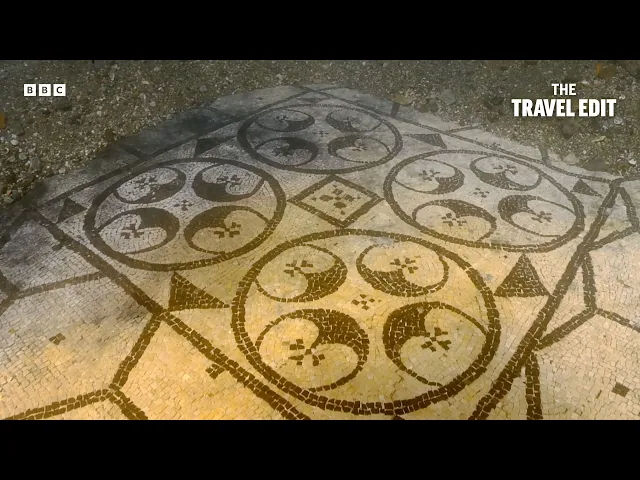
7:50 And I am currently in the process of uncovering this gentleman's mosaic floor.
7:58 If only this mosaic could talk.
8:07 [music] The mosaic floor isn't the only treat.
8:09 The statues in this Roman villa are now faithful replicas so
8:13 that enthusiasts can still share the magic of this lost world.
8:20 There was a wonderful story that in this dining room there was a channel
8:25 of seawater that the plates of exotic food floated on around the diners.
8:33 It was the yo sushi moving belt of the ancient world.
8:39 So, there's a wonderful irony that now this is itself underwater.
8:45 And the fish that once graced the tables now rule supreme down here.
8:56 I absolutely love it.
8:58 This is the first time that I've been able to see this underwater world
9:06 [sighs and gasps] lost in time, wrapped in silence as the sea
9:10 levels have risen and the earth has fallen.
9:15 What a great place to explore.
9:17 a team of underwater archaeologists and restorers
9:20 who are repairing a section of canal wall.
9:25 The visibility is not currently fantastic.
9:30 It's uh incredibly disorientating.
9:35 [music] The team has timed my dive at the turning of the tide.
9:38 As the water starts to rush out of the lagoon,
9:40 it takes some of the silt with [music] it.
9:48 We're starting to get a little bit of clarity now down here,
9:52 which is really exciting.
9:54 So, I'm pressed up just against the canal wall,
9:58 the deep stone foundations under the building.
10:06 As the water clears,
10:08 it reveals the invisible foundations of the Venetians amphibious city.
10:13 What we're looking at here is it's an exposed tops of tree trunks.
10:19 These ones here are in fantastic condition.
10:24 It's hard to believe this is wood from that is hundreds of years old.
10:33 The early Venetians took massive wooden trunks between
10:39 1 and 1/2 to 2 to 3 m long and they pounded them into the mud along
10:45 the boundaries of the area they wanted to build on.
10:50 [sighs and gasps]
10:52 Now, that secured the mud and gave them the beginnings of a strong foundation.
10:58 [sighs] But, obviously, normally wood would not survive.
11:00 And yet, here's the miracle.
11:03 Thanks to the anaerobic conditions deep in the mud where there's no oxygen,
11:08 these tree trunks don't rot.
11:12 The exterior walls of Venice's streets and palazzos
11:15 are supported by thousands of tightly packed
11:18 wooden piles thrust into the mud of the lagoon
11:22 to shore up the city's precious land.
11:25 It's an ingenious piece of engineering that's kept
11:27 [music] the city afloat for hundreds of years.
11:31 Paolo Zanetti and his team are tasked
11:33 with ensuring it lasts into future centuries.
12:08 Now, the 30,000 boats rushing around Venice every day are exposing the piles.
12:14 The wash and the underwater waves
12:16 from propellers are destroying the canal walls.
12:53 [laughter] We need to go back to road boats and everything would be
12:57 grand staircase entrance in the Doge's Palace
13:01 and the smell of power is reeking in the air.
13:06 You've got the god of the sea, Poseidon,
13:09 greeting you on the right to the god of war, Ares, on the left.
13:14 And then above us, the winged lion of St.
13:17 Mark of Venice.
13:19 There's no way that you couldn't be impressed, overwhelmed by this place.
13:24 But, it's an odd one because it looks like a palace fit for a king.
13:28 And yet, the ruler of Venice, the Doge, was no king.
13:31 In fact, Venice had a very complex system
13:34 in which no one person was trusted with absolute power.
13:39 Indeed, despite being a powerful place that dominated the world,
13:44 it was terrified of giving power to any one person.
14:02 Our scans uncover the labyrinthine internal structure of the palace.
14:07 It reflects the Venetian Republic's complex
14:10 political structure that evolved over these centuries.
14:16 This is the room where the Venetian leaders gathered [music] to elect the Doge.
14:19 He would then hold the position for life.
14:25 Then there are grand halls for overlapping
14:27 and competing bureaucracies diluting his power.
14:32 There's the Senate, the College, the Council of 10.
14:37 The members of these bodies and the Doge himself
14:40 were all drawn from the most important assembly of all.
14:47 Welcome to the Chamber of the Great Council of the Venetian Republic.
14:53 53 m [music] long, 25 m wide.
14:57 It's the largest room in the palace.
14:59 Yet, more than that, it's the largest room in pretty
15:02 much any palace or headquarters of state [music] anywhere in Europe.
15:07 The Venetians knew how to build big and [music] build impressive.
15:11 But, what I love about this place is the the way it symbolizes both how
15:16 Venice saw itself and the complex checks
15:19 and balances [music] in how it ran itself.
15:22 So, along the tops of the walls here are portraits of the first 76 Doges,
15:28 the leaders of Venice, the chief magistrates of the Venetian Republic.
15:33 But, just in case anyone forgot that the Doge was not all powerful,
15:38 there is this, the black curtain covering the Doge who tried to go too far.
15:46 Not only was he executed,
15:48 but evermore given damnatio memoriae, banished from memory,
15:53 and yet kept in memory because the Doge was sitting right
15:59 there opposite with this constantly in view just to remind him.
16:05 And frankly, that was probably the last reminder he
16:07 needed because in this great hall is the Great Council,
16:11 the members of every patrician family in Venice, the male members.
16:16 So, something like 1,200 to 2,000 people who
16:20 saw themselves as the bedrock of the Venetian Republic,
16:24 the people who were there to keep guardianship of the laws,
16:27 to keep the Doge in his place,
16:29 and to make sure that the Venetian Republic continued on track.
16:34 isn't going to get me into [music] trouble at home.
16:36 So, this is one of the most famous of the casinos from the 18th century.
16:39 Casanova would have been here.
16:42 And what does one come to one of these little casinos to do?
16:46 [music] Uh gambling and sex.
16:48 Gambling and sex?
16:49 In equal measure or in the same place?
16:51 Gambling is the main thing.
16:52 The the rooms there were beautiful women came here, beautiful courtesans.
16:56 So, it was basically devoted to pleasures of every every every kind.
17:00 Uh as you can see, it's beautifully adorned.
17:03 By the 18th century,
17:05 uh the population of Venice was 100,000 people, men and women.
17:08 And there were 12,000 prostitutes.
17:10 Over 10%.
17:12 Over 10% of the population.
17:13 Now, the courtesans are the finest of the finest of the creme de la creme.
17:16 They're the ones who become extremely wealthy.
17:18 They're the most sought after.
17:20 They would go to extraordinary lengths to make themselves beautiful.
17:21 They would wash their hair in urine so it would have a sort of a Wow.
17:25 I mean, I'm used to it
17:26 from the the ancient Roman perspective that you literally you
17:28 use urine to wash your clothes in because
17:30 of the ammonia kind of cleans everything out.
17:32 But, washing your hair seems to be a whole different level.
17:34 It would actually give them a a sort
17:36 of a reddish golden tinge that was very fashionable.
17:38 So, it's dying then.
17:39 It's it's a it's a And the smell?
17:42 I think if you washed it out, it was all right.
17:44 But, but the main thing was the fashion.
17:45 These extraordinary outfits that they would wear,
17:47 these very low-cut bodices, these with veils.
17:50 Uh and also these shoes, these extraordinary platform shoes.
17:55 And I thought the Spice Girls had been through here.
17:57 I swear these had come from.
17:59 What shoe size are you?
18:00 You can try them on.
18:01 I'm an 11.
18:02 So, I don't know I don't think I I don't think I can fit into it.
18:05 I just want to see what they Let's go.
18:07 What's going on here?
18:09 You can do it.
18:10 All right.
18:10 My hand.
18:11 Why god, I mean, well, you can certainly see everyone in the crowd.
18:14 Like and I guess they can see you, right?
18:16 It's part of the It's part of the the purpose of the shoe.
18:19 Yeah.
18:20 You've got that lovely urine-stained hair and And they'd make
18:24 a bee line to your A bee line, yes, absolutely.
18:26 And then they'd come to about here and basically stare
18:28 at your boobs for the rest of the uh evening.
18:35 Casanova had over 100 casinos to choose from in the city,
18:39 but he would have to be on the guest list.
18:42 All right, Michael.
18:43 So, let me in.
18:44 Let me in.
18:45 So, Oh, you can.
18:48 Hello.
18:48 Hello.
18:49 So, as you can see, it was just like a speakeasy.
18:52 If there was a bang on the door,
18:53 you could come in and you'd look down and you could see who was there.
18:56 If it was someone if it was the someone you didn't want to see,
18:59 uh someone's husband, there was a secret exit out the back.
19:03 So, you could see who was down here and just
19:05 get out of there if you needed to avoid them.
19:08 I don't think we'll let this one in.
19:12 [music] [music] This has been called vaults of heaven.
19:29 And it really does feel not just so far away, but just so vast, so enormous.
19:33 It's the largest dome in bricks and masonry anywhere in the world.
19:39 The dome spans 45 m.
19:43 It makes you look up to heaven, but keeps your mind firmly on hell.
19:50 But, we're not here simply to stare at beautiful things.
19:53 We're here to get underneath their skin.
19:56 And to do that, we're going to have to go behind the scenes.
20:02 It's quite a climb.
20:08 Just as well I don't suffer from vertigo.
20:15 Florence's cathedral [music] was dreamt up in the 13th
20:18 century to show off the city's growing power.
20:22 But no one knew how to build a massive unsupported dome.
20:28 The knowledge had been lost with the Romans.
20:33 For 140 years, this balcony was the highest you could climb.
20:41 The end of the cathedral stood open to the elements.
20:45 Finally, a committee of the greats and the goods, including a Medici,
20:50 of course, held a competition to find someone who could solve the problem.
20:55 The man who stepped forward was Filippo Brunelleschi.
21:00 He offered a design that was a piece of sheer theater and magic.
21:05 And quite literally,
21:06 because Brunelleschi refused to share with the committee the exact
21:11 plan of how he was going to achieve this magic.
21:14 He asked them to trust him.
21:17 There is a wonderful story, and it revolves around the humble egg.
21:23 Brunelleschi said, "Okay, all the competitors,
21:27 can you can you make this egg stand up on a plate?
21:32 If you can, build the dome." None of them could.
21:36 Brunelleschi came along and quite simply cracked the egg on a plate.
21:43 Now, his competitors said, "Well,
21:44 if we knew you were going to do that, we could have done it,
21:47 too." Exactly the point Brunelleschi applied.
21:50 "I'm not going to share my magic with you.
21:53 You're going to have to trust me that I can do the impossible." So,
21:58 Brunelleschi, who never built anything before, got to build his dome.
22:04 But he still refused to reveal his plans and deliberately left no blueprints.
22:11 And no one could work out how he did it.
22:14 It's incredibly disorientating walking up.
22:16 Your body wants to compensate in that direction,
22:18 which means you're leaning onto the wall at the same
22:20 time as you're spiraling round in a circle and going upwards.
22:24 It's ah, it's good to see some daylight
22:27 and get your sense of direction and space again.
22:31 The tower is eight stories high with its famous lean just under 4° off center.
22:44 [music] Our 3D scans reveal a skeleton image of the tower,
22:47 and it can help us see how
22:48 the medieval builders tried to correct [music] the lean.
22:54 Things started to go wrong almost from the word [music] go.
22:59 After just three stories had been completed,
23:01 it became clear the tower was leaning.
23:04 Soft clay and sandy soil had destabilized the foundations.
23:13 [music] Work stopped for almost 100 years.
23:14 But then they tried a novel solution.
23:17 They made stories four, five, six,
23:20 and seven shorter on one side [music] to try to compensate for the lean.
23:27 It didn't help, of course.
23:32 Incredible.
23:34 Sense when you climb this building is one of both human fallibility.
23:39 They didn't realize that the foundations were on sinking ground,
23:44 but also perseverance.
23:46 For 200 years, the Pisans were trying to make this tower work,
23:51 building little by little until finally they got to the bell tower on the top.
24:03 [music] The Pisans never gave up trying.
24:05 In one last attempt,
24:06 the [music] top itself was added at a jaunty angle to the rest.
24:12 At least the Pisans [music] had completed their tower.
24:16 In 1372, Florence's cathedral had stood domeless for [music] 76 years.
24:22 How are you?
24:23 Monica Bietti is the director of Michelangelo's Chapel at San Lorenzo,
24:28 and her enthusiasm for the place is infectious.
24:32 So, this is the work of Michelangelo?
24:34 Yes, all the work of Michelangelo.
24:37 The architecture, the sculpture.
24:40 These are I mean, obviously very famous sculptures now of Michelangelo.
24:45 Can you tell me a little bit about them?
24:47 I explain to you.
24:48 This is the night.
24:50 The night look like the moonlight.
24:53 Yes.
24:54 Look the marble.
24:55 It's shining.
24:56 shining and it is so white.
25:00 Like the moonlight.
25:02 This is the day.
25:04 What I think is that this is the beginning
25:08 of the day when the shadow are not definitely.
25:14 I like it.
25:15 I love it.
25:15 I like it.
25:16 I like it a lot.
25:18 But this is very unusual for a sacristy.
25:21 These kinds of Yes.
25:23 personifications, night and day.
25:25 Are these representative of of Michelangelo's view of the world, of the cosmos?
25:31 Uh Michelangelo and also Medici.
25:37 Because this kind of chapel is like a symbol of the life that finish,
25:47 you know, but the art remain.
25:51 And the art of the Medici remain for all [music] the time.
25:57 Unlike the marble sculptures,
25:59 the relationship between the Medici and Michelangelo
26:03 didn't stand the test of time.
26:07 In 1527, the people of Florence rose up against the Medici,
26:11 and they were forced into exile.
26:14 Michelangelo refused to go with them.
26:18 The great artist stayed in Florence and joined the rebels.
26:23 So, Medici the commission Michelangelo to build this Yes.
26:27 and to sculpt these buildings.
26:27 Yes.
26:28 Then the Medici are expelled from the city.
26:31 Yes, right.
26:32 Michelangelo then takes the side of the city,
26:35 of the Republic of Florence, against the Medici.
26:38 [music] Against the Medici.
26:39 And then the Medici come back to take power, and now he's their enemy.
26:42 And so he was really afraid.
26:45 Michelangelo [music] remain in a secret space for 3 months.
26:52 But nobody knows where.
26:56 So, [music] do you want to see?
26:57 do.
26:58 I can show it to you.
26:59 Where do we go?
27:01 There.
27:06 Where are we going now?
27:08 Oh.
27:09 Down there.
27:11 Down?
27:11 This is a door.
27:12 Yes.
27:13 So, this is where Michelangelo was hiding.
27:15 Yes.
27:16 This is not somewhere the public can go.
27:18 Oh, no.
27:18 This is really [music] secret.
27:21 It remain open.
27:23 We won't get trapped.
27:24 Yes.
27:24 [music] Feels like we're underground.
27:26 Yes, but look on the left, there is a window.
27:32 This?
27:33 Yes.
27:34 Michelangelo wrote that he hid in a tiny cell,
27:37 entombed like the dead Medici above, though hiding from a live one.
27:43 "To forget my fears, I fill the walls with drawings." For over four centuries,
27:50 nobody was able to find [music] where this tiny cell was.
27:54 Then, in 1975, during some building work, this little room was discovered.
28:00 This is the way down.
28:01 The authenticity of the drawings has been debated, but many,
28:04 including Monica, are convinced they're the work of Michelangelo.
28:10 But this face, I recognize this face.
28:11 I know it as a classical art.
28:13 This is the Laocoön.
28:14 Yes, it is.
28:15 This is the sculpture that Michelangelo discovers in the ground
28:19 in Rome and Do you recognize this one?
28:22 What is?
28:25 That's the David.
28:25 The David.
28:26 Of Michelangelo's.
28:27 That's his foot.
28:28 Yes.
28:29 And that's the one that got hammered off.
28:31 In every part [music] you can recognize the thing that he did.
28:37 It's like an autobiography [music] through art of his life and career today.
28:42 When you are terrified for your life, hiding in an underground chamber, Yes.
28:50 it's incredible.
28:51 It's incredible.