Stop Trading Your Time For Nothing
HealthyGamerGG
0:00 I'm back because I failed again.
0:01 Dr.
0:01 K, please give me some closure if you can.
0:04 Earlier times, I can't handle things.
0:06 Maybe I should try harder.
0:07 I can do this.
0:08 Other must have worked hard too.
0:10 Even if I can't do anything or handle anything, I must keep doing.
0:12 I would eventually learn how to deal with stuff.
0:14 I should try harder.
0:15 Everything will be fine.
0:16 Right?
0:16 So, you kind of force yourself to work hard.
0:19 After a long time, I kept fooling myself.
0:21 I thought things would work out.
0:22 I knew something was missing within me.
0:24 I couldn't even do the simplest stuff.
0:25 I took so much stress on simple stuff, I couldn't even begin to live.
0:28 I'm a waste who can't do anything properly.
0:30 I just want to be a parasite.
0:31 I am wrong.
0:32 I have failed at everything.
0:33 Money, time, myself, nothing but a walking corpse.
0:35 Bleak.
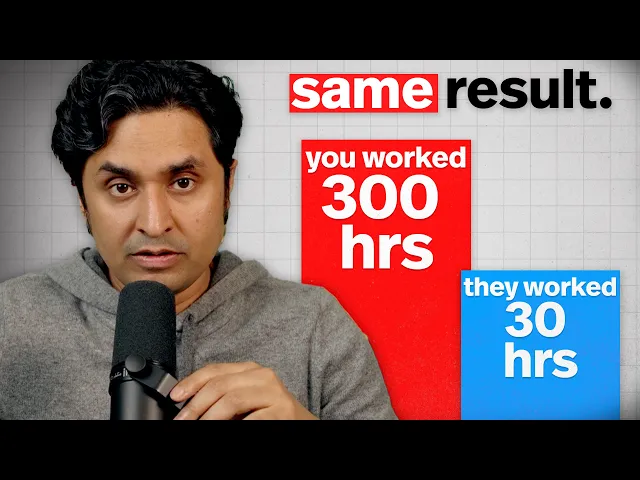
0:36 So, I think one of the biggest scams that we propagate
0:40 in the world today is that hard work will fix your problems.
0:44 Right?
0:45 So, we live in a culture where like you have
0:47 one lever that theoretically you can pull to improve your situation,
0:52 which is that you can expend more effort.
0:54 Right?
0:55 If you get a B in a class, if you just study more hours, you will get an A.
1:00 And it's like sort of true, right?
1:01 Like in the examples that I provided,
1:03 if you do study more, that is correlated with getting better grades.
1:07 If you do work more hours, it is correlated with making more money.
1:12 So, it's kind of this like simple cure all for your problems.
1:16 But I think there's like a basic basic
1:18 basic problem here which is that the people who
1:22 are very successful in life and I've worked
1:24 with like degenerate gamers living in their parents' basement.
1:27 I've worked with like literal billionaires.
1:30 The difference is not in the amount of time they spent productive.
1:37 The difference is actually in their effort.
1:40 The degenerate gamer I think actually spend
1:43 is far more effortful than the successful entrepreneur.
1:48 And I know that sounds weird but like I'll give you all an example.
1:51 Okay.
1:51 So, you know, I'm a psychiatrist.
1:52 So, I work with people who have depression.
1:54 And when people have depression, basic things require a lot of effort.
2:00 Getting out of bed requires a lot of effort.
2:02 Cleaning your room requires a lot of effort.
2:04 And then also when we've got ADHD,
2:06 I was talking to a colleague of mine who's a professor
2:08 and the my colleague was telling me that, you know,
2:11 he he's got two students in his class with ADHD
2:14 and he was like really surprised by this because he's like,
2:17 you know, they're able to carry on conversations,
2:19 they participate well in class, all this kind of stuff.
2:22 So he was like confused by the diagnosis and he's
2:25 not like trying to suggest that they don't have it.
2:27 He he was genuinely trying to learn about this.
2:28 So he's like, "Can you explain this to me?" Because it
2:30 it seems to my perception of what ADHD is is different, right?
2:34 So I thought like people would struggle, but they seem to be well engaged.
2:38 And so I explained to him that one of the key
2:40 things about ADHD is not that you can't do something,
2:44 but that the effort required is way higher.
2:47 Right?
2:47 So when a neurotypical person has participates in a conversation in class,
2:52 the cost to them is pretty low.
2:54 like I can participate in conversations for eight
2:57 hours a day without a problem, right?
2:59 Maybe I feel tired at the end of it, but I can do it.
3:01 The problem with ADHD is that the effort is way higher.
3:04 So we live in a society where we tell people work hard, right?
3:07 Like so especially in America, lift yourself up by your bootstraps.
3:10 This is the land of opportunity.
3:12 The harder you work, the more successful you will be.
3:15 There's a lot of research that shows that this is probably not true.
3:19 And this is something that I realized as a psychiatrist like you
3:22 know everyone talks about I was in residency and residency is like hard.
3:26 It's a lot of work.
3:27 You work 80 hours a week basically every week on average.
3:30 In psychiatry if you're in surgery or neurosurgery it's like 100 110.
3:34 There are these other um there are
3:36 these other you know professions like investment banking
3:38 or big law or things like that where you just work crazy amounts of hours.
3:41 And so like I had this kind of perception
3:43 that you know I'm successful because I work hard.
3:46 like I'm working 80 hours a week, 90 hours a week.
3:49 And then I realized like I have some
3:50 patients who actually work way harder than I do.
3:52 I have patients who have three part-time jobs because a single employer like
3:58 Walmart won't give them full-time hours because
4:00 then they have to pay for benefits.
4:02 So they work like 24 hours at three
4:05 companies because no one's willing to pay them benefits.
4:07 That's the most that they can get.
4:08 And so this concept of hard work,
4:10 I think like this idea that if you have this idea
4:13 in your mind that hard work will fix my problems.
4:17 And I'm not saying that you shouldn't
4:19 be productive and you shouldn't be effortful.
4:21 Right?
4:22 This is what's really hard about this is
4:23 like if hard work doesn't fix your problems, like what are you advocating for?
4:26 You know, I work six to seven days a week.
4:28 We'll we'll get to that in a second because when I
4:30 talk about that, a lot of people get upset or not upset,
4:32 but they're like, "Is Dr.
4:34 K becoming a hostile culture bro?" Not really.
4:36 And we'll we'll get to that in a second.
4:37 But the key thing here is that effort is usually not what we want to do.
4:43 Actually, effort, I think this is this is sort of the scam
4:45 that this idea of I just need to work harder.
4:47 I just need to work harder.
4:48 I just need to work harder.
4:49 And when I work with patients who have things like addictions, right?
4:52 There's this idea that I need more self-control,
4:54 more willpower, more effort, more effort, more effort, more effort.
4:58 I don't think that's the right way to live.
5:01 I think actually, so this is something so silly.
5:03 My daughter and I were playing a board game.
5:05 This is like two years ago.
5:07 And I don't know if you guys have ever had this issue where like, you know,
5:09 you have like a box for a board game and then you put the lid on top.
5:13 And she didn't understand this because if the lid is slightly tilted,
5:16 you can push really, really, really, really,
5:18 really hard and the box will never go down.
5:21 Whereas, if you reorient the box just a little bit, it goes down effortlessly.
5:26 And this is what I think life is like, right?
5:28 So when I work with people,
5:30 when when we have like coaches and stuff working with people,
5:33 the goal there is not to get them to just work harder.
5:37 I think that's actually a mistake because when you just work harder,
5:40 this is how you end up, right?
5:42 You end up in this situation where you
5:45 have all of this hard work that you've expended,
5:47 all of this energy, and then you're absolutely burnt out.
5:50 And then we get into this like pendulum of I just want to be a parasite.
5:55 I just want to take it easy.
5:56 I'm tired of working hard.
5:57 I want to do nothing, right?
5:59 So, I've done everything and more for a long time
6:01 and now I want to do nothing and even less.
6:03 I want to be a degenerate.
6:05 I just wish I had money.
6:06 I wish I won the lottery.
6:07 I wish I had participated in that Starcraft tournament 20 years
6:11 ago where third place was 300 Bitcoin and first place was $250.
6:15 I wish I had done that.
6:17 I I wish I could just be a parasite because we're tired.
6:19 Our relationship with effort is all messed up.
6:22 And so I think the first thing to understand is that like you know if
6:26 my problem is not solved by a certain amount of work we have this idea
6:31 that like okay more work right so how do I build more motivation how do
6:34 I build more discipline how do I how do I do this stuff and I've
6:38 worked with people like that so the I'd say I've worked with a lot
6:40 of people who are let's say between the ages of 27 and 45 and this group
6:45 of people is classically successful so they have early life crises and they have
6:49 midlife crises they've got stuff like imposttor
6:51 syndrome they force themselves to work really hard.
6:54 They end up getting promoted and then like they're doing stuff that they
6:57 don't really want to do and it never really gets better and they kind
7:00 of find themselves sort of like trapped where they've worked really hard
7:03 and and now they find themselves high up on a mountain that they don't like.
7:08 So this is where I think a fundamental thing
7:11 that is missing for a lot of these people
7:13 is actually understanding that if you are working
7:16 really hard and things are not working for you.
7:19 What you need is better understanding right you
7:22 need to shift that box just a little bit.
7:24 You need to understand what is the source
7:26 of resistance and instead of powering through shift a little
7:29 bit and a shift of your efforts will drastically
7:34 change the yield on the energy that you put in.
7:38 And this is something that it's like it's so silly,
7:40 but you know, I sometimes think we can learn a lot from gaming.
7:43 And I think like any sort of ranked multiplayer game,
7:47 this is a really good example of where
7:49 if you understand one or two additional mechanics,
7:53 that's worth like a rank or a medal.
7:55 It's not mechanical skill.
7:57 It's not effort, right?
7:58 It's not necessarily being locked in.
8:00 It's like, okay, if I learn how to creep pull from Dota 2 or if I get a little
8:04 bit better at last hitting or if I learn how to do this, if I learn, you know,
8:08 so I I remember seeing this post from a Dota 2 player that if you're
8:11 a carry and you're on the other side of the river and two people are missing,
8:14 you should leave the enemy's side of the map.
8:16 It's like really simple stuff.
8:18 And the climb from low rank to high rank is not playing more games, right?
8:23 This is why we have people who have played 10,000 hours of League of Legends,
8:28 Valerant, Dota 2, Take Your Pick,
8:30 and they're still like hard stuck at bronze or whatever.
8:33 So there, this this idea that working hard will improve your life,
8:38 I think is like fundamentally incomplete at best and wrong at worst.
8:44 Like it's wrong.
8:45 Now, should you invest your energy productively?
8:48 Absolutely.
8:48 But we'll get to that in a second.
8:50 So, what you need is more understanding.
8:52 And and what I want you all to notice about
8:54 this post is what are they learning from the friction, right?
8:59 This is a person that eventually I'll learn how to deal with stuff.
9:02 I should try harder.
9:03 Everything will be fine.
9:04 Their body, their brain,
9:06 their life is sending them signals that this is not working.
9:10 And they are ignoring those signals.
9:12 So, this is something that like you know this is a problem.
9:14 This is a classic problem in our community.
9:16 When I developed the coaching program,
9:18 this was the problem that was designed to sort of target.
9:21 And the way that it works, I'll just share this with you all and we'll sort
9:23 of walk you all through this a little bit is understanding first.
9:27 So really simple.
9:28 If a patient has if I have the wrong diagnosis for a patient,
9:32 this medication doesn't work, this medication doesn't work,
9:35 this medication doesn't work, I can keep on increasing the doses on medications,
9:39 I can try additional medications.
9:41 They have this treatment refractory problem.
9:43 I can increase the intensity of treatment that I provide,
9:47 but it's not going to work if I'm misdiagnosing the problem.
9:50 Simple, right?
9:52 You can play a thousand games of Dota 2 or whatever,
9:55 Fortnite, whatever, but if you don't learn from your mistakes,
9:58 if you don't understand why the effort is not translating into improvement,
10:02 it's never going to work.
10:04 So, here's what's kind of interesting.
10:05 We were looking at some quality improvement data and a lot of coaching out
10:08 there is about action and accountability
10:11 and and our coaches are trained in that too.
10:13 But the interesting thing is I think our coaches work slower.
10:17 It takes them longer.
10:18 So we see optimal changes in 12 to 16 weeks not 4 to 8
10:22 weeks but we see larger changes
10:25 because it's focused on understanding your problem.
10:27 So let's talk about what your problem is.
10:30 So here's the first thing that you've got to do.
10:32 This is kind of weird, but if you think about this idea of hard work,
10:36 okay, think about where you learned hard work will improve your life.
10:42 Basically, you learned it from the outside, right?
10:45 Because if you look at your own experience like this, hard work is not working.
10:51 If you're someone who has worked really hard,
10:54 and this can include things like someone
10:55 who's got ADHD or someone who's got depression,
10:57 where a ton of effort gives you a tiny little yield.
11:00 So, we've been taught all of this stuff on the outside.
11:03 Everyone tells you just keep working hard, keep working hard, keep working hard.
11:06 Eventually, you'll figure it out.
11:08 That's what you learn from the outside.
11:10 And that works for some people.
11:12 But if it doesn't work for you,
11:14 what you need to do is do a better job of understanding yourself.
11:17 Understand what the diagnosis is.
11:20 So, what I find when I work
11:21 with these people is they ignore their internal signals.
11:26 Just ignore them.
11:27 So, when something doesn't feel good, I need to power through.
11:30 and they kind of get stuck.
11:31 Like part of the reason that they sort
11:32 of ignore their signals is if they listen to themselves,
11:36 they end up just numbing.
11:38 Oh, what do I feel like?
11:39 What does my body feel like?
11:40 What does my brain feel like?
11:40 My body and brain feel like doing nothing.
11:43 So, I'm going to do nothing.
11:44 Well, that's not working.
11:45 So, then I have to ignore what my body and brain do.
11:48 You'll kind of get that, right?
11:49 So, if I I learn to ignore my body
11:51 or brain because listening to my body or brain doesn't work.
11:53 And then I have to push myself.
11:55 But then that doesn't work either.
11:57 So, this is what I recommend you all do.
11:59 This is a bit hard.
12:00 Pay attention to what leads to contentment.
12:03 And we have to define contentment precisely here.
12:06 Contentment is the opposite of regret.
12:09 Okay.
12:09 So the first thing is contentment is after the fact.
12:12 The action is completed.
12:14 And if you are at peace, great.
12:17 If you are not at peace,
12:18 what is the way in which peace gets destroyed after you're done?
12:21 It's basically what we call regret.
12:24 Oh, I should have done things differently.
12:25 It's not enough.
12:26 I should have done things more.
12:28 So pay attention to what leads to peace and what leads to regret.
12:32 And here's the interesting thing.
12:34 Even if you want to be a parasite,
12:36 if you want to waste your time, you know, if you're like, "Oh, I'm exhausted.
12:39 I all I want to do is play video games all day.
12:40 I don't want to work anymore.
12:42 I'm tired of working." That will lead to numbness.
12:44 It will not lead to peace.
12:46 You will wake up the next day and you will have regret.
12:48 Okay?
12:49 So then we get to another problem which is that if you work,
12:53 if you are moving in the right direction, there's still a chance that you will
12:56 have regret even when you shouldn't have regret.
12:59 Here's the options.
13:00 I feel like doing nothing and now I have regret.
13:04 Okay, so that doesn't work.
13:06 Do something and I have regret.
13:09 And what is the nature of this regret?
13:12 Now here's the fundamental problem.
13:13 So look for peace.
13:14 But these people have difficulty finding peace because it's not enough.
13:19 Should have done it sooner.
13:20 Okay.
13:21 So this is what you need to look for.
13:23 So look for when you move in the right direction.
13:27 What are the ways in which your mind turns a W into an L?
13:32 This is what happens.
13:34 The other thing is that there's a there's
13:36 one really really really key clue, right?
13:39 So, so it's it's kind of hard,
13:40 but so this is going to be oftenimes related to the aamara or ego.
13:45 So earlier I I I talked about coaching and so
13:48 I would venture that there's a lot of people
13:50 in the audience who resonate with this idea and then
13:55 when I say okay like you know you can
13:57 work with somebody else and the reason you know
13:59 I'm a psychiatrist so I saw firsthand the value
14:02 of the impact that a professional can have on somebody's
14:05 growth like that's what I do in my day job.
14:07 It's a model that works really well, super evidence-based.
14:10 But there's a problem,
14:11 which is that I don't want to work with somebody else, right?
14:14 So the problem with blind spots is that you're blind to them.
14:17 That's why it helps to work with somebody else.
14:18 But you don't want to work with somebody else.
14:20 You want to be able to do it on your own, right?
14:22 And so what I find with these people,
14:23 it's really subtle is that there are many things that they are unwilling to do
14:27 because they have this idea that there's like
14:30 lazy people and then there's the hardworking people.
14:33 And I want to be this.
14:35 I don't want to be this.
14:37 So oftentimes these people will reject help.
14:41 So this is beautiful.
14:42 There's a great paper taking care of the hateful patient.
14:44 So Jim Groves, absolute brilliant man, works at MGH,
14:49 had the privilege of studying with this guy briefly.
14:52 So he talks about manipulative help rejectors.
14:55 So these are people who will ask for help.
14:57 They actually seem the opposite of entitled.
14:59 They appear to feel that no regimen will help.
15:02 Appearing almost smuggly satisfied,
15:04 they return again and again to the officer clinic
15:06 to report that once again the regimen did not work.
15:09 Their pessimism and tenacious naysaying appear to increase
15:13 in direct proportion to the physician's efforts and enthusiasm.
15:16 So sometimes I'm not saying that everybody who who you know
15:19 falls into this category is a is in the hateful patient,
15:22 but often times these people are very what we call helpseeking, help rejecting.
15:26 They ask for help and when someone says, "Okay,
15:28 here's what you should do." They don't want to do that because
15:31 they have a model of, "I want to do it in this way.
15:34 I want to do it without help.
15:36 I want to be the kind of person who pulls myself up with my bootstraps." Now,
15:42 some of y'all may fall into that category, some of y'all may not.
15:45 That's the challenge of trying to talk about this, right?
15:49 Because this this is my whole point is that this has
15:52 this pattern has a lot of different reasons internally.
15:55 So the patterns that we can look for, this is
15:57 why it's useful to work with people, right?
15:59 So I'm sharing some of the patterns that I see frequently.
16:02 So one pattern is that when you engage in effort and you make progress,
16:07 something in your mind tells you that it's not good enough.
16:10 So even though you're moving in the right direction,
16:12 instead of feeling peaceful about it,
16:15 instead of feeling proud or positive about it, your mind adds something else.
16:20 Look for your mind adding insufficiency.
16:23 It's not enough.
16:24 It's too late.
16:25 I've fallen behind.
16:26 I should have started this a long time ago.
16:28 You're moving in the right direction and your mind is punishing you for it.
16:32 Not going to work.
16:33 Second thing to look for, if you
16:35 are theoretically moving in the right direction,
16:38 is that impacting your ego in some way?
16:41 Is moving in that direction make you feel
16:43 like you're someone that you don't want to be?
16:45 I don't want to do it that way.
16:46 I want to do it by myself.
16:47 I don't want to show people how pathetic I am.
16:49 I don't want to have have to say, "Oh,
16:51 I went and saw a therapist and they helped me
16:52 with my stuff." I want to be able to do it myself.
16:55 I want to be the thing that the rest of the world
16:58 taught me about which is like the hard worker who conquers adversity.
17:01 Look for ego.
17:02 That'll be your second clue.
17:04 And the most important thing, so this is where you know some sometimes in India
17:08 they like when I went to India and you know you
17:10 hear these stories about people going to places like monasteries
17:13 and stuff and they're you know transformed by it which is great.
17:16 Let's transform people.
17:17 All for it.
17:18 What is it that accounts for the transformation?
17:21 One of the most important things that I learned
17:23 in India is getting data from here instead of out there.
17:27 What is it that works for you, right?
17:29 And that's where there are certain things
17:31 like speaking of like effort and working hard.
17:33 So I'll just explain this very simply.
17:35 So there's a lot of people who say that you should work really
17:37 really really hard and expend a bunch of effort right hustle culture people.
17:41 You'll find these people on LinkedIn and they're like I work seven days a week
17:44 bro you got to go hard and like going hard is the way to go.
17:47 Like oh my god like let's go hard.
17:48 That's not what I'm talking about.
17:50 So I I want y'all to ask yourselves a question.
17:53 Do yogis in the Himalayas take weekends off?
17:57 The answer is no.
17:58 Every day is the same.
18:00 Right?
18:00 And this is where you can say rightly so.
18:02 That's easy to do because they're in the Himalayas and they don't
18:05 have my b their boss emailing them at Friday at 5:38 p.m.
18:10 telling them that they need something done by Monday.
18:12 They're not existing in the world.
18:14 And exactly that's why they don't exist here because this world is a mess.
18:18 But here's the key thing that I learned
18:20 in residency and and now when I work a lot, here's the key thing to understand.
18:24 Being able to engage in sustained effort is about not going into the negative.
18:30 Right?
18:30 So this is the problem with people who work really hard and get
18:33 burnt out is they work harder than they have the capacity to work.
18:38 That's the key problem.
18:39 Right?
18:39 Is the moment that you dip into reserves to get something done,
18:44 you are signing up for a debt of exhaustion.
18:47 And this is where people will say, "But Dr.
18:49 K, I don't have a choice.
18:51 My boss demands this of me.
18:54 I have to do it in my circumstance.
18:57 I have no choice.
18:58 I have no choice.
18:59 I have no choice." And that may be true now, right?
19:03 And this is the hard thing about this is crafting
19:07 your life to where that is not true a year from now.
19:10 Being very intentional about, okay, if I have to do this now, so be it.
19:16 But how can I make things better 6 months from now?
19:19 And this is where there are people who do this.
19:21 There are people who will, you know,
19:22 job hop every 2 years because that's what optimizes,
19:26 you know, income and things like that.
19:28 But it's not so much about necessarily optimizing income.
19:30 It's about improving the basic state of your life, right?
19:33 So building that sustainability is the goal.
19:36 It's I'm not saying that it's easy to do right this second,
19:38 but that's what you should strive for.
19:40 And put your effort in a direction that reduces the burden of your effort,
19:46 reduces the demands of your environment over time.
19:49 That's hard to do, right?
19:50 So that's why like often times the details
19:53 of your situation I I mean generally speaking,
19:55 I think there isn't generic advice that works for this.
19:58 This is where you really have to understand what your situation
20:01 is and try to improve things by 1 to 2%.
20:04 move the needle a little bit at a time and there's all kinds of stuff from going
20:07 to bed on time and fixing your sleep which we by the way have a great
20:10 lecture tomorrow on you know so it's hard to do but I think it's doable
20:14 and like this is the hardest thing
20:15 as a psychiatrist is see I have so many patients
20:18 who don't have power in their life
20:22 and I can't like they genuinely don't have power
20:24 but just because you have power today doesn't
20:26 mean that you don't have power today doesn't
20:28 mean that you won't have power tomorrow
20:30 and the hardest thing to do I see this most often in in people who have are
20:34 in abusive relationships is helping them reclaim the power.
20:37 I understand that you don't have a choice in this moment.
20:40 How can you get a choice tomorrow?