She’s Breaking Every Barrier… with One Arm and No Limits!
Jennifer Hudson Show
0:00 As you should already know, here at The Jennifer Hudson Show,
0:02 you know we love to celebrate everything and everyone.
0:06 Yes, we do.
0:07 And May is Asian American and Pacific Islander Heritage Month.
0:12 Yes, it is.
0:14 [cheering]
0:13 Give it a hand.
0:17 [applause] In honor of that, I want to highlight
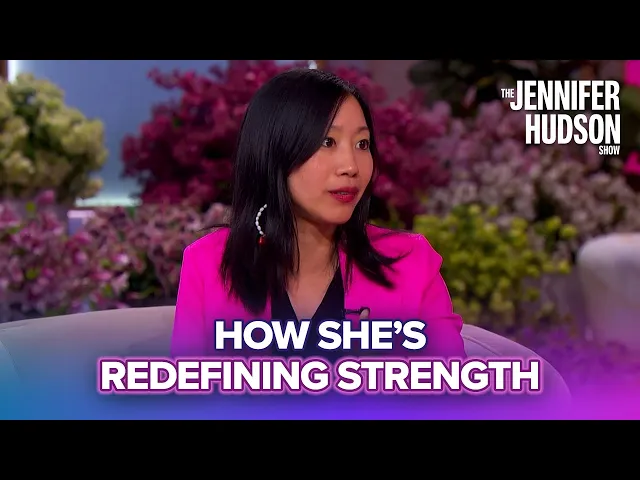
0:18 an amazing woman over here on my Shout Out Couch.
0:21 Tiffany, come on over.
0:24 [music] [cheering] [applause] [music] [cheering] [cheering and music] [applause]
0:41 First of all, welcome to the happy place.
0:43 We're so happy to have you here.
0:45 I am happy to be in the happy place.
0:47 All right.
0:47 Tiffany, can you tell us about yourself?
0:49 Yes.
0:50 So, personally, I am the proud daughter of immigrants.
0:53 And professionally, I'm a disability advocate, an entrepreneur, and author.
0:58 And I'm on a mission to elevate
0:59 the visibility and respect of the disability community.
1:02 That is awesome.
1:04 [applause] And I heard that you've been through a lot throughout your life.
1:08 So, and you're here today.
1:10 So, can you tell us share some of your story with us?
1:12 Yeah.
1:13 So, you know, my journey of belonging started at as a young at a young age.
1:17 My dad is an immigrant from Taiwan.
1:19 My mom is a refugee from the Vietnam War,
1:22 and they both came to the US in the 1970s
1:24 where when there's a lot of anti-Asian sentiment, and probably still now, too.
1:28 And so, they believed that their pathway
1:31 to success was erasure or race and assimilation.
1:34 And so, I internalized that I shouldn't
1:37 share anything that was different about myself,
1:39 that I should blend in with the wallpaper.
1:41 Wow.
1:41 And then, at the age of 9,
1:43 I was involved in a car accident where my dad was driving.
1:45 He unfortunately passed away.
1:47 Sorry to hear.
1:48 Uh I acquired a handful of disabilities.
1:50 I permanently paralyzed my right arm, which was my dominant arm at the time.
1:54 And much later, I was diagnosed with PTSD,
1:57 post-traumatic stress disorder, which is a type of mental health disability.
2:00 And my mom, who was now a single parent, uh four kids,
2:04 9 to 14 at the time, um you know, it was tough for her.
2:09 And so, in my in my family's cultural upbringing,
2:14 we were taught that we shouldn't share anything that might be seen as shameful.
2:17 Wow.
2:18 And so, a death in the immediate family, the car accident,
2:20 the fact that I now had a physical disability, those were all seen as shameful,
2:25 and that in somewhere in our ancestral lineage it was like bad luck,
2:28 and we didn't want to rub our bad luck off on anyone.
2:31 And so, I kind of had just hid for the next decade plus.
2:35 I wore long sleeves all the time.
2:37 I didn't tell anyone about my dad,
2:38 and I didn't tell anyone about the car accident.
2:40 And and uh only up until I got to college.
2:44 Wow.
2:44 You held a lot in for a long time.
2:49 I feel really sad for that girl.
2:53 Right.
2:52 Wow.
2:52 But, you you found your confidence somehow.
2:55 What did you find your confidence in?
2:57 So, freshman orientation, you're you know, you're meeting a lot of new people,
3:02 and I ended up meeting a person.
3:05 Her name was Jackie, and she told me that her mom was from Taiwan.
3:08 I told her my dad was from Taiwan,
3:09 and I made this offhand remark that we should start a club.
3:11 Wow.
3:12 So, we became the co-founders of the Taiwanese
3:14 American Student Club at our university.
3:17 And up until that point, you know, I was one of a few we were one
3:21 of a few Asian families where I grew up in Maryland suburbia.
3:25 And so, when you don't have mirrors of yourself,
3:26 you don't really have anyone to share that experience with.
3:29 So, starting the Taiwanese American Club gave me a sense of pride,
3:33 identity, community,
3:35 culture, history, in an aspect of my identity that I felt so much shame about.
3:39 And in a lot of ways, I wish that my dad could have seen who I became, right?
3:43 And that I was proud of where he came from.
3:46 And so, fast forward a couple of years, I said, "Okay,
3:48 if I was able to do that with one aspect of my identity,
3:51 what if I did that for my disability identity,
3:53 which I had felt so much shame around for so long?"
3:57 And you've been able to do all of those things, right?
3:59 Yeah.
4:01 Your [applause and cheering] dad, I can I'm sure I'm proud for you.
4:05 I'm sure your father is extremely proud and smiling
4:08 down on you because your impact now is worldwide, right?
4:13 Yes.
4:14 [cheering] Tell everyone about your amazing organization.
4:16 Yeah.
4:16 So, I started a nonprofit in 2009 called Diversability.
4:20 We're on a mission to elevate disability pride,
4:22 and I specify that disability pride is different from disability awareness.
4:27 You can be aware of disability,
4:28 but still feel like disabled people are less than or broken or need to be fixed.
4:32 When you're proud, we're saying, "Hey, look at us.
4:35 Like, we exist everywhere.
4:37 Like, we want to be part of your community
4:39 as well." Uh we've grown our digital ecosystem to over 80,000,
4:43 and in addition to that, I Thank you.
4:46 Give that some love, y'all.
4:48 And I think I think in a world where so many
4:51 of us are taught to feel shame about who we are,
4:53 it's just been so liberating to say, "This is who I am.
4:56 This is how my body and or mind works." Uh
4:59 I'm proud to be part of over a billion people globally.
5:02 Uh and one of the other things is
5:04 we've always been entirely disabled run and led.
5:07 And I think when our unemployment numbers
5:09 are twice that of our non-disabled peers,
5:11 we want to show that disability employment works,
5:13 that there's talent there's so much talent and magic within this community.
5:17 Yes, it is.
5:18 Thank you.
5:19 [applause] You have a lot of support, as you can see.
5:21 Thank you.
5:21 And, you know, I think since starting that community,
5:25 I have also found my voice in a lot of different ways.
5:27 So, I've expanded my own advocacy.
5:29 We started something called The Awesome Foundation Disability Chapter,
5:32 where every single month we award $1,000
5:35 to a disability project around the world.
5:37 We've now awarded over $100,000 to [cheering] projects.
5:42 Thank you.
5:43 To projects in 17 countries.
5:47 [applause]
5:46 And then, I guess most recently, uh I've served on a couple advisory boards,
5:50 including the FIFA World Cup Accessibility Advisory Board.
5:53 Coming to LA.
5:55 Um I also serve on the LA28 uh
5:58 one of their working groups around workforce development.
6:00 And I recently learned that the top three sporting events are Olympics,
6:04 FIFA World Cup, and Paralympics.
6:06 And I can't imagine like a more global event
6:08 that will influence how people view the disability community.
6:12 So, I'm really excited to be involved in that way, too.
6:14 Thank you for sharing that with us.
6:17 [applause] And on top of all of that, you're an athlete as well.
6:21 Uh so, and I don't know how many of you can
6:23 relate to this, but after I became disabled when I was 9,
6:27 I was just always the last kid picked in gym class.
6:30 And I think no matter who you are,
6:31 if you have a disability or not, being picked last,
6:34 it can have a lasting impact on how you see yourself,
6:37 what your story looks like.
6:39 And so, about 10 years ago,
6:41 I started on this journey to rewrite that narrative for myself.
6:44 So, I started rock climbing or I got introduced to paraclimbing [cheering]
6:50 last [applause] year.
6:51 Go.
6:51 Last year, I showed up at the US National Championships, and I got last.
6:55 And this year, I'm fourth, which is amazing.
6:58 Thank you.
7:00 [cheering] You might see me You might see me
7:01 in the Paralympics in LA28 if I work really hard.
7:04 Okay.
7:05 We believe you'll do it.
7:06 Uh but in addition to that, I think so much of that narrative is,
7:09 "Let me try the things that I never thought I could do." And so,
7:12 I recently ran my first half marathon.
7:14 I climbed Kilimanjaro.
7:16 I've done a triathlon.
7:18 And so, [applause and cheering] I think I'm still catching
7:20 up to this idea that I'm at that I'm an athlete,
7:23 but I'm also like, "But, actually, I'm a triathlete." Come on.
7:28 So, so yeah.
7:30 You're amazing and such an inspiration.
7:32 [applause] Keep doing what you are doing.
7:34 Don't y'all feel inspired by her?
7:37 I know I do.
7:38 Thank you for being here.
7:39 I want you to sit back, enjoy the show from the Shout Out Couch.
7:42 THANK YOU AGAIN.
7:44 TO FOLLOW TIFFANY YU [cheering] and find resources, visit our website.
7:49 Your happy place is [music] here.
7:51 What was your favorite part?
7:53 Drop it in the comments and subscribe to help keep the joy coming.
7:57 Happy place.