Learn 11 Odd Metaphors in English (What do they mean???)
Learn English with Gill · engVid
0:00 Hello.
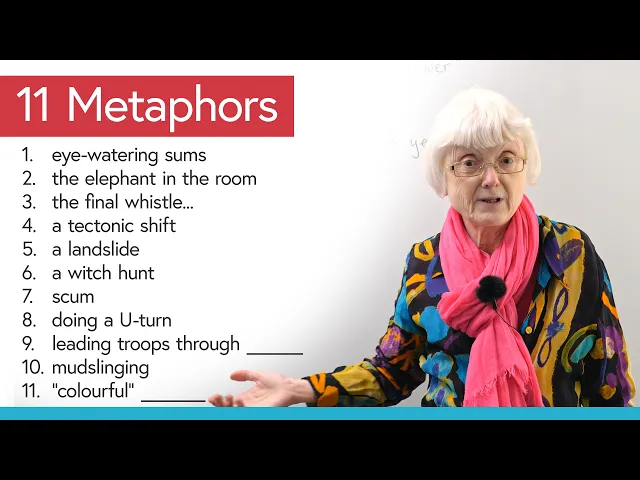
0:00 I'm Gill at engVid, and today we have a lesson on metaphors.
0:07 We've done metaphors before.
0:10 You'll find I have a few other lessons that refer to metaphors.
0:16 This one is about colourful metaphors that you would find perhaps in the news,
0:25 in references to politics and politicians.
0:29 So, the word...
0:31 This colourful metaphors in itself is a metaphor.
0:38 To call a metaphor colourful, you can see it's written in red,
0:44 so in a sense it's literally colourful.
0:48 But metaphorically, these metaphors are very, very strong.
0:54 They're meant to have a strong impact
0:57 and to create a strong picture in your mind.
1:02 Okay?
1:03 So that's the point of metaphors.
1:07 Another word for metaphors is imagery.
1:11 Imagery, so it creates a picture, an image in your mind.
1:17 Okay?
1:17 And they're often very...
1:19 They have a big impact when you hear them,
1:24 more than just ordinary, neutral language.
1:27 So, for example, when people are talking
1:32 about large sums of money, especially when...
1:36 To do with the government and how much money they're spending on...
1:41 On something.
1:43 It's called "eye-watering sums of money".
1:48 "Eye-watering" means, you know, your eyes are watering or the tears are coming
1:57 from your eyes because the amounts of money are so big.
2:03 But also, I think people's eyes water if they're in pain.
2:08 So, the idea is that the amounts of money being spent,
2:13 it's painful to think about the kind of money that's
2:19 had to be spent during the COVID pandemic, for example.
2:24 In the UK, a lot of money was spent trying to protect people's jobs.
2:33 People were put on furlough, which meant that they...
2:38 Their money was coming from the government
2:41 rather than from the company that employed them,
2:45 and the government was spending huge amounts of money
2:49 on that to help to preserve people's jobs so that they didn't lose...
2:55 Lose their job so that the company didn't fail, and so on.
3:01 So, billions and billions of pounds were spent.
3:05 So, that was eye-watering sums were being
3:09 spent on that employment scheme, for example.
3:15 Okay.
3:16 And then more recently, we've had this quotation from one politician in the UK.
3:24 The leader of the opposition accused the Prime
3:30 Minister of leading his troops through the sewer, which sounds rather strange.
3:42 I think the word "troops" you would normally have in the army,
3:50 and these would be soldiers rather than,
3:54 you know, MPs, but that's part of the metaphor.
3:59 We've got a sort of army metaphor as well
4:02 as mention of a sewer, which is where...
4:08 Well, when you flush the toilet,
4:11 everything goes down under the ground through the pipes in the sewer,
4:18 the sewage system, so it's a disgusting thing to think about.
4:26 So, for the leader of the opposition to say
4:32 that the Prime Minister is leading his troops,
4:35 meaning his MPs through the sewer,
4:38 this was a recent situation where the government were being accused
4:44 of corruption or trying to manipulate the political system in a certain way.
4:54 They had a vote in parliament about something to try to get
5:01 around a problem rather than to deal with the problem properly.
5:06 They were trying to get around the problem and to try
5:10 to avoid doing what they should have been doing,
5:15 and the opposition and people generally thought it
5:20 was a rather sort of corrupt thing to do.
5:25 So, this was the description.
5:28 The Prime Minister is leading his troops through the sewer,
5:33 and it's a very sort of unpleasant image for something.
5:37 That was a rather unpleasant situation.
5:44 And then something similar to that, well,
5:48 what happened after this, the next day the government decided,
5:53 "Oh dear, we'd better not do that, then.
5:56 It's causing so much trouble.
5:58 We won't do that.
6:00 We'll change our minds." So what...
6:02 They did a U-turn.
6:04 They were going to do things a certain way,
6:07 and they'd won the vote that allowed them to do it that way,
6:13 but it had caused so much trouble they decided, "Oh no, we'd better not do that.
6:19 We will look really bad if we go ahead with that." So, they did a U-turn.
6:24 So, doing a U-turn in real literal...
6:28 In a literal sense is usually if you're driving
6:33 a car or any vehicle and you're going along the road,
6:38 but then you want to turn round and go back the other way,
6:43 go back the same way you just came.
6:46 So, you go in a U-shape, you're going this way,
6:49 and then you turn and go back the other way,
6:53 and you're sort of creating the shape of a letter U.
6:58 So, to do a U-turn.
7:00 And in driving, when people learn to drive, they learn how to do a U-turn.
7:07 So, that's often used, especially with the present government.
7:12 They do tend to do U-turns every now and then.
7:16 They've said, "We're going to do this." For example,
7:19 everyone should wear a mask, but then a few days later they might say,
7:27 "Oh no, people don't have to wear a mask anymore.
7:30 Only...
7:31 Oh, if you're going shopping, if you're in a shop,
7:34 wear a mask, but otherwise you don't need to." So,
7:38 you know, if the government keeps changing their minds,
7:42 it's very confusing for people.
7:45 But, you know, that's how it's described, doing a U-turn.
7:50 And then, again, not long ago, one politician called some other politicians...
8:01 Or, no, she...
8:03 A politician called another politician "scum",
8:08 again through doing things a little bit unconventionally,
8:14 trying to do something a little bit in a sort of not a very honest way, perhaps.
8:23 And "scum" literally is something unpleasant sort
8:28 of floating on the top of some liquid, sort of dirt floating on the liquid.
8:36 If you see these pictures of polluted rivers and so
8:42 on with sort of chemicals floating on top, it looks horrible.
8:48 So, "scum", you can call people "scum", but it's a very strong term.
8:53 It's not a good idea to call somebody "scum".
8:57 And after the politician had called the other politician "scum",
9:01 she was asked if she was going to apologize for using that word,
9:07 because she'd sort of used it in private.
9:10 She hadn't really said it publicly, but she had been heard saying it.
9:16 And then she refused to apologize for quite a while,
9:21 but then after maybe a few weeks she did eventually say
9:28 she was sorry to have used that word "scum" about another politician.
9:33 Okay.
9:35 Right, so then this one.
9:38 "The final whistle hasn't blown yet." So,
9:42 this normally in a literal sense is in a sports game, perhaps football,
9:51 when at the end of the football match the referee blows
9:59 a whistle to stop the game because the time is up.
10:04 So that's literally the final whistle when the game comes to an end.
10:11 But this was used recently by a medical
10:16 officer who advises the UK government on...
10:21 On COVID and on, you know, lockdowns,
10:25 and wearing masks, and vaccinations, and everything connected with COVID.
10:34 And he was talking about COVID and how some people had sort of relaxed a lot,
10:42 they'd stopped wearing masks, they'd started mixing with other people,
10:48 getting a bit too close perhaps, not doing any social distancing.
10:55 And he was saying people have started to think that COVID has gone,
11:02 gone away, and it hasn't.
11:05 He was trying to get a strong message across that COVID is still around,
11:12 we're still, you know, at risk of infection and serious illness, and so on.
11:20 So he said the final whistle hasn't blown yet.
11:24 You know, it's not the end of the story yet.
11:28 So I think that particular person is well known for his colourful metaphors,
11:35 often to do with football, or other sorts of images,
11:40 to try to get a strong message
11:43 across to people that will influence their behaviour,
11:47 so that they will behave sensibly, sensibly,
11:51 and not help to increase the infection rate.
11:57 Okay.
12:00 Then just a few sort of general metaphors that are often used in politics.
12:08 "The elephant in the room", that's when people are discussing an issue,
12:15 but they're not really talking about the main issue.
12:20 They might be talking about small things when
12:25 there's a much bigger thing to talk about.
12:29 So it could be something like "the elephant in the room",
12:34 could be climate change, for example, that's the really big issue.
12:39 And then if politicians are talking about some small details,
12:45 they are ignoring "the elephant in the room".
12:50 You know, if there's an elephant in the room,
12:54 literally, you would know about it because it's so big.
12:59 So that's the idea.
13:02 Okay.
13:03 And then a tectonic shift.
13:06 If there's been quite a big change in something,
13:11 like maybe recently there's been a climate change conference,
13:19 you could say there was quite a...
13:22 It was quite a good, you know, progress, quite good progress was made.
13:29 I don't know whether you'd say it was a tectonic shift.
13:34 That remains to be seen in what actually happens next.
13:39 It was all based on talking and creating a document for people to agree to.
13:47 It's what people do next that matters.
13:50 We need a tectonic shift in the way what people
13:54 do next in terms of trying to reduce climate change.
14:00 But tectonic shift in a literal sense is
14:05 to do with tectonic plates in the Earth,
14:11 where the things that create earthquakes, if there's a tectonic shift,
14:19 that often causes an earthquake and maybe a tsunami,
14:25 waves coming in from the sea.
14:28 So a tectonic shift is a big movement of the ground underneath under our feet,
14:36 and it can cause earthquakes and tremors and so on.
14:41 So that's quite a big thing.
14:45 So if there is a tectonic shift
14:48 in the way people behave to do with climate change,
14:52 that is what we need to reduce global warming.
14:59 Okay, so next one, a landslide victory.
15:04 That's usually when there's an election,
15:08 people are voting for different parties,
15:11 and then if one party wins by a large number of votes,
15:17 that's called a landslide victory.
15:20 So in a literal sense, a landslide is when if there's a hill or a mountain,
15:28 but then all the Earth, often when it's rained a lot,
15:32 when it's been raining a lot,
15:35 and there's a lot of water collected in the Earth that's piled up,
15:42 it sort of slides down rather dramatically,
15:46 and suddenly you see it sliding down like this.
15:50 So that's quite a dramatic thing.
15:53 So a landslide victory is when one
15:56 particular party gets a large number of votes,
16:01 maybe unexpectedly, because landslides in the real
16:05 world are also unexpected as well, they just happen suddenly.
16:11 Okay.
16:12 Mud slinging, again in politics, this is what opposing parties do,
16:19 they sling or throw mud at each other,
16:24 they kind of accuse each other of bad things,
16:30 and if you throw mud at somebody, it's sticky,
16:34 so it will stick all over them, over their face and their clothes.
16:39 So mud slinging, if both sides are doing it,
16:43 then both sides will end up covered in mud,
16:47 and it's to make each other look bad.
16:51 So, okay.
16:53 And then finally, a witch hunt.
16:58 At one time in history, well,
17:01 women in particular were accused of being witches and were persecuted,
17:08 even executed for being a witch.
17:12 And so this term is used sometimes by politicians nowadays,
17:18 if they're being accused of doing something wrong
17:23 and they want to stand up against it,
17:26 they will call it a witch hunt to make it sound as if it's...
17:34 It's not...
17:35 It's not a valid criticism.
17:39 One particular politician used to do this, who was in power,
17:45 isn't in power anymore.
17:47 Every time that politician was accused of some sort of corruption,
17:53 or hiding something, or having done something wrong in secret,
17:59 that politician would just say, "Oh, it's a witch hunt.
18:04 It's...
18:05 It's just a witch hunt.
18:06 I didn't do anything wrong.
18:08 It's a witch hunt." It's to sort
18:11 of discredit the people who are making the criticism,
18:15 to try to get out of it and say, "No, it's not a valid criticism." Okay,
18:26 so I hope that's an interesting set of colourful metaphors for you.
18:32 If you'd like to do a quiz on this subject,
18:37 just go to the website, www.engvid.com, and try the quiz.
18:43 And thanks for watching, and hope to see you again soon.
18:47 Bye for now.