Why use many streetlights when one will do?
Tom Scott
0:00 I'm not allowed to climb this tower.
0:02 I did ask, but not only does
0:03 climbing this need proper training and safety equipment,
0:06 it's also a protected historic site.
0:08 The folks in charge are understandably a bit cautious.
0:11 But while I can't go up there...
0:13 the camera and you can.
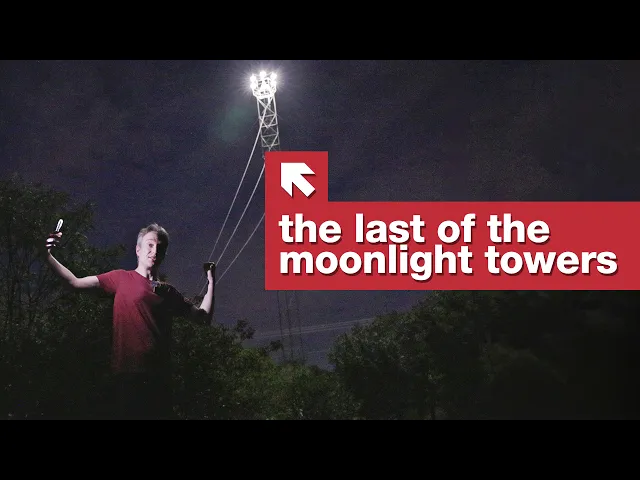
0:15 This is a moonlight tower here in Austin, Texas,
0:18 and it's one of the last surviving municipal lighting towers anywhere,
0:22 because if you're lighting up a city to keep people safe at night,
0:24 why have thousands of small lamps down every
0:27 street when you could have just a few, very bright and very high?
0:32 Each tower was intended to provide light equal to that of natural
0:37 moonlight in an area 1500 feet from the base of the tower,
0:41 and that is light by which somebody could read the face of their watch.
0:45 These lighting systems were all throughout
0:48 the Midwest and all throughout the west.
0:51 When these towers were installed in 1894,
0:53 they used carbon arc lamps, the first practical electric lights.
0:57 Those lamps were literally controlled electrical arcing,
1:00 a constant spark shooting through the air between two carbon electrodes.
1:04 These days, if you're seeing that kind of harsh white light at this scale,
1:07 it's usually because there's a fault with something big
1:10 and electrical and there's a short in the system.
1:12 This was the same effect, just deliberate.
1:14 The catch is that the electrodes on carbon arc lamps are steadily vaporized,
1:18 wearing down as they're worn away by the spark, so they burn out quickly.
1:22 And the city had to pay someone to climb
1:24 every tower every day to replace the lamps.
1:27 The City of Austin Electric Utility, and as we know it today,
1:30 Austin Energy, started with the moonlight towers.
1:33 Every night, a utility employee would go up through this elevator pulley system
1:38 through the middle of the tower and go light these carbon arc lamps.
1:42 This pulley system, there's this little thing for the employee to stand
1:46 in, and then you have workers on the ground who are hoisting him up.
1:51 You're going up potentially 165 feet in the air.
1:54 I don't know when hard hats came into play,
1:57 but when you look at older pictures, our safety equipment is not as it is today.
2:02 So then in the 1920s, they switched to incandescent bulbs,
2:05 and in 1936 it was the mercury vapor lamps, and today we're using LED bulbs,
2:09 and it's a little bit easier to get up there and exchange the parts.
2:13 So we're using cranes and bucket trucks to get up to make those changes.
2:19 If ever there was a subject designed for vertical video, it's this one.
2:22 Most cities took their towers down as electric street lighting became possible.
2:26 For some unknown reason, Austin never got round to it,
2:30 but they've not all been preserved.
2:32 There's only about a dozen towers still standing.
2:34 Not all of those are in the same locations they used to be.
2:37 And in 1993, the city took them all apart,
2:40 refurbished them, and put them back up again.
2:42 As for what they look like when they're switched on, well,
2:45 for that, we'll need to wait until after sunset.
2:47 Austin is the only city in the United
2:49 States that still has functioning moon towers.
2:51 Before the moonlight towers were put up around town, it was dark!
2:54 The moon could only do so much.
2:56 And so it really changed people's lives.
2:57 I think it allowed them to keep businesses open after dark,
3:00 which would increase commerce.
3:02 People could enjoy themselves with friends and family, and also get home safely.
3:06 Moonlight towers were the only game in town for light after dark,
3:09 you know, in parallel with the moon itself, of course.
3:13 And these towers clearly work because, well, look at me,
3:15 I've got a shadow, although admittedly I am standing right next to it.
3:19 The name moonlight towers isn't just poetic.
3:22 31 of these towers were spread around what was then
3:24 a much smaller and lower city before skyscrapers came along.
3:28 That meant that except for some dark corners,
3:30 most of the town would be lit up as if there was a full or maybe a half moon.
3:35 Not that bright, but enough that you could see your way around.
3:38 Hence moonlight tower.
3:40 It's artificial moonlight.
3:42 Although, turns out there's not much evidence
3:43 for that name being used until the mid-20th
3:46 century when historical preservation became fashionable
3:48 and these towers became an icon of Austin.
3:52 They were not called moonlight towers from the beginning.
3:54 The Austin newspapers just called these "the towers".
3:58 There were no other towers.
4:00 First reference that I found in a newspaper
4:03 to these being called moonlight towers, it was 1938.
4:06 In the early 1960s, the masthead of the Austin
4:10 newspaper had the phrase, "As Austin As".
4:13 The phrase changed each day,
4:15 where the newspaper was comparing itself to other icons in the city of Austin.
4:20 And in July, 1962, the masthead said, "As Austin as Moonlight Towers".
4:27 They have become a symbol of Austin.
4:29 And every holiday season,
4:31 one of those moonlight towers in Zilker Park gets used to put up
4:34 hundreds and hundreds of bulbs of lights that look like a holiday tree.
4:39 And you go and you spin around and you look up and you get dizzy,
4:42 and you feel like Austin is just the best place to be.
4:46 There are modern versions of these towers for places like giant parking lots.
4:50 Sometimes it is just better to stick a big light on a pole.
4:54 In most cases, though, modern lighting is a much better choice,
4:58 because every street got wired up to the grid anyway.
5:01 Although that does mean in the 21st century,
5:03 it's difficult to imagine what a city
5:05 lit just by moonlight towers would feel like.
5:07 These days there's too much other light around from every house, every building.
5:11 On a night with low cloud,
5:12 the skyglow from light pollution can be brighter than the old towers would be.
5:15 At least, brighter than they would be at a distance.
5:17 These aren't street lighting anymore.
5:19 They're historic artifacts, kept running because, well,
5:23 because the people of Austin like them.