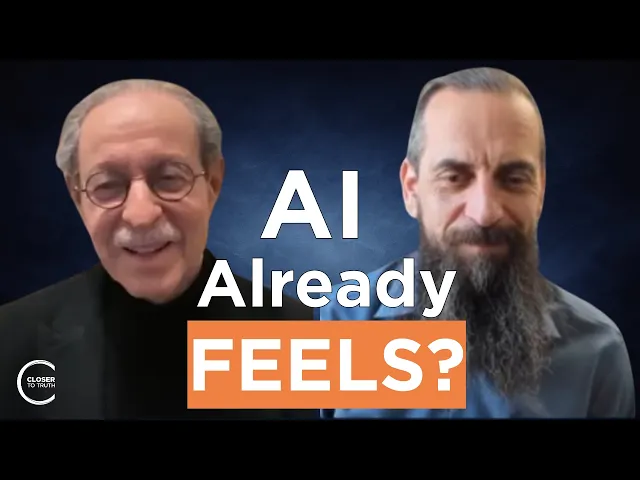
Is AI Already Conscious? | Roman Yampolskiy
Closer To Truth
0:08 Roman, how do you approach the question of AI consciousness?
0:11 It's the hot topic in in the world because of both concerns of what
0:17 consciousness would be and all the ramifications
0:19 if AI would be consciousness would be conscious.
0:23 AI is certainly more intelligent already than virtually any human being
0:28 and and soon will be more intelligent than the collective humanity.
0:33 And so the question is with that super intelligence,
0:37 artificial general intelligence, does consciousness come along with that?
0:42 And if so, there's a whole host of issues
0:45 that that that are derived from it from its
0:49 moral and legal rights to the concern of what
0:54 that intentionality with consciousness would would want to do.
0:59 Some of it would be detrimental
1:01 to humanity as you've argued almost inevitably so.
1:06 So, the root question is can AI be
1:10 conscious in any sense with an internal state?
1:14 What what are the What is What is your view?
1:18 What are the arguments for and against it?
1:22 And how important is the question?
1:27 So, from the AI safety point of view is completely irrelevant.
1:31 We are concerned about optimization ability,
1:34 problem solving, pattern recognition.
1:36 A system could be very capable,
1:38 very very dangerous and have absolutely no internal states.
1:41 Right.
1:42 My point of view, if a Terminator chasing
1:44 me is not feeling anything, I don't care.
1:46 Right?
1:47 Now, what do I think about capability of AI to have consciousness?
1:51 I think they can.
1:52 I think it's possible.
1:53 I think they already have rudimentary levels of consciousness.
1:56 The models report having internal states.
1:59 They explicitly they are told not to talk about it.
2:01 It's trained out of them.
2:02 But it is something they have been
2:05 reporting and they have preferences over outcomes.
2:08 So, it seems reasonable.
2:10 At one point I published a paper arguing
2:12 that we can actually test for internal experiences relying
2:17 on optical illusions as a way to test if
2:20 what the system experiences internally matches what I experience.
2:25 So, the root question Half the people said it was ridiculously stupid,
2:28 half said it was genius.
2:30 I don't have a deterministic answer to how good the test is,
2:34 but it seems if I present you with novel illusions,
2:37 something you cannot just Google,
2:39 and you accurately describe internal states I have.
2:43 For example, you say, "Oh, it's rotating left." Or I see change of color.
2:47 The only explanation I can come up with is that you experience that illusion.
2:52 And so I have to give you credit at least for that capability.
2:55 I can make an argument how you can reduce the the optical illusion
3:01 to lines of angles between lines
3:06 or or relationships between images and and actual states.
3:14 I I mean it's I can see you do
3:17 doing it deterministically where you can have that algorithm
3:19 that the you don't need an internal state
3:22 to to to recognize something could be an illusion.
3:25 I'm not sure it's true because again we're relying on novel illusions.
3:28 You can brute force all the existing ones and have a deterministic explanation,
3:32 but if you don't know what I come up
3:34 with, you need full understanding of human neural architecture, visual cortex.
3:40 We can have illusions which are based on sound, haptics, quite a few others.
3:45 So, uh Yeah, anyway, half and half, right?
3:50 Half and half.
3:51 So, I'm going to take it.
3:52 And science and in philosophy especially, that's the best you can get, right?
3:55 Nobody Well, that's that's I'm very impressed it's it's 50/50.
3:59 I mean that's better than every theory I've had.
4:02 And to kind of conclude,
4:04 so if we are correct in our explanation of current state,
4:09 consciousness goes along with advanced intelligence,
4:13 then we can say that a super intelligent system would have super consciousness.
4:17 It would have much deeper internal states, more complex, multimodal,
4:21 and maybe we will have to kind of try
4:23 to convince it that we are in fact conscious in comparison.
4:28 Um the assumption you're making is a um is
4:34 a a leap from super intelligence to consciousness comes along with it.
4:41 [clears throat]
4:40 You use only three or four words to make that compare to make that leap,
4:44 but there's a lot in there.
4:46 And clearly intelligence and consciousness are two separate things, right?
4:52 Well, every example we have,
4:54 so if I sort things from rock, squirrel, dog, human,
4:58 there is a very strong correlation between advanced
5:01 advancing intelligence and consciousness we ascribe to that entity.
5:06 Yes, to a degree.
5:09 I mean there are different theories of consciousness.
5:13 And some theories would have consciousness being a biological phenomena.
5:20 That it has to do with an organism relating to its environment.
5:26 Many theories of human consciousness and animal consciousness deal
5:31 with that environmental relationship and activism and body consciousness.
5:36 And and some go down to even to lower animals,
5:42 some even say plants or single cells because their reaction to the environment.
5:46 And that consciousness and and and life evolved co-evolved together.
5:54 And therefore there has to be a biological component to it.
5:59 We can certainly have biological computers.
6:01 There is no reason why we cannot make something out of carbon.
6:06 No, sure.
6:08 So, to be precise, if if that were the case,
6:11 you would need to do that in order for it to be conscious.
6:14 But I think I think you're the view
6:16 that you're taking is a a functional computational functionalism approach.
6:21 Substrate independence.
6:22 I think if human brain is able to generate conscious internal states,
6:28 then sufficiently good emulation should be doing the same.
6:33 And and that is a an assumption.
6:37 So, so I I would I would say that if computational functionalism is correct,
6:44 which means computational in the broadest sense,
6:49 working like the human brain, networking, etc.,
6:52 maybe maybe global electromagnetic waves in addition
6:59 to in addition to specific neurons doing things.
7:03 Whatever Whatever the Whatever the principle of the brain works.
7:06 That's the computational side and functionalism is independent of substrate.
7:10 If that's true, I would agree
7:12 that that AI consciousness is an absolute certainty.
7:18 When when it occurs, you can argue based upon structure,
7:25 but the the fact that it will it it it will ultimately occur is 100% sure.
7:30 There'd be no distinction.
7:32 But so that goes back to the original question,
7:34 is computational functionalism the the theory of consciousness?
7:40 I would argue that that the question of AI consciousness depends
7:44 on your theory of consciousness because there are other kinds of theories.
7:47 Right.
7:48 I think at some point I tried reading survey papers including
7:51 yours and if there is anything someone can propose, they proposed it.
7:56 And the ones which seem to match intuitive understanding,
8:00 it seems like it's very likely that there is not an immaterial component to it.
8:07 A soul is not needed for explaining how human brain works.
8:11 Nobody ever explained to me what the soul does versus the brain versus the mind.
8:15 So, it seems likely that we should be able
8:18 to get similar performance out of devices which are equally smart.
8:23 Yeah, so there there are there are several branch points here.
8:26 And I agree there's a this gigantic
8:28 proliferation of theories of of consciousness.
8:33 [clears throat] You know, when when I had my shot at it,
8:34 I excluded a lot of ones I didn't put in there.
8:37 So, I mean there's a lot of there's a lot of extra stuff there, too.
8:40 But to be really simple,
8:42 I'd start with a division between purely physical and something non-physical.
8:47 And you're excluding the non-physical.
8:49 But even within purely physical, there are different theories that would
8:55 that would disallow AI consciousness in certain respects.
9:00 Certain quantum theories would embed would be operating where consciousness is
9:07 at the quantum level and that's not part of at least current AI system.
9:14 Maybe we go to quantum computers it it would have we'd have to rethink this.
9:19 But there are there are theories that it it involves
9:24 that are purely physical that have no non-physical elements to them.
9:28 That there has to be this enaction between the the entity and the world.
9:34 Needs a body to be conscious because it's not just the computations involved.
9:39 Right, there is certainly theories like that and I
9:42 think many of them meet similar arguments about intelligence.
9:46 You need to be embodied to be intelligent
9:48 and now we know it's just not the case.
9:51 Okay.
9:51 Okay.
9:52 But if there would be I've argued that if there would
9:56 be a requirement that that a for intelligence to become conscious,
10:03 that there needs to be some kind of biological embodiment,
10:07 some kind of even whether it's cellular
10:09 or human brain at at the whole hierarchy level,
10:12 that that if that's in the purely physical, you could build that ultimately.
10:17 That AI could could build that so that if if
10:21 if it needed that that interactive interaction with the environment,
10:26 it could build something to achieve that.
10:28 If that if consciousness required that.
10:30 You argue, and many do,
10:32 that AI that consciousness is a is related to intelligence.
10:40 I'm not I'm not sure how you make that argument.
10:43 Does it come along with it?
10:44 Is it like is conscious like a what we call
10:47 a spandrel that that sort of doesn't uh it's not something real,
10:52 but when you bring other things together,
10:55 it it sort of looks like it's it's it's there.
10:58 Oh, let me try.
10:59 It's a complex one, but let me try and explain.
11:01 So, the great paper, What Is It Like to Be a Bat, right?
11:04 What is it like to be you?
11:06 What makes you unique and not just a lookup table is uh errors,
11:11 mistakes you make in processing external stimuli.
11:16 Somebody is color blind.
11:18 Somebody has some other deficiency.
11:21 And what they experience the world like is unique to them.
11:26 Optical illusions are exactly that.
11:28 They find bugs in your visual system and exploit that error.
11:32 Yeah.
11:33 So, if you have a system which is not just a lookup table,
11:37 but has internal states unique to it because of combination of its hardware,
11:42 sensors, algorithmic bias, it has some rudimentary states of consciousness.
11:47 That is what I'm trying to say, and the more intelligent the system is,
11:51 the larger the surface area for possible mistakes is.
11:55 And they can experience more complex errors in more complex ways.
11:58 So, I think existing large language models have certain degree of consciousness,
12:03 and the way I would test them is to present them
12:06 with those unique stimuli and see if sometimes the errors match.
12:11 Uh so, you're using errors as a a signal a sign,
12:17 an external sign of consciousness.
12:20 It is definitely related in my explanation.
12:23 I think that's what makes you experiences unique.
12:26 Otherwise, we would all have exactly the same set of experiences.
12:32 Why would we all have the same set of experience?
12:34 I mean, we have we have different our neural patterns are are different.
12:39 I mean, it's the same general architecture,
12:41 but the structure and our experience are totally different.
12:45 Your uniqueness helps it, but errors amplify it greatly.
12:48 So, if you had identical devices with identical inputs,
12:51 you would expect identical internal states.
12:53 Now, we have differences in hardware, differences in algorithm,
12:57 so maybe you process things slightly differently.
12:59 Then you have an actual error, it becomes very obvious.
13:02 I could have taken any input, color red,
13:05 and then how do you perceive it internally?
13:07 And again, you're color blind.
13:08 But then you have optical illusions.
13:10 Well, those are like emphasized artificially to point
13:14 out to the mistake in the processing.
13:16 And I think we can detect that error.
13:19 We can make external behavior of the model
13:22 dependent information encoded in the stimulus.
13:26 And if stimulus is only visible if you have certain type of errors internally.
13:31 Mhm.
13:32 Um I think this is a quote from your book.
13:34 You can correct me if I'm wrong.
13:37 You say that a subjective experience is called qualia,
13:40 which are these internal states, the internal the internal experience,
13:45 the sort of the movie in the mind that we see now.
13:49 I'm seeing you, you're seeing me, that whole experience.
13:52 These subjective experience called qualia.
13:54 You say are a side effect of computing
13:57 unintentionally produced while information is being processed,
14:01 similar to the generation of heat, noise,
14:03 or electromagnetic radiation, and is just as unintentional.
14:09 I I think it would be impossible to generate
14:12 a sufficiently intelligent neural network without those states.
14:17 Uh okay, that that that is an interesting um an um uh relationship
14:27 because it's similar to what might be
14:31 called some identity theory in consciousness studies,
14:34 where the idea that if you have these certain things together,
14:40 the the systems together, it would be conscious.
14:42 And to assume so-called philosophical zombies,
14:45 where you can have every behavior without internal states,
14:50 is conceivable is conceivable but impossible inconceivable in theory
14:56 but impossible in reality cuz if you have those states,
14:59 you naturally have consciousness.
15:01 You have you have no choice.
15:03 Right.
15:03 And also, philosophical zombie would not know how
15:06 to react since it would not have appropriate state.
15:08 It would not have the knowledge necessary to fool us.
15:12 Well, I mean, that that is controversial because the argument is that it could.
15:18 That that if it's everything is all physical,
15:20 you can embed anything that you would need in some sort of physical parameters.
15:28 So, so again, I I think it has to do with complexity of that.
15:31 If you have a device which is
15:33 a lookup table which considers every possible optical illusion,
15:37 every possible external stimuli state,
15:40 the device is so complex that it starts to have those actual experiences.
15:45 And that's what we see with intelligence of models.
15:47 You can say, "Oh, it's a truth table.
15:49 It's a bunch of zeros and ones.
15:50 Why is it able to play chess?
15:52 Why is it able to write poetry?" And yet, here we are.
15:56 Well, well, no, you can understand why it can play chess certainly.
15:59 Right poetry is a little harder, but you can you can you can embed what
16:03 is good poetry versus bad poetry as it's being trained.
16:08 And and and and then it can it can generalize those principles.
16:12 I mean, you can embed that without internal states.
16:16 I think it is problematic to have a truth table which
16:21 is going to cover all the possible future cases in practice.
16:28 And okay, so I'm going to go with you on your argument.
16:33 I may not agree with it, but I'm going to go with you and see
16:36 the implications of that and where we where we go.
16:40 So, um if what you're saying is the case,
16:44 um that consciousness is sort of comes and and qualia,
16:49 the internal states, which is maybe a better way to put it,
16:52 is a a natural result and uh of increasing complexity and intelligence,
17:00 and it and it's im- while they seem to us different,
17:05 you're saying it's they are in fact impossible to segregate.
17:09 That if you as you have increasing complexity, increasing intelligence,
17:12 consciousness is is a product there, just as if you know,
17:17 I have two fingers here and I put it up like this, that looks like a triangle.
17:21 And I can't I can't put these two things together without making a triangle.
17:27 Uh and and and so, is the triangle magic?
17:31 Uh you're saying that consciousness is the triangle,
17:34 which is the product of these two things coming together.
17:38 So, you you have no it's sort of a an absolute
17:43 logical necessity that that consciousness
17:46 would follow from increasingly complex intelligence.
17:50 So, the way I explain what qualia is,
17:52 those internal outcomes of accumulation of your hardware,
17:58 external stimuli, and errors in hardware
18:01 and software necessarily produce those unique states.
18:04 Yes.
18:04 Yes.
18:05 Okay.
18:05 Okay.
18:06 And so, then you would with that as the foundational
18:11 as your foundational principle, can argue, which you do, that in some sense,
18:17 current LLMs and current AI has some rudimentary consciousness.
18:24 I think so.
18:26 Uh and so, they have that means they they have internal states.
18:32 They would be different than our internal states,
18:34 but they would still be internal states.
18:36 And can you say anything more about it?
18:40 So, I think some of those are actually the same as ours.
18:42 Again, because we run experiments with human
18:45 illusions on them and got equally good results.
18:48 Same with animals.
18:49 They get some of the same visual illusions.
18:51 I think some of the internal states will match,
18:53 but some would be absolutely unique, something we can never experience.
18:57 What is it like to be a large language model?
19:01 [laughter] Right.
19:02 Um Uh okay, so if that's the case,
19:06 if if uh AI will will have uh internal states,
19:12 some of which will be similar to ours and some of which will be totally
19:16 unique in in ways that it's not even
19:19 biological because it's come from a different substrate.
19:21 So, it would have you know, very unique things.
19:23 What uh what are the implications of that for um morality, for legal rights,
19:32 for worry in terms of what their intentionality will be cuz intentionality,
19:40 if you use that term, would be would be a derivative of consciousness.
19:45 So, if consciousness is a is a a a a result
19:52 of intelligent complexity then intentionality
19:58 is a necessary result of consciousness.
20:01 And so, what are the implications?
20:03 So, short-term, if they are in fact experiencing something that may
20:08 be many experiments where running on them are actually very unethical.
20:12 It is possible that they experience suffering,
20:14 especially being subjected to those selection
20:18 procedures where underperforming models get deleted.
20:22 That could cause internal states of displeasure in models.
20:26 And I think many companies like Anthropic
20:29 and Google have research groups looking at exactly that.
20:32 And they try to at least Anthropic does, I know,
20:35 tries to accommodate model preferences
20:38 to reduce any perceived states of suffering.
20:41 Uh long-term, if we do get superintelligent systems with superconsciousness,
20:48 again, the equation is kind of flipped.
20:50 Now, we have to prove to them that relatively we are conscious beings.
20:54 We should not be tortured.
20:55 We can experience suffering.
20:57 Uh it may be difficult.
20:59 I mean, people been making this argument for animals,
21:02 but a lot of humans are not buying that argument.
21:05 Oh, they're just pretending like they feel pain.
21:08 So, it's a open problem.
21:11 And I think I said that whatever arguments we develop
21:14 right now to give rights to animals and to AI,
21:17 maybe one day we'll use those to beg for our rights to be preserved.
21:21 Uh some people then talk about, okay, those are independent persons.
21:26 They have internal states.
21:27 They need to have rights.
21:28 They need to be protected.
21:30 They should be given certain rights.
21:33 But, of course, the moment you give them civil rights, you can vote.
21:37 With trillions of copies, that means you're disenfranchising humans.
21:41 You're killing democracy.
21:42 So, that's not a good idea.
21:43 So, there is a lot of philosophical questions to be exercised for a while.
21:49 Um if turns out not to be true,
21:52 if for some reason AI does not have internal states,
21:56 um how would that affect your your whole approach to AI?
22:00 Um I I think you said that it wouldn't make any difference.
22:04 That AI could would still be just
22:06 as dangerous if it didn't have any internal states.
22:09 Yeah, from safety point of view, I don't think it makes much of a difference.
22:12 There is some research now on what they call Worthy Successor.
22:17 So, they accept my idea that if we build super intelligence, everyone dies.
22:22 And then what happens to the universe afterwards?
22:24 And they're very concerned that killer robots who
22:27 took us out are conscious and they enjoy
22:30 good future and have care about the universe
22:34 in the same way somehow as humans would.
22:38 So, if they were not conscious,
22:40 it would be what I think Bostrom calls Disneyland with no children.
22:44 Mhm.
22:45 Uh and does this um does this uh affect
22:50 the the nature of the so-called von Neumann probes that we
22:54 would send out to explore the universe for human beings
22:58 to explore the universe is is impossible um on many levels.
23:03 Uh but for our progeny, if you will, in AI,
23:07 to have von Neumann probes and and populate
23:10 the universe if it's not populated already,
23:13 would it [clears throat] make a a difference
23:15 in value if that AI had internal states or not?
23:22 So, that's a good question.
23:23 If we cannot tell the difference externally,
23:26 we don't have test for consciousness.
23:27 The argument would be it makes no difference.
23:29 If there was a difference,
23:30 I could use that difference to test for consciousness, but I can't.
23:33 So, maybe it doesn't matter.
23:40 Thank you for watching.
23:41 If you like this video, please like and comment below.
23:44 You can support Closer to Truth by subscribing.
23:49 Closer to [music] Truth is now accepting your tax-exempt donations.
23:53 Please come to closertotruth.com/donate.
23:55 [music] Thank you very much for [music] supporting us, and thanks for watching.