“Blow Up”, “Tell Off”, “Let Down”: 11 PHRASAL VERBS for Emotions
Adam’s English Lessons · engVid
0:00 Hi, everybody.
0:00 Welcome to www.engvid.com.
0:01 I'm Adam.
0:02 In today's video, I want to give you some more phrasal verbs,
0:06 but these are phrasal verbs to talk
0:09 about emotional situations or about emotions themselves.
0:12 And again, just to review, what is a phrasal verb?
0:16 A phrasal verb is a verb and a preposition joined together,
0:19 and when they are joined together, they may have completely different meanings.
0:24 In some cases, meanings you can't even
0:27 guess until you've learned these expressions, right?
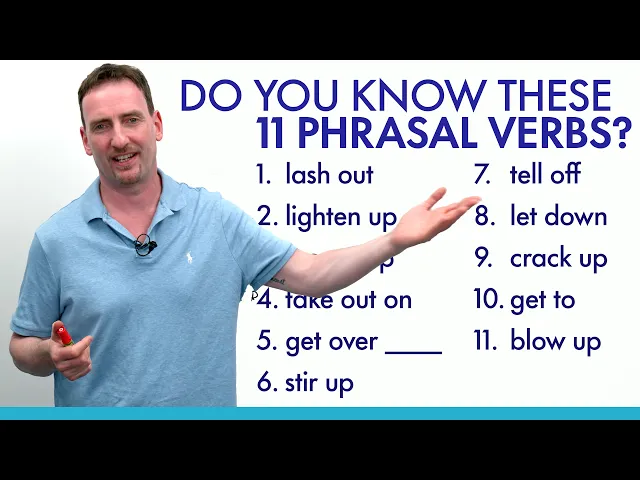
0:30 So, today we're going to look at "lash out" or sometimes "lash out at" someone.
0:36 "Lighten up", "loosen up" mean is essentially the same, so I put them together.
0:43 "To take something out on someone", "to get over something" or "get over it",
0:48 "stir up", "get to", "tell someone off", "let down", "crack up", and "blow up".
0:56 Now, the key to remember is that a lot
0:58 of phrasal verbs have more than one meaning,
1:01 some of them are completely unrelated and used in different contexts.
1:05 So, today we're only looking at the emotional context of these phrasal verbs.
1:10 Let's start with "lash out".
1:12 So, first of all, what is "lash"?
1:14 So, if you think of a whip, like "whoops",
1:16 I don't know if I do that well, some people do it perfectly.
1:19 Or in some places, when they want to punish you,
1:22 they take a very thin stick and they hit you on the back,
1:26 that action, to hit, is called "to lash",
1:29 "to give lashes", and that hit is the lash.
1:32 So, when you lash out at someone, you're...
1:35 Essentially, you're attacking them verbally.
1:38 Not physically, verbally.
1:40 You're saying some mean things or you're saying some very angry things.
1:44 Now, it's not always because you want to hurt them,
1:48 sometimes it's just like you're so frustrated
1:50 and the first person that comes in front of you,
1:53 you just lash out at them, you just attack them for nothing,
1:56 and then later you can apologize because it's not their fault.
1:59 So, "to lash out" or "to lash out at someone" specifically.
2:04 "To lighten up", if somebody says to you "oh, just lighten up,
2:08 you're too tense", or "loosen up, you're so serious all the time", right?
2:12 That means relax.
2:14 Don't be so uptight.
2:17 It's the opposite of uptight.
2:21 So, if you're too serious, too quiet,
2:25 maybe a little bit sad, somebody might say this to you,
2:29 "just loosen up, relax, have a good time",
2:31 especially if you're at a party, they'll say this to you a lot.
2:34 "To take it out on someone", so very similar to "lash out",
2:38 if you have a lot of frustration or a lot of stress
2:41 and you're angry and you just want to get this anger out of you,
2:45 you will do it to whoever is available, right?
2:48 Usually it's the people closest to you, which is not...
2:51 which is unfortunate, but it happens.
2:53 So, you take out your frustrations, your anger on someone.
2:57 You pass it on to them, you yell at them, you verbally abuse them, etc.
3:03 It happens.
3:04 So, you just take it out of you, put it on to them.
3:07 And then, that person will tell you, "just get over it.
3:12 Get over whatever problems you have,
3:14 just let it go", which is another actual phrasal verb.
3:18 Forget about it, whatever happened, let it pass, don't think about it,
3:23 don't worry about it, don't get stressed about it.
3:27 And if it's something, especially personal,
3:29 "get over yourself" basically means don't
3:32 think so much about yourself, you're not,
3:35 you know, the king or the queen of the country,
3:38 forget about it, move on to the next thing.
3:41 "Stir up".
3:42 Sometimes, like if you watch a movie,
3:45 for example, a movie will stir up your emotions.
3:48 They will...
3:49 you know, if you get a cocktail and you
3:52 put some different alcohols and ice and then you stir.
3:56 So, something stirs up your emotions and they come up to the surface
4:00 and maybe you start crying or yelling or laughing or whatever.
4:04 We can also use this to stir up trouble.
4:07 So, for example, if I'm making fun of you, I'm a little bit stirring you up,
4:13 means eventually you're going to have a very bad
4:16 reaction and maybe lash out at me for doing that.
4:21 "Get to".
4:22 If something gets to you, it could be positive or negative.
4:27 So, his, let's say, attacks,
4:32 somebody at work keeps telling me, "Oh, you're doing it bad,
4:35 you're doing it bad, you're doing it bad", but I know I'm not doing it bad.
4:39 So, all those critiques, all the criticism will eventually get to me.
4:44 It will affect me somehow, usually in a bad way.
4:48 But in a positive way, I saw a movie and the character's story,
4:53 like this is a true story, and this person,
4:58 this character, his or her story really got to me.
5:02 Again, affected, but in a positive way.
5:05 It made me feel very sad and I wanted to help or it
5:08 made me realize that I need to change the way I do things.
5:11 All kinds of different reactions,
5:13 but the fact is that something got inside and changed something in me
5:19 or made some emotions come up that made me want to change something.
5:24 So, one other way I want to explain, like the first one, the negative one,
5:28 if somebody gets to you, it can also, another word for that is like "annoy".
5:32 If somebody gets to you, they annoy you.
5:35 That's another explanation.
5:36 So, then if somebody gets to you and you're really angry,
5:40 you can just tell them to F off or just tell them off, right?
5:45 To tell someone off is to swear at them and tell
5:48 them just to go away or say really mean things to them.
5:52 Not a good situation, but it happens.
5:55 To let someone down or just to let down,
5:58 to be let down, etc., means disappointed.
6:01 So, I had very high expectations.
6:04 I wanted my daughter to get into university and I know
6:08 that she could have done it if she worked a little bit harder.
6:12 So, when she got the rejection letter from the college,
6:15 I was a little bit let down.
6:16 I was disappointed.
6:17 She let me down.
6:19 She let herself down even more, right?
6:21 Because she didn't try as hard as she could.
6:25 Okay, so then "crack up".
6:27 Again, two different meanings.
6:29 If you hear a really good joke and it makes you crack up,
6:33 it means laugh really loud and really free.
6:36 But if you have so much stress in your life and so many
6:40 bad things happening in your life and a lot of depressed people around you,
6:45 eventually you can crack up, you can go crazy.
6:48 So, very unrelated meanings.
6:50 Laugh really freely and really loud or go a little bit crazy,
6:55 like your brain cracked and then you don't know what to do with yourself.
7:00 And then last one, "blow up".
7:02 So, there's a literal "blow up" means explode,
7:04 but if a person blows up in terms of an emotional context,
7:09 it means they have a tantrum,
7:12 which is actually a very good word to know as well.
7:17 To have a tantrum means like a little child when he doesn't get his candy,
7:23 starts screaming and swinging his arms and hitting
7:26 his feet on the ground, that's a tantrum.
7:28 So, if you blow up at someone, that means you're having a very angry situation.
7:33 You're yelling at them, you're screaming,
7:35 maybe you're throwing things against the wall.
7:38 So, they will say that you blew up.
7:40 Okay, so there you go.
7:42 A few more phrasal verbs that you can use in everyday context.
7:46 Remember, emotional, some of them have other uses as well.
7:50 Now, if you want to make sure you understand all
7:53 of these, go to www.engvid.com and take the quiz there that I made,
7:56 and you can review all of these phrasal verbs.
7:59 And don't forget to come back next time,
8:01 and I'll give you some more useful vocabulary and expressions to study.
8:05 See you then.