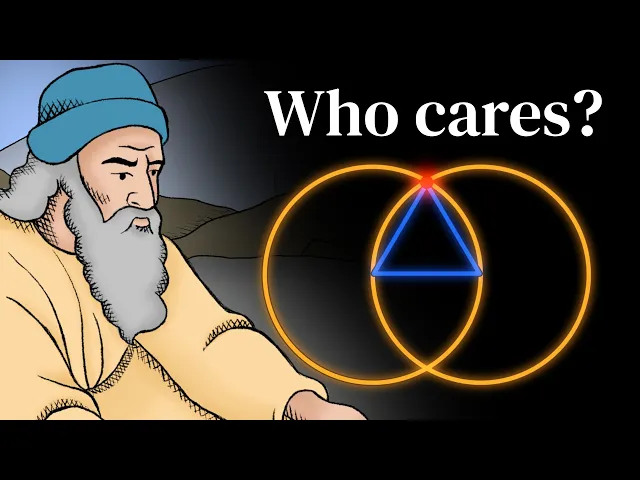
What was Euclid really doing? | Guest video by Ben Syversen
3Blue1Brown
0:00 [Submit subtitle corrections at criblate.com] This is the fifth and final
0:01 in a series of guest videos that I've been putting up on the channel.
0:04 The context, in case any of you missed the first one,
0:07 is that I have been away on leave this summer and I
0:09 decided to use the Patreon funds that were coming into the channel
0:12 during that time to commission a few guest videos from creators
0:15 who I am very excited to share with this particular audience.
0:19 By the way, I am back to making my own videos now,
0:21 currently working on a trilogy about the Laplace Transform,
0:24 the first of which is available as an early view for channel supporters channel.
0:27 Just, you know, throwing that out there.
0:30 This last guest video is probably
0:31 the most different from the channel's usual vibe
0:34 and yet I'm as confident as ever
0:36 that viewers of this channel will thoroughly enjoy it.
0:38 It comes from Ben Syverson,
0:39 who is a very talented and I think underappreciated creator who
0:43 makes these great mini documentaries about the history of math and science.
0:47 The content here changed the way I
0:49 think about Euclid and the history of geometry,
0:51 and perhaps it will for you as well.
0:54 This is the most influential math book in human history.
0:58 Euclid's elements.
1:00 For 2,000 years, it was the ultimate authority for absolute mathematical truth,
1:06 an enduring symbol of exact reasoning from the ancient Greeks.
1:10 But the Greeks didn't approach math the way we do today.
1:14 Their methods fly in the face of some
1:16 of the most important rules of modern practice.
1:18 But yet the approach that Euclid used in the Elements was
1:22 the most successful way to discover mathematical truth until the 17th century.
1:29 Ruler and Compass Constructions.
1:31 But, how could physical tools like these actually
1:36 be a reliable way to do abstract math?
1:40 Understanding what the Greeks were really doing
1:42 starts with the question that anybody who's ever had to use a ruler and compass
1:46 in geometry class has probably asked, what's the point?
1:50 What are these constructions actually for?
1:53 Most people would probably assume that the ruler and compass
1:56 are basically a way of drawing nicer looking shapes.
1:59 Like they're a quaint way of doing it if you don't have a computer.
2:02 And while that's not entirely wrong to the ancient Greeks,
2:06 it's far from the whole story.
2:09 To them, diagrams weren't just incidental schematic illustrations.
2:13 They were part of the reasoning of the proof itself.
2:17 This is not how we do math today.
2:19 Today, every single logical assumption needs to be explicitly stated,
2:23 like a line of code, and a proof isn't considered valid
2:27 until it's completely independent from any diagram.
2:29 But in Euclid's Elements, the compilation of Greek math from around 300 B.C.
2:34 things are different.
2:36 In Euclid's very first proof,
2:38 he makes what modern mathematicians would consider to be an unstated assumption,
2:42 basically a mistake.
2:44 To try to spot what Euclid missed in proposition one of the Elements,
2:48 you have to also know what his stated assumptions were.
2:51 Before he writes any proofs, he lays out some definitions.
2:54 Five logical assumptions called common notions,
2:57 and five assumptions about geometry called postulates.
3:00 Whenever one of these is used in a proof, it'll show up on screen.
3:03 We can read this proposition as a recipe for constructing
3:07 an equilateral triangle using a ruler and a compass.
3:10 You start with a line segment ab.
3:12 When you draw these two circles centered
3:14 at A and B that each have AB as a radius,
3:18 like this, then you get this intersection point.
3:21 Connecting the dots gives you another radius of each circle.
3:24 And of course, we know that the radius
3:26 of a circle is the same length everywhere.
3:29 So this is equal to this and this is equal to this, since
3:32 two things that are equal to the same thing are also equal.
3:35 Euclid proves that he's made an equilateral triangle.
3:40 Did you catch the unstated assumption?
3:42 You never proved that the two circles overlap each other.
3:45 This should have been some other axiom.
3:47 There should have been something else that said how we
3:49 know when the two circles overlap and when they don't.
3:52 But there's another way of looking at this.
3:55 Rather than making a mistake by relying on the diagram,
3:58 the Greeks were arguably using this series of steps
4:02 to build the equilateral triangle as part of the proof itself.
4:06 This is the perspective of Viktor Blåsjö,
4:09 who hosts the excellent podcast Opinionated History of Mathematics,
4:12 which features an 18 episode season about
4:15 Euclid's Elements and the history of geometry.
4:18 When people say there is a gap in the proof, you know,
4:20 I think it is like an anachronistic way of thinking about it,
4:23 that the existence needs to be ensured by a new axiom.
4:26 That's the way modern, you know, logic nerds think it's supposed to be right.
4:31 But in the spirit of the times,
4:33 we should start by thinking of mathematical proofs as something
4:37 that arose alongside the Greek tradition of antagonistic debate.
4:41 You have somebody trying to prove a claim and they're
4:44 confronted by a skeptic who wants to prove them wrong.
4:46 The prover is saying, now carry out these steps.
4:49 The skeptic is then asked to perform these steps and had
4:52 literally just drawn this in front of their very own eyes.
4:55 And then the skeptic is supposed to say, oh, no, I don't think they intersect.
4:59 There's no credibility.
5:00 You know, you just threw it, it's right there.
5:02 Anybody can see, you know, you just look, make yourself look ridiculous.
5:05 In the modern mathematics, you think of the skeptic as if it was
5:08 like a logic machine who is just like crunching axioms,
5:12 like a machine doing calculations, you know, and then, oh,
5:15 there's no axiom here, error, you know, but that's not this.
5:18 The context we must visualize, you know,
5:20 we must think of the, the degrees we're doing this.
5:23 If the skeptic wants to say, I think maybe they don't intersect,
5:27 then the burden is on him to give
5:28 a credible way that you could doubt that these are.
5:30 But if you literally just drew it in front
5:33 of you and it's obviously cutting right through it,
5:35 there's nothing you can say that has any credibility
5:38 to try to get around the fact that obviously they intersect,
5:41 you know, like any normal person would accept.
5:43 By following the steps in the elements,
5:45 our construction undeniably has two circles that intersect.
5:49 It's impossible to create this construction otherwise.
5:51 But how do we decide what's obvious in a diagram and what's not?
5:55 I mean, we can't just look at this diagram and say
5:58 the triangle is obviously equilateral because that's not a proof at all.
6:02 So why is it that we can use
6:04 the picture to know for sure that the circles intersect.
6:06 That is an inexact property because the drawing doesn't
6:09 need to be exact for the two to cross.
6:11 Obviously, however, what you want to prove
6:13 is that this is an equilateral triangle,
6:16 that all the three sides are exactly the same.
6:18 Well, that's different.
6:19 Well, maybe one of them is 99% the length of the other.
6:23 I don't know.
6:24 That's not self evident.
6:25 Obviously that's something that needs to be established with rational argument.
6:29 And like Euclid does.
6:30 This is a key distinction for this interpretation of Greek geometry,
6:34 which is going to come up again later.
6:37 Because Euclid never establishes exact
6:40 properties like equality based on diagrams,
6:42 but he does allow diagrams to be used for non exact or topological properties.
6:48 Whether a point is inside or outside of a figure
6:51 or the order in which points appear along a line.
6:54 This approach to geometry allows the written proof and the diagram
6:58 to go hand in hand to share the work.
7:01 The parts of the proof that were
7:03 impractical to demonstrate verbally are instead demonstrated diagrammatically.
7:08 So these diagrams, they're not just
7:10 a supplemental illustration to an otherwise logical argument.
7:14 They're actually part of the proof itself, which a skeptic would need to refute.
7:21 But for this to work,
7:23 we can't just draw any picture and start doing geometry with it.
7:26 Our diagrams need to follow rules.
7:29 So for every object that's specified in the elements,
7:32 its construction is given by a precise set of steps.
7:36 If the book says, let the equilateral triangle have been constructed,
7:40 then it's referring you back to Proposition 1,
7:43 where the steps for constructing an equilateral triangle are given.
7:48 From this point of view, an equilateral triangle isn't some perfect entity
7:53 that floats in the eternal Platonic realm.
7:56 It doesn't exist at all until you
7:58 follow the steps to make an equilateral triangle,
8:01 almost like the output from some lines of code.
8:08 But given that Greek mathematicians didn't write about their thoughts
8:11 and feelings and were making inferences from their technical work,
8:15 this is kind of a lot of inference
8:17 to take away from one little proposition about equilateral triangles.
8:20 So let's take a look at what Euclid does next,
8:23 because it's about to become very clear that there's more going on.
8:28 If the point of the ruler and compass was just to make accurate diagrams,
8:32 then the very next proposition wouldn't make any sense.
8:36 Proposition 2.
8:37 To place a straight line equal to a given
8:40 straight line at a given point at an extremity,
8:42 somebody has drawn a line segment on a piece of paper,
8:45 and now you want to draw an equally
8:47 long line segment somewhere else on the paper.
8:49 Euclid accomplishes this by a very elaborate construction.
8:54 That's Proposition one.
8:55 It involves drawing several circles and an equilateral triangle.
8:59 It's very elegantly indeed.
9:02 This leads exactly to what you need.
9:04 The given segment has been reproduced in a new position.
9:06 With exact mathematical precision, you can prove everything you know.
9:09 The equilateral triangle,
9:10 the radii and the circle are equal as all kinds of logical steps,
9:15 showing that this is correct.
9:17 This is something that I can literally do by picking
9:19 up this compass and putting it down in another spot.
9:22 So Euclid acts as if this is not possible.
9:26 One might say that Euclid behaves as if his compass is collapsible.
9:31 The compass stays at a fixed opening while drawing a particular circle,
9:35 but as soon as it's lifted from the paper, it collapses or closes up.
9:39 Of course, there are no collapsible compasses.
9:41 It's not a real thing.
9:43 Thus, AL is also equal to BC.
9:46 the moral of this is that this straight line here,
9:48 which was the one that I started with, is equal to this straight line here.
9:51 It's all very Neat.
9:53 It's also very weird, isn't it?
9:55 Seems totally out of touch with reality.
9:57 If a craftsman or an engineer or an architect would need to transfer a length,
10:03 surely they would not use Euclid's absolutely baroque procedure.
10:10 So what are we doing here?
10:12 If we followed these steps every time we wanted to copy a length,
10:15 even the simplest diagram would be incredibly complicated to make.
10:19 But if Euclid's constructions are about serving a theoretical purpose,
10:23 then things start to come into focus.
10:26 Proposition 2 becomes another verified operation
10:28 that you can add to your toolkit.
10:31 So each construction is like a little module or a little subroutine.
10:35 It's a bit of proof that signs off on the fact that this object
10:39 can legitimately be constructed using nothing
10:41 but the initial postulates and common notions.
10:45 Euclid's version of this construction works perfectly
10:47 for any situation involving copying a length.
10:50 So it's not saying that you have to do this every time,
10:53 but whenever we do want to copy a length,
10:55 we can invoke Proposition 2 to show that it is,
10:58 in fact constructible from the postulates.
11:00 But why did Euclid need to be this pedantic?
11:04 What was it about the Greeks that made them
11:06 so fixated on proving things in the first place?
11:09 Civilizations like the Egyptians and the Mesopotamians had been
11:13 doing math in service of things like surveying land,
11:17 collecting taxes, and constructing the pyramids for centuries,
11:20 but they never wrote proofs.
11:23 The first civilization to write proofs were the Greeks,
11:26 with the first proof coming around 600 BC.
11:30 For the Greeks, it wasn't enough for math to just be useful.
11:33 They wanted geometry to address deeply philosophical questions,
11:37 because at the time, philosophy was where the action was.
11:41 And the Greeks had a culture of antagonistic debate,
11:44 where the very nature of absolute truth was hotly contested.
11:47 While there were people arguing for all kinds of wild ideas,
11:51 two main camps emerged that we still think about today.
11:56 The first were the rationalists, epitomized by Plato,
11:59 who said that the only thing that can be trusted is intuition.
12:03 In this view, things like shapes exist in the perfect realm of ideas,
12:08 untarnished by worldly imperfections.
12:10 And then there were the empiricists, often associated with Aristotle,
12:14 who said that observations of the world are the only way to gain knowledge.
12:19 But these conflicting viewpoints were doomed to endless argumentation.
12:23 Their perspectives fundamentally came down to beliefs about how the world works,
12:27 so one camp would never definitively win out over the other.
12:31 But alongside this endless debate, mathematicians found a way to use
12:36 constructions to answer the objections of philosophers.
12:40 It let them build a consistent intellectual framework which
12:44 even outsiders could test and conclusively prove right or wrong,
12:48 and it meant that their field could develop new
12:51 irrefutable knowledge and leave those squabbling philosophers in the dust.
12:57 Math, specifically geometry, would become an indisputable source of absolute
13:02 truth in a world filled with uncertainty.
13:08 But to build knowledge within geometry,
13:10 mathematicians needed some starting assumptions,
13:12 a set of ground rules or demands that you would ask of a skeptic.
13:16 In ancient Greece, these demands were known as postulates or axioms.
13:21 We associate these words with math,
13:23 but their origin is in the crucible of philosophical debate.
13:27 For Euclid and the ancient Greek geometers,
13:30 the first three postulates in the elements
13:33 were basic assumptions about constructions.
13:35 If we agree that the straightedge can draw a segment of a straight line,
13:40 and that we can extend it if we need to, and if we also agree
13:43 that a device like a compass can form
13:46 a circle given a certain center and radius,
13:48 then we've established our first three ground rules.
13:52 It's crucial that any starting assumptions are simple
13:55 enough to be plausible and are free from contradictions.
13:58 Grounding the postulatin physical actions addresses these issues.
14:03 That's what the ruler and compass achieves.
14:05 It shows that Euclid's axioms are not just something some guy made up,
14:09 which is, we know that people can make up inconsistent theories.
14:12 So with the ruler and the compass,
14:14 we are now saying the we have geometries based on these axioms.
14:18 Furthermore, these axioms are instantiated in physical reality.
14:21 Therefore, they must be as consistent as the physical experience itself,
14:25 which has a greater track record than human thought and than just imagination.
14:29 Just making stuff up in your head has a fallible track record.
14:33 Many people have failed at doing that perfectly,
14:36 whereas direct experience is not full of contradiction.
14:39 You know, nature does not contradict itself.
14:40 We know that our first three postulates are consistent
14:43 because we can build them in the real world.
14:46 As long as you only use the straightedge for straight lines,
14:49 no measurement allowed, and the compass for circles,
14:52 then any other necessary assumptions are implied by these constructions.
14:57 Lines and curves are continuous because
14:59 they've been formed by a continuous motion.
15:01 And when they cross each other, they intersect at a point.
15:04 The Elements goes on to build every single geometrical object
15:07 that it ever uses with a ruler and compass construction,
15:10 followed by a proof of its validity.
15:13 So in a sense, the ruler and compass become
15:16 like tools for building geometrical knowledge from the basic postulates.
15:21 But if these constructions are meant to be
15:23 embedded in the philosophy of Euclidean geometry,
15:25 then there was a big problem that these greek
15:28 geometers were going to have to reckon with, because
15:30 it was well known at the time that diagrams
15:33 could have subtle mistakes that would ruin an entire proof.
15:36 If a mistake found its way into a geometric theorem,
15:39 then not only would the proof be wrong,
15:41 but it could potentially ruin the credibility of geometry.
15:45 Because how can you trust a system
15:46 of thought if it's been shown to make mistakes?
15:50 Here's an example.
15:51 I'm going to prove to you that some
15:53 right angles are not equal to other right angles.
15:56 Now, to be clear, this is completely wrong.
15:58 In fact, Euclid's fourth postulate says that all right angles are equal.
16:02 But in this proof, the reasoning behind every single step is flawless,
16:06 except for one subtle, almost invisible mistake which ruins the whole thing.
16:12 Here's a square.
16:13 It's got four equal sides and four right angles.
16:17 I'm going to draw a line over here,
16:18 which I've measured to have the same length as the sides of my square.
16:22 And then I'm going to connect this point to this point.
16:26 So this, this, this, this, and this are all congruent.
16:30 Next, I draw a perpendicular bisector to this side up here.
16:34 And then I draw another perpendicular bisector to this side down here.
16:39 Then I connect these points and I make two triangles here.
16:43 This down here is a perpendicular bisector, which makes these two sides equal.
16:48 Meanwhile, since it's perpendicular, this angle is also equal to this angle.
16:52 And then finally, this side is shared by both of the triangles.
16:56 So side, angle, side, these two triangles are congruent.
16:59 So that means that this length is equal to this length.
17:03 Next, I'm going to draw a line here and a line here.
17:07 If I look at these two triangles once again, this was a perpendicular bisector.
17:12 So this length and this length are equal.
17:14 This line is shared between the two triangles,
17:17 and it's perpendicular, which makes these two angles equal.
17:21 Because of this, these two triangles are congruent.
17:23 And that means that this side and this side are also equal.
17:27 Okay, so far, we have two pairs of triangles which are each
17:31 undeniably equal to each other because
17:33 they came from drawing these perpendicular bisectors.
17:36 And that also means that this third side for each pair is congruent as well.
17:42 So now, this triangle and this triangle also have side,
17:45 side, side congruency with each other.
17:49 Hmm.
17:49 But this is a right angle plus some other angle.
17:52 I'll call that measurement alpha.
17:54 We know it's the same over here because these were congruent triangles.
17:58 So alpha plus a right angle again.
18:00 But this right angle is bigger than
18:02 the other one because of this little extra piece.
18:05 So what happened?
18:08 Well, because my perpendicular bisectors are drawn slightly wrong,
18:11 the diagram made the triangle on the right look
18:14 like it's basically symmetrical to the triangle on the left,
18:17 instead of being completely outside of the square like this.
18:21 Since the right angle of the square is no longer inside of the triangle,
18:24 the proof completely falls apart.
18:26 This is why modern math is so stringent about avoiding diagrams.
18:30 That single hidden assumption about where the triangle is located gave
18:33 us a diagram that allowed us to prove an impossible result.
18:37 But the Greek practice of ruler and compass
18:40 constructions has an answer to this problem.
18:43 Because if you use the recipes from the Elements
18:45 to properly construct the diagram for that false proof,
18:48 you would avoid the subtle mistake that I
18:50 just made when I drew the picture by eye.
18:53 Even if your constructions have a certain margin of error,
18:56 following the steps from the Elements still gives you
18:58 the precision that you need to determine these inexact properties,
19:02 like which point lies inside or outside of which shape.
19:05 Shape.
19:06 In the context of Euclid's Elements,
19:08 if a diagram like this hasn't been properly constructed,
19:11 it effectively doesn't exist, or at least it can't be used in a proof.
19:15 In fact, Euclid is very careful throughout the Elements to only
19:19 ever use shapes that he's already shown how to construct.
19:22 As he proves new theorems,
19:23 he introduces new shapes that these new tools allow him to build.
19:28 But this leads to some surprises.
19:30 Shapes that seem like they should be simple,
19:33 but actually aren't, for example, squares.
19:35 If you asked me to construct a square
19:37 using Euclid's propositions and I didn't know any better,
19:40 I'd probably say the simplest way to do it would be something like this.
19:44 Draw a line segment.
19:45 Construct another line segment equal
19:46 to the first and perpendicular to the first, using Proposition 11,
19:50 and then just do the same thing again and then again one more time,
19:54 and you have a square.
19:58 But when it comes time to prove that this really is a square,
20:01 we've got a problem.
20:02 Because to be sure that the side opposite the first
20:05 one really is the same length as the original,
20:08 we would need to say something about parallel lines.
20:11 Euclid waits until more than halfway through book one before
20:15 he finally uses his most famous and most controversial postulate,
20:19 postulate 5, the parallel postulate.
20:23 Unlike the other postulates, it's not simple or intuitive.
20:27 Even the actual statement is strangely convoluted.
20:30 "If a straight line falling across two other straight
20:33 lines makes internal angles on the same side of itself,
20:36 whose sum is less than two right angles,
20:38 then the two other straight lines being produced to infinity
20:41 meet on that side of the original straight line,
20:44 that the sum of the internal angles is less than
20:47 two right angles." This is a statement about non parallel lines.
20:52 But taking the contrapositive gives
20:54 logically equivalent information about parallels.
20:57 Anytime two lines don't cross, then the sum of the angles equals 180 degrees.
21:02 Today, we usually say it like for any line and a point not on the line,
21:07 there's exactly one line through the point which is parallel to the first line.
21:12 But in the context of ruler and compass constructions,
21:16 the first one is not the same as the other two,
21:19 because there's no way to physically verify
21:22 that lines continue forever and never intersect.
21:25 How do you check for never?
21:28 Even though Euclid's definitions say that parallel
21:30 lines are two lines that never intersect,
21:33 when it comes time to ask somebody to accept an assumption about them,
21:37 he avoids the problem of checking for never
21:39 by phrasing it in a way that can be constructed.
21:44 Whenever two lines are drawn through a transversal so that they're converging,
21:47 they'll cross eventually.
21:49 It's an assertion that's physically checkable,
21:52 even if doing it in practice requires a bit of extra space.
21:57 But even so, this is not empirical science,
22:00 because this postulate lets Euclid derive theorems
22:02 about parallel lines that are not physically checkable.
22:06 We can't actually make lines that go on forever without touching,
22:10 especially on the spherical surface of the Earth.
22:13 So Euclid is is using physically verifiable principles to develop
22:17 a theory that goes beyond the scope of empirical observation.
22:21 It's an approach that's different
22:23 from both Platonic rationalism and Aristotelian empiricism.
22:27 And once he introduces the parallel postulate
22:29 for the first time in Proposition 29,
22:31 all of the subsequent theorems and constructions require it for their existence.
22:36 This kind of additive structure of the elements reveals hidden
22:39 complexities in shapes that we might have assumed to be simple.
22:43 So Euclid's construction of a square is much more complicated than mine.
22:47 In fact, when I followed his construction
22:49 and I included all the subroutines from earlier propositions,
22:52 it took me close to 10 minutes just to make a square.
22:56 Proposition 46: "To describe a square on a given straight line,
23:01 let AB be the given straight line." "Let AC have been drawn at right angles
23:05 to the straight line AB from the point A on it." To get a right angle,
23:09 I have to go to proposition 11.
23:11 Proposition 11: to draw a straight line
23:12 at right angles to a given straight line.
23:14 Let AB given straight line, and C a given point have been taken at random on it,
23:19 and let CE be made equal.
23:20 And let the equilateral triangle FDE have been constructed on proposition 1.
23:24 Make AD equal.
23:25 Propositions 3, DE have been drawn through point D parallel to...
23:30 31.
23:30 Draw a straight line parallel to a given straight line through a given.
23:33 Gonna have me make alternate.
23:35 Let angle DAE equal to angle ADC have
23:37 been constructed on the straight line DA proposition 23.
23:42 Back to proposition 47.
23:43 Let DE have been drawn through point D parallel to AD.
23:46 And let BE have been drawn through point B parallel to AD.
23:49 This and this are parallel, and this and this are also parallel.
23:52 And this angle is equal to.
23:53 Thus we have a square with four equal sides and four right angles.
23:58 The key steps here were that after drawing the second side
24:01 so that it was perpendicular and equal in length to the first,
24:05 the third side was constructed to be parallel to the first,
24:08 and the fourth side was parallel to the second.
24:11 This allows him to then use
24:13 the already established properties of parallelograms to state
24:16 that the opposite sides and the opposite angles are all equal to each other.
24:21 With my simpler method of constructing the square,
24:24 I wouldn't have been able to prove that it
24:26 was a square at all without invoking the parallel postulate.
24:29 But it's actually even worse than that, because without the parallel postulate,
24:34 squares don't exist.
24:37 If the parallel postulate is false,
24:39 one can instead prove that this configuration does not make a square,
24:44 but rather a weirdly disfigured quadrilateral.
24:47 So even though you made sure you had
24:50 right angles at the base of the quadrilateral,
24:52 and that the perpendicular sides were equal,
24:54 the fourth and final side somehow still manages to miss the mark, so to speak.
24:59 It makes non right angles.
25:01 It's as if the sides are sort of bent.
25:04 It's not that Greek mathematicians were doubting whether or not squares existed.
25:08 Or that Euclid somehow anticipated non Euclidean geometry, which he didn't.
25:13 But rather it's that Euclid was using the process of constructions combined
25:18 with axiomatic deductive proofs to pin
25:20 down the very foundations of geometric knowledge.
25:23 To systematically catalogue every assumption that's required
25:27 before we can make something like a square.
25:31 So the Elements isn't just a collection of proofs
25:34 accompanied by subroutines showing how to construct geometric objects.
25:38 It's a taxonomy of the exact components
25:41 that are required for any geometric object.
25:44 A family tree of the universe of geometry.
25:47 And with this type of analysis,
25:49 Euclid is able to identify precisely what fundamental starting
25:53 assumptions are required for the entire Greek system of geometry.
25:58 It's not obvious that the square requires the parallel postulate to be
26:02 true until you pull it apart and put it under a microscope.
26:07 But for centuries, other mathematicians were sure that Euclid
26:11 had made another mistake by calling postulate 5 a postulate.
26:16 This complicated prediction about two lines crossing seems
26:19 more like a theorem that should be proven, not a postulate to be accepted.
26:23 In the Dark Ages when Europe had forgotten about the elements
26:27 and the only people actively studying it were in the Middle east,
26:31 the Arab mathematician Ibn Al Haytham and the Persian scholar Omar
26:35 Khayyam both tried to prove the parallel postulate as a theorem.
26:40 And they weren't the last to try either.
26:43 Many people tried to improve on Euclid in this way.
26:47 Around 1800, people like Lagrange and Legendre
26:50 proposed so called proofs of the parallel postulate.
26:54 These are big name mathematicians.
26:57 Their names are engraved in gold on the Eiffel Tower elite establishment stuff.
27:04 But even these bigwigs were wrong.
27:07 Their proofs contain hidden mistakes.
27:10 It's astonishing that this was more than 2,000 years after Euclid.
27:14 People tried to improve on Euclid for millennia.
27:19 The fact is that Euclid was right all along.
27:22 The parallel postulate really does need to be a separate assumption,
27:25 just as Euclid had made it.
27:27 It cannot be proved from the other axioms,
27:29 as so many mathematicians during those millennia had mistakenly believed.
27:35 The Greeks, you know, those guys were really something else.
27:38 It's so easy to make subtle mistakes in the theory of parallels.
27:42 History shows that there are a hundred ways to make
27:45 tiny invisible mistakes that fool even the best mathematicians.
27:49 Top mathematicians, they were never wrong about anything else.
27:51 They stumbled on this one issue and somehow Euclid got it exactly right.
27:57 He didn't make any of those hundred mistakes that later mathematicians did.
28:01 It's not luck, in my opinion.
28:04 Arguably, the Greeks were genuinely more sophisticated foundational
28:09 geometers than even the Paris elite in 1800.
28:14 Unbelievable, but true.
28:16 Euclid's Elements is not a classic for nothing.
28:19 Euclid is not a symbol of exact
28:22 reasoning because of some lazy Eurocentric birthright.
28:26 No, Euclid's Elements, it really is that good.
28:33 Euclid's construction of the square leads directly
28:37 into the culminating proof of book one,
28:40 the Pythagorean theorem and its converse.
28:42 From there, Euclid has five more books about plane geometry
28:46 before moving on to number theory in books 7 through 10,
28:49 where he gives theories of prime and irrational numbers.
28:53 Even within number theory, Euclid gives every proof a diagram seeming
28:57 to suggest that even numbers are subservient to geometry.
29:02 After all, numerals can't precisely represent an irrational
29:06 number like the square root of 2.
29:08 But a geometric construction can easily show that length.
29:13 The final three books cover three dimensional geometry,
29:16 culminating with the construction of the five Platonic solids and proving
29:20 that they're the only five ways to create 3D figures from regular polygons.
29:25 But this wasn't just the work of a single person.
29:28 It was the culmination of the work of generations of Greek mathematicians,
29:32 other elements of mathematics, and existed before Euclid's.
29:36 But his is the one that survives
29:38 because its impeccable structure made the others obsolete.
29:42 This book and the system of ruler and compass constructions at its core,
29:47 Acted as the arbiter of absolute mathematical truth for the next two millennia.
29:52 The middle eastern scholars who built on the elements
29:55 during the dark ages Developed powerful empirical science,
29:58 which laid the groundwork for the modern scientific method.
30:02 Once Europeans started to read Euclid again,
30:04 Ruler and compass constructions were seen
30:07 as the only path to absolute mathematical certainty.
30:10 Even as the powerful Islamic innovation of algebra found its way to Europe,
30:15 the Europeans saw it as less rigorous than geometry,
30:18 A tool for mere practical applications
30:20 or a mathematical trick for finding the right answer.
30:23 They were skeptical of algebra for centuries because it used
30:27 symbols instead of the physically verifiable procedures of Euclidean geometry.
30:32 In the 17th century,
30:34 when Rene Descartes took the bold step of assigning coordinate values to points,
30:39 the beginnings of analytic geometry,
30:41 he still justified his work with constructions.
30:45 To him, the ruler and compass were like a mechanism for trust.
30:48 His philosophy was to doubt everything.
30:50 But even he didn't doubt Euclid's postulates.
30:54 Descartes went so far as to create new compasses,
30:56 Mechanical devices that were more complex than the ruler and compass,
31:00 but which served a similar constructive purpose.
31:03 He wanted to bring absolute certainty
31:05 to the mathematics of higher degree curves,
31:08 which go beyond the scope of what's constructible with a ruler and compass.
31:12 So even as he revealed the power of using algebra to do geometry,
31:17 he still couldn't let go of constructions,
31:19 Even though he has the alternative right there.
31:22 You know, to do it algebraically, to take algebras to fundamental foundation,
31:26 is he's the one who shows that that could easily be done.
31:29 And still he refuses.
31:31 He has the standing at the gates of paradise where he's denying himself,
31:34 you know, saying, no, no, no, that's wrong.
31:36 We should do it this way.
31:37 He insists on this classical stuff eat despite himself.
31:40 But soon the reign of constructions as the philosophical
31:43 bedrock for math would have to come to an end.
31:46 The 19th century realization that there are valid
31:49 forms of geometry where the parallel postulate is false,
31:53 along with other seemingly contradictory discoveries in that century,
31:56 led to a sear formal foundations for math.
32:00 Math increasingly turned to formal logic,
32:02 which today is embodied by computer systems.
32:06 Rather than relying on intuition or abstract thought,
32:09 computerized proof checkers like Lean serve a similar purpose to the one
32:12 that a skeptic with a ruler and compass would have served in ancient Greece.
32:17 Just like in those early days of axiomatic deductive mathematics,
32:22 we still need tools that ground abstract reasoning in in systematic,
32:26 verifiable procedures.
32:29 Instead of constructions.
32:30 Computer systems are built on countless on off switches of transistors,
32:34 following explicit checkable rules.
32:38 As is the case with Euclid,
32:40 smaller operations based on fundamental starting points form
32:43 subroutines that build into ever larger programmatic structures.
32:47 But where Euclid's basic operations were lines and circles,
32:52 ours are ones and zeros.
32:57 There was a very strong parallel between understanding
32:59 what Euclid was really getting at with constructions,
33:02 and like my own process for making videos with programmatic animation,
33:05 that which felt like a very modern thing,
33:08 like wanting to implement it on a computer,
33:10 was actually maybe more reflective of how people's
33:13 relationship was with math through most of history.
33:16 I don't have...
33:16 I'm not a computer coder,
33:18 but there are many similar ways where actually having to instantiate
33:21 something changes it from what you had in your mind.
33:25 And I did find that kind of core idea.