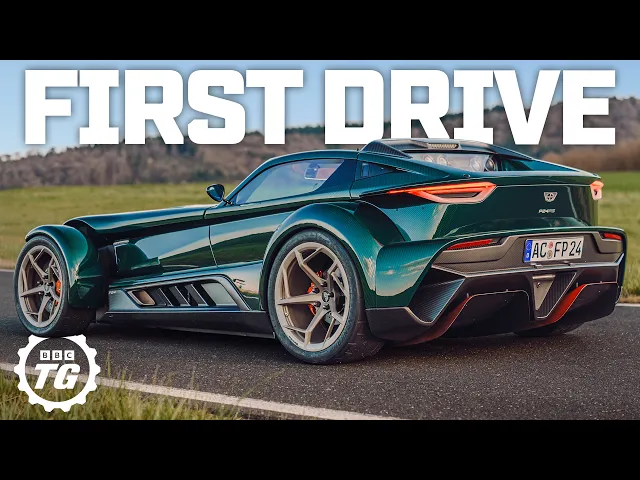
New Donkervoort P24 RS: The Most Extreme Lightweight Supercar! | 4K
Top Gear
0:00 This is the Donkervoort [music] P24 RS, a car inspired by the Lotus Seven
0:05 but hyper-evolved with proprietary carbon fiber technology,
0:09 sophisticated suspension, refined and radically adjustable aerodynamics,
0:13 and a 600 horsepower 3.5 L twin-turbocharged V6 [music] engine.
0:19 So, today on some fantastic German roads, we're going to answer two questions.
0:23 [music] First, the Donkervoort, and secondly,
0:27 have they breathed new life and new energy into the Seven formula,
0:32 or have they forgotten what made it so special in the first place?
0:36 Oh, and we're in Germany, so why don't we find out how fast it goes, too.
0:42 [music] The P24 RS really is a spectacular object,
0:51 and so much of it seems the perfect
0:53 antidote to spiraling weight and ever-increasing complication.
0:57 Put simply, it's a 780 kg front-engine,
1:00 rear-drive sports car with a super-stiff chassis,
1:03 manual gearbox, and a power-to-weight ratio to shame most hypercars.
1:08 You want purist?
1:08 [music] The P24 RS lists power steering and ABS as options.
1:13 Donkervoort claim it will pull 2.3 G in the corners,
1:17 cover naught to 124 mph in 7.4 seconds, and run to over 186.
1:23 Just 150 will be made, and the P24S costs around 312,000 lb plus options.
1:36 Of course, you don't just arrive at a car like the P24 RS.
1:40 In fact, Donkervoort's history stretches back to 1978,
1:44 when Joop Donkervoort decided to import the Lotus Seven into the Netherlands.
1:48 It's still a family-run business, actually, run by his son, Denis.
1:51 But back in '78, the dream didn't really work out
1:54 because the Seven couldn't be homologated for sale in the Netherlands.
1:58 Instead, he had to develop this car, the S7.
2:00 So, that Divergent story begins immediately,
2:04 away from the Lotus 7 into a different direction.
2:07 Very unlike Caterham, who basically stayed true to that original 7.
2:12 So, S7, 1.6 L Ford engine, bigger chassis, different front suspension,
2:17 a number of changes to make it suitable for the local market.
2:21 Lotus didn't really like them using the S7 name.
2:24 So, this is the S8, which came along in '82.
2:29 2 L Ford engine this time, bespoke front suspension,
2:33 but there was a lot more to come.
2:34 So, the S8A came along in 1985.
2:39 The A is for Amber, so Joop's daughter.
2:42 Fuel injection added, still the Ford engine, new independent rear suspension.
2:47 So, ticking along really with the upgrades,
2:50 but you can see how big a leap they started to take [music] with this car,
2:55 the D10, that came out in 1988.
2:57 So, turbocharged Ford engine now,
3:01 but the key about this car is the aerodynamics.
3:04 You can see that they're really starting to think about aero,
3:07 and that that's going to be a big part
3:09 of their future aesthetically and also from an engineering point of view.
3:14 For now, this is the end of the Donkervoort Ford story,
3:17 and in their place we find Audi power.
3:19 First in the experimental D20, fitted with a 2.4 L V6,
3:24 and then the D8 production car, which used the classic 1.8 L turbocharged
3:29 four-cylinder Audi engine and was introduced in 1999.
3:34 The D8 GT arrived in 2007 and was the first closed-roof model.
3:38 The knee Donkervoort raced it with good success in the GT4 category, too.
3:43 Taking us almost up to date is the D8 GTO, O for open, introduced in 2011
3:48 and with Audi's brilliant five-cylinder turbocharged engine.
3:53 And that takes us all the way to the F22, which came out in 2022.
3:58 Completely new chassis, new arrow, new interior,
4:02 new roof system, carbon fiber obviously.
4:05 Everything was changed except the powertrain.
4:08 Effectively, they kept that Audi five-cylinder engine.
4:11 It was developed by Abt for them, 500 horsepower.
4:14 But it's laid the foundation for what was to come.
4:17 They didn't want to change the powertrain at the time,
4:19 but they knew that that was coming.
4:21 They wanted a different engine, more power, more response,
4:25 and that's led very nicely into what we have now,
4:28 which is the P24RS, which is just a whole different world.
4:36 [music] So, that brilliant story has led us to this, the P24RS.
4:45 So, I wanted to start inside the car because it's such an alien environment.
4:51 You don't really see Donkervoorts.
4:52 I've always wanted to drive one.
4:54 So, let's talk about the interior.
4:57 First off, the driving position.
5:00 It's sort of reminiscent of a Caterham
5:04 in that you're sat right over the back axle,
5:06 but the car feels so much more substantial.
5:10 It feels small, but not teeny, not like a teeny lightweight track car.
5:17 And actually, the long bonnet,
5:20 the placement of where you're sat within the chassis,
5:25 is sort of reminiscent of something like a Ferrari 812 Superfast,
5:28 which is a pretty good thing to be reminiscent of, isn't it?
5:32 What else have we got in here?
5:33 Well, the fit and finish is actually lovely.
5:36 Everything you touch is cool.
5:37 I love the sweep perfect carbon fiber and leather.
5:42 And there's some cool details.
5:44 You can see the inside of the chassis in the foot wells, which is quite fun.
5:49 The environment itself is pretty tactile place, as you'd hope really.
5:54 I've got physical controls for the heater,
5:56 heated seats, which came in useful earlier today.
5:59 Wipers, the headlights.
6:02 There's also the um indicators on here, just like in a Lamborghini or a Ferrari.
6:07 But, the real key to this car is down here,
6:09 and again, physical buttons just what we want.
6:12 The engine, the power to choose engine they call it.
6:15 Three modes.
6:17 PTC.
6:18 C for comfort, T for touring, P for performance.
6:22 Those steps are 400, 500, and 600 horsepower.
6:28 Traction control and ABS are combined into one controller.
6:32 So, you're controlling both when you change
6:35 your position on this little dial down here.
6:38 Most restrictive is level five.
6:40 So, let's call that very cold day.
6:44 Level three is what I've been told today.
6:46 Cold day, but no rain on the ground anymore.
6:49 It was a little bit damp this morning,
6:50 but three is a good um compromise setting.
6:54 Two and one are more for slicks, actually.
6:56 They set this car up for slicks, too.
6:58 And then, zero is all traction control gone,
7:03 but just a little bit of ABS assistance.
7:05 Again, I think that's a good idea.
7:07 The next little controller does the suspension.
7:10 So, track dampers, no anti-roll bars on this car.
7:15 And they start at level zero,
7:16 which means they're effectively like working like passive dampers,
7:19 and then they click up from one to five.
7:21 So, increasingly stiff, increasingly more roll control.
7:27 To really dial this car down into the surface.
7:31 Honestly, on the road, I'd use zero or one.
7:34 You don't need to go any stiffer than that.
7:36 Again, the beauty of not having huge amounts of weight,
7:40 don't need super aggressive damping to the car
7:44 to support that body all the time.
7:46 So, the car's stiff, but it does move nicely with the surface.
7:50 It's just a really cool thing.
7:52 I love these little periscope air vents.
7:55 They remind me of like early Zondas or something.
7:57 They're not quite as gorgeous and intricate.
8:01 So, there's a real sense of craftsmanship to the interior, but also focus.
8:07 I was going to say it's like a Caterham 7 if Pagani did the interior,
8:12 but that's not right because that would be too ornate and too intricate.
8:15 This is maybe a Koenigsegg if they ever did a Caterham 7.
8:21 But it's so different from those 7 roots that I'm
8:27 not really going to speak about that car again.
8:30 This is something very, very different.
8:36 So, let's look in detail at it and discover why, how that journey has brought us
8:43 from a very basic concept to something that genuinely
8:51 can be talked about in the same breath as those hypercars or high-end supercars.
9:00 I love doing walk-arounds of cars like
9:02 this and this car in particular because it's so tiny.
9:05 So, it's not going to take too [music] long.
9:06 However, there's lots of really impressive details that we can go through.
9:11 But before we do, a lot of the fascination
9:13 with a Donkervoort is what lies beneath the skin.
9:16 So, let's go back to the very start.
9:23 So, this is the very start of the process.
9:25 Tubular steel, high-tensile steel welded together to form this frame.
9:30 So, this is the basic chassis.
9:32 You can see all these welds.
9:33 They're sort of a goldy color.
9:35 There's a high copper content within
9:37 the welding process that makes it lower temperature,
9:39 means you're not stressing the raw material, the steel.
9:43 What you end up with is something that doesn't
9:45 look particularly dissimilar to something like a Caterham underneath,
9:49 bit bigger obviously, but from here the process really changes because
9:54 the next station is where the X Core carbon fiber,
9:57 which is Donkervoort's own patented material or process comes together
10:03 to form the real [music] chassis and it makes it incredibly stiff,
10:06 58,000 Newton meters per degree.
10:09 So, start over there, powder coated,
10:13 and then the chassis comes over here and it's being
10:15 prepared [music] to marry the steel structure with these side panels.
10:20 This is the carbon fiber X Core material.
10:23 It's a sandwich material basically, but it's Donkervoort's own process,
10:26 so you lay the carbon fiber,
10:28 then you add this foam and it goes into an aluminum tool,
10:31 you heat up that foam and it forms these incredibly intricate,
10:36 lightweight and really, really strong panels.
10:38 It's a really cool technology, also used in WEC by Toyota,
10:42 they supply to F1 teams that they can't talk about, drones, all sorts of stuff.
10:47 It's a small place, but there's so much going on here.
10:50 This is the production facility, so the orange car over there is the very
10:55 last F22 and then these are the first P24s.
10:59 So, [music] now you can see the chassis complete with the X Core side panels,
11:04 so now it's ready to get built up.
11:06 This is actually the very first production chassis P24 RS,
11:10 so this is the X Core new front structure.
11:14 It's got suspension mounting points on it,
11:15 we've got these tractive dampers, carbon ceramic brakes.
11:19 It's really cool, everything in miniature because
11:21 the car's so much lighter than a traditional hypercar,
11:24 but as you can see, effectively the F22 had
11:27 a tubular chassis that went all the way to the front.
11:30 They cut it off here to create this new [music] X-Core.
11:34 uh Um, I guess you could almost call it a subframe.
11:38 The reason they've done that is because they really wanted
11:40 to shorten that inlet tract um to the front of the engine,
11:44 increase response time effectively.
11:46 And then this Ford engine,
11:48 [music] 3.5 L twin turbo V6, again, the key was response.
11:52 So, they've actually had their own smaller turbos put on the car
11:55 to make sure that it revs uh and gets into the boost quicker.
11:59 It's got unique camshafts.
12:01 All of this inlet is created in-house.
12:04 There's [music] just so much care,
12:06 attention, and expertise poured into this car.
12:10 So, that's a little look at the production process.
12:13 As you can tell, really high quality, innovative, and lightweight.
12:18 That's the key, lightweight.
12:19 [music] And that's what we're going to enjoy on the road, hopefully.
12:21 And let's go back there and look at some
12:23 of the other details of a fully built, finished car.
12:30 I think [music] it looks absolutely spectacular.
12:33 The shape, the detailing, but there's so much supercar goodness in this.
12:40 [music] It's not a cheap car, 298,000 euros plus taxes,
12:42 plus options, and there are plenty of options.
12:45 For example, this [music] exposed lacquered carbon finish,
12:49 60,000 euros, and there's plenty more where that came from.
12:53 The tiniest little ceramic brakes I think I've ever seen.
12:56 They're so cool.
12:58 Uh they're an option, too.
13:00 There are three wheel options.
13:01 There's a standard braid wheel.
13:02 This is the forged wheel, so lighter again, but they also do a magnesium option.
13:07 So, you can really tailor the car to what you want,
13:09 and you can go very extreme in terms of lightweight.
13:12 One thing that is quite interesting is the tires.
13:15 Now, they wanted a sort of extreme [music] track-type tire,
13:18 and they've ended up with two options,
13:21 but they are bespoke, and they're built by Nankang.
13:23 Probably not the brand that you would
13:25 normally associate with high-end supercars or hypercars,
13:30 but this car is so light [music] that when
13:32 they tried Cup 2s or Pirelli P Zero Trofeos,
13:37 they just can't get any heat into them.
13:39 So, they need a bespoke tire, but when you go to Michelin,
13:42 Pirelli, whoever, and ask for a bespoke tire,
13:45 they want you to order hundreds of sets,
13:48 which is definitely not what Donkervoort's about.
13:50 Nankang said, "Yeah,
13:51 we can build you a bespoke tire that you don't need a minimum order
13:55 and we know you're a small company." They just wanted a flagship brand really.
13:58 So, there is a more extreme tire than this, believe it or not.
14:01 This is the sort of more road orientated with a bit of track work tire,
14:05 but like I said, ceramic brakes as an option.
14:08 Probably don't need them.
14:09 This car's so light, but again, less rotational mass, less unsprung weight.
14:15 Other cool stuff, obviously the side exit exhausts.
14:17 They thought about combining both banks to make more of a V6 sound,
14:22 but in the end, they just wanted turbo exhaust.
14:25 It's about that long [music] I think the exhaust.
14:27 So, the noise and the heat and the flames will be pretty spectacular.
14:32 This is the standard exhaust.
14:33 There's also a titanium option as well.
14:36 Um, other things I want to show you,
14:37 obviously to open the door, press this little door handle.
14:42 We've got these little butterfly doors.
14:43 You can see it's a pretty high sill.
14:45 So, it's not the easiest thing to get in and out of elegantly.
14:49 Um, but if I press this button, [music] no, if I press this button,
14:54 I want you to see the boot because this car's huge.
14:57 There's like 300 L of luggage space.
14:59 You could [music] easily fit two roll-on bags or quite a big suitcase in there,
15:04 which is really impressive.
15:05 It says max load 50 kilos, but they said that's just for homologation purposes.
15:09 Actually, you can put in as much as you want.
15:12 Um, we should talk aero because they've worked pretty hard
15:16 on the aero and there [music] is a really interesting optional aero kit.
15:21 And it actually consists of physical parts that you take on and off the car.
15:25 So, you get a much wider front splitter, basically,
15:29 and then you get some really cool rear They're almost like
15:33 special alloy style C-shaped wings that fit on the back here.
15:38 They take about 40 minutes to fit,
15:40 but that increases downforce to 90 kilos on the front
15:43 axle and 90 kilos on the rear axle.
15:45 So, if you're going and doing track work,
15:47 that's [music] probably something that you'd want to do.
15:49 On the road, the rears would be fine,
15:52 but the front the ride height just becomes too low to really be usable.
15:55 I actually think it'd be a good idea to do some sort of
15:59 [music] middle ground because this car looks great,
16:01 but when you put that front splitter on, it looks really really cool.
16:04 And if they could make a slightly less extreme one for road use,
16:07 I think owners would really really love it.
16:10 What else do we need to talk about?
16:12 [music] That's the great thing.
16:14 Not much else.
16:15 No hybrid, no torque vectoring.
16:17 The old F22, the 570 in the car, had a Torsen diff.
16:21 Now it's got a mechanical plated diff.
16:23 [music] Five-speed manual box.
16:26 They say because the car's so lightweight, you don't need more than five ratios.
16:30 It means the car is pretty long geared.
16:33 I would agree with them that you don't need six ratios,
16:36 but you don't really need a 780 kilo car [music] with 600 horsepower.
16:40 So, why not have a cool little six-speed?
16:43 You want to engage with the car.
16:44 That's the whole point of it.
16:45 So, the more you change gear, in my opinion, the better.
16:47 But apart from that, I have to say, it just seems such a cool little thing.
16:54 The optional roof is fantastic.
16:56 Um carbon turns it into a [music] proper little coupe.
17:00 Really love the aesthetic when the roof's up,
17:03 and we're going to do that because this is not just a lightweight track car.
17:08 It's a car that you can use and it's a car that they say will do 300 km an hour.
17:13 I'm not sure we're going to get quite that fast,
17:15 but I want to see what it's like.
17:17 Has it got that high-speed stability,
17:19 that supercar feel when you start to push it a little bit harder?
17:23 So, with that, let's go to the Autobahn.
17:32 [music] Well, let's just imagine it.
17:34 We find ourselves on a beautiful stretch of Autobahn at dusk with a roof on.
17:42 And that's the magic of video for you.
17:45 Really, we're not going to try and wind out
17:47 the top speed of this thing because Noble haven't
17:50 even done much high-speed testing with But it is
17:55 fun to see what the high-speed stability is like.
18:05 The car is wandering around a little there.
18:10 It's 270.
18:21 281.
18:23 I don't think I've ever driven any 700 car over about 150
18:27 in an old R500 Evo back in the day on a high-speed bowl.
18:33 It's not locked down like any McLaren, Ferrari, Porsche, etc.
18:38 The car at 270 is wandering around a bit.
18:42 You definitely need your space.
18:46 And I think the front control was getting a bit
18:48 confused and started to cut power at 250, 260.
18:53 But it shows there's potential.
18:54 They claim 186 plus, so 300.
18:58 280 is still pulling, so I have no doubt about it.
19:03 But it's good to drive it as a coupe.
19:05 I actually love it.
19:07 The noise, definitely not tuned fully
19:10 in the way of the five-cylinder Audi engine.
19:15 It's much more industrial.
19:20 But, it's it's sort of alive.
19:24 It's playing all sorts of weird tunes.
19:27 You get a lot of noise from the flywheel.
19:31 So, yeah, it's been a really good exercise to put
19:33 the roof on and feel how different the car is, actually.
19:38 It just it feels even angrier.
19:44 Well, that was a bit of an adventure into the unknown,
19:46 and 280 kph, or 174 mph, felt plenty fast enough.
19:51 Despite the luggage space, this is perhaps not the ultimate grand tourer,
19:55 but it's unique, angry, and feels special.
19:59 Okay.
20:00 Let's find some corners, shall we?
20:09 Okay, so what's this thing like when you get it in sport mode,
20:14 turn it up to performance, and find the proper bit of road?
20:19 Well, let's find out.
20:21 Tires still a little cold.
20:24 Got the traction control on one.
20:27 So, I've still got a bit of support, because this thing is a handful.
20:35 I love so much about it.
20:38 This car's got the optional power steering.
20:43 And it's really nice, because it balances lovely feel, quite low effort,
20:51 which I like, cuz it tells you how light the car is.
20:55 It doesn't make you too physical,
20:57 but there's enough information to know when you're pushing on.
21:01 You tend to get a little bit of understeer first,
21:04 feel that through the steering, and then it just lights itself up.
21:12 Such a such an absurdly quick car.
21:21 The manual gearbox is very uh very physical.
21:26 It's got a short stubby throw.
21:28 It reminds me of a TVR, actually.
21:30 I would like a slightly taller gear shifter cuz I think it would
21:37 reduce the effort I make the gate feel a bit better to find.
21:41 Sometimes going from third down to second can be a bit tricky.
21:46 The production cars in sport mode will
21:48 have a rev match function for down changes.
21:51 This car hasn't got that.
21:53 And honestly, the pedal placement is
21:55 a little bit tricky for heel-and-toe downshifts.
21:59 The accelerator's just a bit too low for me as compared to the brake.
22:05 But the brake pedal is lovely.
22:07 It's got these ceramic brakes.
22:11 And there's such lovely response.
22:13 It's a really good blend of a super responsive pedal,
22:18 but one that's progressive as well.
22:20 It's one of the best brake feel systems I can remember.
22:31 So, what about the engine?
22:33 Well, it's only a five-speed gearbox, so it's very long geared.
22:38 It does like 100 clicks in first.
22:42 And that probably not a bad thing because the engine is a monster.
22:47 I love the noise it makes.
22:49 It's just it's angry.
22:54 Doesn't sound particularly like any V6 I can think of.
23:00 But you can see, once you're in the spot, in these quick corners,
23:06 it really gives you the chance to impose yourself on the chassis.
23:13 In slow corners, because it's lower geared,
23:15 it actually finds loads of traction and bite.
23:19 It's these long sweepers where you start to feel the balance and light it up.
23:24 It's just a huge amount of fun.
23:31 The bad stuff about this car, well, earlier on, when it was really cold,
23:36 I was surprised how difficult it was to actually get heat in these tires.
23:40 It's got the bespoke tires, and they still require some warm up.
23:45 And I think in the corners, you can feel exactly what's happening,
23:49 but if you're too greedy with the power just in a straight line,
23:52 um it lights them up really aggressively.
23:58 But, there's so little to fundamentally criticize,
24:04 because it's just such a really lovely, polished car.
24:07 And this is the Bose time.
24:11 Now, I said I wasn't going to mention the Caterham 7 again,
24:16 but I'm moved to do so.
24:19 And that's only because I hold that car in such high regard.
24:25 And what I wanted from this car was that like supercar feel,
24:32 performance, craftsmanship, but to retain the core values of the Caterham,
24:38 which is fantastic response, that lack of inertia, and adjustability.
24:49 And this car does that, and that's a pretty magic formula to have.
24:58 The interaction of of a super lightweight track car in this exquisite
25:08 package that's also usable and practical and left field, the rare groove.
25:18 I've always been fascinated by Donkervoort.
25:23 And there's a reason for that, and that's because
25:26 everything about it is inherently fascinating and weird and intriguing.
25:33 But most of all, it works.
25:37 It really, really works.
25:39 This car is supercar, it's lightweight track car,
25:44 it's something you can use and tour around in.
25:48 Aside from getting in and out being tricky,
25:53 it just does so many things and ticks so many boxes.
25:58 Plus, it's mentally fast.
26:03 It's just wicked.
26:07 So much fun, in fact,
26:08 that it seems impossible to resist the pull of the Nürburgring,
26:12 which is just a stone's throw from our shoot location.
26:15 Donkervoort has pedigree [music] here, too.
26:17 Back in 2005, a D8 270RS recorded a lap of 7 minutes 14.9,
26:24 setting a new [music] record as it did so.
26:26 Just imagine what the P24RS might achieve.
26:31 Well, the bad news is I'm not allowed to drive the P24RS around the Nürburgring.
26:36 It's still a prototype car, and they actually want to come here themselves,
26:38 maybe even set a lap time.
26:40 So, unfortunately, I can't join all these lucky people who are
26:43 about to file out onto the greatest circuit in the world.
26:49 But, there There some good news,
26:51 and that is the Donkervoort is just such a wicked thing.
26:55 I think it's completely unique.
26:56 It combines that physical analog really
27:01 involving driving experience that we all crave
27:03 with something more akin to a supercar or a hypercar in terms of [music]
27:08 the finish, the detailing, all this clear carbon.
27:12 It's really, really cool.
27:13 And one that is just super left field,
27:15 really esoteric, and they [music] absolutely get it.
27:18 So, we flew to Amsterdam, drove to Germany, came to Nurburgring,
27:23 and I should be sad that I'm not [music] going to get to drive round here,
27:25 but I leave very, very happy indeed.
27:28 The P24 RS is absolutely [music] mega.