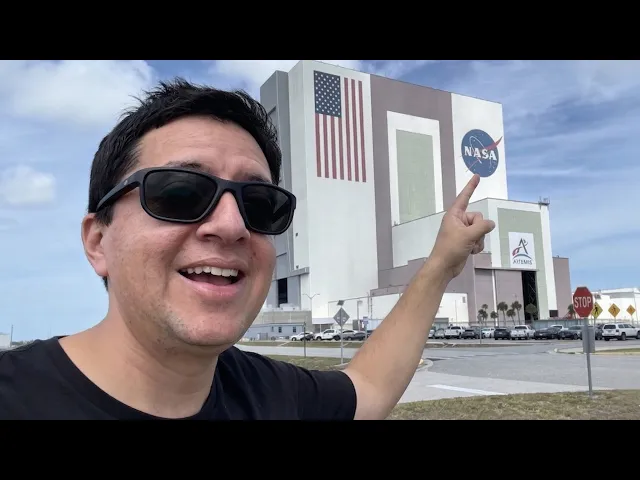
¡Me Invitaron a la NASA!
El Robot de Platón
0:09 Space System Processing Facility.
0:13 Harold You should break so we can see
0:52 and drive forward where we're trying that lever with technical.
1:05 So let's start and go back on technical and not make it perfect.
1:08 So we can go fast and incrementally
1:11 move towards that perfect because originally so all
1:23 the components of the space station were worked
1:25 out of this building and we got big doors.
1:30 So when you say space station processing facility,
1:35 the International Space Station that they built parts of it here,
1:39 they built and tested most of it here.
1:41 Everything that blew up on the space shuttle space systems process.
1:48 Oh wow.
1:51 Welcome into our Hi people.
2:14 I'm Trent Smith.
2:15 I I'm Julia sidekick and our research adviser for space travel production.
2:19 I'm Julia NASA.
2:20 I am the principal scientist for space crop production program.
2:24 So we grow crops in space for whole food nutrition.
2:28 They improve the variety to the package
2:30 diet and psychological well-being or behavior health.
2:35 And then plants by their very nature do photosynthesis.
2:37 So they're going to contribute to the life support,
2:40 the environmental control and life support of a habitat
2:44 because they're going to be recycling the atmosphere.
2:46 They're going to be cleaning water.
2:48 So that just happens while you're drawing for food and behavior at home.
2:51 Let's take a moment to show the Hopkins uh Thanksgiving dinner.
2:55 Well, that is a Thanksgiving dinner on space station just like you have at home.
3:00 I think two Thanksgivings they actually had uh harvest
3:03 and they had leafy greens to go with their Thanksgiving dinner.
3:06 And then here you can see a photo of Hopkins growing some uh radishes in a
3:13 plant habitat.
3:14 You see all the cables and the metal and the plastic, right?
3:17 So, it's a very artificial environment and an extreme environment.
3:21 No, this is just Yeah.
3:23 Don't The warning signs have to be posted for all of our systems.
3:27 This is monitoring plant health using scanning um
3:31 to to detect stress before it becomes growth limiting.
3:36 In here, we have strawberry plants just getting started in our veggie chamber.
4:16 the monster.
4:28 All right, we're going to walk underneath you all.
4:39 Some of you all are plenty tall to get hurt.
4:41 So, please do not hit anything with your head.
4:44 Uh, it will hurt.
4:45 You will not hurt our machine.
4:47 Um, plenty of things to slip on.
4:50 You're going to go up.
4:51 You're going to walk a loop around and come back down.
4:54 You can take pictures of anything you want except the driver's cabs.
4:57 There's a driver's cab here and one on the other end.
5:00 Do not take pictures of the driver's cabs.
5:02 Okay.
5:04 Okay.
5:05 Okay.
5:07 Okay.
5:06 Let's go.
5:28 You kind of get a peek in here.
5:29 See the engines.
5:44 plural.
5:57 Transport foreign.
6:20 Okay.
6:33 Hey, motor.
7:04 anti-jamming technology.
7:09 That's something we had a telescope.
7:20 Sorry.
7:42 construction.
7:44 So, we got a healthy SLS out there.
7:47 Or just spoke to the crew like an hour ago.
7:51 They're charged up.
7:52 I promised them they could go drive the M wrap
7:54 around the pad all they want tonight and weather's looking good.
8:01 Nice.
8:03 Yeah.
8:03 Well, anyway, I appreciate all of you being
8:05 here and uh and covering this uh historic mission,
8:10 the start of an incredible journey right now
8:12 as we undertake frequent missions to the moon
8:15 again uh and start building out our moon
8:19 base which we're all pretty charged up about.
8:21 In fact, yesterday uh reason I got
8:24 in late last evening because had an opportunity
8:26 to meet with the uh the Italian space agency and talk about their contributions,
8:31 their habitation modules for building the moon as well,
8:35 building the base on the moon as well.
8:36 So really really unbelievably exciting time right now.
8:39 Um and we're still doing some of the other fun things
8:42 right preparing for what comes even after the moon with SR1 freedom,
8:45 the nuclear power and propulsion demonstration.
8:48 those that are tracking in summer and fall of 2028.
8:52 You got three nuclear payloads making their way through Kenya Space Center.
8:55 Pretty wild.
8:56 So, you're gonna have the the big uh the big
8:58 R on uh Rosland Franklin's rover that's going to Mars.
9:01 You're going to have the uh plutonium RTG
9:04 that's going on Dragonfly to explore uh Titan.
9:08 And then you're going to have the first of its kind, you know,
9:10 inter interplanetary spaceship freedom that's going to have a actual nuclear
9:15 reactor on it uh to deliver the skyfall payload to Mars,
9:18 which is really really incredible because when you bring all this together,
9:21 right, returning to moon, building the moon base,
9:23 working on uh the South Pole with the water ice, getting uh you know,
9:27 start to master the techniques
9:30 for institute resource manufacturing and then power.
9:32 Now you've got all the ingredients to really embark on a mission someday where
9:36 we can send astronauts to Mars and bring it back safely to talk about.
9:39 So a lot going on these days and appreciate you covering
9:41 it all and getting getting the world fired up a long way.
9:44 So with that happy to answer any questions you all have.
9:48 And you mentioned the samples return mission from Mars.
9:51 Um is that canled definitely or do you have
9:55 any hopes that we're going to get them somehow?
9:57 Oh, we certainly want to do it.
9:58 I I the the other mission for sure is canceled.
10:00 I mean that was that was canceled on canceled under the previous administration.
10:04 it was just it was not going to work and we were being blow through
10:06 12 billion dollars um at that point and uh and look I think that that's
10:11 that's a part where like you know when you don't have competition I can tell
10:15 you there our our uh our rival
10:17 in China is looking to undertake that mission which
10:19 is which is great honestly you know I mean the breakthrough that can come
10:23 from that is very important I would have
10:25 loved for us to have been spearheading it
10:26 but I don't know if we establish that mission
10:29 to achieve an outcome or or to to bring
10:31 a lot of people along with us and and when you do do that.
10:34 Sometimes it's not truly outcome oriented.
10:36 Uh you know, budgets can get out of control,
10:39 schedules can be lost and unfortunately
10:41 missions canceled and and hundreds of millions of dollars along the way are lost
10:45 which could have gone to science and discovery.
10:46 So um in its form not workable.
10:49 Um we are absolutely open.
10:51 We receive funding as part of our 26
10:53 appropriations to evaluate the reformulation of a new mission.
10:57 We don't have the full budget for it,
10:58 but we've got the dollars to look around and see is there a better way?
11:01 And I and I sure hope there is.
11:03 So it's going to be only um it's better if
11:06 we send humans there and bring the samples back or
11:09 you know what um maybe that would have been the answer uh
11:11 when uh we were thinking about a a crude mission to Mars.
11:14 Right now we are laser focused on moon.
11:17 Uh that is the objective.
11:18 That's what uh you know uh Reed, Victor,
11:21 Christina and Jeremy are are are uh you know preparing for under Artemis 2.
11:26 They know they are part of a grander program to return astronauts with frequency
11:30 to the moon to build the moon base
11:32 to learn to prepare for future missions to Mars.
11:35 So that's great when we we will do that that like there
11:37 there is no doubt in my mind that you know next 10 20
11:41 years time crime you will have astronauts on Mars and they will be
11:44 able to come home safely because of what we learned on the moon.
11:47 But should we consider a sample return mission prior to that?
11:50 Absolutely.
11:50 But we we need to set one up that's you know achievable.
11:53 It's affordable and and we do have the resources to start formulating that.
11:56 Thank you.
12:24 instrument.
12:37 foreign.
13:06 for dude.
14:00 For the first time there is a science officer
14:02 on console and mission control which is really exciting.
14:05 So they will be communicating directly um throughout the mission.
14:09 Uh we also have um the science evaluation room
14:12 at Johnson Space Center and there is a team there.
14:15 They've been training with the astro they've been training the astronauts.
14:18 They they have you know these amazing screens with these maps.
14:21 They can see what the astronauts are seeing um
14:23 and and kind of talk them through in real time.
14:37 What will they test?
14:41 So yeah, so we have that de
14:43 developmental flight test objective that I mentioned.
14:47 So you got to think of this suit is built for long duration survival.
14:51 Um so there could be a situation where the cabin depressurizes or loses cabin.
14:57 So we do a lot of during that time.
14:59 They'll actually take this up to the full
15:01 pressure and live in their soup that nothing happens.
15:04 The environmental control life support system they would eat,
15:07 breathe and water while remaining in their soup for that entire up to six hours.
15:12 Eight and a half up to six days up to six days for example.
15:19 That's a fantastic question.
15:20 That is your pass through for the urine pass through.
15:22 So that's where your urine would go.
15:24 You have hardware that you would wear underneath the suit
15:26 that would direct the urine out through this pass
15:29 through and out out of the vehicle actually and it'll
15:31 spray out into the vacuum of space and create all about food and water.
15:36 So for there for like if you actually look
15:40 at the helmet here you can see this small black port.
15:44 This is called the drink portion through this.
15:46 We have essentially a bag with a straw connected to it where the crew
15:51 members could rotate their helmet on their neck ring and they could insert
15:55 that straw through the helmet and they would be able to drink have like
15:58 a nutrition shake for food and then they could take medication that way as well.
16:03 So that's how they would remain liquid diet.
16:06 Yes.
16:07 But that's how they would remain pressurized
16:08 in the steel and get the nutrition that they need.
16:12 That's a great question.
16:13 Oh, the connectors.
16:15 Yeah.
16:15 So, so, so the blue connector is the supply gas connector and so
16:21 through that the air would come from the E-class system into this connector,
16:27 flow up through a ventry and come out of here.
16:30 Then it would then be flowing that fresh air over their head and down
16:35 into the volume of the gas would return back to the vehicle through
16:39 an umbilical connected to the red connector and that would allow the gas
16:44 to circulate and constantly be recycled but also
16:47 conditioned to give them fresh air remaining.
16:51 Is there a special reason why those colors in particular are red?
16:55 The colors are actually inherited from the Apollo program.
16:58 So during the Apollo program these these were
17:01 how much designed to be blue and red
17:04 for blue is supply and red is return and we just kept consistent with that
17:07 because you know sometimes we have the idea that blue
17:10 is for cold and inner red is for hot
17:14 it's not that's not temperature however they do
17:17 have a way to control temperature in the suit
17:19 they actually wear a liquid cooling garment under the suit which is kind of like
17:23 a jacket with two zone in it and then that connects to this knob here where they
17:29 can control the amount of cold water flowing
17:32 through the tubes that are up against their skin.
17:35 That's how they control their temperature.
17:36 All right.
17:37 Thank you.
17:39 Yeah.
17:42 So, you're saying what is a very shiny tape?
17:47 Is that thing every day?
17:57 You can touch it.
17:57 You can hold it.
17:58 Is this a ceramic?
18:00 Um, this is ceramic.
18:01 Uh, this is more like it's kind of like
18:03 the texture of like a racer that got hard.
18:05 It starts off as like a powder.
18:07 So, this is part of the Artemis one mission.
18:09 That's correct.
18:10 This is a flown Artemis one tile.
18:12 So, you can see where it was on the spacecraft.
18:15 In this picture right here, uh,
18:17 you have Scio tape that covers all of the tiles on the back shells,
18:20 but there's certain sections of the spacecraft
18:22 that are not covered with this tape.
18:24 That's where the phased array antennas are.
18:25 you want you don't want any interference with the phase ray antennas.
18:28 So in this tile you can see where
18:29 the SCOX tape comes and then where it stops which
18:32 is right there uh in that picture and this is
18:34 the famous picture of Apogee of the Orion
18:36 spacecraft beyond the moon and so this is
18:39 the view that the astronauts will be able to get
18:41 on Artemis 2 be 4,000 mi beyond the surface
18:44 of the moon further than any human has gone before.
18:47 So, just part of the Orion capsule then?
18:49 Yes.
18:50 Yes.
18:50 This came right off of Artemis 1.
18:53 Uh the materials team wanted to do some additional uh test to a flown tile uh
18:58 just to see how it reacts compared
18:59 to what it reacted before the before the mission.
19:02 Do you have
19:03 Oh, do I have any souvenirs?
19:04 No, no, no, I don't.
19:05 Um in fact, they're all going to end up in museums.
19:07 Artemis one is going to be handed over to the Smithsonian
19:10 and they'll get to pick where they display it in the future.
19:13 Um yeah, we just used this one.
19:15 Uh we pulled this part off to be able to do that additional test.
19:19 Uh many parts did come off of Artemis one to fly on Artemis 2.
19:23 Uh 10 parts specifically.
19:24 Um but um let me get to what parts in just a minute.
19:29 But no, we don't get to keep any parts as souvenirs
19:33 because if you see that is going to be displayed in Smithsonian,
19:36 the Artemis one of the spacecraft.
19:37 This part is going to be missing.
19:38 And am I right?
19:39 Yes, this part will be missing.
19:40 You'll be able to see where this was and it'll be with me.
19:44 Um, yeah.
19:47 So, I'm here with Paul Anderson.
19:49 He is the deputy manager of the Orion capsule.
19:52 Yes, I'm the deputy program manager for Orion for Loheed Martin,
19:57 which really is multiple elements.
19:59 Everybody thinks of the crew module and if you look at it over here there,
20:03 this is of course is the part
20:04 that the the crew enters and flies throughout the mission.
20:07 But we also have got the European service module back
20:10 here provided by uh issa to NASA to lock Martin.
20:14 We integrate that piece and there's over
20:16 10 countries in Europe that help support that.
20:18 And we also build this ring which people are
20:20 maybe not as familiar with called the crew module adapter.
20:23 And what's not shown in the model is another I'll call it
20:27 the rocket on top of the rocket that's called the launch abort system.
20:30 So all of those components, the launchboard system,
20:33 the crew module, this crew module adapter, and the service module,
20:37 we Lockheed Martin uh get over at the ONC building here
20:42 across uh campus on Kennedy Space Center and do the integration.
20:46 And so right now, obviously,
20:48 we've got Artemis 2 ready to go and 3, four, and five in.
20:52 What are the key differences or main differences between the this capsule
20:56 and the previous ones from Apollo from the Apollo era?
21:00 Okay, the major difference if you would say
21:02 I mean there many they they kind of look
21:04 the same and a lot of people at face
21:05 value say oh gosh isn't that like an Apollo capsule.
21:08 This is actually uh almost 33% larger
21:11 in volume than what the Apollo astronauts flew.
21:14 And then when you go inside there's almost no comparison.
21:18 Everything in here is modern.
21:19 The crew displays, the life support systems, all of the safety aspects,
21:23 the seats, the way that the suits interface, all modern, brand new.
21:29 And when you go back to the Apollo capsule, it was a miracle at the time.
21:33 It's analog switches.
21:34 The crew had to um have codes that they decoded for.
21:39 They did not have flight computers.
21:40 We have five flight computers, for example, that are running at any given time.
21:44 And so I would say yeah, you know, physically it looks similar,
21:47 but there really isn't any comparison,
21:49 especially for uh the capability to keep uh the crew safe,
21:53 to keep the crew comfortable,
21:54 and uh I'll I'll say to do missions uh to the moon,
21:58 not only to the moon, but future uh all the way out to Mars.
22:01 So Orion is designed to be an interplanetary vehicle.
22:04 The solar panels also very good.
22:06 In the Apollo era, because the missions were up relatively short,
22:11 they actually had fuel cells.
22:12 Here we've added solar arrays,
22:14 lithium-ion batteries that are absolutely new to be
22:16 able to do these much longer missions in Paul.
22:19 I'm here with astronaut Steve Bowen.
22:22 Uh he's been part of the NASA for how long?
22:24 25 years.
22:26 25 years.
22:27 25 years.
22:27 And how many days have you spent in space?
22:29 I spent 220 something days in space and then missions.
22:33 Have you thought about what is the part that you enjoy the most?
22:36 What do I enjoy the most?
22:38 I enjoy being on a crew in space and when you're just having fun as a team.
22:43 Uh, floating never gets old.
22:45 Looking out the window never gets old.
22:47 Hanging out for months on end with really great people also never gets old.
22:52 Are you going to spend some time working in other missions
22:55 apart from the space space station maybe for Artemis or No.
22:59 Oh, I you know we are continuously working everything, right?
23:03 So that's part of our jobs.
23:04 who are supporting when you're not flying in space,
23:06 you're supporting people who are flying in space and making
23:09 sure the programs are are meeting the needs of the astronauts.
23:13 And so I've been a part of uh Artemis, commercial crews,
23:19 so many of the programs that we've had coming through.
23:22 It's just an honor and a pleasure to have the opportunity to work at NASA
23:26 and I'm really excited about what we get to work on ahead of time.
23:29 And that's the broader NASA, you know,
23:32 thousands and thousands of people working in the team.
23:34 It's incredible.
23:36 What would you say to uh child or somebody
23:39 who from Latin America that wants to be a astronaut?
23:44 Well, I as I said, you know, this the opportunity to become an astronaut
23:48 is going to is basically open to everybody.
23:50 The opportunity to be part of, you know,
23:53 Artemis or the future of men's exploration.
23:57 uh you know you know study those things that that'll get you science,
24:00 mathematics, engineering, uh medicine, all the sciences.
24:05 Those are probably the key things to to look at if you
24:07 want to be a part of exploration whether it be on Earth,
24:10 in the oceans, in space, those are the things that will carry you forward.
24:15 So study those.
24:16 It's incredibly exciting.
24:17 You know when you get the chance to challenge
24:19 yourself uh sometimes you do think we do
24:22 a poor job uh telling kids kids you'll feel
24:27 the you'll feel great when you solve a difficult problem
24:31 you know and when you do it as a team it
24:33 feels even better because they get to share it with somebody else.
24:36 So challenge yourself, you know, push yourself to to really do the best you can.
24:42 And going forward, we're going to the moon as a international community.
24:47 We're going to go to Mars, the larger international community.
24:50 You know, the opportunity is going to be there for everybody.
24:59 Oh my god.
25:07 Oh my god.
25:07 Oh my god.
25:08 This is real.
25:37 What?
25:49 there.
26:07 Okay.
26:18 Uhhuh.
26:34 Yeah.
26:46 for YouTubers.
27:47 No, the on there right now.
28:03 on those.
28:07 All right.
28:07 10.
28:11 Four.
28:11 Four.
28:13 Three.
28:12 All right.
28:12 Three.
28:14 Two.
28:15 Here we go.
28:15 We have liftoff.
28:16 Lift off.
28:18 Lift off.
28:19 There it goes.
28:26 Wow.
28:24 Oh my god.
28:26 Oh my god.
28:26 It's here.
28:29 Yes.
28:32 Oh, it's coming.
28:34 It's going.
28:34 It's going.
28:35 Lift off.
28:38 Go.
28:37 Go, baby.
28:38 Go.
28:46 Oh.
28:46 Woo.
29:04 That's go this.
29:18 Go SLS.
29:27 Oops.
29:31 Sorry about that.
29:36 It happened.
29:36 Finally happened.
29:40 All right, next up is going to be SRB Jettison.
29:45 At this point, they should have uh reached Super Sonet.
29:49 Oh my god.
29:52 So, we're now looking for the solid rocket.
29:59 What?
29:56 So, that is on its way to the mirror.
30:02 So, SRB solid rocket booster should be Godspeed.
30:07 Ram is to God speed.
30:15 He's heading down here shortly.
30:21 There's staging SRB jettison looks successful.
30:28 Happy 250 America on the sides of those SRVs.
30:35 Yes.
30:34 So stageful stage continuing the shadows.
30:51 Oh my god.
30:52 Wow.
30:54 Oh.
30:54 Wow.
30:57 See that the winds he's sitting now and Artemis.
31:07 is God speed.
31:22 Okay.
31:44 The smarter every day.
31:48 iso.
31:49 How do you say?
31:59 So, uh, to see C is bonita.
32:18 Lunch's lunch.
32:19 And the smoke.
32:20 The smoke is so engines.
32:41 Rocket engines.
32:44 Uh tienrois is RS25.
32:58 So see see without the platon wouldn't exist.
33:24 That's good.
33:24 No, not not true.
33:25 Not true.
33:25 It's it's a it's a tall tale.
33:27 You were inspiration and that's true.
33:28 But uh thank you very much.
33:30 Thank you very much and I'm glad that I
33:31 was I enjoyed watching the rocket with you.
33:34 Yeah, me too.
33:35 Have a look.
33:35 Look at the uh look at the vortex.
33:37 Ah the vortex.
33:38 Yeah, the vortex in the smoke.
33:39 You see it?
33:40 Yeah, he he knows a lot about rocket.
33:42 You can speak in English.
33:43 I can translate it.
33:44 Don't worry.
33:44 Oh, okay.
33:45 Yeah.
33:45 My my Spanish is bad, but I try.
33:47 I know a few technical words.
33:48 It's okay.
33:49 That was a good one.
33:50 That was a strong rocket.
33:52 Yeah, it was bright.
33:52 Did it burn your eyes?
33:53 Yes.
33:54 Yes, it did.
33:56 Yeah.
33:58 I was like looking Would you see Fore.
35:19 You