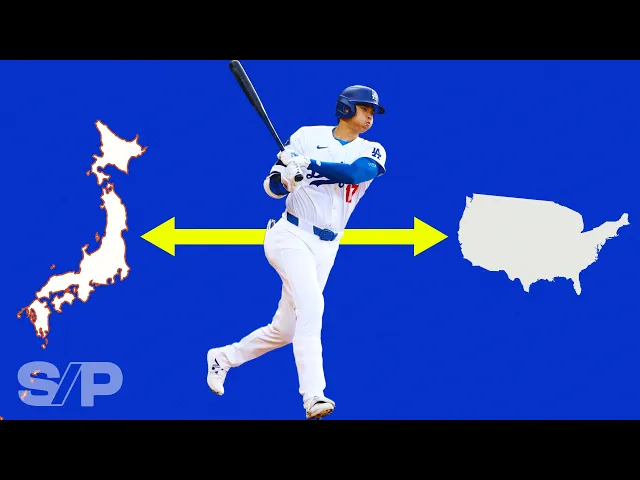
How Shohei Ohtani happened
Search Party
0:00 [Commentator] And in a one-run game, the dream match-up.
0:03 [Sam] It's easy to see why someone might call this a dream match-up,
0:06 it's the Final Out of the 2023 World
0:09 Baseball Classic between the two best baseball countries,
0:12 the USA, who invented baseball, and Japan,
0:15 whose own baseball culture has thrived for more than a century.
0:20 [Commentator] One ball, no strikes.
0:22 [Sam] It's also a match-up between the two best players,
0:24 Mike Trout, one of the best American hitters ever,
0:27 and Shohei Ohtani, the best Japanese pitcher ever,
0:30 the best Japanese hitter ever, and some say, the best baseball player ever.
0:35 [Commentator] The 1-0 pitch, swing and a miss.
0:39 A fastball at 100.
0:41 But I think this is more than a dream match-up between two great teams.
0:45 [Commentator] 2-1, 2 and 2.
0:48 [Sam] Or even two great players.
0:50 [Commentator] The count goes full.
0:51 It's the moment baseball's past,
0:53 met baseball's future- [Commentator] Ohtani's ready, Trout's ready, 3-2.
0:59 [Sam] And the future won.
1:01 [Commentator] He struck him out, Japan's back on top of the baseball world!
1:06 Yeah, that symbolized the passing of the torch,
1:08 from baseball being America's pastime, to baseball being a global game.
1:14 [Sam] This is the story of how Japan produced the best baseball player ever,
1:18 and how he's paving the way to baseball's future.
1:22 (rhythmic music) (text clicking) (playful music)- [Reporter] For many years,
1:37 the American pastime has been the Japanese pastime.
1:41 Americans introduced baseball to Japan around the 1870s,
1:44 so it's no surprise that American and Japanese baseball share a lot in common,
1:47 first and foremost, it's an obsession.
1:51 Here's a stadium packed for Japan's High School Baseball Tournament,
1:55 1920, Shinto Priests blessing home plate,
1:58 opening day 1931, and Babe Ruth, swarmed by fans in Tokyo, 1934.
2:04 The US crushed Japan in World War II,
2:06 but baseball helped the two countries become allies soon after.
2:10 [Reporter]] This isn't Big League stuff yet, but someday, it may be.
2:15 [Sam] Japan's Nippon Professional Baseball League was structured
2:18 a lot like the US' Major League Baseball,
2:20 teams were divided into two leagues, and some even shared the same name.
2:25 But the two leagues didn't always see eye to eye, in the mid-20th century,
2:29 American teams often looked down on Japanese talent,
2:32 and while some American players played in Japan,
2:35 they typically were near retirement.
2:37 Meanwhile, Japanese players were often pressured to stay in Japan.
2:40 Part of it was wanting to like maintain Japanese culture and pride.
2:46 [Sam] Joon Lee's been reporting on baseball for a decade.
2:48 He was on ESPN, now he runs one of my favorite YouTube channels.
2:52 [Commentator 2] It is swung on and foul-tipped by Lee.
2:55 This was kind of where Japan was like politically,
2:58 over the course of like a lot of the 20th century,
3:00 which was culture that was very inward-focused.
3:03 It all came to a head over this guy, pitcher, Masanori Murakami.
3:07 In 1964, the Nankai Hawks sent him
3:10 to the San Francisco Giants' Minor League team, just for some experience.
3:14 But Murakami impressed the Giants who started him on their Major League squad.
3:18 Murakami became Major League Baseball's first Japanese-born player,
3:21 and dominated the rest of the season.
3:24 But when the Giants gave him a contract, the Hawks objected,
3:27 the two leagues argued for months until reaching a compromise.
3:30 Murakami would play with the Giants for one season, then returned to Japan,
3:34 and from then on, MLB teams
3:36 were prohibited from directly signing Japanese players,
3:39 and vice versa, it widened the gulf between the two leagues.
3:43 American players continued to go to Japan,
3:45 but no Japanese player appeared in Major League Baseball for the next 30 years.
3:50 They stayed in Japan and developed a distinct style of playing.
3:54 Very quickly, I wanna show you something pretty cool,
3:57 machinists at Henson started out making aerospace machinery,
4:00 parts for the Mars Rover and the International Space Station,
4:03 then they went off to find a fix for a more everyday problem,
4:06 shaving, and the result is this, the Henson Razor,
4:09 the blade extends just 0.0013 inches past the shave plane,
4:14 that's thinner than a human hair,
4:15 which means it offers way more support than most razors.
4:18 That precision means the blade chatters less while shaving,
4:21 which results in a healthier, more skin-friendly shave.
4:24 And Henson Razor is made entirely of aluminum and built to last a lifetime,
4:29 and the blades themselves, are just 10 cents each and fully recyclable.
4:33 That's better for the environment than those plastic cartridge razors,
4:36 and it turns, out better, for your wallet too.
4:38 This chart shows the cost of razor ownership over time,
4:40 with other razors, the cost keeps climbing,
4:42 but Henson's line stays flat, because when you buy it once, you're set for life.
4:46 So if you shave every day or multiple days a week,
4:48 this Henson Razor is really worth it.
4:50 If you go to henson.com/searchparty or use
4:53 the code "Search Party," and buy a razor,
4:55 they're gonna give you 100 blades for free.
4:57 That's more than two years' worth.
4:59 Make sure both are in your cart for that code to take effect.
5:02 Thanks again to Henson for making a great razor,
5:04 and for supporting Search Party, now I'll take you back to the episode.
5:09 Japanese people are built differently than American people,
5:12 and so they have adapted the Japanese game to kind
5:15 of suit the physical strengths and weaknesses that Japanese people have,
5:20 and as a result, stylistically,
5:22 the game is very different than what you would see in the United States.
5:25 [Sam] Great American batters have power, they swing for the fences.
5:28 [Commentator 3] He's got a home run.
5:29 [Sam] While great Japanese batters have consistency,
5:32 they hit more singles, doubles, even bunts to get on base.
5:36 Great American pitchers rely on velocity,
5:38 throwing a hundred-mile-per-hour fastballs past batters.
5:41 [Commentator 3] That's his fastball.
5:42 [Sam] while Japanese pitchers rely more on craftiness,
5:44 throwing fork balls, splitters, and sinkers to fool batters.
5:48 In Japan, baseball players are also known to train
5:51 far more often and with far more intensity.
5:53 This is just kind of the culture around the sport that the repetition,
5:57 build strength, it requires this intense level of discipline.
6:01 [Sam] Still, many Americans doubted Japanese players would succeed in the US,
6:04 if they could ever get there.
6:07 Then in 1995, pitcher Hideo Nomo found a loophole.
6:12 The Kintetsu Buffaloes owned his contract, but Nomo simply retired at age 26.
6:17 Legally, a retired player could go anywhere,
6:19 so Nomo went to the LA Dodgers, his twisting wind-up flummoxed American batters,
6:24 and he went on to win Rookie of the Year, and start the All-Star Game.
6:28 [Commentator 4] waved at and missed.
6:30 And down goes Martinez, and down goes Bell,
6:33 and who would've figured Hideo Nomo, last year pitching in Japan?
6:38 [Sam] Nomo also got more Japanese fans
6:40 to start paying attention to American baseball,
6:42 but his loophole made NPB owners, worried their best players would leave.
6:47 So in 1998, it made a new system,
6:49 where a Japanese team could do what's called posting a player,
6:52 to allow MLB teams to bid on him,
6:54 then the Japanese team could send him in exchange for a fee.
6:58 Finally, a pipeline existed between the two best baseball leagues,
7:01 and over the next 20 years,
7:02 a steady stream of talented pitchers and hitters developed in Japan,
7:06 then went to the US, where they won awards and World Series,
7:10 broke records and made the Hall of Fame,
7:13 all along proving that the Japanese style could thrive in the US.
7:16 Ichiro is kind of the ultimate manifestation of this, where
7:20 he hit often less than 10 home runs a year,
7:22 but he would get 300 hits in a season,
7:25 I think that completely changed the perception of what was possible,
7:28 if we brought over Japanese players to the United States.
7:33 [Sam] But Shohei Ohtani was different.
7:36 He threw nearly a hundred miles an hour,
7:38 smashed home runs, and he was only in high school.
7:42 I first heard of Shohei Ohtani when he
7:44 was 16 years old because I'm a baseball sicko, and I was following what was
7:49 happening in the Japanese baseball tournament, Koshien.
7:53 [Sam] The century-old tournament is watched by millions in Japan,
7:56 and in 2012, everyone was watching Ohtani, including Major League teams.
8:01 He was kind of unlike any player that had ever come out of Japan.
8:06 [Sam] The Yankees, Red Sox, Rangers,
8:08 and Dodgers wanted Ohtani to skip the NPB entirely,
8:11 and sign directly with them as a pitcher, Ohtani wanted that too, In 2012,
8:15 he warned NPB teams not to draft him, but the Nippon-Ham Fighters did anyway.
8:20 It put Ohtani in a unique position, he could refuse to play for the Fighters,
8:24 or use his leverage to pressure them into letting
8:28 him do something no American team ever would.
8:32 Two-way players are a thing of the past,
8:34 that's someone who's both a pitcher and a position player, like Babe Ruth.
8:38 But since the 1940s, no one in the Major Leagues really pulled it off,
8:42 and today, no one's really allowed to try.
8:44 [Joon] Being a pitcher and a batter,
8:46 is like playing two completely different sports,
8:49 they require two completely different skill sets,
8:52 two completely different approaches,
8:54 and that wear and tear really, really adds up.
8:57 A Major League team, if they had gotten Ohtani at 18 years old,
9:00 it would've just forced him to become a pitcher.
9:02 [Sam] But the Fighters were more willing to let him try both,
9:05 so Ohtani made the fateful decision to stay in Japan.
9:09 If Ohtani had grown up in Arkansas, he doesn't become the player that he is.
9:13 He was this massive power hitter,
9:15 there's a video of him hitting a baseball into the roof of the Tokyo Dome,
9:20 (ball thudding) (crowd cheering) and the fact that he was also doing it while
9:25 being one of the best pitchers in NPB was kind of blowing everyone's mind.
9:31 [Sam] But after five years in Japan, Ohtani still faced doubts in the US.
9:35 So in 2017, when the Fighters posted him,
9:38 Ohtani turned down bids from big-market teams,
9:40 and instead went to the LA Angels, where he again,
9:44 used his leverage to be a two-way player.
9:47 In his first at bat in LA, Ohtani did this.
9:50 [Commentator 5] That's out to toward right center field.
9:54 [Commentator 6] Gone, big fly Ohtani style.
9:59 [Sam] In 2021, he hit 46 home runs, and went 9 and 2 on the mound,
10:03 becoming the first player to be an All-Star, as a hitter and a pitcher.
10:07 Ohtani was fast becoming the most exciting player baseball had seen in decades,
10:12 and by 2024, he didn't need leverage anymore,
10:15 the LA Dodgers signed him for $700 million,
10:17 nearly double the next-highest contract,
10:20 because he really was two players in one,
10:22 actually, he was the two best players in one.
10:26 Wins above Replacement measures a player's total value,
10:29 and in the last five years, Ohtani has the highest in the Majors.
10:32 And just last week, Ohtani played
10:34 probably the greatest game in baseball history, he struck out 10 batters,
10:37 and gave up only two hits over six innings, and hit not one,
10:41 not two, but three home runs, to send the Dodgers to the World Series.
10:46 Ohtani's a new kind of baseball player,
10:48 mixing American-style power and Japanese-style consistency
10:52 on both sides of the ball, but he only got the chance to do
10:55 it because he started playing baseball in Japan.
10:58 Shohei Ohtani is America's impact,
11:01 reimagined and then repackaged back to itself.
11:05 [Sam] Now, Ohtani's bringing the two
11:06 best baseball leagues closer together than ever.
11:09 [Commentator 1] Impossible Theater, and in a one-run game, the dream match-up.
11:14 [Sam] Now, why was this moment so important?
11:16 It's because it was the first moment
11:18 that Japanese baseball and American baseball shared a superstar.
11:22 In the US, it was the most watched WBC game ever, but in Japan,
11:27 42% of households tuned in, even though it was 8:00 in the morning there.
11:31 In 2025, MLB saw higher viewership across US TV,
11:35 and a 20% increase on Japanese TV, making it the most watched season ever there.
11:41 Ohtani's also getting more Japanese fans to come to Major League games.
11:45 When I asked Joon to come on his episode,
11:47 he texted back from Dodger Stadium, where he saw scores of Ohtani fans,
11:51 Ohtani jerseys in English, Japanese, Japanese beer,
11:55 and a giant homage to Ohtani on a Japanese-themed hotel.
11:59 This is just the beginning for MLB.
12:02 I had a conversation with an executive over Major League baseball,
12:05 and they said that, "Shohei Ohtani was
12:08 their entire international growth strategy." If you,
12:11 Shohei Ohtani as their Messi and Ronaldo faker,
12:14 the type of person who almost becomes bigger
12:17 than the sport to get people in the door, to care and invest emotionally in it.
12:23 Ohtani may even give MLB an edge over its competitors.
12:27 US sports leagues are racing to become global leagues,
12:30 the NFL is playing games in Europe and South America,
12:33 the NBA is in Asia, hosting a league in Africa,
12:36 and talking about creating a league in Europe.
12:38 They're competing to win over new fans in other countries,
12:41 but nothing wins over fans in another
12:43 country like a superstar from that country.
12:46 The lesson from Ohtani is that sometimes
12:48 that means letting a player do something different,
12:52 because Ohtani isn't Ohtani if he's not a two-way player,
12:56 and he's not a two-way player if he doesn't play first in Japan,
12:59 and he doesn't play first in Japan,
13:01 if not for generations of players who perfect baseball,
13:05 the Japanese way,- America invented baseball,
13:09 but it has been elevated by someone who is not from the United States.
13:14 He breaks all of the unwritten rules of what people
13:17 thought was possible for someone to accomplish as a baseball player.
13:21 (gentle music)- Okay, thanks so much for watching,
13:28 this week, I have a special ask of you guys.
13:30 I cover stories from all over the world, and you guys live all over the world,
13:34 I wanna get your help telling more of these stories.
13:37 Imagine if there was a platform that I could ask my Japanese
13:40 audience to send me images of Ohtani fever in their community,
13:43 or a place I could talk to my Italian
13:45 audience about watching games at the San Siro.
13:48 Imagine if there was a platform where you could help me
13:51 tell stories about your city or your community or your sport,
13:54 we're building exactly that over at NewPress.
13:57 NewPress is a new community-driven journalism platform started by me,
14:01 Johnny Harris, Christophe Haubursin,
14:03 and more creators to come, and right now, we'd love to have you join us.
14:06 It's super easy, you just go to the link in the description,
14:09 that'll take you to newpress.com, where you can Join the Waitlist,
14:13 then you'll hear from Johnny,
14:14 who's gonna tell you about what we're cooking up and what's to come next.
14:17 Thanks again for watching, thanks again for supporting NewPress,
14:20 we'll see you in a couple of weeks.