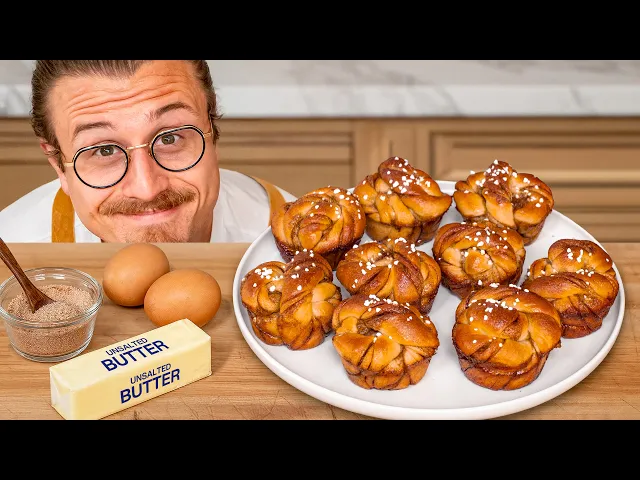
The Best Cinnamon Buns At Home
Joshua Weissman Recipes
0:00 Let me stop you right there.
0:01 This is not a cinnamon roll, and that was on purpose.
0:06 I love cinnamon rolls.
0:08 They're fantastic.
0:08 Matter of fact, I have a recipe for them, but this is something else entirely.
0:13 This [music] is something special, and it doesn't require that much more effort.
0:17 In fact, maybe even slightly less cuz you don't have to make an icing.
0:19 It's very much like a cinnamon roll, yet the flavor is even deeper.
0:22 It has a fragrance to it.
0:24 It has a little bit of cardamom to it, a little spiciness to it.
0:26 But also, the dough is like a rich brioche,
0:29 and the bottoms will become beautifully [music] caramelized.
0:31 And the surprising thing is, I think anyone can make this.
0:34 So, that being said, let's make this, shall we?
0:36 We'll start by making our dough and filling, then we'll shape, bake, and serve.
0:40 It's a simple recipe with incredible [music] results.
0:44 Woo!
0:45 We're making cinnamon buns, not cinnamon rolls.
0:49 But you could use them as an alternative to cinnamon rolls.
0:51 These are the best cinnamon morsels you'll ever have,
0:53 like I said, and it starts with a dough.
0:56 You don't have to use a stand mixer, but I would highly recommend that you use
0:59 a stand mixer [music] cuz it just makes the mixing
1:00 process so much easier in this particular case because
1:03 there is a lot of butter in the dough.
1:05 So, you're going to start with 1 cup plus 2 tsp whole milk,
1:07 which has been warmed, by the way.
1:09 That's lukewarm, around 95 Fahrenheit.
1:11 And then you're going to add 1 tbsp plus 2 tsp, or 12 g of active dry yeast.
1:15 I know it's a lot, but you have a lot
1:16 of fat in this, and I'm just honestly [music] compensating for that.
1:19 Give that a little mix.
1:21 One whole egg, ideally room temperature, but if it's cold, that's fine, too.
1:24 Give that a little whisk.
1:26 A quarter cup plus 1 tbsp or 65 g of granulated sugar,
1:29 2 tsp of cardamom, 1 tbsp plus a half tsp of fine sea salt.
1:34 It's a lot of salt, really important to balance this dough out.
1:37 I think a lot [music] of recipes just do not put enough salt in their dough,
1:40 and you end up with sort of a bland-tasting sweet roll dough.
1:43 I want this dough to be like, "Bang, dude.
1:45 Bang.
1:46 Bang." Dude, it's not even February yet at the date
1:49 of filming this, and I'm already going clinical right now.
1:52 So, we got our dough hook attachment.
1:54 Start this on a low, very low speed.
1:56 We're going to add 4 and 1/3 cups, or 650 g of bread flour.
2:01 You're going to add your bread flour about a half
2:03 cup at a time till all of it's added, and then you're going to add 3/4 of a cup
2:06 plus a tablespoon of fully softened unsalted butter.
2:09 And you're going to mix that on low speed
2:11 for about 4 minutes until the dough starts to come together.
2:14 Now, in that first 4 minutes, you may have to drop this and kind
2:16 of scrape [music] down the sides couple times if necessary,
2:19 and then just let it keep going.
2:21 Okay, last step.
2:22 It's been 4 minutes.
2:23 Now, we're going to increase the speed to medium speed,
2:25 and we're going to let it mix for another
2:26 10 minutes or until we get a smooth, voluptuous dough.
2:29 So, walk [music] away, go to the bathroom, be sure to wash your hands.
2:32 Find something to do.
2:33 10 minutes.
2:33 All right, it's pulling from [music] the sides of the bowl.
2:35 The dough is smooth.
2:36 That means something, and it means you're done making the dough, at least.
2:40 Well, sort of.
2:40 Right, lower the bowl, take the damn thing off.
2:46 Look at that, dude.
2:47 Okay, if your dough is super sticky and just not cohesive,
2:49 [music] like you can't pull it out like this, you either need more mixing time,
2:52 or you might need to add a little bit of flour,
2:54 but hopefully that did not happen.
2:55 So, take it out.
2:57 Always [snorts] sniff it.
2:58 It's part of the process.
2:59 The reason you sniff it is so you look forward [music] for what is to come.
3:04 It smells fragrant of cardamom, sweet, it's buttery, it's rich, it's smooth.
3:09 I'm just going to give it a few extra
3:11 kneads to get it into the shape I'm looking for.
3:13 I mean, it's so soft and supple.
3:15 This is a good dough.
3:16 I will say it is important to get adequate gluten development,
3:19 and because of all the fat in here, it takes [music] a while.
3:20 That's why you end up having the mixer knead it for 10 minutes.
3:24 And once you have that smooth dough,
3:25 you can see that it's not sticking to anything.
3:27 See if I can stretch this until you
3:29 can basically see through the other [music] side.
3:30 You can see my finger poking back there.
3:32 That's called the windowpane And if it's passing that, woo,
3:36 you got a good dough on your hands.
3:37 All right, so I'm going to shape this.
3:38 You can even give it a couple slap and folds if you want, too.
3:41 Shape it into a rough ball.
3:42 Make sure to seal the bottom completely.
3:45 We got a large bowl, grease that lightly.
3:47 Add your lovely dough in there.
3:51 I like to flatten mine out just a little bit
3:52 so I can actually tell the progress of its rising.
3:55 So, when it rises, it'll start to sort of dome.
3:57 Cover that with plastic wrap.
3:59 You can also use a damp towel.
4:01 Let that rise for about 45 to 60 minutes
4:04 or until close to, if not doubled in size.
4:08 Room temperature.
4:09 Cinnamon roll, you got to have a little buttery sugar filling.
4:12 So, we have a lot of butter, 200 g on the dot,
4:15 which is like 3/4 of a cup plus 2 tbsp of unsalted butter, softened.
4:19 You don't have to use an electric mixer, you can do this completely by spatula,
4:22 but I use an electric mixer just to make it easier to mix.
4:25 So, cream that as much as you can.
4:26 First, we're going to add 50 g, roughly a quarter cup, of dark brown sugar.
4:30 Beat that in.
4:33 Before I add the majority of my light brown sugar,
4:34 I'm going to add the 1 and 1/2 tsp of fine sea [music] salt,
4:37 tablespoon or 10 g of ground cinnamon, and 1 tsp of ground cardamom.
4:43 Beat that all together, and finally,
4:46 200 g of light brown sugar, or 1 cup packed.
4:50 Okay, so this is mixed.
4:52 There we go.
4:52 That looks great.
4:53 It's really important that your butter is fully softened.
4:55 Please don't try and throw a cold brick [music] in there.
4:57 Just like microwave it 5-second intervals till
4:59 it's as soft as possible, not liquid.
5:01 You want it to be stiff enough that it holds itself together like so,
5:05 but also smooth enough that you can spread it.
5:08 Now, let's put it in our dough.
5:10 I have a beautiful dough [music] right here, risen.
5:14 [snorts] Oh, god.
5:14 And it smells, it looks stunning.
5:17 I'm going to lightly press out [music] some of that gas in there.
5:19 It's a little under doubled in size.
5:22 Ideally, you want to bring it to doubled,
5:23 but if it's 3/4 of the way up, that's fine.
5:25 So, we're going to lightly flour our board.
5:27 We're going to take our dough out.
5:28 We're going to roll this out into a rectangle.
5:30 It's about 22 in long, 15 in wide.
5:33 So, we get the bottom floured, flour the top.
5:36 I'll be honest, I'm not the best at rolling out rectangles.
5:38 It's [music] okay if it's not a perfect rectangle,
5:40 you know, if it's more of like an oval, that's fine.
5:43 All right.
5:43 So, our dough's been rolled out.
5:45 Look at that.
5:46 Nice and [music] thin.
5:49 [snorts] Ah, you can smell the spiciness, the fragrance from the cardamom,
5:51 [music] which is exactly what I want.
5:53 So, we're a little over 22 in, but we're 22 in and a little over 15 in.
5:57 That's fine.
5:57 It doesn't need to be perfect.
5:58 It's more of like a marker, but I would try not to go under.
6:01 It's better to go a little over than to go a little under.
6:04 Now, we're going to add our cinnamon cardamom butter.
6:07 There's a few ways you can spread this on.
6:08 You can [music] just kind of glob it on and spread it out.
6:10 I actually like to do little dots.
6:11 This part is not a science.
6:13 I mean, [music] I just do this to make it easier to spread.
6:14 You could just fiddly fart it on there and call it a day.
6:17 It kind of already gets you spread out by doing this method.
6:21 If you put it all in the center and try to spread it out,
6:22 sometimes the dough stretches or flattens in one area.
6:26 This just kind [music] of gets you a head start on being evenly spread out.
6:30 All right.
6:30 So, you can use your spatula.
6:31 You can use an offset spatula, like one of these guys,
6:34 pastry spat, and just kind of get in there.
6:37 You're going to spread a thin layer of this across your entire dough.
6:40 I would leave [music] little to no bordering.
6:42 You can leave a tiny half-inch border at most, maybe.
6:45 All right.
6:45 So, we're just about there.
6:46 Make sure it's even [music] in how it's spread.
6:48 You don't really want one spot to have more than the other.
6:51 Don't spend so much time here.
6:53 You're wasting hours getting [music] the perfect little edge
6:55 cuz your dough's going to rise at that point.
6:57 But, you know, do your best to keep it even.
6:59 That's [music] all I'm saying.
7:00 Boom.
7:00 That looks nice to me.
7:01 Now, we're going to fold this like a business letter.
7:04 You know, you're sending a little message to somebody saying,
7:07 "This is really good,
7:07 and if you don't eat this, I was going to say you're going to get fat,
7:10 but this will probably do that, actually." So,
7:12 we're going to [music] take the left side and fold that over towards the center.
7:16 You want to make sure it evenly covers the dough.
7:19 Push out any air bubbles.
7:20 [music] Make sure there aren't any in there.
7:22 If there's any excess flour here,
7:23 this is a good moment to kind of brush that off.
7:25 Make sure that there's no [music] sort
7:27 of anti-sticking agent on here because what we're going
7:29 to do next is fold our other side of the dough over [music] this, like that.
7:34 Try to go edge to edge.
7:35 Pat it out, and then [music]
7:37 you're just going to lightly sort of roll this out to get out any air bubbles.
7:41 You want it to be completely connected, one singular piece.
7:44 [music] At this point,
7:45 it is important that you try to keep this relatively even.
7:48 Don't try to go too crazy.
7:49 Put very little pressure.
7:51 We're already a little over 8 in wide, so I just want it a touch longer.
7:54 Just carefully pick this up and rotate, and I want this guy to go up to 24 in.
7:59 So, we're going to do that side.
8:01 Over.
8:02 [music] Flour this side.
8:03 Just roll that out.
8:05 Now is the fun part.
8:06 So, [music] we're going to split these into about 1-in wide strips.
8:10 I used a measuring tape just to be accurate, right?
8:12 You don't have to.
8:12 You could eyeball it, but if you eyeball it,
8:14 I can almost guarantee you're going to end up with an odd number.
8:17 You're going to end up with less or more.
8:18 You're going to have one that's huge, one that's small.
8:20 If you have measuring tape, I don't want to know why you have it,
8:22 but I want you to use it.
8:25 [music] So, first I'm making small 1-in markers along the entire dough.
8:28 Hypothetically, you should get exactly [music] 24
8:30 of these if it's 24 in long, right?
8:32 You don't have to do the marker thing if you don't want to, but if you do,
8:35 it'll make your cutting life a little easier.
8:37 And then so, you basically just find your little marker,
8:39 and then you're going to cut straight across
8:41 in as straight of a line as you can.
8:43 Do try to keep them consistent.
8:45 I imagine if you worked in a bakery doing this though,
8:47 it's probably not fun cuz you're just like sick [music] and tired of doing
8:49 this, and then one day you end up like going right over your finger,
8:51 and you're like, "Oh, great.
8:52 Awesome.
8:52 Cool.
8:52 I'm going to the hospital." Okay, 2 4 6 8 [music] 10 12 14 16 18 20 22 24.
8:59 I will say the ends sometimes don't end up being perfect.
9:01 But look at this.
9:02 You have a beautiful cinnamon stripe running through this.
9:05 Now, [music] you're ready to shape these.
9:06 You're going to take one of your strips,
9:07 and I want you to very delicately and gently stretch it out a little.
9:11 I want a little more length on this.
9:12 Start from the center, light pressure,
9:15 and I'm just kind of dragging my fingers out, lightly stretching.
9:18 I kind of slap it down.
9:20 So, you're going to stretch this out to roughly 18 [music] to 20 in.
9:23 Once the filling starts to come out, stop stretching it.
9:26 Now that you have it lengthened out, you to kind of twist your dough so you get
9:29 a little bit of a braid look to it, like [music] that.
9:31 You can twist it two, three, four times.
9:33 It depends on how braided you want it to look.
9:35 And then you're going to take this, and you're
9:36 going to twist it around [music] your finger two times.
9:38 One, two.
9:39 And then, you're going to take your twisted dough,
9:41 and I want you to go over [music] the top, like that.
9:44 So, you see how it's now gone around twice,
9:46 and now it's going over the top of it.
9:48 You can now remove [music] your fingers,
9:49 and you're going to take this sort of hangy bit here,
9:52 stretch that, and kind of [music] stuff it underneath itself,
9:54 and you'll end up with this sort of beautiful little braided ball [music]
9:58 that looks like that.
9:59 And then you're going to repeat that with all of your dough strips.
10:01 Call a friend.
10:02 Call a neighbor.
10:02 Get your roommate to do it.
10:04 In fact, maybe make them do it and you go have fun.
10:06 Just kidding, this is more fun.
10:08 Make your roommate watch you do it.
10:09 Make them sit there silently.
10:11 No music.
10:12 Lock their phone away.
10:13 They're going to watch you make this.
10:15 All right, so you've done it.
10:17 You have all your coily balls.
10:19 You have two options.
10:20 Option one, you put it on a baking sheet, right?
10:22 These can obviously stand up on their own and they get voluminous and it's fine.
10:25 Or option two, you can put them in a muffin tin.
10:28 I'm doing a muffin tin because first of all, it contains the shape.
10:30 [music] I like the idea that they develop a bottom that they can stand on.
10:33 I like that look.
10:34 You don't have to do that.
10:35 You can throw it on a baking sheet if you don't have muffin tins,
10:37 but there's another hidden [music] benefit to the muffin
10:39 tin and that is you can take more butter, soften butter, pastry brush,
10:43 and then just brush each tin with a little bit of softened butter,
10:46 a thin veneer of butter, if you will.
10:48 Doesn't need a lot.
10:49 You'll brush each and every one till they're thoroughly coated.
10:52 And once you've brushed all these, you're going to take a little
10:55 bit of light brown sugar and just sprinkle [music] it in those tins.
10:58 Not a lot.
10:59 We're talking like less than a teaspoon, maybe even just a half teaspoon.
11:01 [music] And then you'll rub that sugar around, sort of coat the bottom.
11:05 You can even shake it out so it sort of sticks to where the butter is.
11:08 And then we're ready to put our balls in here.
11:09 Now, this only applies to the muffin tin.
11:12 It's not going to work if you use your sheet tray.
11:13 If you use a sheet tray, just do sheet tray,
11:14 parchment paper, put them on and proof them.
11:16 Now, for this, we're going to take each of these, we're
11:18 going to place them nicely into each muffin tin.
11:22 You'll notice that they fit literally perfectly.
11:24 The other reason I love the muffin tins [music] is, especially for beginners,
11:27 is if you didn't coil these perfectly or you didn't wrap them up perfectly,
11:30 [music] maybe you have a loose end kind of sticking out,
11:32 it's not going to unravel when it bakes.
11:34 It's all contained.
11:34 You put it on a baking sheet and you coil [music] it incorrectly,
11:36 guess what's going to happen?
11:38 They're just going to And you don't want that.
11:41 That sucks.
11:42 It's a lot of work for that to happen.
11:44 So, there's also the safeguard when [music] using a muffin tin.
11:47 All right, now, at this stage,
11:48 you're going to wrap these in grease plastic wrap and let them
11:51 proof at room temperature until 1 and 1/2 times their current size.
11:54 Double is also fine.
11:55 That'll take roughly 1 hour.
11:58 Now, we're going to make our egg wash,
11:59 which is consisting of one whole egg and 2 Tbsp of whole milk,
12:03 and you're just going to whisk
12:04 that together till thoroughly combined and homogeneous.
12:06 And our egg wash is ready.
12:08 Okay, these have risen for about an hour.
12:10 Depending on your temperature, they may take 30 minutes,
12:11 but you want them to look fuller.
12:13 Now, at this stage, you're going to take your egg
12:15 wash and you're just going to lightly brush each of them,
12:17 making sure just to coat it nicely.
12:19 This is going to help them rise,
12:20 but it's also going to give them a nice [music] light browning.
12:22 Just a little help on the browning.
12:24 There's also a lot of butter in this, so
12:25 it doesn't need that much help, let's be honest.
12:27 Now, this part is optional.
12:28 I think it looks nice.
12:29 It also gives them kind of a more traditional sort of Scandinavian look,
12:32 which is to add a little sprinkle of pearl sugar on the top.
12:35 Not a lot, a little tiny pinch.
12:37 I've kind of combined two different baked goods in one.
12:39 The [music] inspiration of the Danish cardamom
12:41 bun and then the Swedish cinnamon bun, which [music] is, I think, kanelbullar.
12:47 This is the name.
12:48 This is the Swedish one.
12:49 It's kind of mixing the two.
12:50 [music] And then adding a little Swedish pearl sugar never hurt anybody, right?
12:53 Now, these are going to go into a 375° oven for about 18
12:56 to 20 minutes or until golden brown on top and the bottoms have caramelized.
13:00 All right, these are done.
13:02 Look at that.
13:04 Let them cool for about 2 to 3 minutes [music] in their little casing.
13:07 You can then remove them, place them on a wire rack,
13:09 let that cool for 5 to 10 minutes.
13:11 And look, you can serve these completely [music] cool,
13:13 but I would recommend serving them while they're still warm.
13:15 If they do cool all the way down and you're
13:17 going to serve them to a bunch of people,
13:18 you might want to give them a little reheat in the oven just till they're warm.
13:20 Look at these beauties.
13:22 Caramelized on the bottom.
13:24 I mean, glossy, perfect.
13:25 The tops burnished brown,
13:27 but also a little bit of that soft dough peaking underneath.
13:29 They're crisp and chewy, but how chewy?
13:32 I don't just smell [music] cinnamon, I also smell the fragrance of cardamom.
13:37 That is better than most cinnamon rolls, by far.
13:41 The texture of the dough is almost like monkey bread-esque
13:43 [music] in the sense of like ooey-gooey on the inside.
13:47 It's so soft, it's so buttery and rich.
13:49 The caramelized bottom, your teeth kind of clink up against it and then
13:52 crack through like crème [music] brûlée and it's chewy.
13:54 Like the fragrance of the cinnamon goes so perfectly with the cardamom.
13:57 It almost makes me ask, why wasn't there always cardamom with cinnamon?
14:00 It's like they're just born to be together.
14:02 [music] It's perfectly sweet, but not too sweet.
14:04 The dough's seasoned perfectly.
14:06 I mean, this is a perfect baked good.
14:08 Why are we even making cinnamon rolls anymore?
14:09 We should be making this.
14:10 And now's your chance.
14:11 The link's in the description.
14:12 Don't forget, the recipe's free as always.
14:14 Just click the link if [music] you want
14:15 the written version or you can follow along here.
14:16 Love you so much.
14:17 Subscribe.
14:18 Bye.