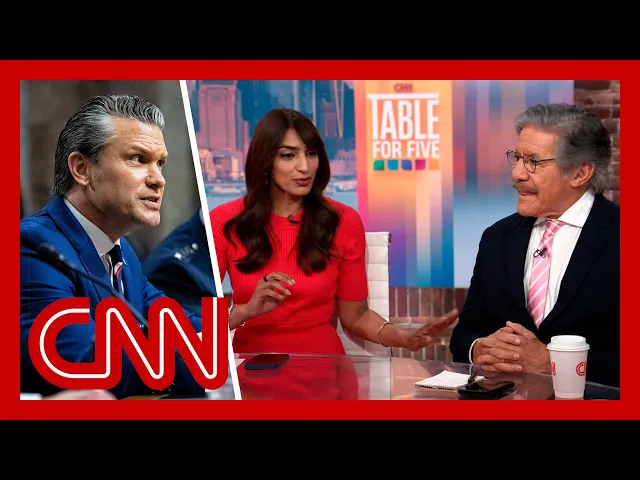
Debate: Can you question the war and still be a patriot?
CNN
0:00 In the very first hearing on this war,
0:02 where lawmakers can ask legitimate questions of the Pentagon,
0:06 instead of getting a sober and fact-finding scene,
0:08 it became a circus of shouting,
0:11 insults, and deflections, mostly from Defense Secretary Pete Hexith.
0:15 And in one instance, like he's done with the press,
0:18 he's questioning the patriotism of anyone who dares to ask
0:22 questions about the war or anyone who criticizes it.
0:26 The biggest challenge,
0:27 the biggest adversary we face at this point are the reckless,
0:32 feckless, and defeist words of congressional Democrats and some Republicans.
0:37 The president has got himself in America stuck
0:40 in a quagmire of another war in the Middle East.
0:43 He's desperately trying to extricate himself from his own mistakes.
0:47 My generation served in a quagmire in Iraq and Afghanistan.
0:50 The way you stain the troops when you
0:52 tell them two months in, two months in, Congressman, you should know better.
0:57 Shame on you.
0:58 Calling this a quagmire, two months in.
1:00 The effort, what they've undertaken, what they've succeeded,
1:03 the success on the battlefield that could create strategic opportunities,
1:06 the courage of a president to confront a nuclear Iran,
1:08 and you call it a quagmire, handing propaganda to our enemies.
1:12 Shame on you for that statement.
1:14 And statements like that are reckless to our troops.
1:16 Don't say I support the troops on one
1:18 hand and then a two-month mission is a quagmire.
1:20 Who are you cheering for here?
1:21 Who are you pulling for?
1:23 Our troops are doing incredible work.
1:25 So that was the tone in a nutshell over on Capitol Hill.
1:29 Um, and Heraldo, I mean,
1:30 I think one of the problems with what Pete Hexith is saying is
1:34 that Americans very recently have been in a place where they've been told,
1:39 "Support this war effort because it's the patriotic thing to do," only to find
1:43 out that they were lied to about how they got into the war,
1:46 only to find out that that war effort was going to last decades.
1:49 Um, and some of those very troops were asking, "Why were they there?
1:53 What was the endgame?" Isn't it the patriotic thing to ask questions?
1:57 Well, yes, unless you're in uniform in combat and it's a, you know,
2:02 a violation of your uh of the chain of command.
2:06 I I I think that with Pete's case,
2:09 the frustration comes because people were saying that the War
2:12 Powers Act and the various uh congressional resolutions over
2:15 the years indicated very strongly that uh the the president
2:19 of the United States had the ability the constitutional
2:23 right to be commander-in-chief of our armed forces
2:26 and to wage a conflict like this if he felt it
2:30 necessary for the or he or she feels it
2:33 necessary for the national uh the defense of the So,
2:36 I I don't think that uh what Pete did, aside from being maybe overro in his dram
2:42 dramatic presentation at playing a fellow there,
2:45 just a kind of kind of silly maybe.
2:48 But the there's real tension though between the commander-in-chief
2:52 of the armed forces of the United States and the Congress,
2:56 which has the constitutional right to declare war.
2:59 So you have this you have this tension
3:01 constantly and Pete mentioned Afghanistan and Vietnam and Iraq
3:05 and and yes it is quagmire in the modern
3:08 day because we don't do total war anymore.
3:11 Uh but uh his frustration I think is is real over the fact that he
3:15 he feels in that setting in the setting
3:18 of Congress that he's among enemies not friends.
3:21 But but he's he's frustrated that people are questioning
3:25 the war but the polls show that it's pretty widespread.
3:28 It's not like a niche thing just among Democrats on Capitol Hill.
3:32 It's those conflicts you mentioned the Iran
3:36 war is as unpopular as Vietnam as Iraq.
3:39 And on top of that, what I thought was fascinating when you ask Americans,
3:44 when you consider all the costs and benefits of this conflict, is it worth it?
3:50 Um, overall, just 25% of Americans say that it's worth it.
3:54 And among Republicans where generally you get a lot
3:57 of support for what President Trump is doing,
4:00 only 58%, so fewer than 60% of Republicans say it's worth it.
4:04 This is more widespread than just Democrats on Capitol Hill.
4:07 It's definitely more widespread than just Democrats
4:09 on Capitol Hill or across the country.
4:11 It's also independents that you're seeing move
4:14 towards um their discomfort with the war.
4:16 And I think part of it is not only that we don't have a defined mission.
4:21 We don't know when we're going to actually leave
4:24 um and and pull ourselves out of this war,
4:26 but it's also when are prices going to go down.
4:28 And I'm sure we'll talk about, you know,
4:30 how high gas prices are for Americans around the country.
4:32 But I think that is sitting very uncomfortably
4:33 with people as they go to the pump.
4:35 I mean, that is something that you can see every single day ticking upwards.
4:39 and the fact that someone is driving by their gas station
4:41 every single day and seeing that number continue to rise and rise
4:45 and you're wondering from this administration when we're going to get
4:48 clarity about when this ends and they still can't give it.
4:51 I think that's why you're seeing the polling sink
4:54 for Republicans and particularly Donald Trump because people are placing blame
4:58 on him for not laying out the case for why
5:01 we went in in the in the first place to Iran,
5:04 but also understanding when we get out.
5:06 So, I don't know that, you know, you played the clip of Congressman Gar Mendy
5:10 questioning Pete Hegsath and and saying it's a quagmire.
5:12 I don't know we're there yet,
5:14 but we're certainly at a place where when does this end?
5:17 Even if the administration likes to play
5:19 a creative game with the law and interpretation,
5:22 I don't think we have an understanding of how this ends and when.
5:24 I mean, Pete, is it smart for them to say
5:27 that anybody who criticizes what they're doing in Iran is unpatriotic?
5:31 Is that a smart political strategy?
5:33 Well, there is a line between asking
5:36 questions and oversight on the part of Congress
5:39 and the legislative branch and these Democrat
5:41 members of Congress calling it a quagmire,
5:44 calling it a destructive and disastrous war, saying that it is a forever war.
5:49 Within hours, within days of this conflict starting,
5:52 they were already saying it was a forever war.
5:55 So, I understand Secretary Hegsth's frustration at some
5:59 of the rhetoric that is being used.
6:02 questions can be genuine.
6:03 They can get to the bottom of what's happening,
6:06 but they're sitting there making it a partisan spectacle.
6:09 And look, he's not perfect either.
6:11 The Secretary of Defense got defensive and personal in some
6:15 of his responses and lobbing barbs back across uh to the deis.
6:21 But, you know, I look at this and the the polling also Washington Post
6:25 had a poll that showed 79% of Republicans said it was the right decision.
6:29 So there's been all this talk about erosion among the Republican base,
6:33 the MAGA base, but they still stand with President Trump.
6:37 They believe it was the right decision.
6:39 I would also point out that the very nature of conflict is opaque.
6:44 That that is just the way conflict goes.
6:47 And there's a balancing act,
6:48 but there's a balancing act between disclosure and concealment.
6:52 And that is one that every administration has to balance.
6:56 And so in some respects the public unless
6:59 there is a full-fledged PR campaign which there
7:02 could have been maybe should have been
7:04 but you also throw away the element of surprise.
7:07 Well you'll remember you also you also harm operation to the people and he
7:11 asked I mean he laid out even if you disagreed with the war
7:15 in Iraq and why we went in for the the mission set that we
7:18 did he still went and laid out the case for the American people.
7:21 Well, I mean, are you think it's turning out that way?
7:23 All that leadup time to prepare for an attack.
7:26 I don't think that that was not the thing.
7:29 In this case, I do believe that that wasn't the thing.
7:31 Yeah, I mean the difference the problem with the the with those wars
7:34 was that we weren't going to be able the element of surprise
7:37 is what we needed and sometimes well the people are certainly surprised
7:41 by their I I do think both conflicts the the the if there
7:46 is any similarity between both conflicts it's in that the objective which
7:50 in the case of Iraq was nation building which could not be achieved
7:54 and the objective here which in the case of Iran is uh sort
7:58 of re a rehabilitation of the nation Perhaps they have no nuclear weapons.
8:03 They stop funding terrorism.
8:04 It's unclear if that's going to be achieved either.
8:07 That's what that's the only similarities between No,
8:09 the greatest similarity is that both of these conflicts were built on lies.
8:13 We had a functioning nuclear deal with Iran.
8:16 Barack Obama is probably the first person to ever earn
8:20 his Nobel Peace Prize a few years after he got it.
8:23 But many nations came together to form this nuclear deal with Iran.
8:27 And our military swore up and down for years that Iran was
8:31 complying with the deal up until the moment Donald Trump tore it up.
8:34 So, if you're going to come out here and say
8:36 we have to do this war because we can't let
8:39 them get a nuke after this is the same team
8:41 that tore up the deal keeping them from getting a nuke,
8:44 they're essentially saying you have to believe our military was lying for years.
8:48 Yeah, you want to bet what if you're wrong and what if what if Iran is really,
8:54 as the president indicated, you know,
8:56 on the verge of creating a a shortcut to an Well,
9:00 imagine the surprise of all the Republicans
9:02 who believed him for years when he said,
9:05 "No more wars, no more wars." He swore up and down Kla Harris would do this.
9:09 He represents a lie.
9:11 They say no more advantageous but it's a it
9:15 is the dumbest thing that to answer um Heraldo's question.
9:20 I mean we don't have a lot of actual hard
9:23 evidence about what that about this one way or another.
9:26 We do have the sworn congressional testimony of the director of national
9:30 intelligence who said that after we bombed their facilities last summer,
9:33 they had made no efforts to reconstitute their nuclear program.
9:36 Does the president just get to say whatever he
9:39 wants and we just have to say we trust you.
9:41 I think the American we live in a democracy.
9:44 I think the American people deserve the right
9:47 to ask questions to demand evidence to demand proof.
9:50 And the reason they deserve that right is because they have been lied to before.
9:55 And you can't you can't just say trust me.
9:58 Okay.
9:59 There is no adult.
10:00 Do the American people have the right to tell the commander-in-chief how to wage
10:06 what he perceives to be war against the foreign policy should not be dictated.
10:11 Wait, hold on.
10:12 This is taxpayer dollars.
10:14 This is our money being spent on munitions to go and and bomb Iran.
10:18 Absolutely.
10:19 I think the American people have a right
10:21 to at least be explained why we're in this.
10:23 But we also have a right to free speech
10:26 and to petition the government for address of grievances.
10:29 And there is no reason for anyone to believe anything these men say ever.
10:34 They have lied so much in the course of this confict.
10:38 Trump has already come out and said he wants the oil.
10:41 There is no reason to take them at face value.
10:43 And Abby, you're one of the best cable news hosts in the world.
10:46 You're brilliant.
10:47 You're so great at this.
10:48 But I would never hire you to a cabinet position overseeing the Pentagon.
10:51 And you're a good cable news host.
10:53 Thank you.